More than 4 million Canadians aged 18 to 64 identify as having a disability, including about 1.6 million with a severe or very severe disability, according to the federal government's Canada Disability Benefit regulatory framework. Yet finding the right benefits for disabled in Canada isn't as simple as submitting one application. The system combines a direct income benefit, a non-refundable tax credit, and a contributory pension program, each with different rules.
The most effective strategy is to treat the system as a layered application pathway. Start with the Disability Tax Credit, keep your tax filings current, then assess the Canada Disability Benefit and CPP disability separately. Applying blindly can leave money on the table, create avoidable delays, or lead you to assume one program replaces another.
This article is for informational purposes and is not medical advice. Consult a healthcare provider for personalized guidance.
Table of Contents
Understanding Canada's Disability Benefits System
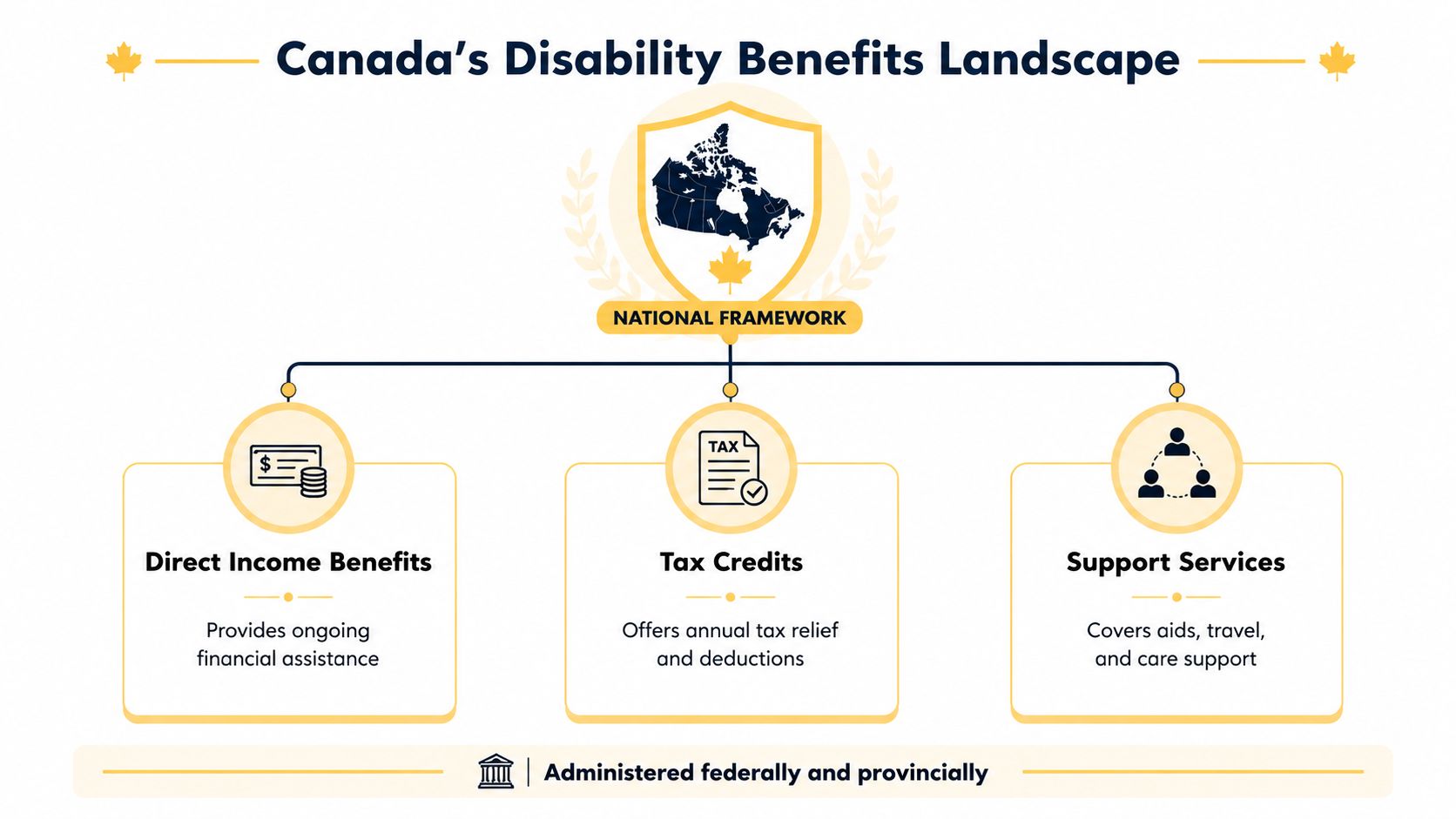
Canada's federal disability programs do different jobs, and the order of your applications affects what you can access. The Canada Disability Benefit provides direct income support for low-income adults aged 18 to 64. The Disability Tax Credit reduces tax payable and can connect you to other programs. CPP disability replaces income when a disability prevents substantially gainful work and the applicant meets contribution requirements.
Federal support rests on three connected pillars:
- Direct income benefits provide payments to eligible applicants. The Canada Disability Benefit depends on factors including Disability Tax Credit approval, residence, age, and tax filing.
- Tax credits reduce tax payable rather than automatically sending cash. The Disability Tax Credit is the central program in this group and may open access to related benefits.
- Contributory benefits depend on work and contribution history. CPP disability belongs in this pillar and has its own test for whether a disability prevents substantially gainful work.
Why the order matters
The DTC is not interchangeable with the CDB or CPP disability. It is a non-refundable tax credit, while the CDB provides direct income support and CPP disability is a monthly contributory benefit. For many applicants, DTC approval is the administrative gateway to the CDB and related programs. It does not establish CPP disability eligibility.
Start by mapping each program separately. A CDB application can stall if you do not already have an approved DTC certificate. A DTC application alone can also leave a contributory benefit unexplored after you stop working.
Practical rule: Check every program on its own terms. A diagnosis, provincial disability approval, or tax credit does not automatically satisfy each federal eligibility test.
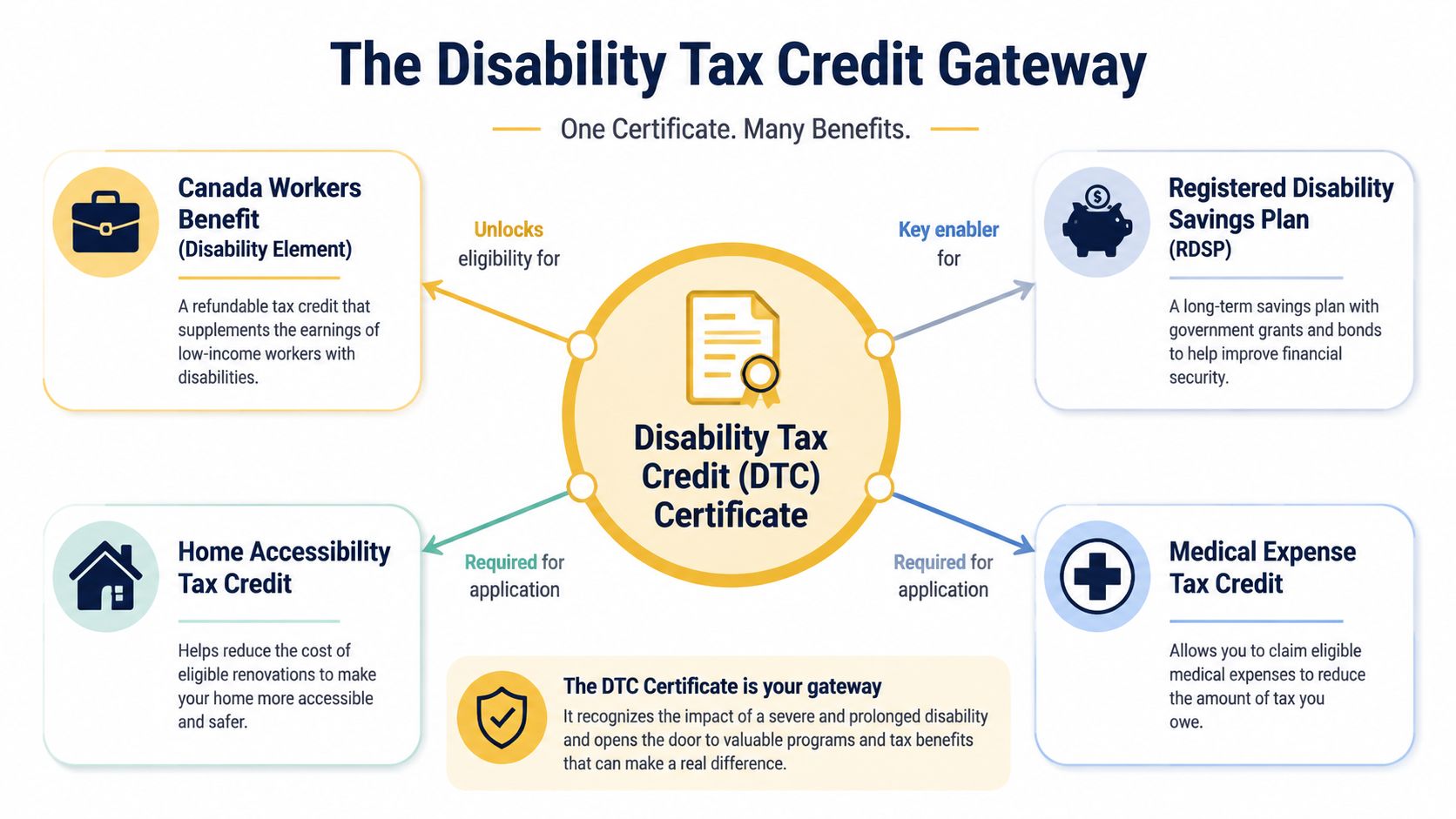
The Canada Revenue Agency describes the DTC as a non-refundable credit that can reduce income tax owed and connect eligible people with the Registered Disability Savings Plan, the Canada Workers Benefit disability supplement, and the child disability benefit. This layered structure creates the main administrative barrier: approval for one program does not automatically transfer to another.
Keep your tax filings current, track the status of your DTC certificate, and review CPP contribution requirements separately. That approach prevents a common mistake, applying for one benefit and assuming it covers every form of support available.
Canada Disability Benefit Eligibility and Payment Amounts
The Canada Disability Benefit is for low-income adults aged 18 to 64 who satisfy a specific federal eligibility path. The Canada Disability Benefit eligibility guidance sets out four gates: Canadian residence, an approved Disability Tax Credit, the required age, and the relevant prior-year tax return.
Check the four gates first
Age and residence come first. You must be at least 18 and under 65, and you must meet the Canadian residence requirement. These conditions separate the CDB from programs for children, seniors, and people supported mainly through provincial systems.
DTC approval is required. The CDB does not replace the DTC application. If the Canada Revenue Agency has not approved your DTC certificate, your CDB application cannot proceed through the required gateway. Confirm that approval before spending time on a CDB application.
Tax filing is part of eligibility. The payment uses adjusted family net income from the 2025 federal income tax return. The CDB payment period runs from July 2026 through June 2027, with the amount based on that tax information. The official CDB amount guidance lists a maximum of $204.20 per month for this period.
Your payment may be lower. The CDB is means-tested, so the calculation depends on the income information used for your household. Keep tax filings current and check that family income details are accurate before relying on an estimate.
What the CDB adds
The CDB provides direct federal cash support for eligible working-age adults. That matters because disability assistance has often relied heavily on tax relief, which does not help households in the same way as a monthly payment.
The CDB does not replace CPP disability or provincial assistance. The Government of Canada CDB service page presents it as targeted support, while CPP disability serves a different purpose. Provincial programs may apply their own treatment or clawback rules, so check how this federal payment affects your existing assistance before adjusting your budget.
Budgeting advice: Treat $204.20 per month as the ceiling, not your expected payment. File the required tax return, confirm DTC approval, and review the final calculation against your adjusted family net income.
If you skipped a prior-year tax return because your income was low or zero, file it before assuming you are excluded. The tax return is part of the CDB eligibility mechanism, not a minor paperwork preference. Apply only after checking the full chain: DTC approval, age, residence, filing, and income calculation.
CPP Disability Versus the Canada Disability Benefit
CPP disability and the Canada Disability Benefit solve different income problems. CPP disability replaces income for eligible contributors whose disability prevents substantially gainful work, while the CDB provides needs-based support for eligible, low-income working-age adults. Review both pathways instead of treating one application as a substitute for the other.
| Feature | CPP Disability | Canada Disability Benefit |
|---|---|---|
| Primary purpose | Monthly income replacement | Direct support intended to improve financial security |
| Age | Over 18 and under 65 | 18 to 64 |
| Main gate | Severe and prolonged disability plus CPP contribution history | DTC approval, Canadian residence, age, and tax filing |
| Work history | Requires CPP contributions, generally in 4 of the last 6 years | No equivalent contribution test |
| 2026 maximum | $1,741.20 per month | $204.20 per month for July 2026 to June 2027 |
| Payment basis | Basic amount plus contribution-based earnings-related portion | Adjusted family net income from the 2025 tax return |
The CDB and CPP disability also differ in how they assess disability. CPP requires an impairment that regularly prevents substantially gainful work. A diagnosis alone does not meet that test. The program's corresponding annual substantially gainful occupation amount is $20,971.45 in 2026, and the maximum monthly payment is $1,741.20, according to the official CPP disability amount explanation.
Why CPP amounts vary
CPP disability includes a fixed basic monthly component of $610.46 in 2026. The remaining amount depends on contribution history and past earnings, so two people with the same disability can receive different payments. Check the calculation against your CPP record rather than relying on the maximum.
This difference affects household planning. A person with a strong contribution record may receive considerably more through CPP disability than through the CDB. Someone with limited contributions may still qualify for the CDB if they meet its DTC, residence, age, tax filing, and income requirements.
Apply according to the gate, not the label
“Disabled” is not one federal eligibility category. CPP examines work capacity and contribution history. The CDB uses DTC-linked, residence, age, tax filing, and income rules.
Check your contribution record through your federal services account, then assess the CDB route at the same time. Do not wait for a CPP denial before reviewing the second program, and do not assume CDB approval proves CPP eligibility. The payments can complement each other, but they are not interchangeable.
The Disability Tax Credit and the New Certification Supplement
The Disability Tax Credit is a non-refundable tax credit, not a monthly benefit. It reduces tax payable. If you have too little tax payable, the unused amount is not paid as cash. The CRA Disability Tax Credit guidance sets out this limitation. The adult DTC amount is $9,428 per year, while children under 18 may qualify for an additional up to $5,500 per year. These are tax-credit amounts, not guaranteed deposits. Where the rules permit, you may transfer the credit to an eligible supporting family member.
The value beyond the tax return
DTC approval can provide access to several connected programs:
- Registered Disability Savings Plan, a long-term savings program linked to DTC eligibility.
- Canada Workers Benefit disability supplement, for eligible workers.
- Child disability benefit, for qualifying families with children.
- Other disability-related tax and savings measures administered through the federal system.
The application turns on functional limitations, not a diagnosis alone. A medical practitioner must certify a severe and prolonged impairment. CRA defines “prolonged” as lasting, or reasonably expected to last, continuously for at least 12 months. For cumulative-effects claims, restrictions must exist all or substantially all of the time, generally 90% or more, according to the CRA technical interpretation of DTC eligibility.
The 2026 certification supplement
A 2026 regulation creates a $150 one-time supplement for each DTC certification or re-certification. Payments are expected to begin September 1, 2026, though CRA has not yet published detailed eligibility criteria for former CDB recipients. The published federal regulation connects the payment with certification costs, an administrative barrier that can discourage applications.
The confirmed information covers the amount, expected payment start date, and link to certification or re-certification. It does not settle every question about former CDB recipients, renewal timing, or first-time applications. Do not assume that paying a practitioner guarantees the supplement. Confirm how CRA applies it to your specific certification event.
Keep your DTC forms, practitioner invoices, approval notices, and renewal dates together. This file gives you a way to check eligibility, identify a missing automatic payment, and challenge an incorrect decision.
How to Apply and What Documentation You Need
A strong application describes what you can't do, how often the restriction occurs, and how long it has lasted or is expected to last. A diagnosis by itself may not explain the functional impact CRA needs to assess.
Build the file before submitting
Start with your DTC status. If you don't have an approved certificate, obtain the CRA form and arrange certification with the appropriate medical practitioner. Bring a concise record of daily limitations, treatment history, work impact, and the duration of the impairment.
Prepare:
- Medical records: Gather records that support the functional restrictions and their duration.
- Practitioner certification: Ask the practitioner to describe the impairment accurately rather than relying on a diagnosis label.
- Tax records: Confirm that required federal returns have been filed.
- Identity and residence information: Keep documents consistent across CRA and federal benefit accounts.
- Copies: Save every submitted form, attachment, receipt, and decision letter.
For a cumulative-effects claim, the practitioner must address the frequency standard. The CRA guidance says restrictions generally need to exist 90% or more of the time for this pathway. That makes a symptom diary useful as supporting preparation, although it doesn't replace professional certification.
Submit in the right sequence
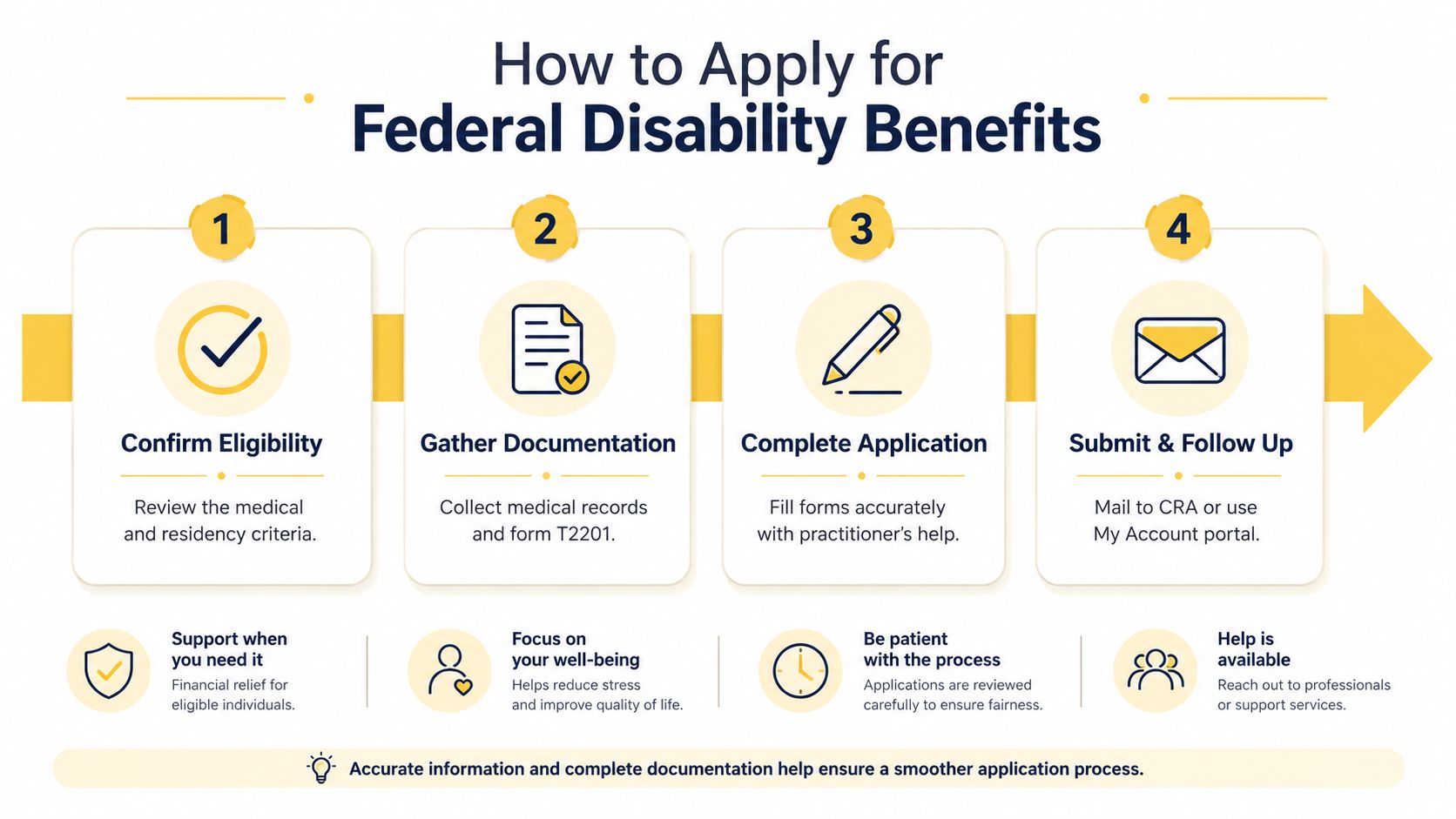
- Confirm the program: Separate DTC, CDB, and CPP requirements before completing forms.
- Complete the DTC certification: Work with the medical practitioner and review every functional description.
- File your taxes: The CDB uses tax-return information, so missing returns can block eligibility.
- Apply for the CDB or CPP disability: Use the program whose gate matches your circumstances. Some applicants should pursue both.
- Track the file: Use CRA My Account where available and keep a written record of dates and correspondence.
There's no reliable universal approval timeline to promise. Processing depends on the completeness of the medical information, the program involved, and whether CRA or Service Canada needs clarification. If a claim is rejected, read the reasons closely, obtain more precise supporting information, and use the available review or appeal process rather than submitting the same incomplete explanation.
Common Mistakes and Misconceptions That Lead to Denied Claims
A diagnosis alone does not establish DTC eligibility. CRA reviews the impairment's severity, duration, and effect on specific daily activities. Medical forms should describe those functional restrictions clearly, rather than relying on the diagnosis as shorthand.
Errors that block otherwise viable applications
- Assuming DTC approval guarantees CDB approval: The DTC is a gateway, not a promise of payment. CDB eligibility also depends on the program's income and tax requirements.
- Skipping tax filing: CDB eligibility uses tax-return information. An unfiled return can prevent the income assessment needed to determine payment.
- Calling the DTC cash assistance: The credit reduces tax payable. It is not a refundable monthly benefit, and its immediate value depends on the person's tax liability.
- Assuming provincial approval transfers automatically: Provincial disability assistance and federal programs apply different tests. Provincial approval does not prove that the federal DTC requirements are met.
- Treating CDB as a CPP replacement: The CDB is needs-based and linked to the DTC. CPP disability is contributory and assesses work incapacity, so the programs serve different purposes.
- Submitting vague medical wording: Phrases such as “the patient struggles” leave the reviewer to guess. The practitioner should identify the affected activity, the frequency and duration of the restriction, and the assistance required.
Variable impairments need equally precise descriptions. Document the pattern across ordinary days, including how often the limitation occurs and what support is needed. A single unusually good or bad day can distort the application.
A complete application connects medical evidence to daily function. It does not ask the reviewer to infer the connection.
The DTC's non-refundable design creates another blind spot. Someone who owes little or no tax may receive limited immediate tax value, yet DTC approval can still support access to related federal programs. Assess the certificate by the benefits it can connect, not only by the reduction on one tax return.
Keep copies of the forms, medical notes, and CRA correspondence. Administrative gaps, unclear functional descriptions, and incorrect assumptions about how programs interact cause avoidable delays and denials. Review each requirement separately before submitting the next claim.
Your Action Plan for Securing Disability Benefits
A strong disability application is an administrative project. Set up one file for medical evidence, tax records, correspondence, and deadlines, then assign each task to a specific person.
Before You File: Confirm These Three Things
- Identify the decision you need: Decide whether you are preparing a DTC submission, reviewing CPP disability eligibility, or gathering information for another program. Each application needs evidence matched to its own test.
- Confirm the records available: Request the relevant clinical notes, treatment history, medication information, and functional descriptions. Organize them by condition, affected activity, duration, and support required.
- Confirm who will handle correspondence: Create or review CRA My Account and My Service Canada Account. Make sure a family member or caregiver has authorization before asking them to monitor notices or respond on your behalf.
Check CRA correspondence for a DTC approval, expiry date, or request for information. Review your CPP contribution record through My Service Canada Account. Book time with the practitioner who can describe how the impairment affects ordinary activities, rather than relying on general statements about diagnosis.
After Filing: Track These Deadlines
Record the submission date, expected follow-up, requests for information, renewal dates, and tax-filing obligations in one calendar. Keep a complete copy of every form, medical note, receipt, and message. If CRA requests clarification, answer the specific question and match the response to the supporting records.
File missing federal tax returns instead of assuming a benefit can be assessed without current tax information. Review notices as they arrive and correct errors promptly. For a dependent, ask CRA how the DTC may be claimed or transferred under the applicable rules. The person paying household bills does not automatically receive the credit.
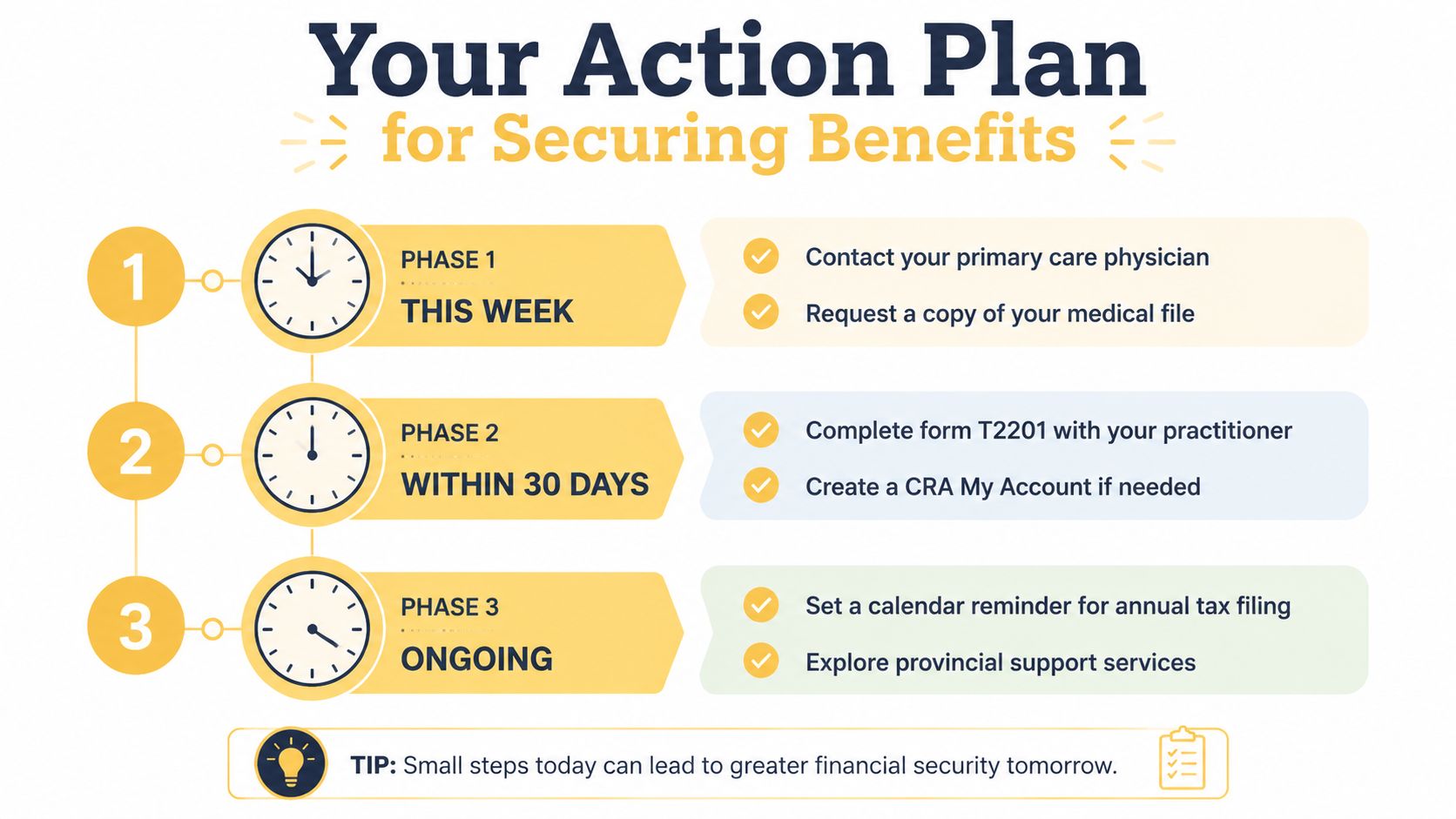
Start with the missing document, not the largest benefit. A complete record, precise functional evidence, and tracked deadlines make later benefit decisions easier to manage.
While you work through DTC forms and tax-filing requirements, keep health records organized in one place. Relief offers a migraine-tracking tool for logging symptoms, triggers, attacks, medications, and environmental data on iOS, which can help you review health patterns alongside the administrative work without replacing medical care or benefits advice.


