Can sleep apnea cause migraines? Yes, it can be linked to higher migraine rates, but not in everyone, and the connection seems to depend on sleep fragmentation, oxygen dips, and migraine subtype. A large 2025 cohort study found 12,613 people with obstructive sleep apnea (OSA) 6.4% developed migraine, compared with 6,356 people 3.2% without OSA, and the adjusted hazard ratio for incident migraine was 1.85 (PubMed).
If you've woken up with head pain so often that you've started to wonder whether your sleep is part of the problem, that question makes sense. Migraine can feel random from the outside, but for some people it's tightly tied to how they breathe, sleep, and recover overnight. This article keeps the answer practical. You'll get the evidence, the warning signs that make sleep apnea worth discussing, and the clearest way to tell migraine apart from an apnea-related morning headache.
Table of Contents
- Can Sleep Apnea Cause Migraines
- Oxygen drops and sleep fragmentation
- Carbon dioxide and nerve sensitivity
Can Sleep Apnea Cause Migraines
The honest answer is yes, sometimes, but not in a universal, one-size-fits-all way. The strongest newer evidence suggests that OSA is associated with a higher future migraine rate in large populations, but earlier studies and reviews show the relationship is mixed and may depend on who you're looking at, how the study was done, and what kind of migraine the person has.
That nuance matters because people with migraine often get told their symptoms are “just stress” or “just poor sleep.” Sometimes the underlying issue is more specific. Sleep apnea can fragment sleep, disturb overnight breathing, and create a pattern where someone keeps waking unrefreshed, then wakes again with head pain.
A 2025 population-based study found the signal stayed similar in sensitivity analyses and in an external TriNetX validation dataset, which makes the association harder to dismiss as a one-off finding (PubMed). At the same time, a population-based cross-sectional study and a 2020 systematic review did not find proof that OSA universally causes migraine (PMC). Both ideas can be true at once.
Practical rule: if your headaches cluster around waking, and you also snore, gasp, or feel unrefreshed, sleep apnea is worth bringing up instead of assuming the migraine diagnosis explains everything.
For a migraine sufferer, the question isn't “Can one condition cause the other in every person?” It's “Could sleep apnea be making my attacks more likely, more frequent, or harder to control?” That's the version that leads to useful action.
How Sleep Apnea Might Trigger Migraine Attacks
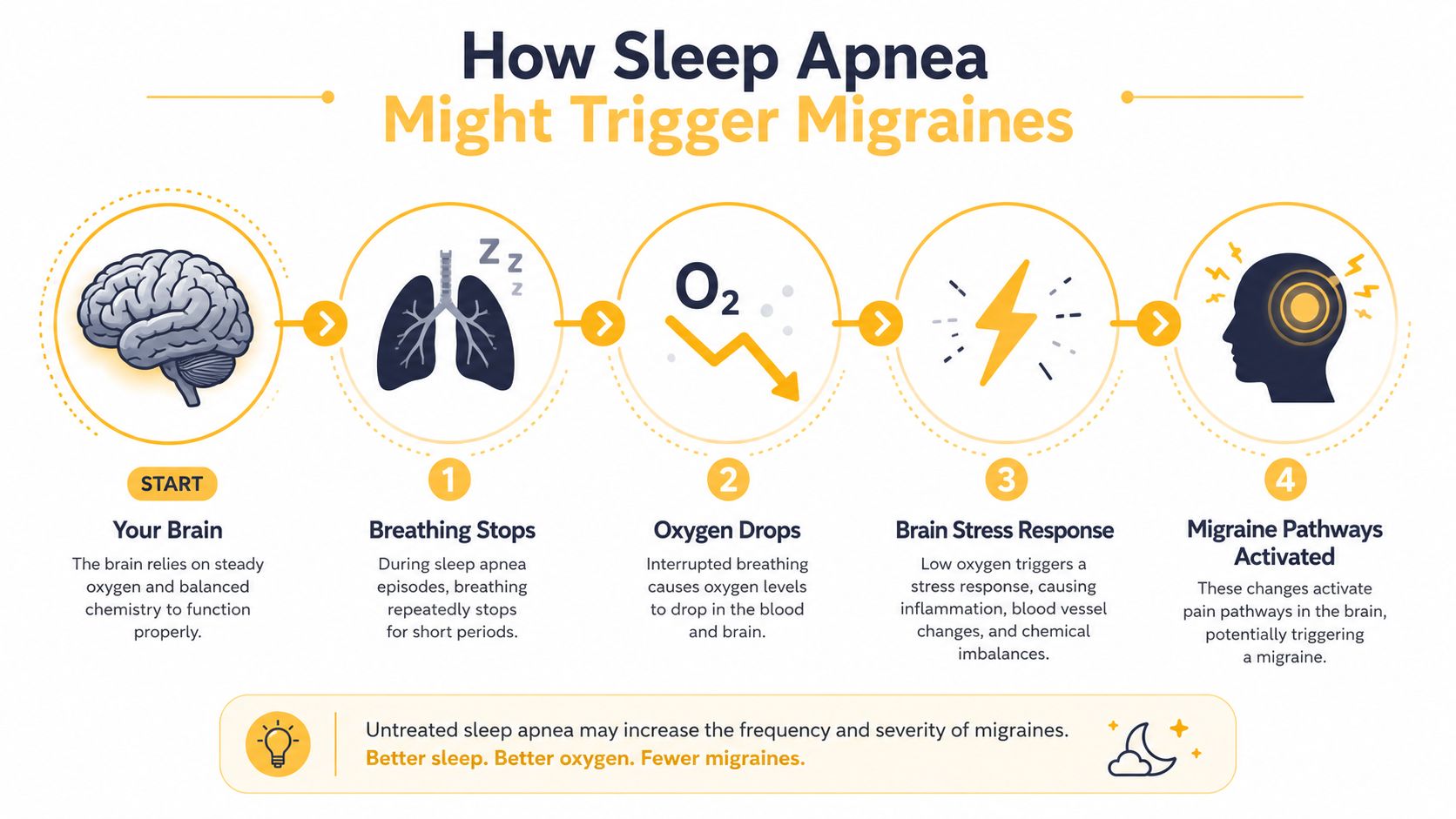
Sleep apnea disrupts three things the brain depends on for stability, stable oxygen, stable carbon dioxide, and uninterrupted sleep. Migraine-prone brains often react badly when any of those pieces keep shifting overnight.
Oxygen drops and sleep fragmentation
Hypoxia means lower oxygen levels than the body wants. In obstructive sleep apnea, breathing pauses can cause repeated oxygen dips, then brief arousals that break up sleep. That pattern is like a computer that keeps losing power before it can finish a task, it may restart, but it never gets the chance to settle into a steady rhythm.
Migraine biology is sensitive to that kind of repeated disruption. Each awakening can leave the nervous system more reactive, so the brain may be easier to trigger the next day. Slow-wave sleep is the deepest, most restorative stage of sleep, and when sleep is interrupted again and again, the body may not get enough of that recovery time.
Carbon dioxide and nerve sensitivity
OSA can also raise carbon dioxide levels overnight. That matters because the brain and blood vessels respond to breathing chemistry as well as oxygen. Researchers also discuss trigeminal sensitization, which means the trigeminal nerve system, a major pain pathway in migraine, becomes easier to activate.
Lower oxygen, more awakenings, and unstable breathing chemistry can leave the nervous system starting the day on edge.
For a migraine patient, that helps explain why sleep apnea can matter even if it is not the only cause of head pain. The more useful question is whether OSA is making attacks more likely, more frequent, or harder to control in a specific migraine subtype. Morning-predominant attacks, headaches that cluster around waking, or migraine that stays stubborn despite standard treatment are the patterns that make sleep apnea worth asking about.
Research Findings on OSA and Migraine Association
The research is mixed, and that is part of why this question keeps coming up. Some newer studies support an association, while older population studies and reviews do not show a universal causal link.
The clearest recent signal comes from a cohort study that found people with OSA had a higher incident migraine rate than similar people without OSA, with an adjusted hazard ratio of 1.85 (PubMed). The same study reported that the association held up in sensitivity analyses and in an external validation dataset, which makes the finding more convincing.
Other evidence points in a different direction. A population-based cross-sectional study found no statistically significant relationship between migraine and OSA, even after OSA was separated into moderate and severe categories (PMC). A 2020 systematic review concluded that the available studies had not proven a causal relationship, while still leaving room for OSA to act as a trigger in selected patients (PMC).
That tension makes more sense if you think about which patients each study is likely to include. A broad population sample can blur a subgroup in which sleep apnea really does matter. A migraine clinic sample can overrepresent people whose sleep problems are already obvious enough to come to attention.
Useful way to read the evidence: “mixed” does not mean “nothing here.” It means the link may depend on the patient, and some migraine patients are more likely to benefit from sleep apnea screening than others.
A subtype-specific angle is starting to emerge as well. A Mendelian-randomization analysis suggested a causal association specifically between OSA and migraine with aura, not the reverse direction (Dove Press). That does not settle every question, but it does support a more targeted approach, where the patients most likely to need attention are not everyone with migraine, but certain subtypes and symptom patterns.
Migraine vs Morning Headache From Sleep Apnea
A lot of people use “migraine” to describe any bad head pain, but that can blur an important distinction. Migraine is a neurological disorder that often comes with throbbing pain, light sensitivity, nausea, and sometimes aura, which means temporary sensory or visual symptoms that can happen before or during the attack. A morning headache from sleep apnea is often more like a dull, waking headache that fades as the day goes on.
Here's a simple way to think about it. Migraine often feels like a full-body sensory problem. Sleep apnea headache often feels like a body that never got a clean start to the day.
| Feature | Migraine | Sleep Apnea Morning Headache |
|---|---|---|
| Pain quality | Often throbbing or pounding | Often dull, pressure-like, or diffuse |
| Associated symptoms | Light sensitivity, nausea, sound sensitivity, aura | Snoring, poor sleep, dry mouth, waking unrefreshed |
| Timing | Can start any time, often lasts hours | Often present on awakening |
| Pattern | May recur with known migraine triggers | Often linked to sleep quality and breathing problems |
One patient story helps make the difference clearer. A person might spend years assuming every morning head pain is their usual migraine, especially if the pain shows up on workdays and feels miserable enough to interrupt the day. Then a sleep study reveals OSA, treatment improves sleep quality, and the waking headache pattern changes. That doesn't mean the person never had migraine. It means two overlapping problems were hiding in plain sight.
The overlap can be real, too. Someone can have both migraine and sleep-apnea-related morning headaches. If your pain is mostly on waking and comes with snoring, dry mouth, or poor restorative sleep, that pattern deserves a closer look.
Signs That Suggest Sleep Apnea in a Migraine Sufferer
The signs that matter most are often the ones people shrug off because they seem ordinary. Snoring, waking tired, or having a dry mouth can look small in isolation, but together they can point toward a sleep-breathing problem rather than migraine alone.
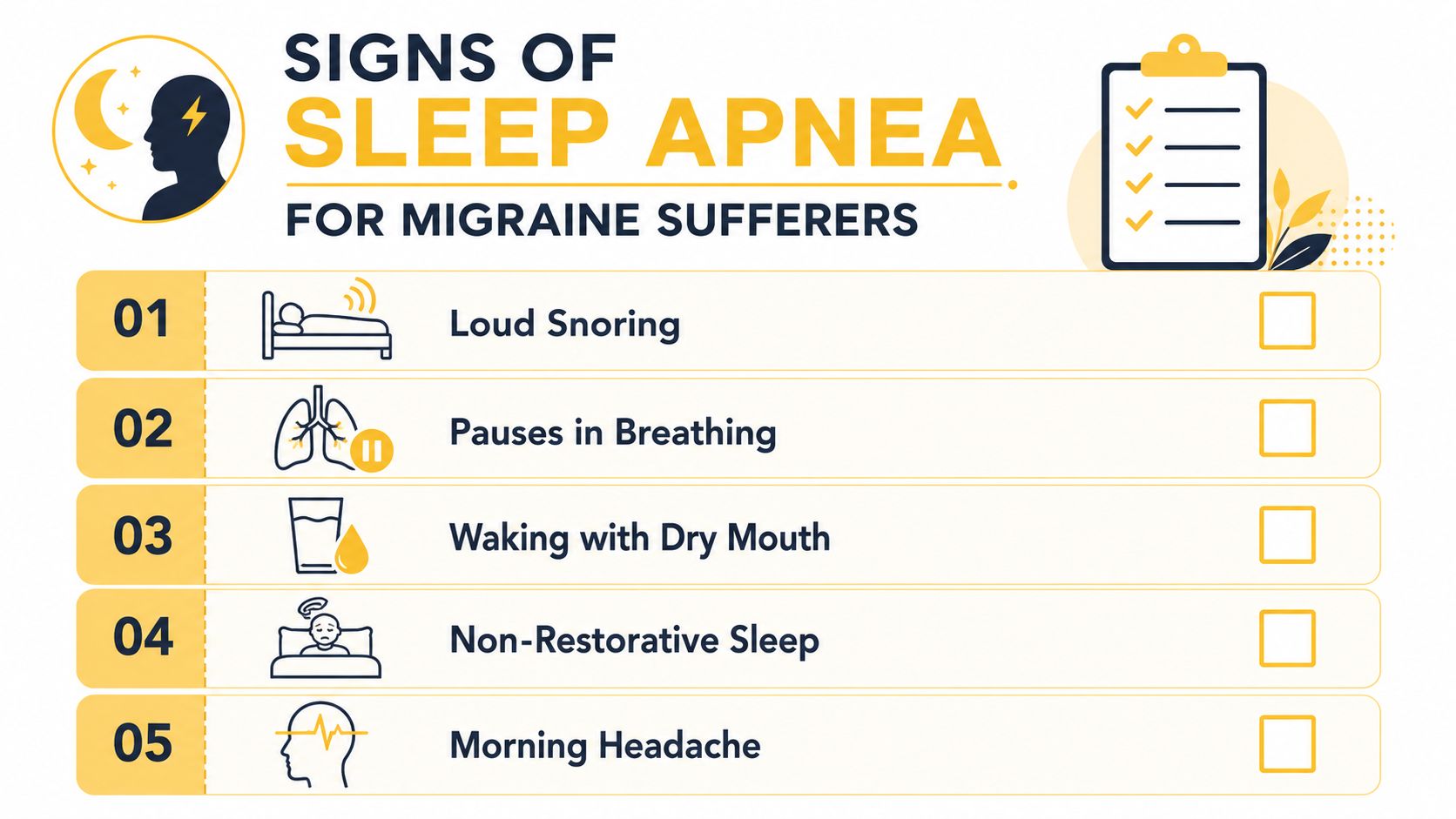
- Loud snoring: Frequent, noisy snoring is one of the clearest clues that airway obstruction may be happening during sleep.
- Pauses in breathing: If a partner notices you stop breathing and then gasp or snort, that's a classic reason to ask about OSA.
- Waking with dry mouth: Mouth-breathing at night often leaves the mouth dry by morning.
- Non-restorative sleep: You slept, but you still feel unrefreshed, foggy, or worn down.
- Morning headache: Head pain on waking can be a sleep-apnea clue, especially when it repeats.
A less obvious clue is migraine that seems to track sleep quality more than food, hormones, or stress. If your attacks cluster after short sleep, fragmented sleep, or a bad night of snoring, that pattern is worth noticing.
If you never feel sleepy during the day, don't assume sleep apnea is off the table. Some people mainly notice morning headaches, poor sleep quality, or a bed partner reporting breathing pauses.
These signs don't prove sleep apnea. They do make it reasonable to bring up the topic with a clinician, especially if your migraine pattern has changed over time.
Getting Diagnosed and When to See a Clinician
Sleep apnea is usually evaluated step by step, not guessed at from one symptom. A clinician may start with screening tools such as STOP-BANG or the Epworth Sleepiness Scale, then decide whether a home sleep apnea test or an in-lab polysomnography is the better fit. Polysomnography is the overnight sleep study that monitors breathing, oxygen, brain activity, and sleep stages.
A sleep specialist often leads the apnea workup, but neurologists are useful too when migraine is part of the picture. If your head pain has a strong sleep pattern, it helps to mention both the migraine symptoms and the sleep symptoms in the same visit. That makes it easier for the clinician to decide whether the problem is one condition, two conditions, or one condition aggravating the other.
When to seek immediate medical care: sudden severe headache, headache with fever or stiff neck, neurological changes, or headache after head injury.
Those warning signs don't belong in a routine sleep-apnea discussion. They need urgent evaluation.
A regular appointment makes sense if your headaches are recurring, waking-related, or paired with snoring, dry mouth, or unrefreshing sleep. You don't need to prove the diagnosis yourself. You just need to describe the pattern clearly enough that the right test gets considered.
Treating Both Conditions Together
Treating sleep apnea and treating migraine are related, but they aren't the same job. OSA treatment focuses on keeping the airway open and sleep stable. Migraine treatment focuses on reducing attack burden, lowering sensitivity, and managing symptoms when attacks do happen.
For sleep apnea, the main options include CPAP, oral appliances, positional therapy, weight management when relevant, and reducing alcohol use, since alcohol can worsen airway collapse in some people. CPAP is not a migraine cure, and the review evidence is honest about that uncertainty (PMC). Still, if your attacks are being pushed by fragmented sleep or repeated oxygen dips, better breathing at night may help some people feel fewer or milder attacks.
Migraine care should stay separate and complete. That means thinking about lifestyle approaches like sleep regularity and hydration, over-the-counter options when appropriate, prescription treatments when a clinician recommends them, and emerging research that may expand choices over time. The right plan depends on attack pattern, disability, and whether you have migraine with aura, chronic migraine, or another subtype.
The key is coordination, not guessing. If sleep apnea is present, treating it can remove one nightly stressor. If migraine is present too, it still needs its own care plan.
Tracking Patterns and Reducing Your Risk
A few days of notes can reveal more than memory does. Track sleep duration, awakenings, snoring, waking with dry mouth, morning headache, migraine onset, headache severity, and anything you think might be a trigger. You're looking for patterns, not perfection.
Start tonight with a simple three-line log. Write down when you went to bed, whether you woke up during the night, and how your head felt when you got up. If you can add whether you snored, had an aura, or felt unusually sleepy, even better.

Over time, patterns matter more than single bad nights. If waking headaches line up with snoring or unrefreshing sleep, that's a strong conversation starter for a clinician. If attacks happen without any sleep clue, that's useful too, because it helps narrow the picture.
For people who like a more structured view, Relief can help you keep sleep, symptoms, and environmental patterns in one place so you can spot trends faster. The goal isn't to replace medical care. It's to make the next appointment more useful, because you'll have a clearer record of what's happening and when.
If you're trying to figure out whether sleep apnea is part of your migraine story, Relief can help you track the patterns that are hard to notice in the moment. Visit Relief to log sleep, symptoms, and triggers in one place so your next conversation with a clinician starts with better information.


