Medication overuse headaches are rebound headaches caused by the very pain relievers meant to help. They can develop when headache medicine is used often enough that headaches start happening on 15 or more days a month for at least 3 months, with overuse defined as 10 or more days a month for triptans, opioids, ergotamines, and combination pain medicines, or 15 or more days a month for simple analgesics.
If you're reading this because your migraine attacks seem to be showing up more often, and you're reaching for treatment more often too, you're not imagining the pattern. A lot of people end up in this loop slowly. One extra dose here, one bad week there, then suddenly it feels like you're treating headaches all the time and getting less relief from the medicine that used to work.
That cycle has a name: medication overuse headache. It's separate from your underlying migraine disorder, even though the two can overlap and blur together in real life. And it isn't a sign that you've done something wrong or that you lack discipline. It's a recognized neurological condition where the treatment itself starts contributing to more frequent headache.
Table of Contents
- Withdrawal is still the main treatment
- What supportive care can look like
- When prevention treatment enters the plan
The Vicious Cycle of Medication Overuse Headaches
You take something for a migraine attack. It helps. Then attacks start coming closer together, so you use the medicine more often. After a while, the medicine seems less reliable, but stopping it feels impossible because your head hurts so often.
That's the vicious part of medication overuse headaches. The medicine is still being taken for a real reason, but over time the brain can become more sensitive, and the pattern shifts from occasional rescue to a near-daily trigger.
Migraine and medication overuse headache are not the same
Migraine is a neurological disease. A migraine attack can include head pain, but also nausea, photophobia (light sensitivity), phonophobia (sound sensitivity), aura, and postdrome, which is the drained or hungover feeling after the attack. A headache is a symptom. Migraine is the broader disorder.
Medication overuse headache sits on top of that. It is classified as a secondary headache disorder, meaning it happens because of another factor, in this case regular overuse of acute medication. It does not erase your primary diagnosis. It complicates it.
Practical rule: If your headache pattern changed after your medication use increased, that pattern is worth discussing with a clinician even if the medicine still seems to help sometimes.
Globally, medication overuse headache affects an estimated 63 million people and has a prevalence of 1 to 2%, making it the most common cause of secondary headaches according to this review of MOH burden and prevalence. That matters because it means clinicians see this often, and there are established ways to recognize and manage it.
Why it feels so confusing
The same tablet, capsule, or spray can feel like both the solution and the problem. That's what makes rebound headache so hard to spot early.
A lot of readers get stuck on this question: "If the medicine lowers my pain, how can it also be making things worse?" The short answer is that short-term relief and long-term pattern change can happen at the same time. That's why looking at your use over a month matters more than judging one dose in isolation.
How Doctors Diagnose Medication Overuse Headache
Doctors don't diagnose this based on a hunch. They use formal criteria from the International Classification of Headache Disorders, 3rd edition, often called ICHD-3, described in the NCBI overview of medication-overuse headache.
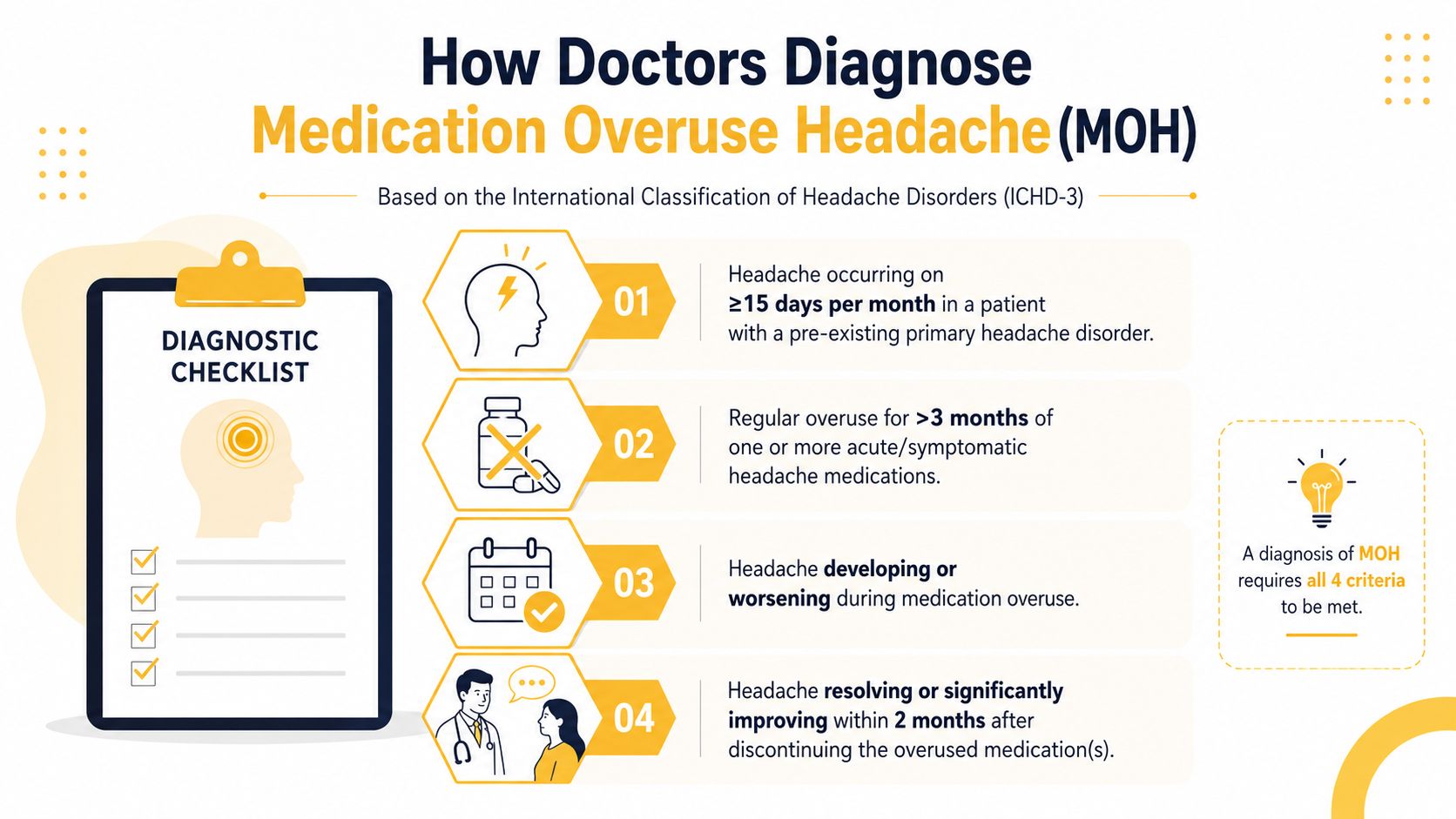
The three questions doctors usually ask
The checklist is more straightforward than it sounds.
Are headaches happening on 15 or more days per month?
This is the frequency threshold that moves the pattern into the medication overuse headache zone.Do you already have a primary headache disorder?
Usually this means migraine or another pre-existing headache condition came first.Have you been taking acute headache medicine regularly for more than 3 months, and above the medication-specific threshold?
The threshold is 15 or more days per month for simple analgesics such as acetaminophen, aspirin, and NSAIDs, and 10 or more days per month for triptans, ergotamines, opioids, and combination analgesics.
Those numbers matter because MOH isn't defined by how many pills you take in a day. It's defined by how many days per month you're relying on acute treatment.
A simple self-check before your appointment
If you're trying to figure out whether this conversation is worth having with your doctor, this quick self-check can help.
- Count headache days: Look back over the last month and estimate how many days your head pain showed up, even if it was mild.
- Count medication days: Mark every day you took an acute treatment. If you took two doses on one day, that still counts as one medication day.
- Check the pattern length: Ask whether this has been going on for more than 3 months.
- Separate prevention from rescue: Daily preventive treatment and acute "rescue" treatment are not the same thing. MOH is about overuse of acute medication.
If you've been logging only "bad migraine days" and not every medication day, it's easy to miss the trend until you're already deep in it.
A clinician also looks at whether the headache developed or worsened during medication overuse, and whether it improves after stopping the overused medicine, which is why follow-up matters. You don't need to diagnose yourself. You just need enough detail to make the appointment more useful.
Common Medications That Can Trigger MOH
Many people mistakenly believe medication overuse headaches only happen with strong prescription drugs. They can also happen with common over-the-counter pain relievers if use becomes frequent enough.
Why some medicines create risk faster
The risk isn't identical across medication classes. According to this review on the pathophysiology of medication-overuse headache, MOH involves increased neuronal excitability and central sensitization. In plain language, the nervous system becomes more reactive and more likely to amplify pain signals.
That review also notes that triptan overuse leads to MOH development more rapidly than other analgesics, and that both triptans and NSAIDs are more likely to trigger MOH when your underlying headache frequency is already high. So if your migraines have already become more frequent, your risk changes even before you hit a formal diagnosis.
Medication overuse thresholds
| Medication Type | Overuse is Defined As |
|---|---|
| Simple analgesics such as acetaminophen, aspirin, or NSAIDs | 15 or more days per month |
| Triptans | 10 or more days per month |
| Ergotamines | 10 or more days per month |
| Opioids | 10 or more days per month |
| Combination analgesics such as products that combine pain relievers with other active ingredients | 10 or more days per month |
A few practical points make this easier to use in real life:
- Simple does not mean harmless: Over-the-counter medicines can still contribute to MOH when used often enough.
- Combination products deserve extra attention: If a medicine has more than one active ingredient, don't assume the threshold is the same as a basic pain reliever.
- Prescription rescue treatments count too: Triptans, opioid-containing treatments, and ergotamine-based options all count toward medication days.
- Frequency matters more than dose size: A "small" dose taken on many days can be more relevant than a larger dose taken rarely.
Many people don't realize they're approaching the line because they think in terms of attacks, not medication days.
One more point of confusion: using medicine appropriately during an occasional severe migraine attack is not the problem. The issue is when acute treatment starts showing up across the calendar so often that it becomes part of the headache pattern itself.
Evidence-Based Strategies for Managing MOH
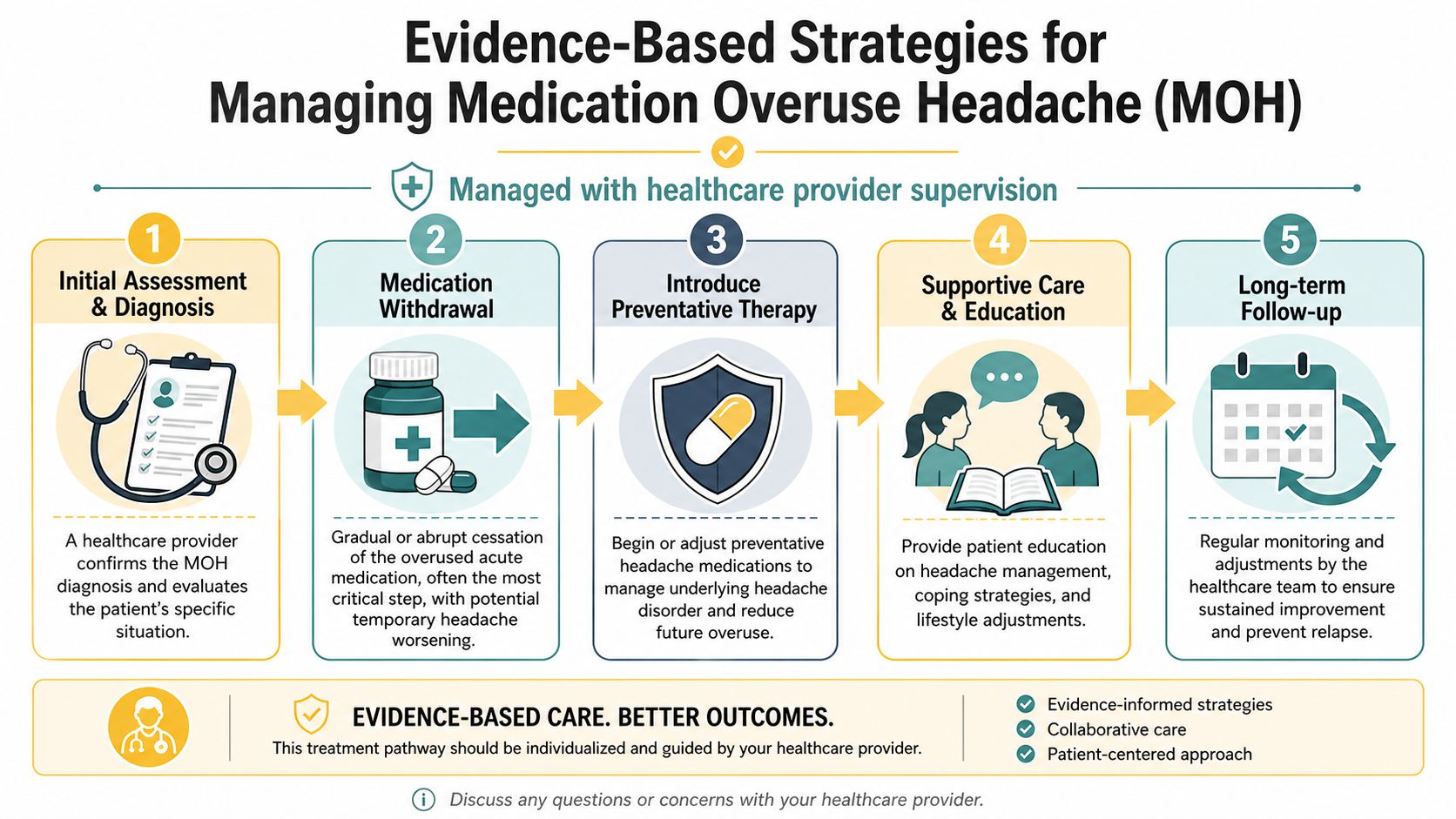
By the time medication overuse headache is established, the usual goal is to reduce the headache burden by breaking the overuse cycle. This condition is common enough that management is well described, but it still works best when a healthcare provider helps guide the plan.
Withdrawal is still the main treatment
The most effective management strategy for established MOH is complete withdrawal of the overused acute medication for about two months, as described in MedLink's review of medication-overuse headache management. That can sound intimidating, but it reflects the core idea that if the medicine is sustaining the cycle, the cycle usually won't break until the overuse stops.
A more limited approach, restricting acute medication to a maximum of two days per week, can also be used, though it's considered less efficient in that same review. In practice, the right route depends on the medication type, your baseline migraine pattern, and the support available to you.
What supportive care can look like
Withdrawal doesn't mean "go home and suffer without a plan." Doctors often build in support around the process.
Some people need bridge therapy, which is short-term treatment used during withdrawal to help manage the temporary worsening of symptoms. A clinician may also give you instructions for what symptoms to monitor and when to check back in.
- Medical supervision matters: Some medication classes are harder to stop than others, and the safest approach can differ.
- Education reduces panic: Knowing that symptoms may flare temporarily helps you interpret the process correctly.
- Follow-up prevents drift: Without follow-up, it's easy to slide back into frequent rescue use during a rough week.
The goal isn't to prove you can tolerate pain. The goal is to lower the total headache burden over time.
When prevention treatment enters the plan
If your underlying migraine disorder is driving frequent attacks, your clinician may also discuss preventive treatment. According to a 2024 review on medication-overuse headache management, complete withdrawal of the overused medication is typically the treatment of choice, but when withdrawal can't be achieved, CGRP-targeting agents and OnabotulinumtoxinA may be beneficial.
This is an important nuance. A lot of patient education stops at "just stop the medicine." Real care is usually more layered than that.
That same review notes that MOH is more than three times more common in women than men and estimates worldwide prevalence at 1%, affecting about 58.5 million people in the 2015 Global Burden of Disease study. The scale of the problem is one reason headache specialists now talk more openly about realistic treatment pathways, including prevention strategies when pure withdrawal isn't workable.
Navigating the Medication Withdrawal Period
The part people dread most is often the part nobody explained well. If you're stopping an overused medication, there may be a stretch where your head feels worse before it feels better. That doesn't mean the plan is failing.
What this stretch can feel like
A common story goes like this: you stop the medicine that had become your safety net, then the next days feel raw, noisy, and discouraging. The headache may intensify. Your patience drops. Light and sound may feel harsher than usual. If migraine is your primary disorder, the whole experience can feel like you're inviting attacks on purpose.
That fear is real. It's also one reason some people need a more supported plan.
Research in Frontiers in Pain Research on MOH risk factors found that patients with regular tranquilizer use or a Hospital Anxiety and Depression Scale score of 11 or higher had a 5-fold increased risk of developing MOH. That's a useful reminder that mood symptoms, stress, and overlapping pain conditions can shape both the buildup to MOH and the withdrawal experience.
Small things that can make the days easier
You're not trying to optimize your whole life during withdrawal. You're trying to get through a rough phase with as little extra strain as possible.
- Protect sleep: Keep your room dark, cool, and quiet if you can. Sleep disruption can make a hard week feel much harder.
- Use low-effort comfort measures: Ice packs, a familiar eye mask, hydration, bland food, and reduced stimulation can lower the overall load.
- Tell one or two people what's happening: A partner, friend, coworker, or family member may be able to help with errands, meals, or lowering demands.
- Stay in touch with your clinician: If the plan included check-ins, use them. If something feels off or unmanageable, say so.
For a general overview of migraine education and support during hard stretches, this short video may help frame the experience:
You don't need to act cheerful about withdrawal for it to be worthwhile. It can be difficult and still be the right step.
How to Proactively Prevent Medication Overuse
Most articles meet people after medication overuse headaches have already taken hold. The bigger opportunity is spotting the trend earlier, while you still have room to change course.
This article is for informational purposes and is not medical advice. Consult a healthcare provider for personalized guidance.
Track medication days, not just migraine days
A key gap in the literature is the lack of focus on proactive, data-driven prevention, especially for people who can't reliably self-monitor patterns in their head while juggling work, parenting, school, or chronic symptoms. This article discussing proactive prevention in MOH notes that patients often don't realize they're approaching the 10 to 15 day threshold until the chronic cycle is already established.
That means a simple paper calendar, spreadsheet, or app log can be more powerful than it seems. Not because tracking cures anything, but because tracking makes the pattern visible before your brain starts normalizing it.
What to watch for before you cross the line
Prevention is usually less about one dramatic decision and more about noticing drift.
Try watching for these signs:
- Medication days are spreading across the month: Not just bad clusters, but a pattern where rescue treatment keeps appearing every few days.
- Attacks feel less cleanly separated: You stop knowing where one migraine ends and the next begins.
- You start pre-planning doses out of fear: That's understandable, but it can be an early sign that your relationship with acute treatment is changing.
- Your monthly count is getting fuzzy: If you can't confidently say how many days you used rescue medication, that's a sign to start logging more carefully.
A forecasting and tracking tool can help because it puts medication use next to attack frequency, symptoms, and possible environmental triggers in one place. If you want a practical example of that kind of approach, Relief's migraine forecasting and tracking app is built around logging attacks, symptoms, triggers, and medications so you can see trends before they turn into a monthly spiral.
When to See a Headache Specialist
You don't need to wait until things are unbearable to ask for specialist help. Consider seeing a neurologist or headache specialist if your diagnosis feels unclear, your migraine pattern is difficult to control, or you've tried to reduce acute medication use and keep falling back into the same cycle.
A specialist can also help if withdrawal feels unrealistic, if your symptoms are complicated by anxiety or other pain conditions, or if you need a more structured long-term plan for prevention and rescue treatment.
Get immediate medical care for red flag symptoms: sudden severe headache, headache with fever and stiff neck, new neurological changes, or headache after a head injury.
If something feels dramatically different from your usual migraine pattern, it's better to treat that as urgent and get checked.
If you want help seeing patterns earlier, Relief can support your tracking by logging attacks, symptoms, triggers, and medication use in one place so you can spot changes before medication overuse headaches become the story.


