You're in a dark room, but the refrigerator hum still feels like a drill and the kitchen light seems brighter than daylight. Light and sound sensitivity are common migraine symptoms, not a sign that you're overreacting. They're called photophobia, sensitivity to light, and phonophobia, sensitivity to sound, and they can occur during an attack or between attacks.
Migraine is more than a headache. It's a neurological condition that can affect pain, vision, hearing, smell, movement, balance, and how your brain decides which sensations deserve attention. Understanding that broader pattern can help you describe your symptoms accurately, manage exposures without living in fear of them, and recognize when persistent sensitivity deserves medical attention.
This article is for informational purposes and is not medical advice. Consult a healthcare provider for personalized guidance.
Table of Contents
- Reduce intensity without isolating yourself
- Pace the transition
- Consider treatment options with professional guidance
What Light and Sound Sensitivity Really Mean
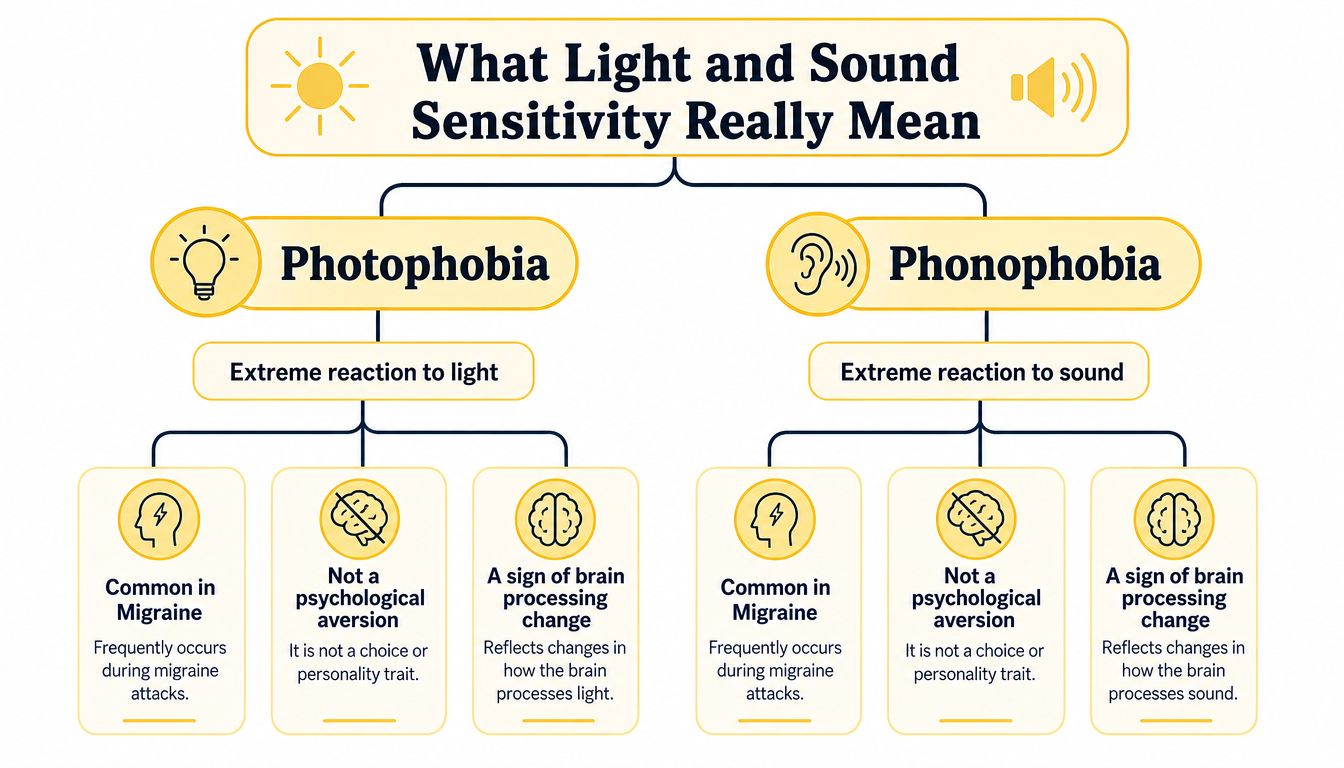
Photophobia doesn't mean you're afraid of light. In migraine care, it means that light feels unusually unpleasant, overwhelming, or painful, or that it makes existing head pain worse. The kitchen bulb may seem harsh, sunlight may hurt your eyes, or a phone screen may become impossible to tolerate.
Phonophobia works in a similar way. Ordinary sounds can feel intrusive, sharp, or painful. A coworker's voice, traffic, dishes, a television, or the steady hum of an appliance may suddenly demand all your attention. Discomfort and pain can overlap, but you don't need to describe the sensation as pain for it to matter clinically.
Photophobia is one of the most common migraine symptoms. Clinical sources place light sensitivity during attacks at roughly 80% to 90% of people with migraine, while an early questionnaire study found that about 74% reported light sensitivity outside attacks as well, as summarized in this clinical review of migraine photophobia.
A symptom is not always a trigger
People often say, “Light triggers my migraine,” and sometimes that description fits. A bright exposure may precede an attack for you. But light and sound can also be symptoms produced by the migraine process itself. Once an attack is underway, the sensitized nervous system may make previously tolerable input feel unbearable.
That distinction matters because total avoidance can shrink your life without necessarily preventing every attack. Instead of assuming that every bright room or noisy place caused the migraine, note whether the exposure came before pain, intensified pain already present, or remained difficult during the recovery period.
For a clinician, useful language sounds like this: “Bright light worsens my headache,” “I'm sensitive to sound even when the pain is mild,” or “The sensitivity continues after the headache improves.” Those details are more informative than saying that light and noise bother you.
Practical rule: Describe what the stimulus does to your symptoms, not whether you think you should be able to tolerate it.
Sound sensitivity is also widespread. Research summarized in a PubMed study on migraine sensory sensitivity reports that roughly 70% to 90% of people with migraine experience phonophobia during attacks, while about two-thirds report some sound sensitivity between attacks. This is a measurable sensory change, not a character flaw or a psychological aversion.
Why Migraine Changes How the Brain Processes Light and Sound
During an attack, a room that usually feels comfortable may suddenly become painful, and ordinary conversation may seem impossible to ignore. The change is not just in the brightness or volume. Migraine can alter how the brain filters and prioritizes sensory information.
Researchers call part of this process central sensitization. Interconnected pain and sensory networks become more responsive, including the trigeminovascular system, the thalamus, and cortical regions that process sensory information. The trigeminovascular system carries signals involving the head and its blood vessels. The thalamus helps relay and organize sensory input before it reaches wider brain networks.
A review of migraine photophobia mechanisms found that the most common pattern is headache exacerbation by light, meaning light worsens pain that is already present. It also described pathways that appear to depend on ongoing trigeminovascular activity. Light, therefore, does not act like a simple external switch that independently starts every attack. The findings are discussed in this review of migraine photophobia mechanisms.
Why harmless sounds can feel urgent
Brain imaging has linked migraine-related light and sound sensitivity with stronger connectivity between the primary visual and auditory cortices and the right dorsal anterior insula. The insula helps assign importance to sensations inside and outside the body. If these networks communicate more intensely, a neutral stimulus may feel urgent, unpleasant, or impossible to ignore.
That can make chewing, keyboard clicks, or a low electrical hum intolerable. Hearing has not necessarily become more precise. While pain networks are active, the brain may assign the sound greater salience, or importance, so it demands attention.
This broader sensory shift is why migraine is not limited to pain alone. Processing can change across vision, hearing, smell, touch, and balance. Light sensitivity may occur without aura, and sound sensitivity may occur with or without aura. These symptoms can appear in migraine with aura and migraine without aura.
A controlled study comparing 65 migraineurs and 80 headache-free controls found lower thresholds for sound discomfort among participants with migraine, both during and outside attacks, with p<0.0001. It found no difference in sound sensitivity between migraine with aura and migraine without aura. The results appear in this controlled migraine sound-sensitivity study.
This pattern can offer more than an explanation for one difficult room. Sensitivity across several senses may reflect a broader sensory phenotype, while balance symptoms may point toward vestibular involvement. Tracking which sensations change, when they change, and whether pain is already present can help show whether the problem is exposure, amplification, or both.
Common Triggers People Identify and Why They Vary
You leave a dim cinema and step into bright sunlight. Later, a restaurant's overlapping conversations feel unbearable, although the same room seemed manageable last week. These differences are common because sensitivity depends on the type of exposure, its intensity, and the state of your migraine system that day.
Common exposures people identify include:
- Fluorescent overhead lighting: Flicker, glare, or the visual strain of a large lit workspace may become difficult.
- Flickering screens: Video content, scrolling, screen reflections, or rapid visual changes can feel worse than a still display.
- Oncoming headlights: Night driving can combine glare, contrast, and repeated bursts of light.
- Sudden loud noises: A slammed door, alarm, siren, or dropped object may provoke discomfort or intensify an attack.
- Busy environments: Restaurants, shopping areas, concerts, and crowded workplaces combine many voices and unpredictable sounds.
- High-contrast patterns: Stripes, repetitive designs, or strong light-dark transitions may be visually demanding.
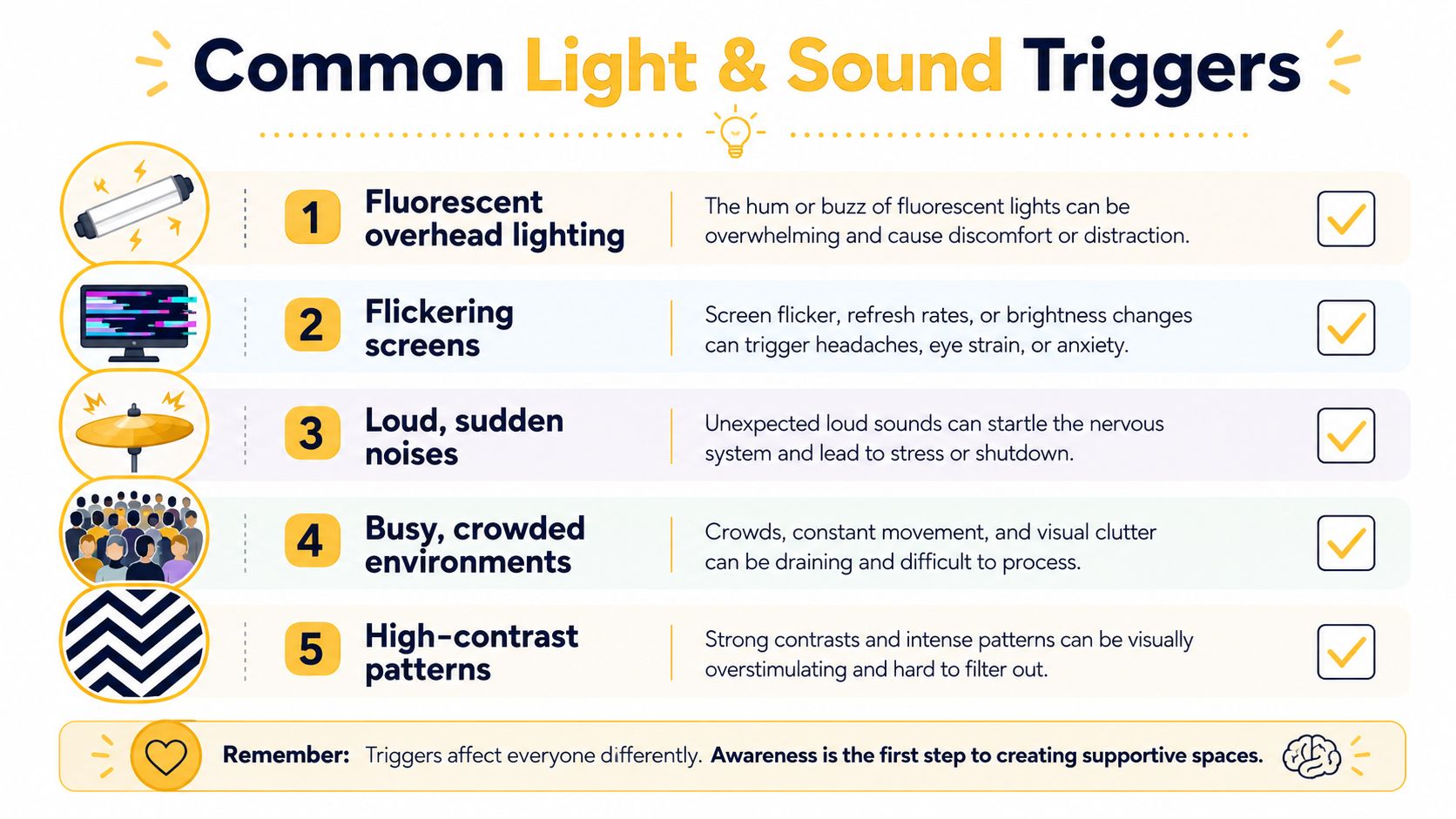
The same category can behave differently across people and across attacks. One person may react to flicker but tolerate steady daylight. Another may manage overhead lighting yet struggle with headlights, screen glare, or sunlight after leaving a dark room. Sound sensitivity can depend on predictability too. A steady background hum may be tolerable, while a sudden alarm captures attention and feels painful.
A diary can help separate patterns by specific exposure. Record the light source or sound, where you encountered it, how long it lasted, and whether symptoms began before, during, or afterward. “Noise” is less useful than “ambulance siren” or “crowded restaurant.” A review of migraine sound hypersensitivity cites research in which ambulance sirens, police sirens, and railroad crossing bells were rated as significantly more unpleasant by migraine patients than by controls. See this review of migraine sound hypersensitivity.
Other conditions may appear beside sensory exposures in the same diary, including dietary, hormonal, sleep, stress, and weather-related factors. Keep those categories separate so timing does not become proof of cause. A light or sound may contribute to an attack, intensify symptoms already developing, or become noticeable because the brain is processing sensory input with greater sensitivity. Repeated patterns across different days provide more useful guidance than a single difficult experience.
What Light and Sound Sensitivity May Signal About Your Migraine
Photophobia and phonophobia can reveal how broadly your nervous system is processing sensory input during migraine. They do not identify a specific migraine subtype, and intense sensitivity does not determine what the next attack will look like. Still, sensitivity that is persistent, severe, or expanding to other senses gives your clinician useful information about your overall migraine burden.
A 2025 cross-sectional study found that misophonia, an intense negative response to particular sounds, occurred 2.5 times more often in people with migraine than in controls. Those with misophonia also reported more frequent and intense photophobia, phonophobia, osmophobia, meaning sensitivity to smells, and allodynia, meaning pain from touch that is normally not painful. The findings are described in this study of misophonia and migraine sensory symptoms.
Sensitivity can travel with other symptoms
During one attack, bright light, sound, smell, touch, and movement may all become harder to tolerate. The brain can behave like an alarm system with its sensitivity dial turned up, so several types of input feel threatening or painful at once. Record the full cluster rather than reducing the episode to only “head pain” or “light sensitivity.”
Research reported in 2024 found that photophobia and phonophobia independently predicted higher headache pain scores. A study published across 2025 and 2026 examined sensory hypersensitivity between attacks, called interictal sensitivity, and connected it with substantially higher vestibular symptoms. Interictal photophobia was associated with about a four times higher risk of dizziness or vertigo, according to the same research.
These findings do not show that light sensitivity causes vertigo, and they do not mean that every person with photophobia has vestibular migraine. They do make dizziness, visual motion discomfort, imbalance, and sound sensitivity worth recording together. Sensitivity that continues between attacks, or interferes with walking, driving, work, or daily tasks, deserves discussion with a clinician.
Persistent sensory sensitivity is not just an inconvenience to work around. It can provide clinically useful information about your overall migraine burden.
Use concrete descriptions during an appointment. “I need sunglasses indoors” communicates more than “light bothers me.” “Crowded rooms make me dizzy, and sounds feel painful for hours afterward” describes severity, timing, and possible vestibular involvement.
Practical Strategies to Manage Symptoms During and Between Attacks
You don't need one perfect solution. Build a small toolkit, test one change at a time, and keep the options that make your day more manageable.
Reduce intensity without isolating yourself
During an attack, lower the sensory load where you can. A dim, quiet room, an eye mask, earplugs, or noise-canceling headphones may help you cope. Outside, sunglasses with comfortable coverage can reduce glare. Some people try FL-41-tinted lenses or screen filters, although the benefit varies and these tools aren't a cure.
At work, you might turn off unnecessary notifications, move away from a flickering fixture, use a desk lamp instead of harsh overhead lighting, or reduce screen brightness while preserving enough contrast to read. At home, prepare a low-light area before you need it rather than searching for supplies at the peak of an attack.
Make the environment adjustable: A dimmer switch, screen filter, earplugs, and a prepared recovery space can give you choices without requiring total avoidance.
Pace the transition
Sudden changes can be harder than steady exposure. If bright outdoor light tends to trouble you, allow your eyes to adjust gradually when moving from a dark room outside. Before a known noisy event, plan where you can take a quiet break and decide how you'll get home if symptoms escalate.
Regular hydration, consistent sleep, and eating when you're able may support attack management for some people. These aren't moral tests, and they won't prevent every migraine. They're basic supports that may reduce additional strain on a sensitized system.
Consider treatment options with professional guidance
Some people find over-the-counter pain-relief or anti-inflammatory medicine useful when an attack is starting, while others need a different approach. A pharmacist or clinician can help you choose safely based on your health history, other medicines, and how often you use acute treatment. Don't follow a dosing plan from an article, and ask for advice if you regularly need acute medicines.
Prescription preventive and acute treatments may help reduce migraine frequency or severity for some people. Emerging research also includes CGRP-targeted therapies and neuromodulation devices, but suitability depends on your diagnosis, symptoms, medical history, and access to care. These options shouldn't replace an individualized conversation with a qualified provider.
If privacy affects whether you'll keep a symptom diary, review Relief's privacy information before choosing a tracking tool. Relief can support awareness and lifestyle management, but it isn't a medical treatment or replacement for care.
How Tracking Can Reveal Your Personal Patterns
“Light” and “noise” are too broad to guide decisions. A useful record captures what happened, when it happened, how long it lasted, and what followed.
Try logging:
- Exposure: Fluorescent office lights, a long video call, a concert, traffic noise, sirens, or a crowded restaurant.
- Timing: Whether the exposure happened before pain, during the attack, or during recovery.
- Response: Light sensitivity, sound sensitivity, nausea, dizziness, aura, head pain, or touch sensitivity.
- Context: Sleep disruption, missed meals, hydration, stress, weather, air quality, or hormonal timing if relevant to your tracking.
- Severity and duration: How intense the symptoms felt and when they returned to your usual baseline.
Exposure hit rates can make this more concrete. If you record every fluorescent-light exposure and note whether an attack followed within your chosen observation window, you can compare that pattern with other exposures. This doesn't prove causation, but it can show which inputs deserve closer attention and which feared triggers may not correlate with your attacks.
A useful one-week log might say: “Monday, two hours under office fluorescents, mild light sensitivity afterward, no headache. Wednesday, long screen session followed by sound sensitivity and moderate pain. Saturday, concert, immediate phonophobia and dizziness, recovery the next morning.” That record gives you something actionable to review instead of a vague impression that “everything triggers me.”
Relief combines symptom logging with personalized forecasting and pattern recognition, including logged light and sound sensitivity and environmental information, as a tool for awareness rather than treatment.
When to Seek Care and Red Flags You Should Not Ignore
A sudden, severe headache needs immediate medical care, especially a thunderclap headache, headache with fever or stiff neck, new neurological changes, or pain after a head injury. Treat the “worst headache of your life” as an emergency warning, particularly when it begins abruptly or feels unlike your usual migraine.
Contact a primary care provider if attacks are becoming more frequent, more painful, or different from your established pattern. Arrange an evaluation for new aura features, sensitivity that continues between attacks, or dizziness and vertigo that disrupt work, walking, driving, or daily activities. Persistent sensory sensitivity can be part of a broader migraine pattern, but it may also require checking for other causes.
A neurologist or headache specialist can help when symptoms remain disabling, the diagnosis is uncertain, or initial management is not helping. Bring a record of symptom timing, light and sound exposures, attack duration, medications or self-care methods tried, and changes between attacks. A tracking tool such as Relief's information about its tracking and forecasting approach may help organize that history.
Relief lets you log light and sound sensitivity alongside attack severity, timing, symptoms, medications, and environmental conditions. This record can help reveal patterns specific to you, without replacing medical evaluation. Learn about Relief if you want to begin documenting your migraine days.
This article is for informational purposes and is not medical advice. Consult a healthcare provider for personalized guidance.


