Migraine treatment guidelines are evidence-based roadmaps, and 2023 to 2025 guidance consistently places acetaminophen, acetylsalicylic acid, diclofenac, ibuprofen, naproxen sodium, and triptans among the strongest acute options, while prochlorperazine and greater occipital nerve blocks stand out in emergency care. They matter because they help match treatment to attack severity, timing, and your other health factors, instead of treating every migraine like a generic headache.
If you're tired, frustrated, or wondering why the same medication works one month and fails the next, you're not alone. Migraine isn't just head pain, it's a neurological disorder that can come with aura, photophobia, nausea, and a long after-effect called the postdrome, and the right treatment depends on which part of that pattern you're in. This article is for informational purposes and is not medical advice. Consult a healthcare provider for personalized guidance.
Table of Contents
Understanding Migraine Treatment Guidelines
A migraine attack can feel random until a clinician starts asking the questions that matter. Migraine treatment guidelines exist to turn that scattered experience into a practical plan, so care is based on the attack itself, your other health conditions, and what you can realistically use. They do not ask everyone to follow the same path. They help you and your clinician choose a path that fits the situation in front of you.
Who makes the roadmap
Specialty groups such as the American Headache Society, American Academy of Neurology, Canadian Headache Society, and NICE review the evidence and rank treatments by strength of support. Current guidance treats acute migraine care as route-specific and attack-specific, with clear first-line and no-use recommendations for outpatient and emergency settings CMAJ review on modern migraine guidance. That shift matters because migraine is a distinct neurological disorder, not just a generic headache label.
A better way to read these documents is as a map, not a script. The map shows the best-supported options, while your actual route depends on whether the attack is mild or disabling, whether nausea makes pills hard to keep down, and whether conditions like heart disease or pregnancy change what is safe.
Practical rule: if a treatment plan ignores your attack pattern, your comorbidities, or whether you can actually take the medicine early, it is probably too generic.
How the evidence gets ranked
Guidelines usually begin with a systematic review of clinical trials, then grade how consistent and high-quality the results are. That is why some treatments appear as first-line options for many people, while others are listed as alternatives only when standard choices do not fit. The International Headache Society also recommends taking acute treatment as early as possible in the headache phase, because delay can make it harder to stop the attack from progressing IHS acute treatment recommendations.
If you have ever felt dismissed because “it's just a headache,” that reaction is exactly why these guidelines exist. Migraine is not interchangeable with tension-type headache or other headache disorders, and once that difference is clear, the treatment conversation becomes much easier to follow.
Use guidelines as a conversation tool with your clinician, not as a self-diagnosis guide. If you want a simple way to track your own pattern before that visit, About Relief explains the kind of tracking that can make the discussion more useful.
Acute Treatment Options for Migraine Attacks
The first dose should usually happen when migraine symptoms begin, not after you have spent hours trying to push through them. Acute treatment works best when it matches the stage of the attack, because migraine is not a single pattern and the same medicine will not fit every situation.
What to reach for first
For many people, the first step is still an over-the-counter option. The evidence base supports NSAIDs and other simple pain relievers as starting points for many attacks, especially when pain is still moderate and nausea has not taken over CMAJ review on modern migraine guidance. Acetaminophen also appears in major guideline sets, especially when NSAIDs are a poor fit or cannot be used.
If the attack is clearly more severe, or if NSAIDs do not reliably stop it, triptans remain the main prescription option in guideline summaries. Newer classes such as ditans and gepants are alternatives when triptans fail or are not appropriate, which matters if you have been told that every migraine prescription works the same way. They do not.
Why timing changes the result
Migraine treatment guidelines repeatedly emphasize early dosing. Once the attack has had time to settle in, it becomes harder to stop, so waiting until pain is severe can make even a good medicine look as if it failed. That does not mean you should treat every minor twinge, it means learning your own early warning signs, such as yawning, neck stiffness, light sensitivity, or the start of aura.
Practical rule: the earlier you treat the headache phase, the better the chance that one medication can still interrupt the attack.
What if nausea or vomiting shows up
When nausea or vomiting is part of the attack, a swallowed tablet may not be absorbed well enough to help. Guidelines support non-oral routes, including intranasal and subcutaneous sumatriptan, in that setting Illinois migraine prophylaxis guidance. That detail sounds small, but it often explains why a pill did not work during a bad attack even though the same drug may work fine another day.
| Option | Evidence Level | Best For |
|---|---|---|
| NSAIDs like ibuprofen, aspirin, diclofenac, naproxen, ketorolac | High in major guideline summaries | Mild-to-moderate attacks, early treatment |
| Triptans | High and still the mainstay for many attacks | More severe attacks, or NSAIDs that are not enough |
| Gepants and ditans | Supported as alternatives | When triptans fail or cannot be used |
| Non-oral routes such as intranasal or subcutaneous sumatriptan | Guideline-supported in nausea or vomiting | Attacks where swallowing or absorption is a problem |
A common point of confusion is whether a newer drug is automatically better. Guidelines do not say that. They say the best treatment is the one that fits the attack, the person, and the route you can use.
When Preventive Therapy Makes Sense
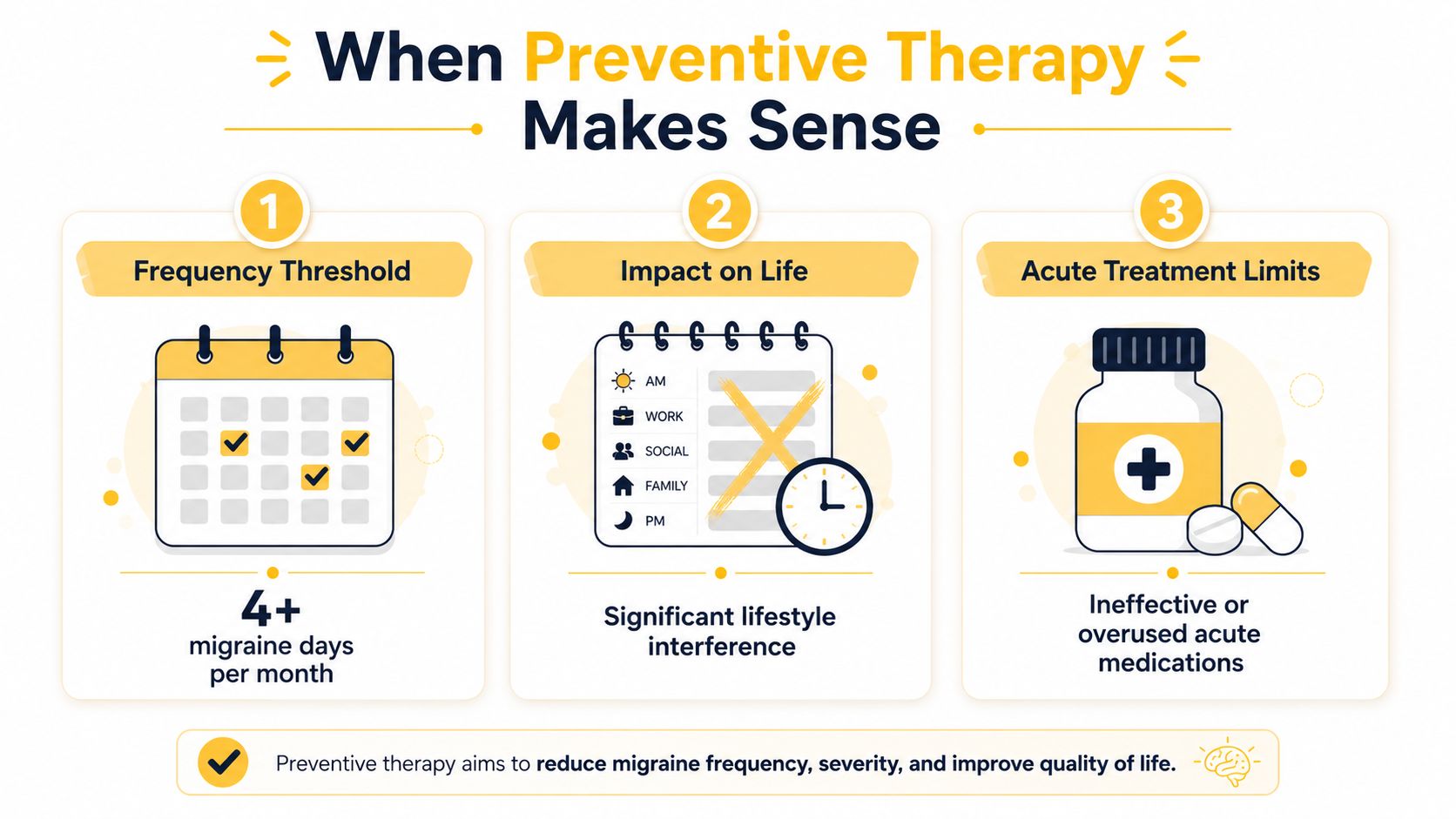
A person may handle one migraine attack at a time, then notice the attacks keep coming back often enough that daily prevention starts to make sense. One evidence-based review says preventive treatment should be considered with 4 or more attacks or 8 or more headache days per month, or when attacks stay disabling despite appropriate acute treatment, or when acute medication fails or is being overused CNS Spectrums review on current migraine management. The goal is to stop repeated attacks from becoming your default setting, without treating every rough month as a long-term disease problem.
What prevention is trying to do
Preventive therapy is meant to lower the overall burden of migraine. In practice, that can mean fewer migraine days, shorter attacks, or less disruption when attacks do happen NP Journal primary care review00184-9/fulltext). That is why prevention usually enters the conversation when migraines are frequent, disabling, or not responding well to the acute plan you already use.
Guidelines commonly discuss beta-blockers, anticonvulsants, certain antidepressants, and CGRP-based therapies. The best fit depends on your health profile, since one person's good option can be a poor match for someone else. For example, someone with asthma may not be a candidate for a beta-blocker, while someone with kidney stones may need a different choice than topiramate.
A few non-drug supports still matter
Guidelines also support nonpharmacologic prevention strategies, especially when they are used alongside medication rather than as a replacement for it. Cognitive behavioral therapy, biofeedback, and regular aerobic exercise are often part of a broader prevention plan NP Journal primary care review. These approaches do not work like a rescue medicine, but they can make the overall plan steadier and easier to live with.
Practical rule: start prevention at a low dose, increase it gradually, and give it enough time. One review notes that preventive therapy should be started at a low dose, increased gradually, and given an adequate 2 to 6 month trial before deciding whether it helps CNS Spectrums review on current migraine management.
A quick self-check
- Frequency: Are migraine days piling up month after month?
- Impact: Are attacks forcing you to cancel work, school, caregiving, or plans?
- Medication limits: Are you relying on acute medicine so often that it is losing effectiveness or creating new problems?
- Fit: Do you have health conditions that make some acute options a poor match?
If you answered yes to more than one, preventive therapy is a reasonable conversation to have, even if you have been managing on your own for years.
Special Populations and Treatment Considerations

Migraine guidelines change as soon as the person in front of you is not a standard textbook case. Pregnancy, adolescence, older age, and medication overuse all change the risk-benefit balance, which is why the same drug can make sense in one setting and be a poor fit in another. That is not inconsistency, it is good medicine, adapted to the person in front of you.
What changes in special situations
For people who are pregnant or breastfeeding, the safety discussion gets tighter, and guidelines often start with simpler options first when that is possible. In older adults, comorbidities and medication interactions matter more, so the best migraine plan may be the one that fits the rest of the medication list. In adolescents, the evidence base is thinner than it is in adults, which makes clinician guidance and follow-up more important.
Medication overuse headache is another reason guidelines become more individualized. If acute medication is being used too frequently, it can contribute to a cycle of more headache days, which is why clinicians look closely at how often you are reaching for rescue treatment. The goal is not to shame people for needing medication, it is to notice when the pattern has turned counterproductive.
Why emergency guidance matters here too
Recent emergency-department guidance shows how much treatment thinking has changed. The 2025 update says IV prochlorperazine and greater occipital nerve blocks have the strongest evidence and must be offered for eligible adults needing parenteral therapy, while IV hydromorphone should not be offered PubMed 41321235. It also supports options such as IV ketorolac, IV metoclopramide, and SC sumatriptan, while IV acetaminophen/paracetamol is not recommended PubMed 41321235.
That shift matters because it shows the guidelines moving away from opioid rescue and toward treatments that fit migraine biology better. If you have ever ended up in urgent care or the ED, that difference can change the whole visit.
If you suspect medication overuse, the next step is usually not to stop everything on your own. It is to talk through a safer transition plan with a clinician who understands migraine.
Emergency and Specialist Care Thresholds
A migraine plan also needs a clear line for help that is outside your usual routine. If a headache feels different from your normal attacks, or if it arrives with warning signs that do not fit your usual pattern, it deserves prompt medical attention. A sudden severe headache, a headache with fever and stiff neck, new neurological changes, a headache after head injury, or a major change in your usual migraine pattern are all reasons to seek immediate medical care.
When the emergency department is the right place
The emergency department is the right setting when symptoms are severe, changing quickly, or bundled with red flags. The point is to rule out dangerous causes first, then treat the migraine itself. For adults who need parenteral migraine care, current emergency guidance favors IV prochlorperazine and greater occipital nerve blocks, and it says IV hydromorphone should not be offered. That matters because many people still expect opioids to be the default rescue option, even though migraine care has moved in a different direction as outlined in the emergency care update.
When a headache specialist helps
A headache specialist is useful when attacks keep breaking through first-line treatment, when medication overuse starts to show up, or when your situation is complicated by comorbidities, aura concerns, or unusual attack features. A specialist can help sort out whether the next move should be a different acute option, a preventive strategy, or a different route for treatment if nausea or vomiting makes tablets hard to keep down. That kind of adjustment is often the difference between a plan that looks good on paper and one you can use on a bad day.
If you want a place to organize patterns before that visit, a migraine tracking plan can help you see what is breaking through and when.
Guideline-based care is also about knowing what to avoid, not just what to prescribe. That is why current ED guidance is so direct about steering away from opioids and unsupported parenteral options, and why a referral can be a sign that your care is becoming more precise rather than more alarming.
Practical rule: if your migraine has become unpredictable, more frequent, or harder to treat, specialist care is a good escalation, not a sign that you failed.
Building Your Personalized Management Plan
The most useful migraine plan is the one you can follow on a bad day. That means tracking the basics, knowing when to escalate, and bringing specific questions to your clinician instead of trying to remember everything in the exam room. A guideline-based plan is much easier to build when you know your own pattern.

What to track before your appointment
Start with the details that affect treatment decisions. Track attack frequency, severity, timing, aura, nausea or vomiting, photophobia, and every medication you tried, including whether you took it early or late. Also note any obvious triggers you personally suspect, because patterns matter more than guesswork.
A short log is better than a perfect one you never keep. If you can show your clinician the difference between an occasional attack and a pattern of repeated disability, it becomes much easier to discuss whether acute treatment, prevention, or a specialist referral makes sense.
Questions worth asking
- Acute plan: What should I take first when an attack starts, and what if that doesn't work?
- Route options: If nausea or vomiting is part of my attacks, should I have a non-oral option?
- Prevention: Do my migraine days or disability level make preventive therapy reasonable?
- Safety: Do any of my other conditions or medications change what's safe for me?
- Escalation: When should I ask for a headache specialist or urgent care?
A simple conversation starter
You can say, “My migraines are affecting my life in this pattern, and my current plan isn't working the way I need it to. I'd like to review acute options, whether prevention fits, and what I should do if an attack becomes severe.” That kind of direct statement gives your clinician the context they need without forcing you to sound like a medical expert.
The goal isn't to memorize every guideline. It's to use them as a shared language so you can get a plan that fits your real life, not just your chart.
If you want a practical way to spot patterns before your next appointment, Relief can help you log attacks, symptoms, and triggers so your migraine history is easier to understand and easier to act on. Visit Relief to start tracking what's driving your migraines, and to bring a clearer, more confident picture to your next conversation with a healthcare provider.


