You're not overreacting if your child's “headache” keeps stopping homework, sleep, or school. Pediatric migraine headaches are a real neurologic problem, and they often look different from the adult version people expect. This guide will help you sort out what migraine can look like in children, how doctors diagnose it, what to track, and when you need urgent care.
A child who curls up in a dark room, says their eyes hurt, or starts vomiting after getting upset at school may be having migraine, not just a bad day. Pediatric migraine is common enough that it deserves routine recognition, careful history-taking, and a plan that fits a child's age, symptoms, and daily life, rather than adult-style advice that misses the pattern.
Table of Contents
- What a Pediatric Migraine Headache Looks Like
- What the clinician is looking for
- How to describe the attack at an appointment
- Acute care for an attack that's already started
- Prevention for children who are having frequent attacks
- Avoiding medication overuse
What a Pediatric Migraine Headache Looks Like
A parent often walks into the room wondering whether this is really migraine or just a bad headache. That question matters, because pediatric migraine is more than head pain. It is a recurrent, disabling headache disorder, and in children it often shows up with frontal or bilateral pain, not just the one-sided pattern many adults picture.
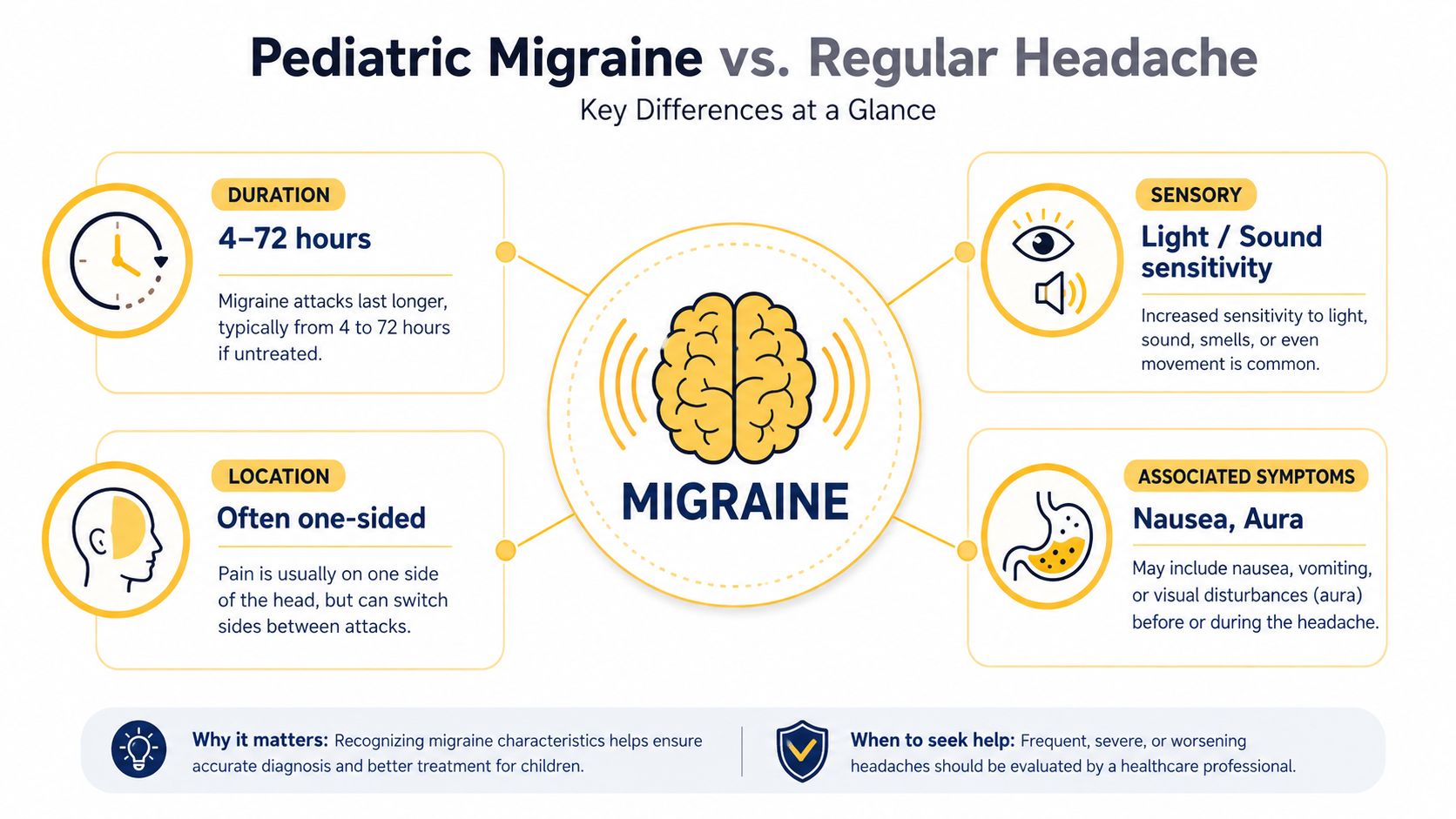
A seven-year-old might not say “my head is throbbing.” They may lie down, ask for the lights to be turned off, look pale, or say their stomach hurts. Pediatric headache specialists rely on symptom patterns, not just the word “headache,” because children often describe the attack through behavior before they can name the pain clearly.
A migraine attack in a child usually includes head pain along with photophobia or phonophobia, which mean light sensitivity and sound sensitivity, and often nausea or vomiting. One pediatric review describes migraine without aura as the most common pattern in children, often appearing as a frontal, pounding, nauseating headache lasting 1 to 72 hours PMC review.
Children can also have attacks that are shorter than the adult criteria people sometimes expect. The pediatric framework uses a 2 to 72 hour attack window, so a child's episode can still be migraine even when it does not match an adult textbook description AAN guideline.
Practical rule: if the headache keeps returning, disrupts normal activity, and comes with light, sound, stomach, or motion sensitivity, think migraine first, not “drama.”
That matters because pediatric migraine is common enough that it should be recognized early, not brushed aside. A systematic review found headache affected 58.4% of children and adolescents, and migraine affected 7.7% across reviewed studies, while a later pooled estimate put migraine prevalence at about 11% overall, with 8% migraine without aura and 3% migraine with aura PubMed review. In plain terms, this is common enough that families should expect a real plan, not dismissal.
How Pediatric Migraine Gets Diagnosed
Diagnosis relies on the clinical history first. Pediatric migraine is clinical, which means the clinician listens for the pattern, the timing, and the associated symptoms instead of waiting for a blood test or scan to “prove” it AAN guideline.
What the clinician is looking for
Under the pediatric ICHD-3 framework, a child needs at least five attacks. Each attack should last 2 to 72 hours in children and include at least two of four core features, which are bilateral or frontotemporal pain, pulsating quality, moderate or severe intensity, or worsening with routine activity, along with nausea or vomiting or photophobia and phonophobia AAN guideline.
That shorter minimum duration matters because adults often expect longer attacks. A child can have a classic migraine attack that ends too soon to fit adult-only assumptions, which is one reason pediatric migraine gets missed in primary care or school notes.
How to describe the attack at an appointment
A helpful way to prepare is to describe what you see in concrete terms:
- Where it hurts: forehead, both sides, behind the eyes, or the whole head.
- What happens during the attack: lying down, avoiding light, vomiting, crying, dizziness, or irritability.
- How long it lasts: from the first sign to recovery, even if the pain comes and goes.
- What changes behavior: school refusal, sleep, appetite, screen avoidance, or needing quiet.
You do not need to prove the diagnosis with a dramatic story. You need to give the clinician enough detail to match the child's symptoms to a pediatric pattern rather than an adult template.
The best headache history is ordinary, specific, and boring. “She stopped playing, wanted the room dark, and threw up twice” is more useful than “it was bad.”
That approach also helps when you are dealing with the gray zone of probable migraine, which is much more common than strict migraine in childhood. In one population-based study, overall migraine prevalence was 3.76%, while probable migraine was 17.1% PubMed study. In practice, this gap reflects how often a child has the right pattern but does not check every adult-style box, so families may hear mixed messages before anyone names migraine clearly. One study also reported that migraine in childhood is often recognized only after the history is pulled together across home, school, and clinic rather than from a single visit.
Recognizing Symptoms and Age-Specific Patterns
A child with migraine may complain of a headache, but the clue is often in the whole episode, not just the pain. In younger children, vomiting, abdominal pain, lethargy, irritability, or behavior changes can be the main signs, so adults may first suspect a stomach virus, fatigue, or stress before migraine comes into view Cleveland Clinic.
What changes with age
The pattern becomes easier to spot as children grow. A pediatric review reports migraine prevalence rising with age, reaching about 5% by age 10, around 10% among children ages 5 to 15, and 28% in teenagers PubMed review. School-based data also showed a rise from 3.8% in ages 5 to 12 to 6.9% in ages 12 to 15 PubMed review.
A middle-schooler who suddenly cannot tolerate cafeteria lights, or a teen who starts missing activities after lunch, deserves a migraine workup even if they rarely say “headache.” As children get older, the pattern often starts to resemble the migraine picture adults recognize, but it may still show up in a quieter, less direct way.
Comparing common headache patterns
| Feature | Migraine | Tension-Type | Sinus Headache |
|---|---|---|---|
| Pain pattern | Often throbbing or pounding, may be frontal or bilateral | More like pressure or tightness | Facial pressure with nasal symptoms |
| Sensory sensitivity | Light, sound, and sometimes smell sensitivity | Usually less prominent | Not a core feature |
| Associated symptoms | Nausea, vomiting, dizziness, behavior change | Usually fewer associated symptoms | Congestion or other sinus symptoms |
| Activity effect | Often worse with routine activity | May not change much | Can worsen with facial pressure changes |
The strongest clue is still the cluster of symptoms, not one symptom by itself. A child with head pain, nausea, and light sensitivity fits migraine much better than a child with isolated pressure that never changes how they act.
Another pattern parents often miss is aura, which means temporary neurologic symptoms that can happen before or during migraine, such as visual changes. Not every child has aura, and many pediatric migraines happen without aura, so the absence of visual zigzags does not rule migraine out.
Common Triggers and Environmental Contributors
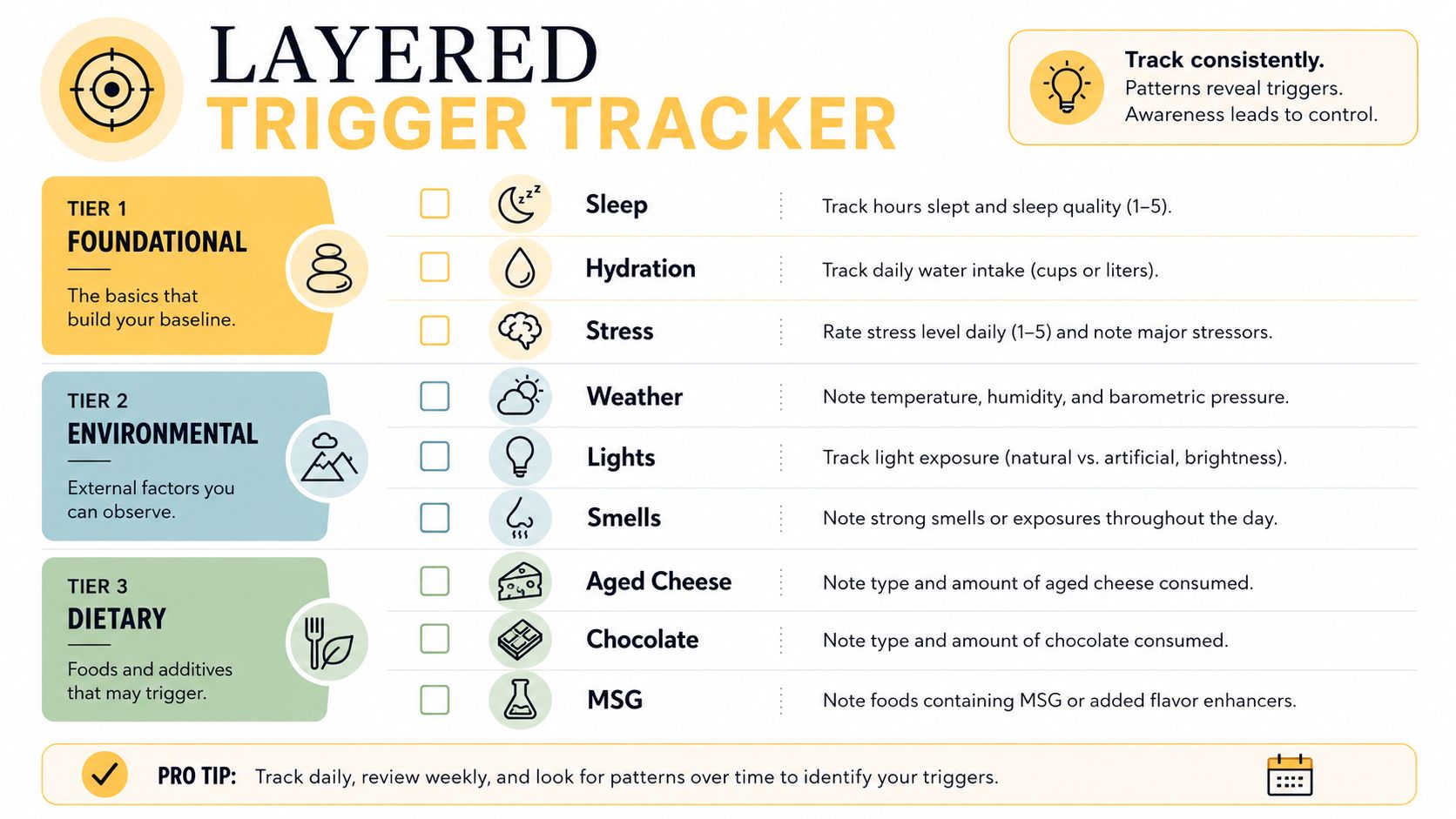
Parents are often handed a flat list of migraine triggers, then told to “watch for patterns.” That usually fails because triggers are rarely isolated. In children, they work more like layers, with sleep, hydration, stress, weather, sensory load, and hormones interacting rather than acting alone.
Think in layers, not in blame
A child who skips breakfast, sleeps poorly, and then spends the day under bright fluorescent lights may be set up for an attack even if no single factor seems dramatic. A teen's pattern can also shift around hormonal changes, which helps explain why migraine becomes more noticeable in adolescence Cleveland Clinic.
Environmental shifts matter too. Families often notice weather changes, including barometric pressure shifts, on days when attacks cluster, but the useful question isn't “Did weather cause it?” It's “What combination of factors made today a high-risk day?”
Track the stack, not just the trigger. Sleep, meals, hydration, stress, bright light, and schedule changes often matter more together than alone.
A simple way to test patterns
Try logging just five items for a few weeks:
- Sleep: bedtime, wake time, and whether sleep was broken.
- Meals: skipped breakfast, delayed lunch, or poor appetite.
- Hydration: whether water intake was normal for the day.
- Environment: heat, bright light, loud noise, strong smells, or weather changes.
- Body changes: puberty-related changes, illness, or unusual fatigue.
Avoid treating any food as a universal trigger. Some children identify specific foods, but the evidence is individual, not one-size-fits-all. A better rule is to record suspected foods only when they show up repeatedly beside the same symptom pattern.
A tool like the Relief app can fit naturally, as it logs attacks and helps surface patterns against weather and personal history without turning every meal into a suspect. A paper notebook works too if that's easier, as long as you keep the entries consistent enough to spot a trend.
Acute Treatment and Prevention Options
Families often get handed adult migraine advice and are told to adapt it at home. Pediatric migraine needs a cleaner split between treating the attack now and lowering the chance of the next one. The right choice depends on age, symptom pattern, and how often attacks are showing up AAFP guidance.
Acute care for an attack that's already started
For younger children, ibuprofen is first-line in the AAN/AFP guidance. Adolescents may benefit from triptans such as sumatriptan/naproxen, zolmitriptan nasal spray, sumatriptan nasal spray, rizatriptan, or almotriptan AAFP guidance. The practical question is not only which medicine is chosen, but how quickly it can be used and whether the child can keep it down.
That matters because a tablet that sits in the stomach during nausea may not help much. If vomiting starts early, a non-oral option can fit the attack better, since the medicine does not have to wait on the digestive tract. Early treatment also helps, because migraine is often harder to settle once the pain and light sensitivity have already climbed.
Prevention for children who are having frequent attacks
Prevention starts with the basics. Regular sleep, steady meals, hydration, and stress reduction all lower the odds that the next attack will gather momentum. Behavioral care such as cognitive behavioral therapy can also help, especially when stress and routines are part of the pattern.
Preventive medication choices for children are narrower than they are for adults, and recent reviews note that many pediatric prevention trials still do not clearly beat placebo Recent review. That does not mean prevention is pointless. It means families should expect a careful, individualized plan rather than a quick fix that works for every child.
A clinician may also talk through supplements such as magnesium or riboflavin in some cases. Those choices belong in a visit that weighs the child's age, symptom pattern, and what the family is already seeing day to day. Prevention usually works best as several small supports lined up together, not as a single answer.
Avoiding medication overuse
Rescue medicine can become part of the problem if it is used too often. Pediatric guidance warns that frequent use of acute medication can make headaches happen more often over time AAFP guidance.
If an attack plan is being used most school weeks, the plan needs a review, not more guessing.
Headache tracking helps here. It shows whether the pattern is becoming more frequent, whether the rescue plan is helping, and whether the family should revisit prevention before the cycle gets harder to break.
School and Daycare Management Strategies
A child shouldn't have to choose between staying in class and surviving an attack. The school or daycare plan should make it easier to catch migraine early, rest safely, and return when they're functional again.
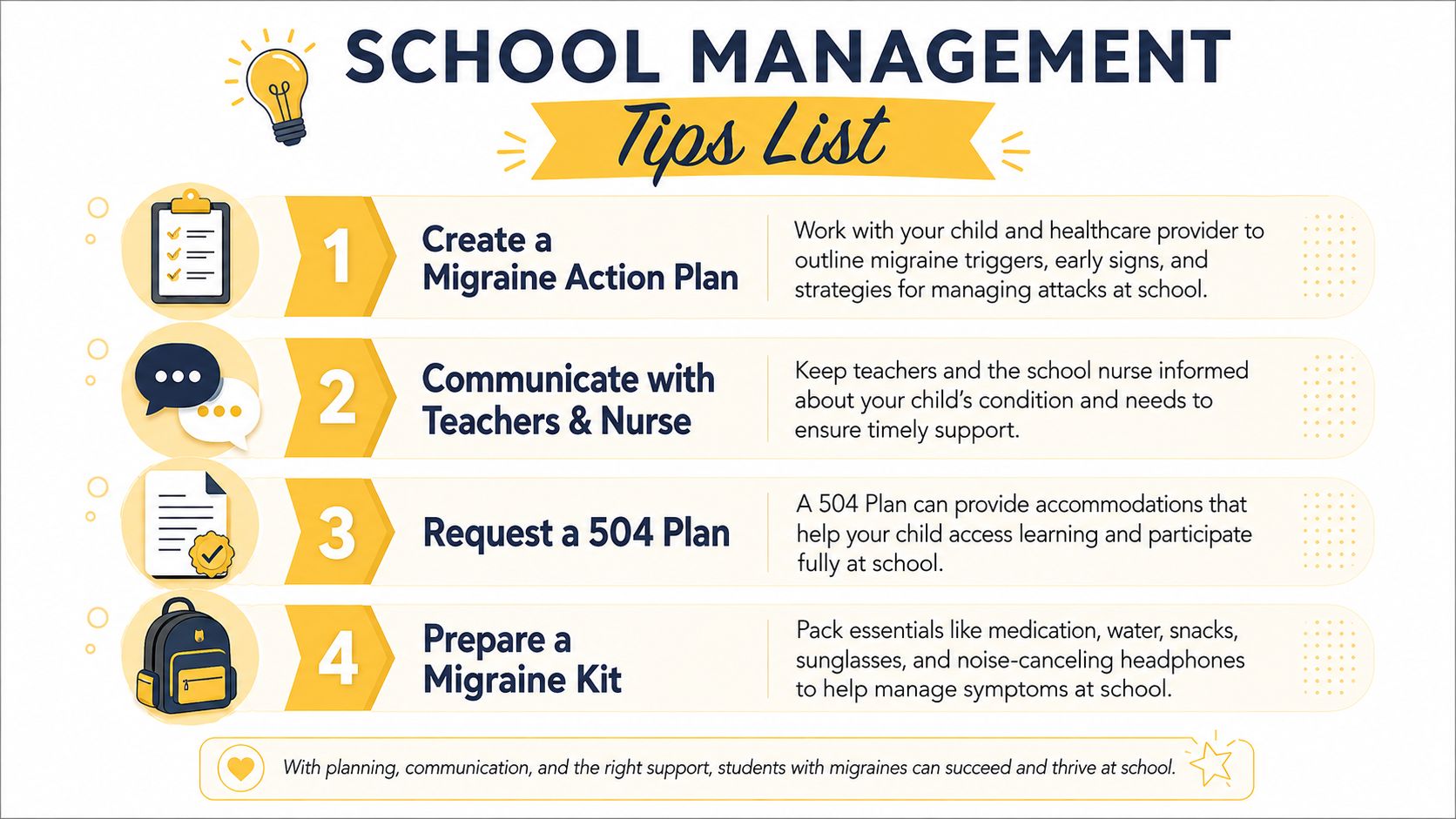
A useful school plan usually starts with a short written summary for the nurse and the main teacher. Keep it practical, not dramatic, and focus on what staff should do when the child shows early signs like light avoidance, nausea, or a request to lie down.
What to ask for
- A quiet rest space: A dim room or nurse's office where the child can decompress.
- Hydration access: Permission to drink water during class.
- Attendance flexibility: A plan for late arrivals, excused absences, and make-up work.
- Sunglasses outdoors: Helpful for kids who are light-sensitive.
- A clear contact path: One person who can call you when the warning signs start.
For older children, a 504 plan or a school health plan can formalize accommodations. For daycare, the language should be simpler, but the goal is the same, which is to keep staff from treating pain as misbehavior or tiredness.
A short script for caregivers
You can tell staff, “My child gets migraine attacks that can look like stomach pain, light sensitivity, or needing to lie down. If that happens, please follow the plan and contact me early.” That keeps the message clear without oversharing medical detail they don't need.
The YouTube resource below can also help families think about school-based routines and advocacy conversations.
When the school knows what to do, the child gets fewer delays, less shame, and a faster return to the day.
Why Pediatric Migraine Is Often Missed or Undertreated
Parents usually notice the mismatch before the chart does. A child may stop playing, seek a dark room, complain of belly pain, or need to lie down, while adult-style headache questions still miss the pattern. Pediatric migraine gets overlooked for a few stubborn reasons. Adult criteria do not always fit children well, pediatric trials are thinner than adult trials, and access to specialty care still depends on geography and family resources.
The care gap is bigger than bad luck
That matters because headache disorders are a leading cause of neurologic disability in youth, yet they remain the most underfunded pediatric disease category. Families end up trying to solve a real problem in a system that was not built around their child's symptoms.
A global burden analysis reported marked geographical and gender disparities, with adolescents in low-resource settings and females disproportionately affected Global burden analysis. That does not mean every child fits the same risk profile. It means the burden is uneven, and the care pathway often is too.
How to advocate in the room
Bring a short log of attack timing, behavior changes, nausea, light sensitivity, and school disruption. If the first clinician brushes it off, ask whether the child should be seen by a pediatric neurologist or a specialty headache clinic, because pediatric migraine often needs more specific care than generic headache advice.
A plain-language overview of the organization behind this tool is available at Relief's about page. That kind of tracking support can help families document what is happening between appointments, especially when symptoms are inconsistent or hard to describe.
Building a Home Routine and Knowing When to Act Fast
The most useful home plan is simple enough to do on a tired day. Keep sleep, meals, hydration, and screen breaks as steady as you can, then log attacks in a way that captures severity, duration, symptoms, suspected triggers, and what helped.
A routine that doesn't collapse under stress
A migraine log works best when it's short. Record the date, the start time, how long the attack lasted, where the pain was, whether there was nausea or light sensitivity, and what medicine or rest strategy you used.
The point of tracking isn't perfection. It's pattern recognition, especially when family memory gets fuzzy after a hard week. A forecasting tool can also help by combining local weather, air quality, and personal history, which is useful when a child's attacks seem to cluster around certain conditions.
That's where Relief can support awareness, because it's built for logging and forecasting, not replacing medical care. It can help families see when risk is rising so they can act earlier with the plan they already have.
When to seek immediate medical care
Get urgent help right away for a sudden severe headache, a headache with fever and stiff neck, new neurological changes such as weakness, trouble walking, or trouble talking, or a headache after a head injury. Those are not situations for waiting, tracking, or watching overnight.
If a headache feels different from the child's usual pattern, trust that instinct and call for medical advice promptly.
You should also seek prompt medical attention if the child is unusually sleepy, has repeated vomiting with dehydration, or the pain is severe and unrelenting. A calm tracking routine is useful, but red flags override the log every time.
If you're trying to make sense of recurring migraine attacks in your family, Relief can help you log symptoms, spot patterns, and notice risk before the day falls apart. Visit Relief to see how tracking and forecasting can support the migraine plan you're already building with your child's clinician.


