
For individuals with migraine, a stiff neck is part of the migraine attack itself, not the cause of the headache. A 2022 review found neck pain was reported by 77.0% of people with migraine, and it was even more common in chronic migraine at 87.0%.
If you've ever woken up with a neck that feels locked up and thought, “Great, is this another migraine coming?”, you're not imagining the pattern. That neck ache can be an early clue, and it can also be one of the most confusing parts of migraine because neck pain can come from migraine, from the neck itself, or sometimes from both.
A lot of people get brushed off here. They're told it's “just tension,” or they start worrying they've missed a serious neck problem. Both reactions can leave you stuck. The useful question isn't just “why does my neck hurt?” It's “what pattern is this pain following?”
This article is for informational purposes and is not medical advice. Consult a healthcare provider for personalized guidance.
Table of Contents
- That Familiar Ache Is It a Stiff Neck or a Migraine Attack
- Why the neck can hurt before the head does
- What to watch for in your own pattern
That Familiar Ache Is It a Stiff Neck or a Migraine Attack
You wake up, roll your head to one side, and feel that familiar pull under your skull or across your shoulders. Maybe you can already tell the day is changing. The light feels sharper, your brain feels slower, and you're wondering whether the neck stiffness caused the migraine or whether the migraine is already underway.
For many people, it's the second one.
That matters because it changes what you do next. If every neck ache gets treated like a posture problem, you might miss the chance to respond early to a migraine pattern. If every neck ache gets dismissed as “just migraine,” you might miss signs of a separate neck condition that deserves its own care.
Practical rule: Ask, “Does this neck pain behave like my migraines usually behave?” Pattern matters more than panic.
The frustrating part is that both experiences can feel similar at first. A migraine-related stiff neck may show up before head pain, during the attack, or linger after. A neck-driven headache may begin in the upper neck and refer pain into the head. The overlap is real, which is why people get confused.
What helps is learning the small clues. Where the pain starts. What symptoms come with it. What movement does to it. Whether it predicts a migraine for you or stands alone as a separate problem.
The Chicken or Egg Question Neck Pain as a Migraine Symptom
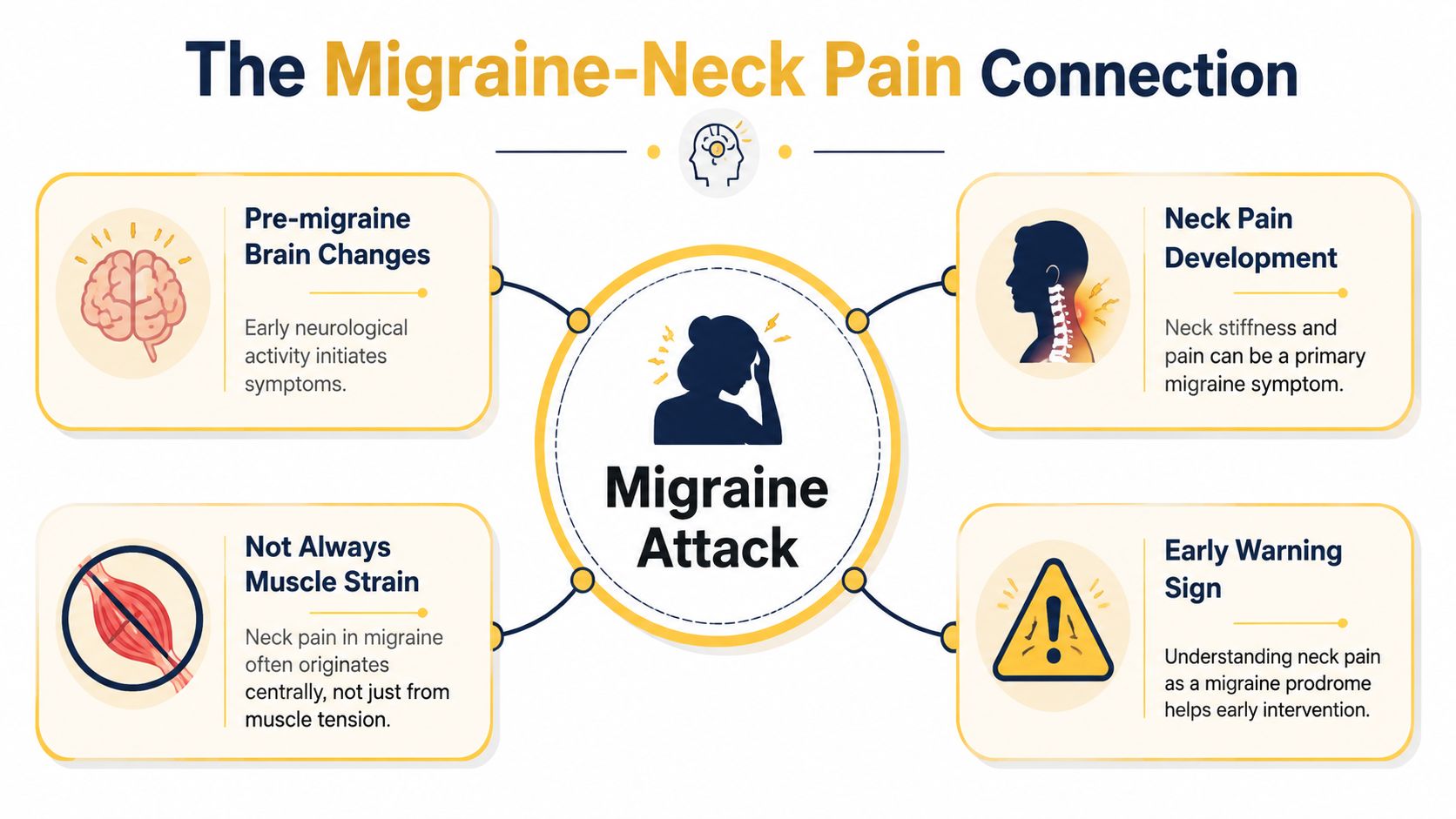
A lot of migraine symptoms begin before the main head pain does. This earlier phase is called the prodrome, which means the pre-headache part of the attack. It's when some people notice yawning, mood changes, food cravings, fatigue, trouble concentrating, or neck discomfort that seems to come out of nowhere.
Research summarized by the American Migraine Foundation on neck pain and migraine says about 89% of people with migraine report neck pain, and 70% to 80% experience a prodrome phase. That makes neck stiffness a useful early warning sign for many people, not automatic proof that you've strained a muscle.
Why the neck can hurt before the head does
Migraine isn't just a bad headache. It's a neurological disorder with phases. The brain and pain pathways start changing before the classic migraine pain fully ramps up.
That means your neck can feel tight, sore, or stiff because the migraine process is already active. In other words, the neck pain may be a signal from the same attack, not the spark that started it.
People often get tripped up. They think, “My neck hurt first, so the neck must have caused the migraine.” Sometimes that's true. Often, it isn't.
Neck stiffness that shows up alongside your usual pre-migraine clues can be a warning sign, especially if it tends to arrive in the same sequence each time.
What to watch for in your own pattern
Try asking yourself these questions the next few times it happens:
- Timing: Does the neck stiffness show up hours before your head pain?
- Companions: Does it arrive with light sensitivity, nausea, brain fog, or that hard-to-describe “off” feeling?
- Consistency: Does it happen in a repeatable pattern before many attacks?
- Response: If you use your usual migraine plan early, does the neck symptom settle with the rest of the attack?
If that sounds familiar, your neck may be acting more like a migraine messenger than a neck injury. Tracking early migraine warning signs can make that pattern much easier to spot.
Stiff Neck Migraine vs Cervicogenic Headache
The big distinction is this. Migraine with neck pain means the migraine process is creating neck symptoms. Cervicogenic headache means the pain starts in the neck structures themselves and then refers into the head.
Harvard Health explains that cervicogenic headache often originates in the upper cervical spine through pain signaling along C1 to C3, with pain that starts at the base of the skull and may spread to the forehead, behind the eyes, shoulder, or arm. Harvard also notes that physical therapy is considered first-line treatment for cervicogenic headache, while more invasive options are reserved for selected structural causes such as herniated disk, arthritis, or whiplash, as described in Harvard Health's overview of headache that starts in the neck.
A simple way to think about the difference
If the neck is the source, movement and neck mechanics often matter a lot. If migraine is the source, the neck may hurt as part of a broader neurological event.
That doesn't mean migraine neck pain is “all in your head.” The pain is real. It means the driver may be different.
A correct label matters because the management path can change. Migraine care and neck-directed physical therapy can both help, but they aren't interchangeable.
Migraine neck pain vs cervicogenic headache
| Symptom | Migraine with Neck Pain | Cervicogenic Headache |
|---|---|---|
| Where pain begins | May begin in the head, neck, or both. Pattern can vary from attack to attack. | Often starts in the upper neck or base of skull and refers upward. |
| Pain quality | Often throbbing or pulsating, though not always. | Often a steadier ache linked to neck structures. |
| Other symptoms | Light sensitivity, sound sensitivity, nausea, aura, brain fog, fatigue may show up. | Neck movement restriction is often more prominent. Migraine-type symptoms may be less central. |
| What triggers it | Can follow a broader migraine pattern such as sleep disruption, stress, hormones, or environmental triggers. | May be more tied to neck position, mechanical strain, injury, or cervical joint irritation. |
| What movement does | Gentle movement may or may not change it much. | Specific neck movement may reproduce or worsen the pain more clearly. |
| Typical treatment path | Migraine-focused treatment plan. | Often starts with neck-focused evaluation and physical therapy. |
A few extra clues can help. If your pain always starts at the base of the skull after neck strain, feels strongly tied to turning your head, and doesn't come with your usual migraine features, a neck-first evaluation makes sense. If it arrives with classic migraine symptoms, it may fit better in the migraine column.
Sometimes both can coexist, which is one reason people and clinicians may consider options like greater occipital nerve block for migraine in a broader treatment conversation. That kind of discussion belongs with a qualified clinician, especially if your pattern has changed.
Common Symptoms and Critical Red Flags
A stiff neck migraine can feel alarming even when it's following your usual pattern. That's partly because neck pain in migraine often travels with a heavier symptom load. In a multinational analysis, people with migraine who had neck pain during headaches had worse outcomes, including 47.7% with moderate-to-severe disability compared with 28.9% among those without neck pain, according to Neurology Advisor's report on neck pain in migraine.
That doesn't mean neck pain always signals danger. It does mean it's worth taking seriously and tracking carefully.
Symptoms that commonly travel with migraine
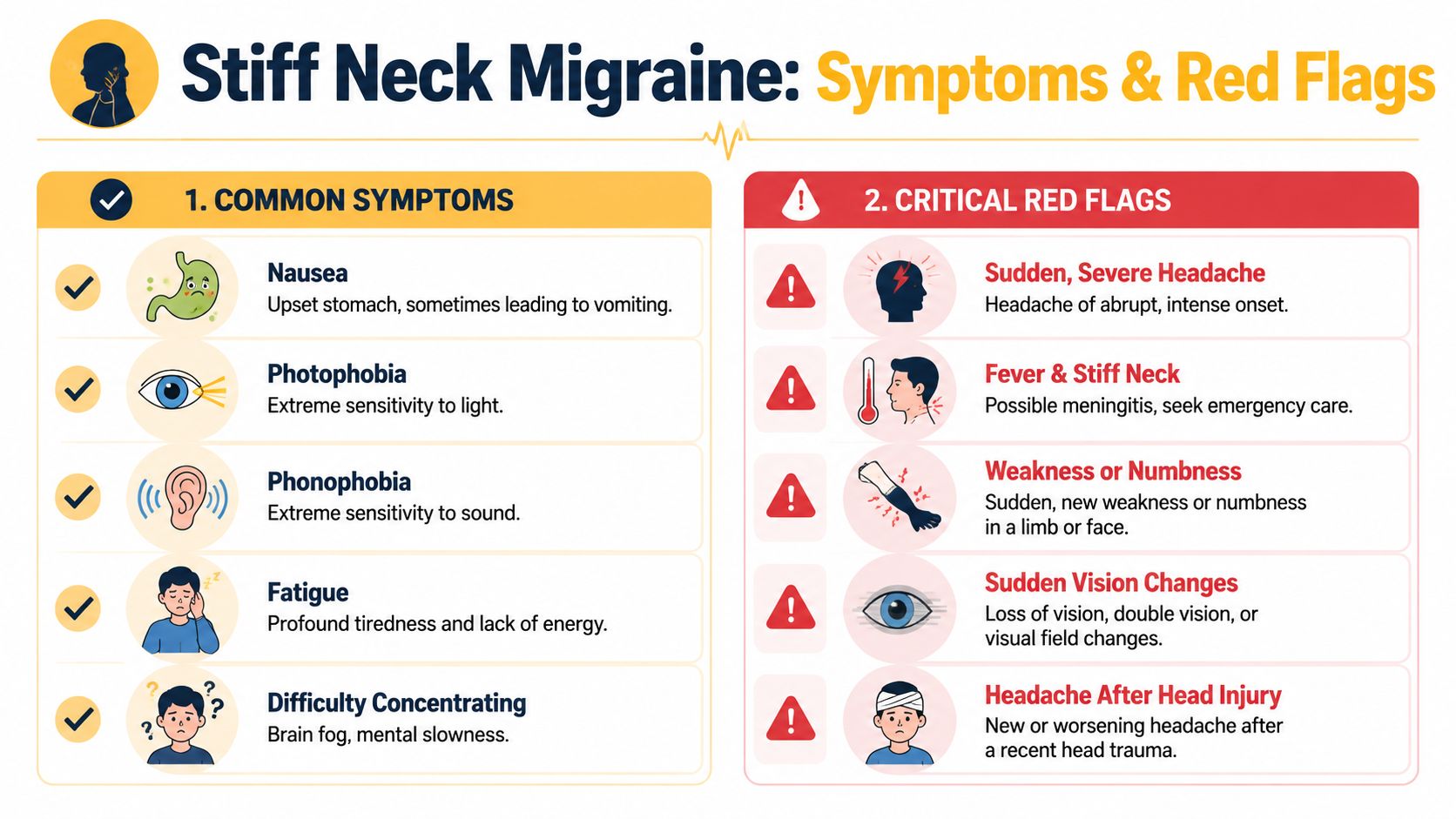
When neck stiffness is part of migraine, it often shows up with a cluster of other symptoms rather than by itself.
- Nausea or stomach upset: Your neck hurts, but your gut also feels unsettled.
- Photophobia: Light feels abrasive or painful.
- Phonophobia: Sound seems too loud or sharp.
- Fatigue and brain fog: Thinking, reading, or working can suddenly feel much harder.
- Aura for some people: Aura can include visual or sensory symptoms before or during the attack.
If those symptoms tend to come as a package, that supports the idea that your neck pain may be part of migraine rather than a stand-alone neck problem.
Signs that need urgent medical care
Some combinations should never be waved away as “probably migraine.” Seek immediate medical care for:
- Sudden severe headache: A very abrupt, explosive headache is an emergency.
- Headache with fever and stiff neck: This needs urgent evaluation.
- New neurological changes: Weakness, numbness, confusion, trouble speaking, or sudden major vision changes require emergency care.
- Headache after head injury: New or worsening headache after trauma should be checked right away.
If you have a headache with fever and a truly rigid neck, or a sudden severe headache unlike your usual attacks, seek emergency care immediately.
Another red flag is a major change in your normal migraine pattern. If your usual attacks don't behave this way and now something is dramatically different, don't assume it's the same condition.
Finding Immediate Relief During an Attack
When your neck is tight and a migraine is already unfolding, simple comfort measures are often the most realistic place to start.

What you can try right now
A few low-effort options may help reduce the neck component of an attack:
- Cold or heat: Some people prefer a cold pack on the head and gentle warmth on the neck. Others prefer just one. Use what feels soothing, not what sounds ideal on paper.
- A dark, quiet room: If your neck pain is part of migraine, lowering light and sound can reduce the overall sensory load.
- Gentle position changes: Support your neck with a pillow or rolled towel and avoid awkward angles.
- Very gentle movement: Slow chin tucks or tiny range-of-motion movements may help if they feel relieving. Stop if movement clearly worsens the pain.
- Reduce input: Put the phone down, dim the room, and simplify decisions. Migraine brains usually do better with less stimulation.
Sometimes seeing movement helps more than reading about it. This gentle video may be useful if motion feels tolerable for you:
When over the counter options fit in
Some people use over-the-counter pain relievers such as acetaminophen or NSAIDs as part of their migraine plan. Follow package directions and talk with a healthcare provider if you're using them often, if you have other medical conditions, or if you're unsure whether they fit safely into your care.
This article is for informational purposes and is not medical advice. Consult a healthcare provider for personalized guidance.
If your neck is so stiff that you can't move it normally, or if the pain is paired with fever, neurological changes, or head injury, skip home care and get urgent medical help.
Long-Term Strategies for Prevention and Management
A stiff neck migraine isn't just an annoying side note. It's a pattern worth paying attention to, especially because a 2022 systematic review and meta-analysis found neck pain in 77.0% of people with migraine and 87.0% of people with chronic migraine in clinic-based studies, as reported in the PubMed summary of the review. When neck symptoms show up often, they can become part of prevention planning.
If the pattern looks mostly migraine driven
If your neck stiffness behaves like part of the attack, the long game usually centers on migraine management.
That may include talking with a clinician about preventive treatment if attacks are frequent, disabling, or escalating. It may also include refining your early-response plan so you act when your neck starts warning you, rather than waiting for full head pain.
A steady routine can help support that plan:
- Consistent sleep: Irregular sleep can destabilize migraine patterns for some people.
- Stress regulation: Not because stress “causes” all migraine, but because it can make an already sensitive system more reactive.
- Workspace setup: Screen height, chair support, and breaks won't cure migraine, but they may reduce extra neck strain layered on top of it.
If the neck itself seems to be part of the problem
When symptoms look more mechanical, a neck-focused approach may matter more. A physical therapist can assess posture, range of motion, muscular support, and movement habits. The goal isn't to blame posture for migraine. It's to reduce an added source of irritation if one is present.
For some people, the best plan is combined care. Migraine treatment addresses the neurological attack pattern, while physical therapy addresses stiffness, guarding, or cervical dysfunction that may be worsening the experience.
Keep two questions in play: “How do I reduce migraine frequency?” and “How do I make my neck less vulnerable between attacks?”
That combination is often more useful than arguing about whether the pain is “really” migraine or “really” neck. Your body doesn't care about perfect categories. It cares about what lowers the burden.
How Tracking Triggers Can Reveal Your Patterns
The most helpful clue is often repetition. If neck stiffness shows up before your attacks, only after poor sleep, or mainly on days with certain environmental triggers, tracking can turn that vague impression into something you can use.
A good log doesn't need to be complicated. Write down when the neck stiffness started, whether head pain followed, what other symptoms appeared, what the day looked like, and what seemed to help. Over time, that can reveal whether your “stiff neck migraine” is usually prodrome, part of the peak attack, or more likely to point toward a separate neck issue.
If you want a digital option, Relief's migraine tracking app can help you log symptoms, triggers, and timing in one place so you and your clinician can look for patterns more clearly.
If you want one place to track neck stiffness, migraine symptoms, and possible triggers over time, Relief is a practical tool to help you spot patterns earlier.


