
Hemiplegic migraine is a very rare type of migraine with aura that causes temporary weakness on one side of the body, and it affects about 0.01% of the general population, or around 1 in 10,000 people. It can feel a lot like a stroke, which is why it's so frightening, but it's a distinct migraine condition that needs careful medical evaluation.
If you're reading this because a migraine attack left your arm heavy, your face numb, or your speech tangled, your fear makes sense. Symptoms like that can be alarming even if you've lived with migraine for years. The hard part is that migraine is not “just a headache,” and hemiplegic migraine is one of the clearest examples of that.
This article is for informational purposes and is not medical advice. Consult a healthcare provider for personalized guidance.
Table of Contents
- That Frightening Moment Your Migraine Felt Like a Stroke
- Why the weakness happens
- How it differs from other migraine with aura
That Frightening Moment Your Migraine Felt Like a Stroke
You are going about your day and the first warning feels familiar. Light starts to shimmer. A sentence slips away mid-thought. Then your hand will not grip properly, your cheek feels strange, or one leg turns heavy. For many people, that is the moment fear takes over, because these symptoms can overlap with stroke warning signs.
That fear makes sense.
Hemiplegic migraine can produce temporary one-sided weakness along with other aura symptoms such as numbness, tingling, visual changes, or trouble speaking. The symptom pattern can look dramatic from the outside and feel even more alarming from the inside. A person may feel as if the brain is sending a weak or scrambled signal to one side of the body, like a phone call breaking up at the worst possible time.
The word hemiplegic often causes extra alarm because it refers to weakness or paralysis affecting one side. In real life, people describe it in plain, unsettling terms. “My arm felt disconnected.” “My face was not moving right.” “I knew what I wanted to say, but the words came out wrong.” Even when the symptoms later fade, the experience can be frightening during the attack.
One detail matters right away. A hemiplegic migraine usually unfolds over a timeline, with aura symptoms building and shifting before, during, and after the headache phase. A stroke can also cause weakness or speech trouble, but it needs urgent medical assessment because fast treatment matters. If these symptoms are new, sudden, severe, or different from your usual pattern, treat the situation as an emergency.
Practical rule: If weakness, trouble speaking, facial drooping, or other new neurological symptoms appear, get emergency care right away until a clinician rules out stroke or another urgent cause.
It also helps to separate migraine from headache. Head pain is only one part of migraine. Migraine is a neurological disorder that can affect vision, sensation, speech, movement, balance, and thinking. In hemiplegic migraine, the nervous system symptoms often take center stage, which is why this type deserves careful attention and a clear plan for what to do when symptoms begin.
The Core Definition of Hemiplegic Migraine
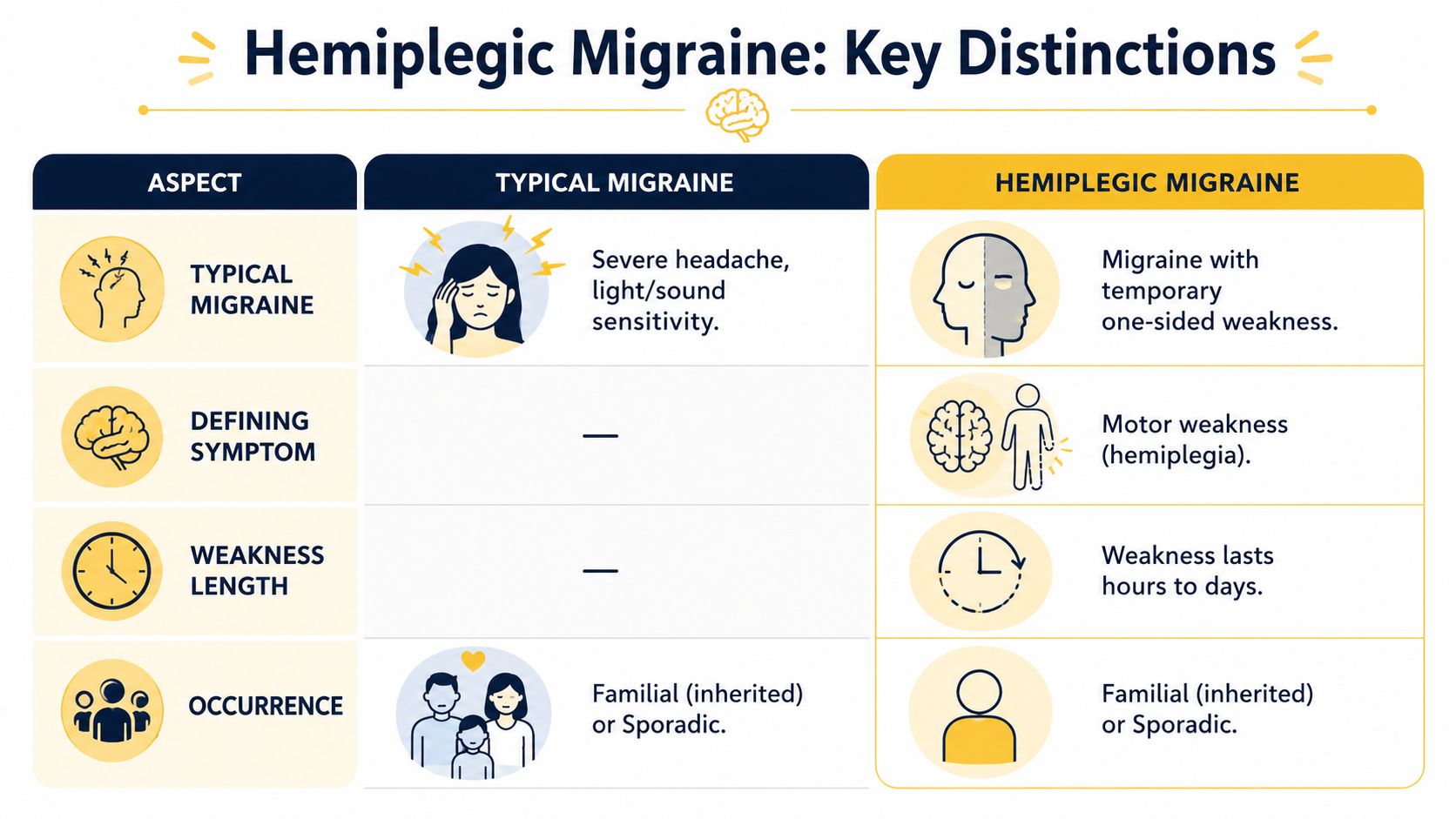
A clear answer to “what is a hemiplegic migraine” starts with one key idea. It's not a regular migraine that happens to feel intense. It's a specific migraine subtype in which the aura includes motor weakness.
Aura means temporary neurological symptoms that often happen before the head pain phase, though timing can vary. In many people, aura involves visual changes such as flashing lights or blind spots. In hemiplegic migraine, aura can also involve speech changes, numbness, tingling, and weakness affecting one side of the body.
Why the weakness happens
A simple way to picture this is to think of the brain as an electrical city. During aura, some of the brain's signaling becomes disrupted for a while. In hemiplegic migraine, that disruption seems to affect areas involved in movement, so the “message” from brain to body doesn't travel normally for a period of time.
That doesn't mean your muscles are damaged. It means the control system is temporarily not sending clean signals. This is one reason the symptom can look dramatic while still being reversible.
Some people get weakness in the arm and face. Others feel it in the leg, hand, or an entire side. The symptom is often paired with sensory changes, like pins and needles or numbness, and with speech or language trouble.
| Feature | Typical migraine | Hemiplegic migraine |
|---|---|---|
| Aura may happen | Sometimes | Yes, by definition |
| Motor weakness | Not a defining feature | Defining feature |
| Stroke-like symptoms | Less common | More likely to be confused with stroke |
| Main concern | Symptom control | Symptom control plus urgent evaluation when needed |
How it differs from other migraine with aura
A lot of readers get stuck here. They already know migraine with aura can cause strange neurological symptoms, so they wonder what makes this subtype different.
The answer is straightforward:
- Typical migraine with aura may involve visual, sensory, or speech symptoms.
- Hemiplegic migraine includes those kinds of aura symptoms, but also motor weakness.
- That weakness is the defining feature that sets it apart.
Hemiplegic migraine sits at the intersection of migraine and neurology in a way that can be deeply unsettling. The symptom is real, the fear is real, and both deserve careful attention.
Not every attack looks identical. Some people have strong headache pain. Some have less head pain than expected. The feature doctors focus on is the reversible one-sided weakness occurring as part of a migraine aura pattern.
Familial vs Sporadic Types
Hemiplegic migraine comes in two main forms: familial hemiplegic migraine and sporadic hemiplegic migraine. The difference is about family history, not about whether your symptoms are “more real” or “more serious.”
According to an epidemiology review in the Journal of Neurology, Neurosurgery & Psychiatry, hemiplegic migraine has an estimated prevalence of 0.01%, or about 1 in 10,000 people, and familial hemiplegic migraine and sporadic hemiplegic migraine each account for roughly half of cases. The same review notes that onset most often occurs between 12 and 17 years, and women are affected more often than men, with reported female-to-male ratios from 2.5:1 to 4.3:1, as described in this JNNP review on hemiplegic migraine.
What familial means
Familial hemiplegic migraine, often shortened to FHM, means the condition runs in a family. If close relatives have had similar attacks diagnosed as hemiplegic migraine, doctors may classify it this way.
That family history matters because it can help explain why the attacks happen and guide discussions about genetics. If you've ever heard stories like “my parent used to lose speech during migraines” or “my sibling had migraine attacks with one-sided weakness,” mention that during a medical visit.
What sporadic means
Sporadic hemiplegic migraine, or SHM, describes the same kind of migraine attack pattern in someone without a known family history of the condition.
That can be confusing because people often assume “sporadic” means mild, random, or uncommon attacks. It doesn't. It only means there isn't a known family pattern.
A simple comparison helps:
- Familial hemiplegic migraine means similar diagnosed attacks are present in relatives.
- Sporadic hemiplegic migraine means the person has the condition without that known family pattern.
- Symptoms can look very similar in both types.
If your clinician asks detailed questions about parents, siblings, grandparents, or children, that isn't small talk. It's part of sorting out which category may fit best.
The Symptom Timeline of an Attack
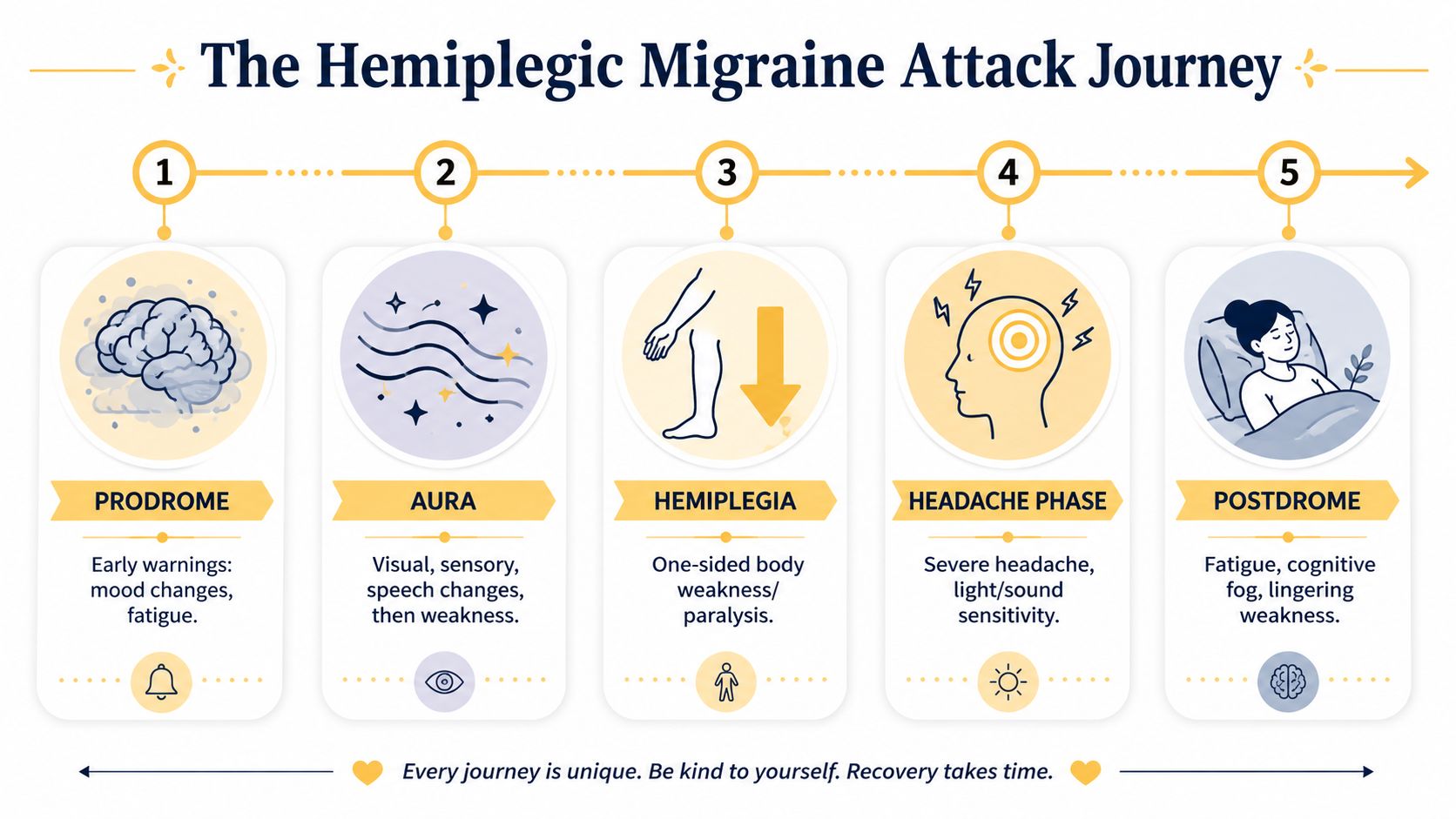
One of the hardest parts of hemiplegic migraine is how the attack can unfold like a moving wave instead of one single moment. A person may feel normal, then slightly off, then notice visual or speech changes, then develop weakness that can look frighteningly similar to a stroke. Seeing the sequence clearly helps many people describe what happened without getting lost in the fear of the worst symptom.
Before the weakness starts
For some people, the first signs show up hours before the main attack. This early phase is called the prodrome. You might feel unusually tired, irritable, thirsty, foggy, or unlike yourself. If you want a clearer explanation of that early warning stage, read this guide to what prodrome means in migraine.
Next comes the aura. In hemiplegic migraine, aura can include visual changes, tingling, numbness, trouble finding words, or trouble understanding language. These symptoms often spread step by step rather than appearing all at once. That gradual progression matters because it is part of what makes the attack pattern different from many other neurological emergencies, even though it can still feel just as alarming.
When the motor symptoms appear
This is often the most unsettling part of the timeline. Weakness can affect the face, arm, and leg on one side of the body. Some people describe it as heaviness. Others say the limb feels disconnected, clumsy, or slow to respond, like the signal from brain to muscle is being delayed.
Motor weakness in hemiplegic migraine usually develops during the aura phase and may build over minutes instead of striking instantly. It often improves within days, but in some attacks it can last longer. The timing varies from person to person, which is one reason detailed symptom tracking can help your clinician.
Common descriptions include:
- Arm weakness that makes gripping, lifting, or typing difficult
- Facial involvement with drooping, numbness, or slurred speech
- Leg weakness that makes standing or walking feel unsteady
- Language symptoms such as word-finding trouble or confused speech
A simple visual rule can help here. Migraine aura often spreads like a dimmer switch turning up in stages. Stroke symptoms are often described as more sudden, like a light going out. That comparison can help you understand the pattern, but it is not a way to diagnose yourself at home.
New weakness, facial droop, or speech trouble needs urgent medical attention, even if you have had migraine before.
The headache and the recovery phase
The headache may start during the aura or after it. Pain is often throbbing and may come with nausea, vomiting, light sensitivity, or sound sensitivity. In some hemiplegic migraine attacks, the neurological symptoms are more dramatic than the headache itself, which can confuse people who expect migraine to be mainly about pain.
After the main symptoms ease, many people enter the postdrome. This phase works like the brain's recovery period after a system overload. You may feel wiped out, mentally slowed, emotionally flat, or unusually sensitive to activity. Some people also notice lingering shakiness or a sense that their body is still catching up, even after the obvious weakness has improved.
A clear attack map looks like this:
- Prodrome with subtle warning signs
- Aura with visual, sensory, or speech symptoms
- One-sided motor weakness during the aura
- Headache, which may overlap with the aura or follow it
- Postdrome with fatigue, brain fog, and gradual recovery
If you ever need to explain an attack, focus on the order of events. What came first, what spread next, how long the weakness lasted, and what recovery felt like are often the details that make the pattern easier for a clinician to recognize.
How Doctors Diagnose Hemiplegic Migraine
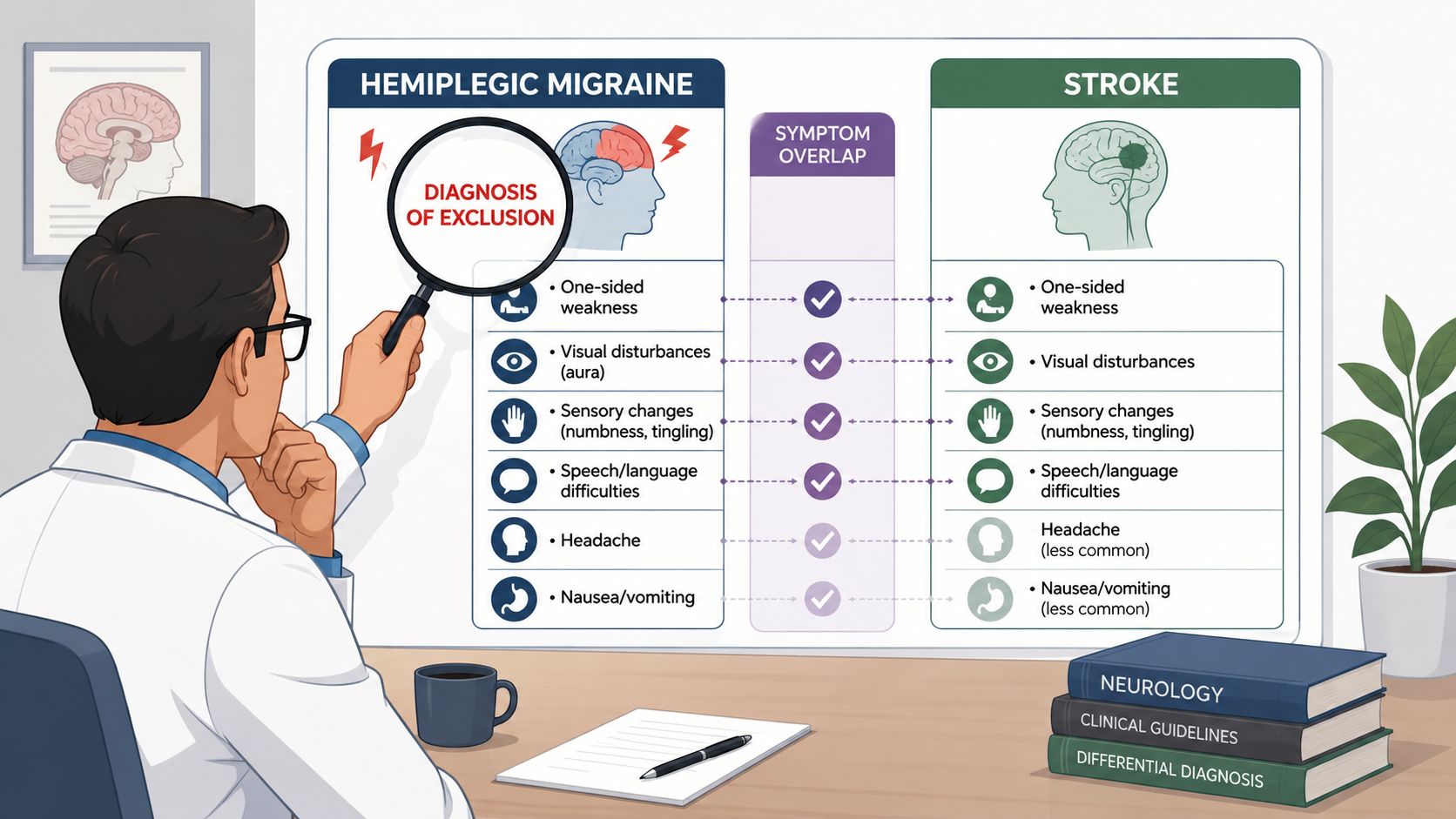
Doctors don't diagnose hemiplegic migraine by glancing at a symptom list and moving on. They take it seriously because the symptoms can overlap with conditions that need urgent treatment.
Why stroke has to be ruled out first
A severe hemiplegic migraine can mimic stroke. That's one reason diagnosis matters so much. Clinical references also note that rare complications have been reported, including seizures, coma, permanent deficits, or cerebral infarction, which raises the stakes for getting the diagnosis right.
Seek immediate medical care if you have any of these red flags:
- Sudden severe headache unlike your usual attacks
- Headache with fever or stiff neck
- New neurological changes, including weakness, confusion, facial droop, or trouble speaking
- Headache after a head injury
This is not a situation for self-diagnosis.
What the evaluation usually includes
A clinician will usually start with a detailed history. They'll ask what happened first, how fast symptoms developed, whether the weakness moved from one area to another, and whether you have a personal or family history of migraine.
They'll also do a neurological exam and often order testing to rule out other causes. Depending on the situation, that may include brain imaging such as a CT scan or MRI, along with other tests based on your symptoms and risk factors.
A diagnosis often depends on the full picture, including:
| What doctors look at | Why it matters |
|---|---|
| Symptom sequence | Helps distinguish migraine patterns from other neurological events |
| Family history | Helps identify familial forms |
| Neurological exam | Checks strength, speech, sensation, reflexes, and coordination |
| Imaging or other tests | Helps rule out stroke, TIA, seizure, or other causes |
The safest mindset is simple: treat first-time or unusual one-sided weakness as urgent, even if you also have a migraine history.
Common triggers to track
Triggers aren't universal, and no list fits everyone. Still, people often notice patterns. Commonly discussed examples include stress, sleep disruption, routine changes, illness, and in some cases minor head trauma.
Instead of guessing, keep notes on:
- Timing of symptoms and how they unfolded
- Sleep the night before
- Stress level and major schedule shifts
- Meals, hydration, and caffeine changes
- Recent illness or injury
- Medication taken and what happened next
That record won't diagnose you, but it can help your doctor spot patterns faster.
Acute and Preventive Treatment Options
Treatment for hemiplegic migraine usually has two goals. One is helping you through an attack that's happening now. The other is reducing how often attacks happen and how disruptive they become over time.
This article is for informational purposes and is not medical advice. Consult a healthcare provider for personalized guidance.
Acute treatment during an attack
Acute treatment means the plan used during an active attack. For some people, that includes resting in a dark, quiet room and using clinician-approved medicines aimed at pain, nausea, or other symptoms.
Because hemiplegic migraine is unusual and can look like stroke, treatment decisions should be individualized. Some migraine medicines that are commonly used in other forms of migraine have historically been approached cautiously in hemiplegic migraine, so it's important to discuss your specific plan with a neurologist or headache specialist.
If you're exploring one category sometimes discussed in prevention planning, ReliefMigraine has a plain-language overview of calcium channel blockers and migraines.
Preventive treatment between attacks
Preventive treatment is about lowering the chance of future attacks or making them less severe. A clinician may consider preventive options if your attacks are frequent, prolonged, disabling, or hard to distinguish from other emergencies.
Broad categories that may come up in treatment discussions include:
- Preventive prescription options used regularly to reduce attack frequency
- Therapies borrowed from broader migraine care when appropriate for your case
- Specialist follow-up to adjust the plan as your pattern changes
The key is not finding a “best” medication online. It's building a safe plan with someone who understands both migraine and neurological red flags.
Lifestyle support still matters
Medication is only one piece. Everyday habits still influence how manageable migraine feels.
Try focusing on a few basics:
- Consistent sleep because irregular sleep can make attacks harder to predict
- Steady meals and hydration so your nervous system isn't dealing with extra stress
- Reduced sensory overload during vulnerable periods
- A written emergency plan so you know when to rest and when to seek urgent care
Some people also benefit from preparing a short one-page summary for urgent care or emergency visits. Include your diagnosis if you have one, your usual symptom pattern, medicines you use, allergies, and your neurologist's contact information.
Living with Hemiplegic Migraine and Tracking Your Data
Living with hemiplegic migraine often means balancing caution with routine. You don't want to dismiss serious symptoms, but you also don't want every attack to feel like total chaos.
One of the most useful things you can do is keep a detailed record after each episode. That gives you something concrete when your memory is blurry and helps your clinician compare attacks over time.
What to log after each attack
A good migraine log should capture more than pain level. Try tracking:
- First symptom and what time it started
- Aura details such as visual changes, numbness, tingling, or speech issues
- Weakness pattern including which side of the body was affected
- How long symptoms lasted
- Possible triggers like stress, poor sleep, illness, or routine shifts
- What you took or did and whether it helped
If you want a simple starting point, use this migraine log template.
A short walkthrough can also help if you prefer to see how digital tracking works in practice.
Over time, patterns become easier to spot. That can make specialist visits more productive and help you feel less blindsided by what your nervous system is doing.
Relief can help you track symptoms, aura patterns, possible triggers, and recovery details in one place, so you have a clearer record to review with your clinician and a better sense of what your own migraine pattern looks like.


