
Clinical effectiveness is whether a treatment reliably improves real outcomes for real patients in everyday care, including you. In migraine care, that may mean being pain-free two hours after treatment, staying free from pain without rescue medication, or reducing monthly migraine days over time.
You may be reading this while deciding whether a new treatment will help before an important work deadline, or while wondering why a therapy that looked promising in a study hasn't felt as useful in your own life. That uncertainty is understandable. Migraine isn't just head pain, and your experience may include aura, nausea, photophobia, meaning sensitivity to light, phonophobia, meaning sensitivity to sound, disrupted sleep, fatigue, or difficulty functioning.
Clinical effectiveness asks the practical question: Will this work for me, in my real life, this month? This article explains how that question differs from efficacy, which migraine outcomes researchers measure, why patient-reported experience matters, and how careful tracking can give you clearer information to discuss with a healthcare provider.
This article is for informational purposes and is not medical advice. Consult a healthcare provider for personalized guidance.
Table of Contents
What Clinical Effectiveness Really Means
Clinical effectiveness means using the best available evidence, clinical experience, and patient preferences to achieve the best possible outcomes in actual care. The National Institute for Health and Care Excellence explanation of clinical effectiveness describes the main clinical benefits and harms of a technology, while WHO-aligned guidance frames effective healthcare around improved health outcomes for individuals and communities.
For migraine, effectiveness isn't a property of a treatment in isolation. It depends on who uses it, how they use it, what else affects their health, and whether the benefit lasts long enough to matter. A preventive may look useful if it reduces migraine days in a study, but your decision also depends on whether it fits your routine, whether side effects interfere with work or sleep, and whether you can continue using it as directed.
The treatment in real life
Suppose you're considering a preventive because migraine attacks are interfering with an upcoming deadline. You might reasonably want to know whether it could reduce your monthly migraine days, make attacks less severe, or help you return to normal activity. A laboratory result or controlled trial can't answer every part of that personal question.
Real-world effectiveness research follows typical patients in ordinary settings and may reveal differences in adherence, coexisting conditions, treatment timing, toxicity, quality of life, and longer-term outcomes. It also recognizes that a treatment can work for some people and provide little benefit for others without either experience being invalid.
Practical rule: Judge a treatment by patient-relevant outcomes, not by a promising mechanism or a favorable score alone.
The rest of the evidence picture becomes clearer when you separate efficacy, what an intervention can do under controlled conditions, from effectiveness, what it achieves in routine care. For migraine, that means looking at pain freedom, symptom relief, monthly migraine days, function, and quality of life rather than asking only whether a therapy “works.”
Efficacy vs Effectiveness in Migraine
Consider an acute migraine treatment tested in a tightly controlled randomized trial. Participants may meet narrow eligibility criteria, use the treatment at a specified point in the attack, and record outcomes at fixed times. The trial might report a 70 percent pain-free response at two hours, but that example is hypothetical and isn't a claim about a specific medicine or study.
That result answers an important question: Can the treatment work under the conditions tested? The FDA distinguishes efficacy, established through an adequate and well-controlled clinical trial, from effectiveness, which is a regulatory determination based on clinical efficacy plus other data, as described in its guidance on clinical evidence.
Now place the same treatment in ordinary life. You may have ten headache days in a month, attacks linked to menstrual changes, disrupted sleep, another health condition, or difficulty taking treatment before pain escalates. You may also experience nausea or fatigue that makes it hard to follow a study protocol. Effectiveness asks what happens in that less predictable setting.
| Dimension | Efficacy | Effectiveness |
|---|---|---|
| Main question | Can the treatment work under controlled conditions? | Does it reliably improve outcomes in everyday care? |
| Participants | Often selected to meet study criteria | More representative of routine patients |
| Treatment use | Carefully timed and monitored | Affected by timing, adherence, access, and daily life |
| Outcomes | Fixed trial endpoints | Patient outcomes, function, safety, persistence, and quality of life |
| Interpretation | Shows potential benefit | Shows practical value for the intended care pathway |
A gap between efficacy and effectiveness doesn't automatically mean a treatment has failed. It may show that timing, adherence, side effects, comorbidities, or patient selection changed the result. Research on the efficacy-effectiveness gap also emphasizes that the difference can involve quality of life, toxicity, cost-effectiveness, and patient time, not only survival or symptom scores.
Both forms of evidence matter. Efficacy helps establish whether an intervention has a genuine effect under controlled conditions. Effectiveness helps you and your clinician decide whether that effect is likely to remain useful in your particular care pathway.
How Researchers Measure Clinical Effectiveness
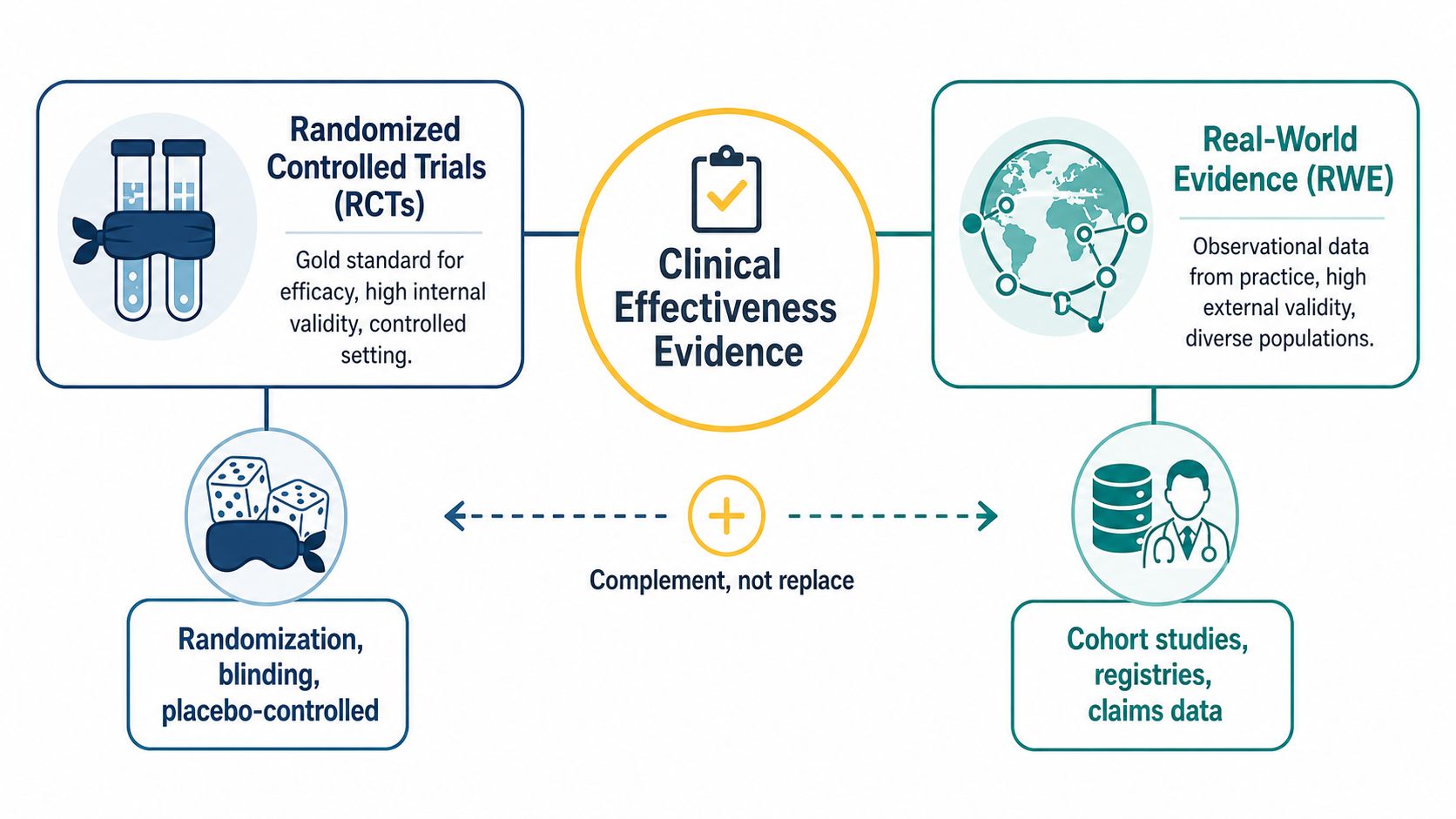
Researchers use several study designs because no single design answers every question. Randomized controlled trials help isolate an intervention's effect by assigning treatments under structured conditions. Real-world evidence adds information about diverse patients, longer use, adherence, safety, and what happens outside the trial environment.
A pragmatic randomized controlled trial keeps randomization but makes participation and follow-up more similar to routine care. Observational cohort studies follow people who receive treatment in practice, while registries collect structured information over time. Claims-based analyses can examine treatment use and healthcare outcomes across large healthcare records, although they may not capture every symptom or patient experience.
Meta-analyses combine results from multiple studies. Head-to-head studies compare active treatments directly, which can be more useful for decisions than comparing each therapy with a separate placebo group. Single-arm studies can provide information about treatment use when a comparison group isn't available, but their interpretation requires care because changes may reflect factors other than the treatment.
Why researchers separate treatment effect from uptake
Wald's framework argues that effectiveness should be estimated assuming 100% acceptance and adherence, with separate estimates for uptake and persistence. That distinction prevents researchers from confusing what a treatment can do when used consistently with its total population impact when some people don't start it, stop it, or use it differently. The framework is discussed in work on estimating effectiveness and adherence.
Regulators and health technology assessors therefore value patient-relevant outcomes such as symptom reduction, hospitalization, mortality, or functional improvement. In migraine, the useful endpoints are more specific: monthly migraine days, pain freedom, acute medication use, return to activity, and quality of life. A study that measures only a surrogate marker may not tell you whether you can work, sleep, care for family, or participate in normal activities.
Migraine-Specific Outcomes You Can Track
A difficult attack can make a treatment seem ineffective, while one good day can make it seem better than it is. Consistent records provide a clearer answer to the question that matters: will this work for me, in my real life, this month? Record the same outcomes over time, without turning your life into a research laboratory, so you and your healthcare provider can see a lasting pattern.
For an acute treatment, pain-free at two hours asks whether head pain has stopped at a defined point. The International Headache Society also considers sustained pain freedom, from two to 24 hours, meaning pain does not return and no rescue medication is needed during that period. Relief from the most bothersome associated symptom at two hours matters as well. That symptom might be nausea, photophobia, or phonophobia.
For preventive treatment, researchers often examine change from baseline in monthly migraine days. Studies of chronic migraine may also track moderate or severe monthly headache days, or days when acute migraine medication is needed. These measures connect treatment results with calendar time and daily decisions. A patient-reported outcome is a health-status report that comes directly from the patient, without clinician interpretation.
| Outcome | What It Measures | Everyday Meaning |
|---|---|---|
| Pain freedom at two hours | Whether head pain has stopped at a fixed time | Can you resume activity sooner? |
| Most bothersome symptom freedom | Relief from the symptom troubling you most | Is nausea, light sensitivity, or sound sensitivity easing? |
| Sustained pain freedom | Whether relief continues without recurrence or rescue medication | Does the treatment keep helping after the first improvement? |
| Monthly migraine days | Number of days with migraine during a month | Is migraine taking up less of your calendar? |
| Acute medication-use days | How often you need treatment for attacks | Are you relying on acute treatment less often? |
| Moderate or severe headache days | Burden of more intense headache | Are the disabling days becoming less frequent? |
Researchers may also classify people as responders, using a threshold such as a 50 percent reduction in monthly migraine days. The International Headache Society review of migraine endpoints discusses responder rates, onset of effect, cumulative hours of pain, and symptom duration. These measures describe changes that may affect work, sleep, family plans, and other parts of ordinary life.
A diary or migraine tracking tool from Relief can help you record attack start and end times, symptoms, possible triggers, treatment timing, and whether relief lasted. Bring the pattern, not only the single hardest attack, to your next appointment.
Why Patient-Reported Outcomes Matter
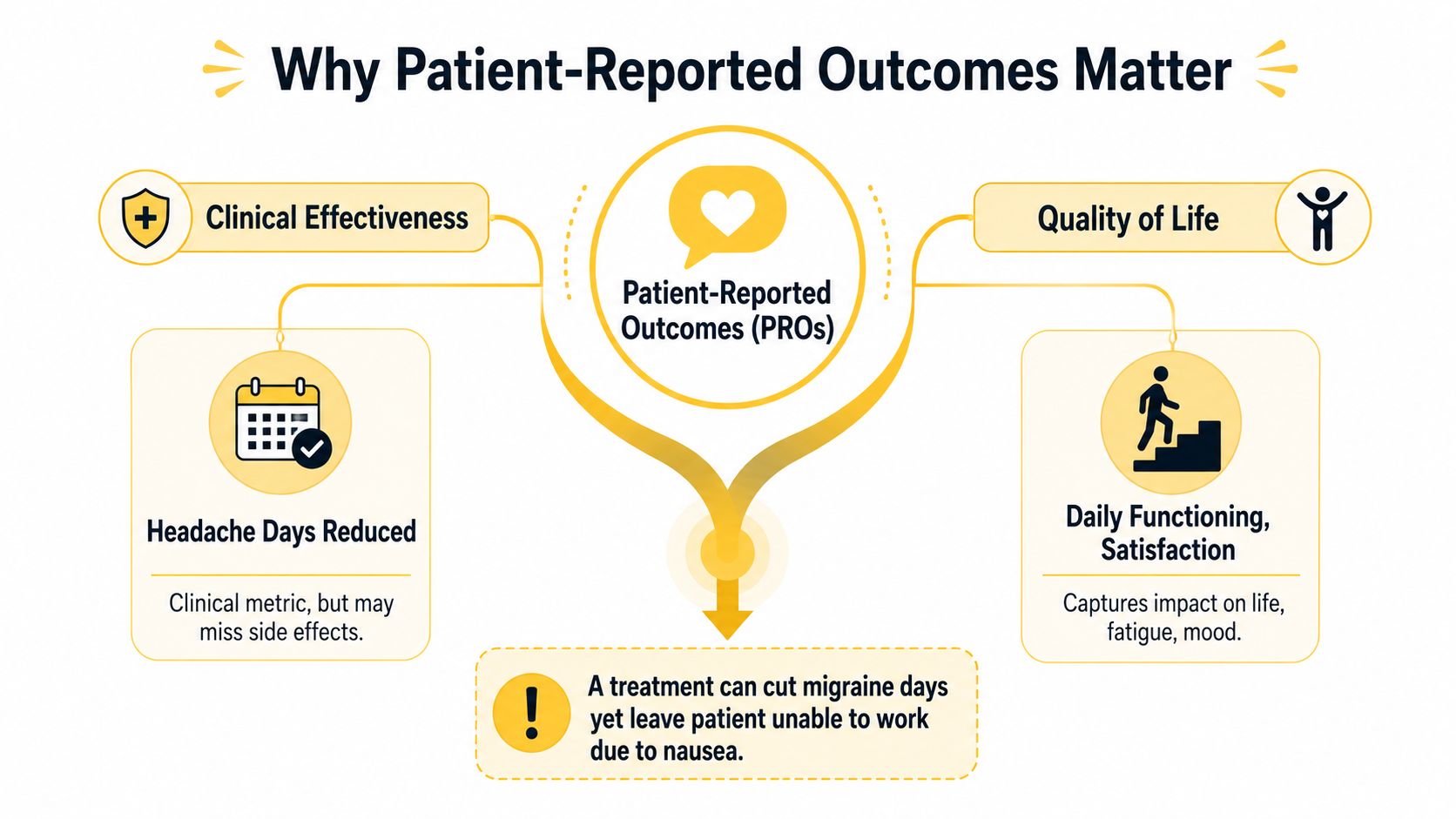
A treatment can reduce headache days while leaving you exhausted, unable to concentrate, anxious about the next attack, or burdened by side effects. That's why clinical effectiveness includes the patient's view of functioning and quality of life, not just a clinician's assessment or a pain score.
Patient-reported outcomes, often called PROs, come directly from the person living with the condition. Migraine research may use tools such as MSQ v2.1, a migraine-specific quality-of-life measure, HIT-6, a measure of headache impact, MIDAS, which assesses disability and lost time, and WPAI, which examines work and activity impairment. These questionnaires translate invisible costs into information that can support a clinical conversation.
Function belongs in the decision
Suppose two preventive options appear similar on a trial's main headache outcome. You might prefer the one that lets you stay alert at work, sleep more normally, or participate in family plans, even if the average pain reduction looks comparable. You might also decide that a smaller reduction with fewer disruptive side effects is more useful than a larger reduction that makes everyday life harder.
That's shared decision-making in practical terms. Your clinician can help weigh benefits, risks, treatment burden, and your preferences instead of treating one number as the entire answer. Research on patient understanding and patient-centered clinical effectiveness notes that there isn't a universal framework for assessing patient understanding, which makes clear communication and personal tracking especially important.
A treatment's success should include what you can do with your life after taking it.
Patient-reported evidence doesn't replace clinical measurement. It completes it. Effectiveness for approval and effectiveness for you overlap when studies measure outcomes that reflect real decisions, real functioning, and the tradeoffs you experience.
For information about how a tracking service handles data, review Relief's privacy information.
A Migraine Treatment Example
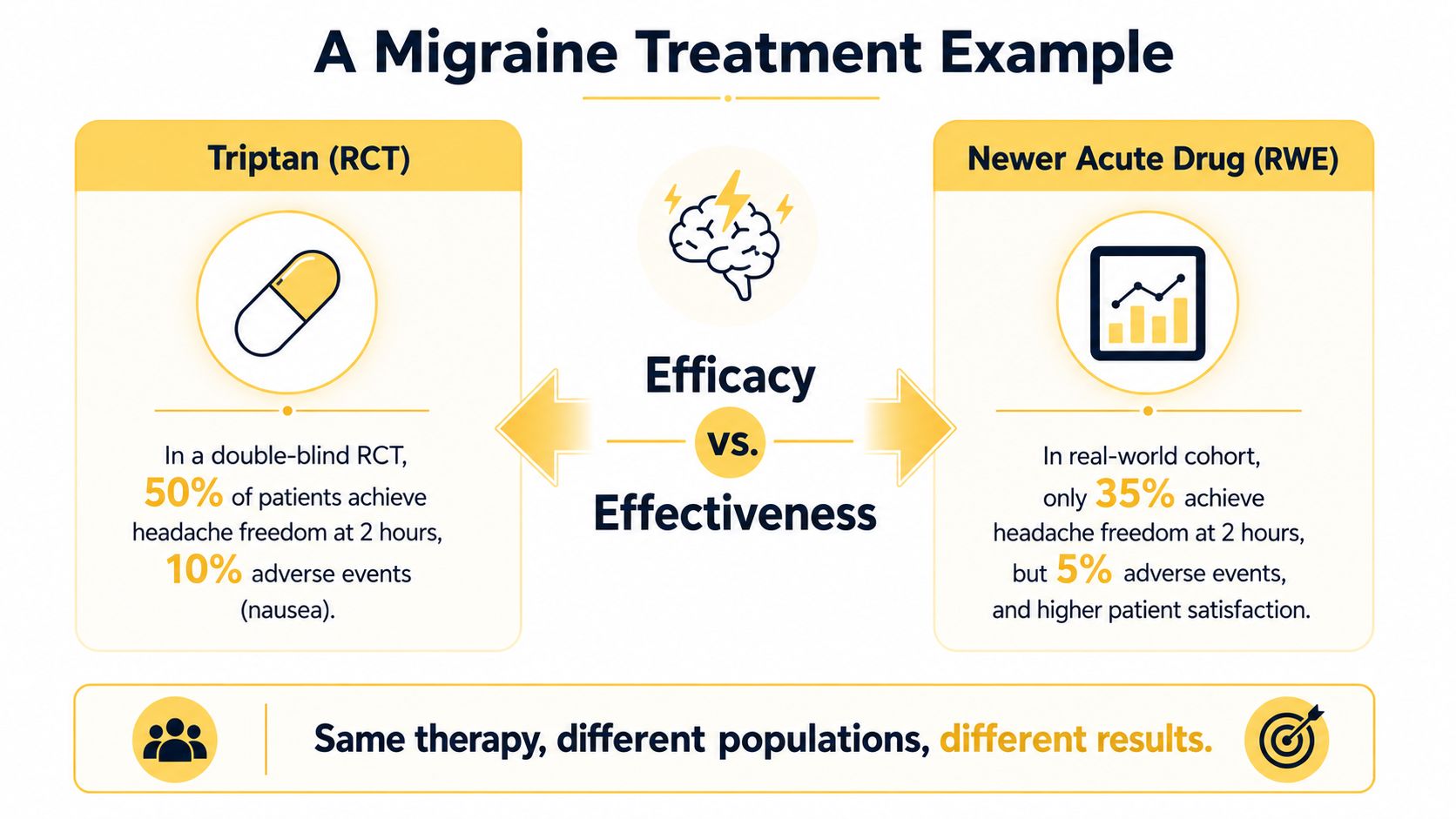
A triptan may look promising on paper, yet the useful question is personal: Will it help me in my real life this month? Before choosing or changing treatment, consider the attacks you experience, the symptoms that interfere most, and what you need to do afterward.
Bring your migraine pattern to the appointment. Note whether attacks begin suddenly or build gradually, whether nausea makes swallowing difficult, and whether sleep disruption, menstruation, aura, or another feature changes your response. Record when you take the medicine, how long relief lasts, whether the most bothersome associated symptom improves, and whether side effects prevent normal activities.
A short record can turn a vague impression into a useful treatment discussion. Ask:
- Timing: When should I take it for the kind of attack I have?
- Success: Should we track pain-free status, symptom relief, sustained relief, or return to work?
- Tolerance: Which side effects should prompt a call or a treatment change?
- Pattern: Does my response vary with aura, hormonal changes, poor sleep, or nausea?
- Plan: What should I do if the first dose does not provide enough relief?
The International Headache Society's acute migraine guidance supports tracking pain freedom and freedom from the most bothersome associated symptom. Those measures give you and your clinician a shared way to judge whether the treatment fits your life, rather than relying on a general impression.
How Digital Tools Are Changing the Evidence
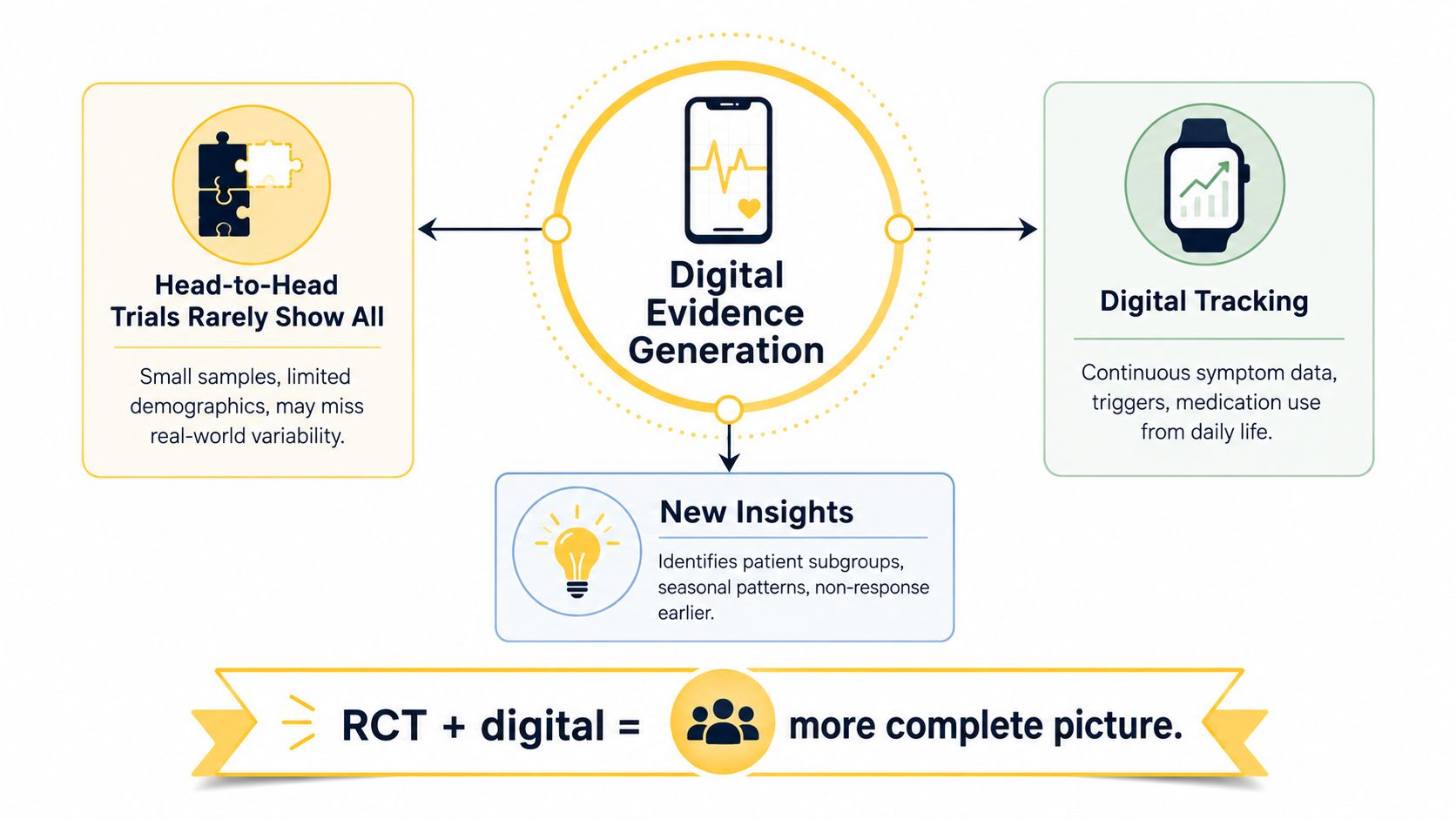
A treatment that helps one person won't necessarily help everyone with migraine. A trial can estimate an average effect, but averages may hide differences linked to migraine subtype, comorbidities, treatment timing, sleep, hormonal patterns, environmental exposure, and adherence.
Digital diaries, wearables, and patient registries add continuous information from ordinary life. People can record attack severity, symptoms, medication use, timing, weather exposure, and functional impact rather than relying on memory during a short appointment. Researchers can then study patterns that smaller, tightly controlled studies may not capture.
Tracking adds context, not certainty
A structured record may help show who responds, who stops responding, or whether improvement appears alongside behavioral changes. It can also reveal that an apparent trigger occurs frequently without reliably preceding an attack, which is different from assuming every exposure causes migraine.
Relief combines symptom logging with local environmental information, including weather, air quality, pollen, and cycle-linked patterns, to provide an informational risk forecast. Its forecast is a probabilistic estimate, not a prediction of fact, and it isn't a clinically validated measure of treatment effectiveness. You can learn more about the product's purpose through information about Relief.
A digital tool doesn't replace randomized trials, diagnosis, or medical care. It can help you collect clearer personal evidence, identify patterns worth discussing, and bring more specific observations to an appointment.
Questions to Ask Your Doctor Next Visit
Take a short list with you so the discussion stays focused on outcomes that matter in your life. You might ask:
- Outcome: What improvement should we look for, such as pain freedom at two hours, fewer monthly migraine days, fewer medication-use days, or better function?
- Evidence: How did this treatment perform in people with a migraine pattern similar to mine?
- Population: Were people with my subtype, aura status, age group, or other health conditions included?
- Real-world use: Is there observational, registry, or pragmatic trial evidence beyond the controlled trial?
- Meaningful change: What level of improvement would make continuing the treatment worthwhile?
- Time frame: How long should we track benefit, side effects, and adherence before reviewing the plan?
- Personal data: Which symptoms, attack features, treatment timing, and daily activities should I record?
Ask how to interpret an outcome that improves in one area but worsens another. Fewer migraine days may matter less if fatigue prevents you from working, while modest pain relief may be valuable if it consistently lets you return to normal activity.
Consistent logging turns a vague impression into information you can revisit with your clinician. It won't prove that a treatment caused every change, but it can make the pattern easier to examine.
Relief helps you log migraine severity, symptoms, triggers, medications, and daily patterns while combining your history with environmental signals such as weather and air quality. Visit Relief to use tracking as a practical record for understanding your own migraine patterns and preparing for better-informed healthcare conversations.


