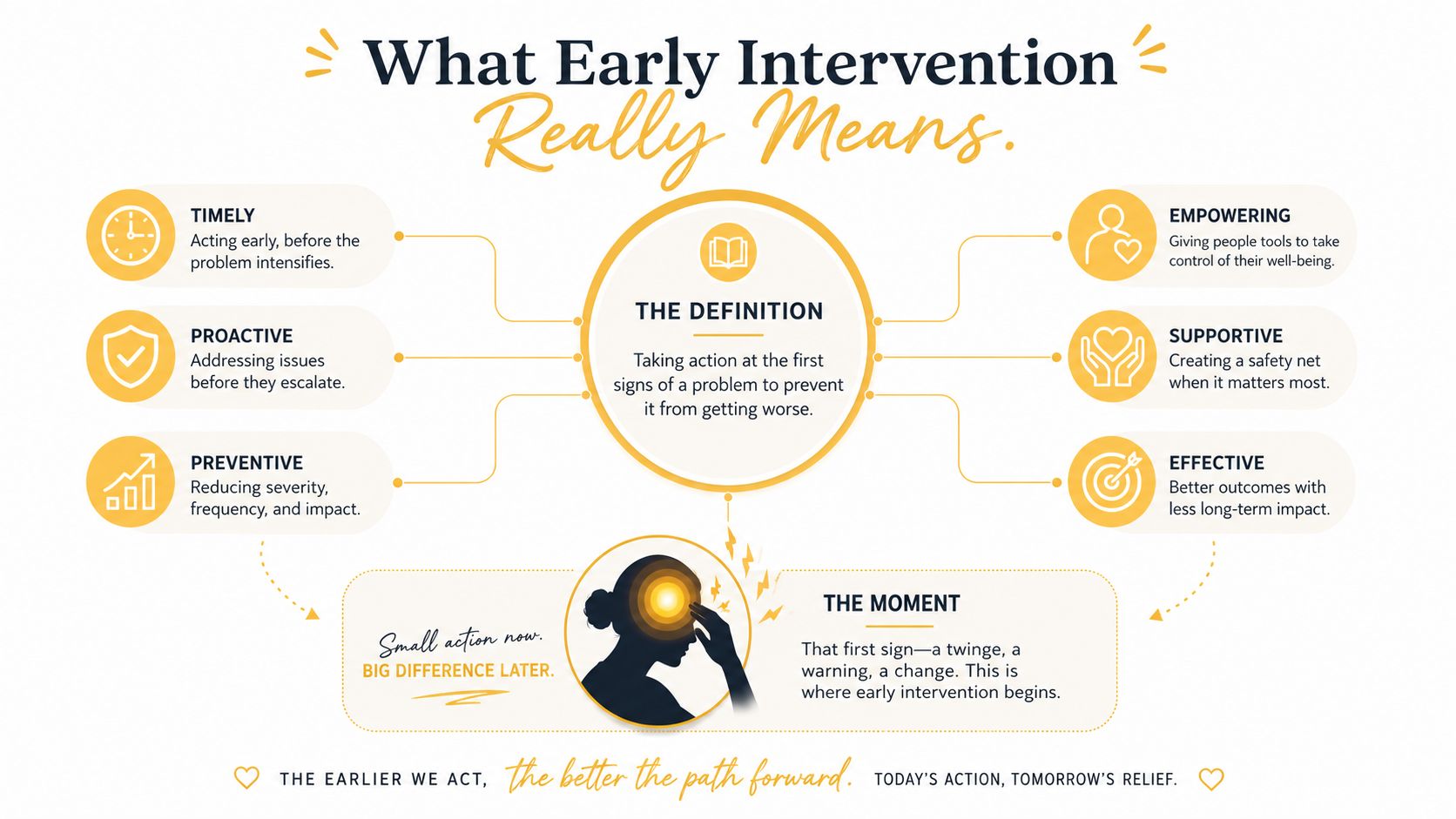
Early intervention is a proactive, time-sensitive approach that identifies and addresses a problem at its earliest signs, before it becomes entrenched or harder to reverse. In migraine care, that can mean recognizing prodrome or treating mild pain early, rather than waiting for a disabling attack.
You may know the moment well. You notice unusual yawning, a tight neck, light sensitivity, or a vague change in mood, then wonder whether it's “really” a migraine and decide to wait. Families face a similar uncertainty when a child's communication or motor development seems different, but no one can yet say exactly why.
The question, what is early intervention, has two useful answers here. In developmental services, it refers to support for eligible infants and toddlers and their families. In migraine care, it means acting during the earliest recognizable phase of an attack or disease pattern. Both rely on the same practical idea: notice carefully, act proportionately, and review what happens next.
This article connects those two settings without treating them as identical. You'll find the policy basics behind IDEA Part C, the evidence for earlier action, warning signs that deserve attention, and steps you can take this week if migraine symptoms are becoming more predictable or disruptive.
Table of Contents
- A Clear Answer to What Early Intervention Really Means
- Where Early Intervention Shows Up in Real Life
- Developmental intervention
- Migraine treatment
A Clear Answer to What Early Intervention Really Means
Early intervention means finding and addressing risk at the first meaningful sign, before a problem becomes more established or causes avoidable downstream effects. It isn't about reacting to every minor symptom with alarm. It's about creating a reasonable response while the situation may still be easier to understand and manage.
For someone with migraine, the first sign might arrive before head pain. Prodrome, the early phase before the headache, can involve changes such as yawning, neck stiffness, food cravings, or mood shifts. You might also experience aura, temporary neurological symptoms such as visual or sensory changes. If pain has already started, early treatment generally means responding while it remains mild instead of waiting until it becomes severe. Guidance on early acute treatment supports this timing approach, particularly when oral treatment may be less effective during nausea or vomiting (major headache treatment guidance).
The same principle appears in developmental care, though the decisions unfold over months rather than hours. A parent may notice limited communication, unusual movement, or a child losing a skill. One sign doesn't establish a diagnosis, but it can justify observation, screening, or a conversation with a qualified provider.
Practical rule: Early action should reduce uncertainty, not create panic. Record what you noticed, when it began, and what changed afterward.
The rest of the process is about follow-through. You might track a recurring migraine signal and discuss treatment timing with a clinician. A family might request developmental screening and learn whether state services apply. In both cases, the goal is a clearer decision, not perfect certainty on the first day.
Where Early Intervention Shows Up in Real Life
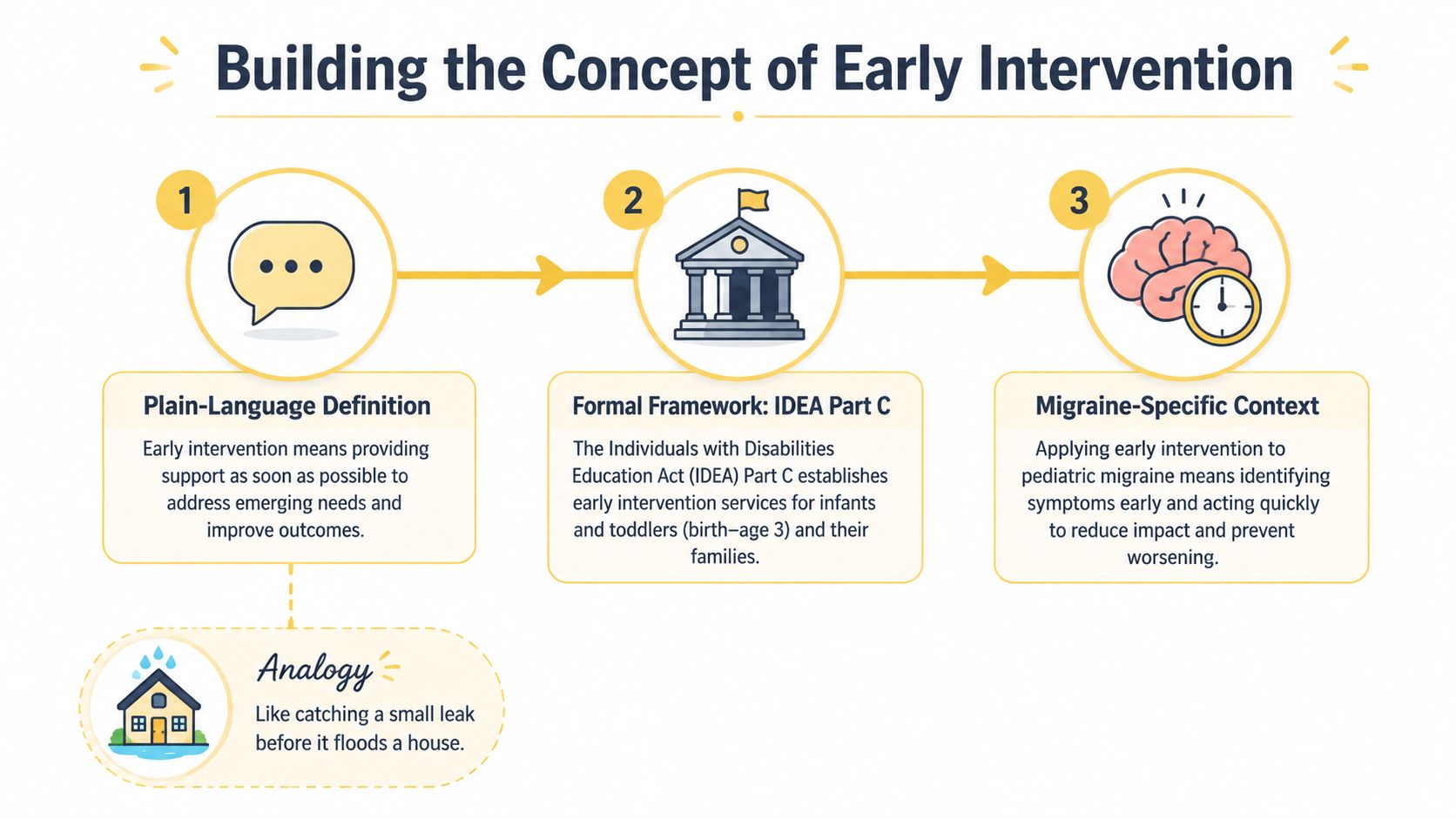
A simple analogy makes the concept easier to remember. If a small leak appears under a sink, you don't wait for the floor to collapse before checking the pipe. You look for the source, limit the damage, and decide whether you need a repair. Early intervention works similarly, but the “leak” may be a change in development or a recognizable migraine warning sign.
In the United States, IDEA Part C made early intervention a formal policy category for infants and toddlers with, or at risk for, developmental delays. Federal guidance describes Part C as serving eligible children from birth through age 2 and their families, while state systems can differ in eligibility rules, procedures, and the length of available support (CDC guidance on Part C early intervention). The framework is therefore both national and local. The federal category gives families a route into services, but the practical experience depends on the state program.
Migraine has a faster timeline. A person may notice a prodrome signal, then aura or mild head pain, followed by a more disabling attack. Each phase offers a different opportunity:
- Before pain: Record reliable prodrome signs and prepare according to your clinician's plan.
- At mild pain: Use the acute treatment strategy prescribed or recommended for you.
- As symptoms escalate: Seek clinical guidance if the pattern is unusual, persistent, or difficult to control.
This timing rule doesn't mean every warning sign predicts a headache. It means your observations can help you recognize patterns and choose a response earlier when a pattern is established. Evidence on treating migraine while pain remains mild supports acting before symptoms become moderate or severe (evidence on early migraine treatment).
The practical bridge between these settings is observation plus access. A parent needs to know whom to contact and what information to bring. A person with migraine needs to know which early symptoms matter and when their treatment plan applies. A tracking tool such as Relief's migraine tracking and forecasting app can help organize symptoms, exposures, and timing, but it doesn't replace medical evaluation.
What the Evidence Says About Acting Early
A family may notice a child struggling with communication, while a person with migraine may recognize a familiar warning pattern before head pain begins. These situations differ, yet both raise the same practical question: what can timely, well-matched support change?
Developmental intervention
A research synthesis describes potential gains in cognitive, language, motor, behavioral, and social-emotional development, particularly when support starts during the first three years of life. It also examines whether early services can reduce later reliance on more intensive special education support (evidence review of early intervention).
A later meta-analysis of parenting interventions delivered across the first three years found a moderate improvement in cognitive development, with a standardized mean difference of 0.32 and a 95% confidence interval from 0.23 to 0.40 (2021 meta-analysis of parenting interventions). The analysis also reported improvements in language, motor, and socioemotional development.
These findings do not predict the response of one particular child, and they do not turn a concern into a diagnosis. They support assessing concerns promptly and matching services to the child and family.
Migraine treatment
For migraine, acting early can mean using an effective acute treatment while headache pain is still mild, according to the person's clinical plan. It can also mean discussing preventive treatment when attacks occur often enough for a clinician to consider prevention appropriate. A recent review describes starting a well-tolerated preventive treatment when monthly migraine days reach about 2 to 4, with goals that include reducing progression, preserving function, and improving longer-term outcomes (migraine prevention review).
The PRODROME trial examined an earlier point in the sequence. It studied adults who could reliably identify prodromal symptoms followed by headache within 1 to 6 hours, then evaluated ubrogepant taken during prodrome. The primary endpoint was the absence of moderate or severe headache within 24 hours after dosing (PRODROME trial report). This evidence applies to a specific, studied pattern. It does not support taking medication without medical guidance.
| Context | Key finding | Direction of benefit |
|---|---|---|
| Developmental early intervention | Reviews report gains across developmental domains, especially with support in the earliest years. | Earlier, appropriate support may improve function and reduce later needs for intensive services. |
| Migraine acute treatment | Treatment during mild pain is more effective than waiting for moderate or severe pain. | Earlier treatment may improve pain control and reduce disability. |
| Migraine prodrome research | A phase 3 trial studied treatment before headache in people with reliable prodrome patterns. | Earlier treatment may prevent or lessen the coming headache for some people. |
Timing improves the chance of responding while the problem remains easier to address. Professional assessment still determines what support or treatment fits.
This article is for informational purposes and is not medical advice. Consult a healthcare provider for personalized guidance.
Signs You Should Act On Sooner Rather Than Later
Early intervention depends on recognizing a pattern without jumping to a conclusion. A symptom is information. It becomes more useful when you note its timing, frequency, intensity, and relationship to what happens afterward.
Migraine signals
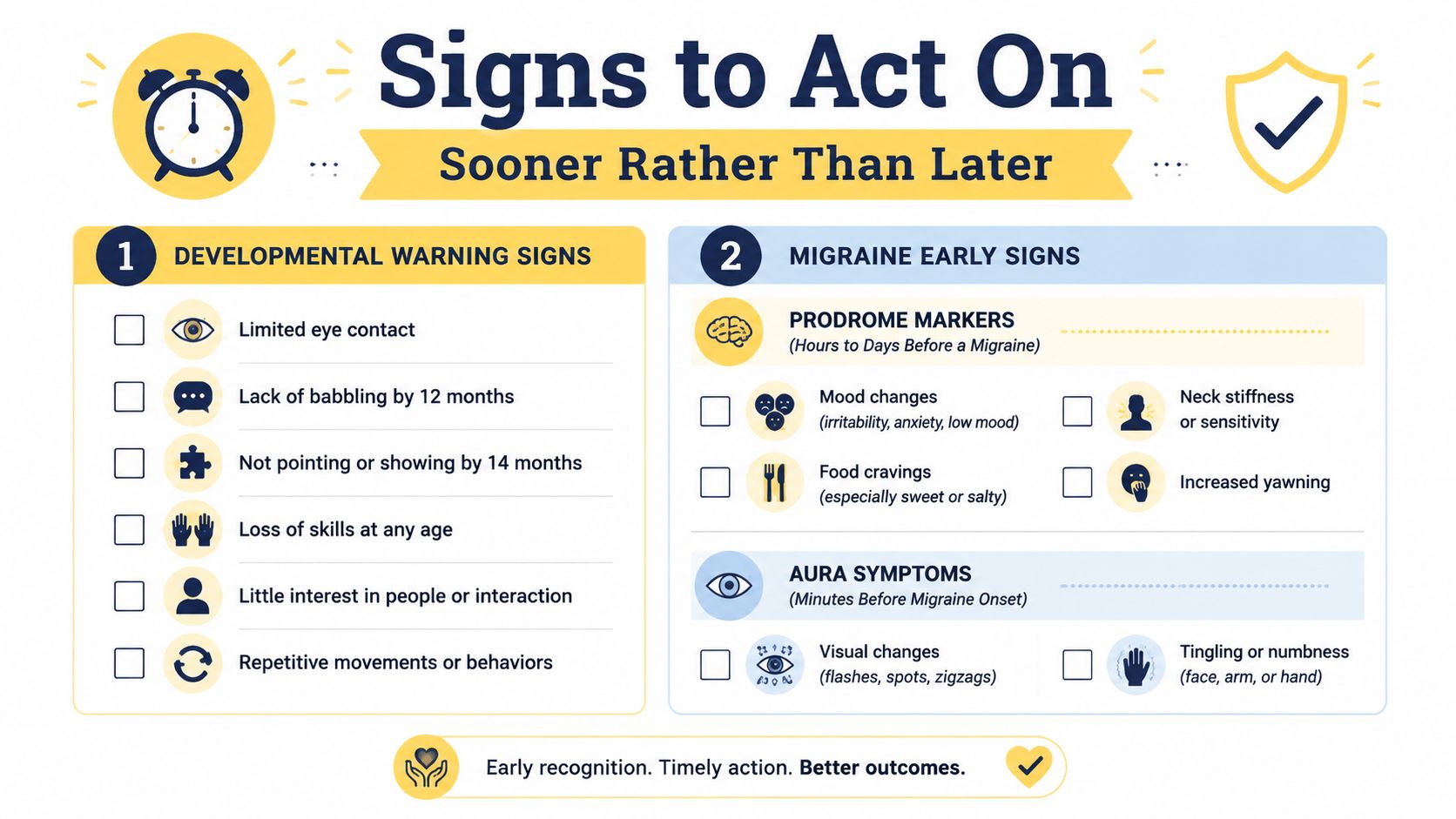
Prodrome may occur before head pain and can include mood changes, neck stiffness, food cravings, and yawning. Aura refers to temporary neurological symptoms that may include visual changes, tingling, or speech changes. Aura symptoms commonly described in clinical guidance last 5 to 60 minutes, but any new or unusual neurological symptom deserves medical attention rather than automatic self-labeling (headache classification and management guidance).
If head pain begins, note its intensity and progression. A personal plan may be more useful when it tells you what to do at mild pain, rather than leaving you to decide only after the attack becomes overwhelming. Don't change prescription treatment or medication timing without discussing it with your healthcare provider.
Developmental signals
Families may want to discuss concerns such as:
- Social communication: No social smile by 3 months or limited eye contact.
- Early sounds: No babbling by 9 months.
- Words: No words by 15 months.
- Phrases: No two-word phrases by 24 months.
- Regression: Loss of skills at any age.
Milestones vary, and a single difference doesn't prove that a child has a developmental disorder. A lost skill is different from a skill that is emerging slowly, so report regression promptly to the child's healthcare provider.
A simple urgency rule can help you choose the next step:
- Mild and brief: Track it and look for a repeat pattern.
- Persistent or multiple signals: Contact a provider this week.
- Severe, sudden, or rapidly changing symptoms: Seek same-day evaluation.
For migraine, seek immediate medical care for a sudden severe headache, a headache with fever or stiff neck, new neurological changes, or a headache after a head injury. For a child, sudden loss of milestones or developmental regression also warrants prompt clinical contact.
Practical Steps to Access Early Help
You don't need a perfect record before asking for help. A short, organized account of what you've noticed can make the first conversation more productive.
If you're concerned about a child
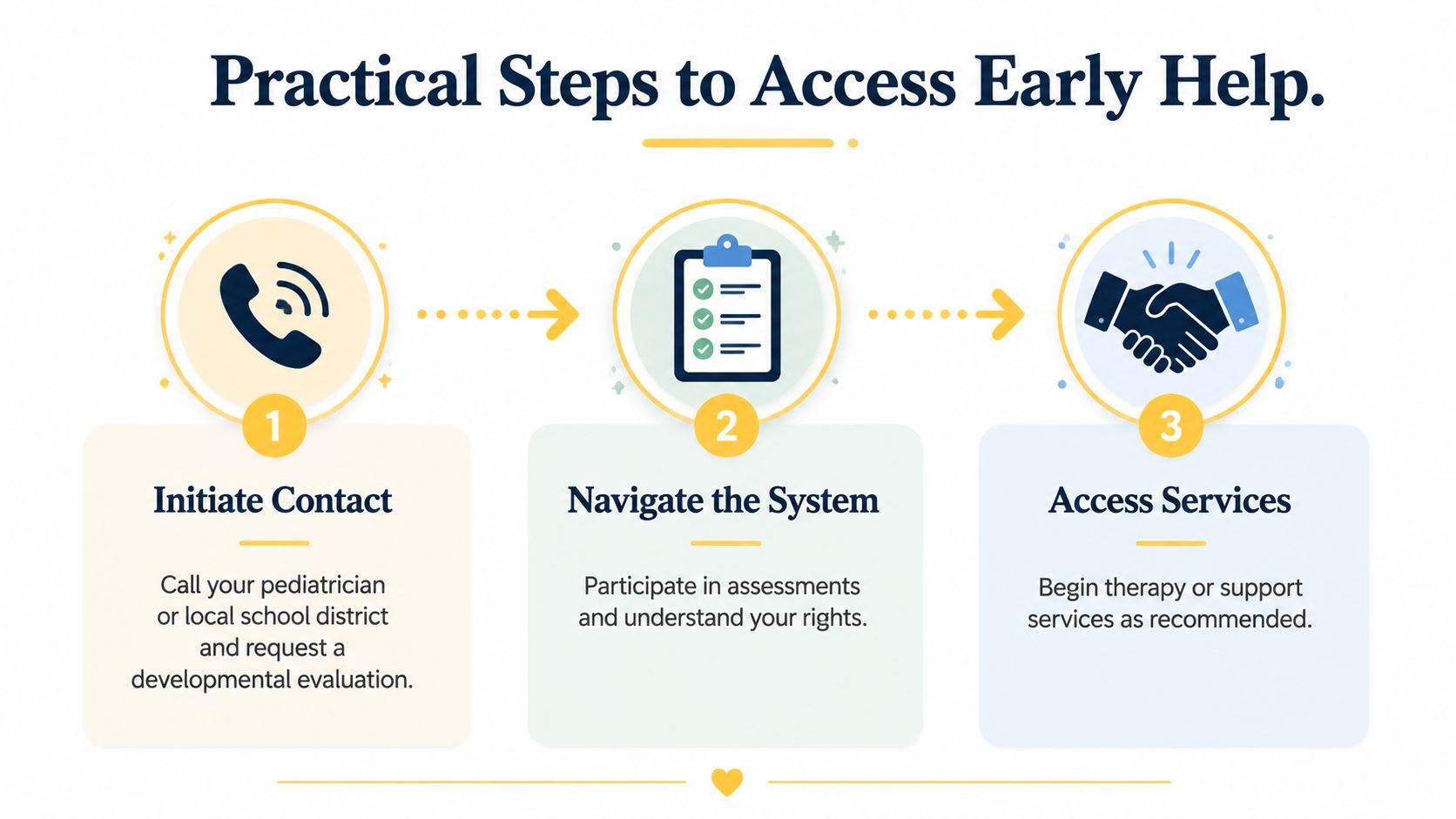
Start with the person who can open the next door. Call the child's pediatrician or local school district and request a developmental screening or evaluation. Ask whether your state's Part C Birth to 3 program is the appropriate referral route, and ask what eligibility process and timelines apply in your area.
Then prepare a one-page timeline. Include the skills you've observed, when they appeared, any skills that changed or disappeared, and examples from daily life. Videos or brief notes may help a clinician understand what you're seeing, but protect the child's privacy when storing or sharing them.
If you're managing recurring migraine
Begin with your own early-warning map. Identify 3 to 5 personal prodrome signals that you can recognize reliably, such as yawning, neck tightness, smell sensitivity, or unusual light sensitivity. Log when they occur, whether head pain follows, and what else was happening that day.
Use the treatment plan you've discussed with your healthcare provider during the mild-pain window. If pain continues for 72 hours, contact a clinician for guidance rather than repeatedly improvising treatment. If attacks exceed 4 per month, book a consultation to discuss whether a preventive approach may be appropriate. These thresholds are included for planning conversations, not for self-diagnosis or medication changes.
Tracking tools can support earlier decisions by putting symptoms, possible exposures, and timing in one place. Relief combines user logs with local weather, air quality, and pollen information to provide an hour-by-hour migraine risk forecast, while its records can show patterns in symptoms, triggers, and attacks. Forecasting isn't certainty, but it can give you a prompt to protect sleep, plan breaks, or review your clinician-approved strategy before symptoms peak.
Why Early Intervention Often Does Not Happen
“Act sooner” sounds simple until you meet the barriers. Families may be told to wait because a concern seems subtle, screening may not happen during a short visit, or the referral route may be unclear. A child can have a real need without looking severely delayed.
Migraine creates a parallel problem. You may normalize pain because you've lived with it for years, dismiss prodrome as stress, or wait until the headache becomes impossible to ignore. Limited specialist capacity, insurance friction, and disconnected referrals can make early treatment difficult even when you're ready to pursue it.
The access gap is visible in available reporting. In the United States, only 3.7% of children under three are served by the federal Early Intervention program, according to an analysis of the federal program and its reach (analysis of vulnerable children and federal early intervention). That figure doesn't explain each child's circumstances, but it shows why parental awareness alone can't solve under-identification.
State capacity also varies. Virginia reported serving 23,429 eligible infants, toddlers, and families in FY 2025, while expenses exceeded revenues by about $1.6 million, illustrating the strain that can affect service availability and consistency (Virginia early intervention reporting).
| Barrier | Developmental early intervention | Migraine early treatment |
|---|---|---|
| Under-identification | Subtle differences may be missed or minimized. | Prodrome and early pain may be mistaken for ordinary stress or headache. |
| Capacity | Staffing and state resources can limit timely access. | Specialist appointments may be difficult to obtain. |
| Fragmented pathways | Families may not know whether to contact a pediatrician, school district, or Part C program. | Patients may move between primary care, urgent care, and specialists without one shared plan. |
| Wait-and-see culture | Waiting can postpone assessment during an important developmental window. | Waiting can mean treatment begins only after disability is high. |
The problem isn't that families or patients lack effort. It's that systems often require people to recognize a problem, find the right entry point, and persist through delays while they're already exhausted. Tracking and clear self-advocacy can't fix capacity, but they can make the need easier to communicate.
Your Next Steps for Acting Early With Confidence
Early intervention becomes manageable when you turn a vague concern into a repeatable process. You don't need flawless data. You need enough information to notice patterns and define what action follows.
Try this four-part plan:
- Track for two to four weeks. For migraine, record early symptoms, pain intensity, sleep, medication use, and relevant environmental exposures. For developmental concerns, record milestones, communication attempts, movement, play, and any change in previously learned skills.
- Choose two or three warning signs. Select signals you can recognize without second-guessing yourself. A child's loss of a skill is especially important to record, while a person with migraine might choose yawning, neck stiffness, or a familiar visual symptom.
- Set an action trigger. Decide what will prompt a call, such as contacting a provider within 48 hours of a repeated early warning pattern or scheduling a developmental screening within a month.
- Review outcomes monthly. Ask what appeared before the problem, what response you used, and whether the next episode or developmental observation changed. Bring the record to your healthcare provider or the child's evaluation team.
Forecasting tools, symptom diaries, and AI-assisted prompts can translate scattered observations into earlier questions. They can highlight a possible pattern, but they can't diagnose you, determine eligibility, or replace a clinician's judgment.
Seek immediate medical care for a sudden severe headache, headache with fever or stiff neck, new neurological changes, or headache after head injury. Contact a clinician promptly for developmental regression, sudden loss of milestones, or severe and rapidly changing symptoms.
You can learn early action through small steps. Notice one signal, record it, follow the appropriate care pathway, and adjust your plan with professional guidance. For more about how Relief approaches tracking and forecasting, visit Relief's app information.
Relief helps you log migraine severity, symptoms, triggers, and medications while combining those records with local weather, air quality, and pollen signals. Visit Relief to turn early warning patterns into practical planning prompts, without using the app as a replacement for medical care.


