About one-third of people with migraine report alcohol as a trigger at least occasionally, but it isn't a universal one. In one large prospective diary study of 487 people with migraine, alcohol was not associated with a higher migraine probability the next day, which is why the alcohol-migraine connection often feels confusing, inconsistent, and very personal.
You might know this feeling well. You're out with friends, staring at a wine list or a beer menu, doing that familiar mental math: Is this worth the risk tonight? For some people, the answer is clearly no. For others, one drink is fine sometimes, a problem other times, and impossible to predict unless they look closely at the details.
That uncertainty is real. Migraine is a neurological condition, not just a bad headache, and triggers rarely act in isolation. Sleep loss, stress, skipped meals, hormone shifts, dehydration, and the type of drink itself can all mix together and muddy the picture. If alcohol has ever seemed like an obvious trigger one month and a false alarm the next, you're not imagining things.
This article is for informational purposes and is not medical advice. Consult a healthcare provider for personalized guidance.
Table of Contents
- The Complicated Truth About Alcohol and Migraine
- Alcohol can activate migraine pain pathways
- Congeners may explain why some drinks hit harder
- Histamine and related compounds can matter
- Dehydration lowers your margin for error
The Complicated Truth About Alcohol and Migraine
If alcohol feels like a gamble, that's because for many people it is.
In studies of 2,197 migraine patients, alcoholic beverages were reported as a trigger by 35.6% of participants, which supports the idea that alcohol matters for about one-third of people living with migraine (review of alcohol as a migraine trigger). That's common enough to take seriously, but it also means the majority of participants in that group did not report alcohol as a trigger.
What this means in practice: “Alcohol trigger” doesn't automatically mean “all alcohol, every time.”
That difference matters. Many people hear “alcohol can trigger migraine” and turn that into a hard rule. Then they notice they can sometimes have a cocktail without trouble, but get an attack after a glass of red wine on a stressful, sleep-deprived night. The inconsistency can make you feel like your body is random, when it may be responding to a stack of factors.
Migraine also unfolds in phases. A prodrome is the early phase that can include symptoms like fatigue, mood changes, food cravings, or neck stiffness before head pain starts. Aura refers to temporary neurological symptoms, often visual, that some people experience before or during an attack. Postdrome is the drained, foggy phase after the attack. If alcohol enters the picture during a day when your brain is already vulnerable, it may look like the sole cause when it's really one piece of a larger pattern.
- Common confusion: You had a drink, then got a migraine, so the drink must be the reason.
- More realistic view: The drink may have interacted with poor sleep, stress, dehydration, missed food, or timing.
- Useful mindset: Don't assume. Track.
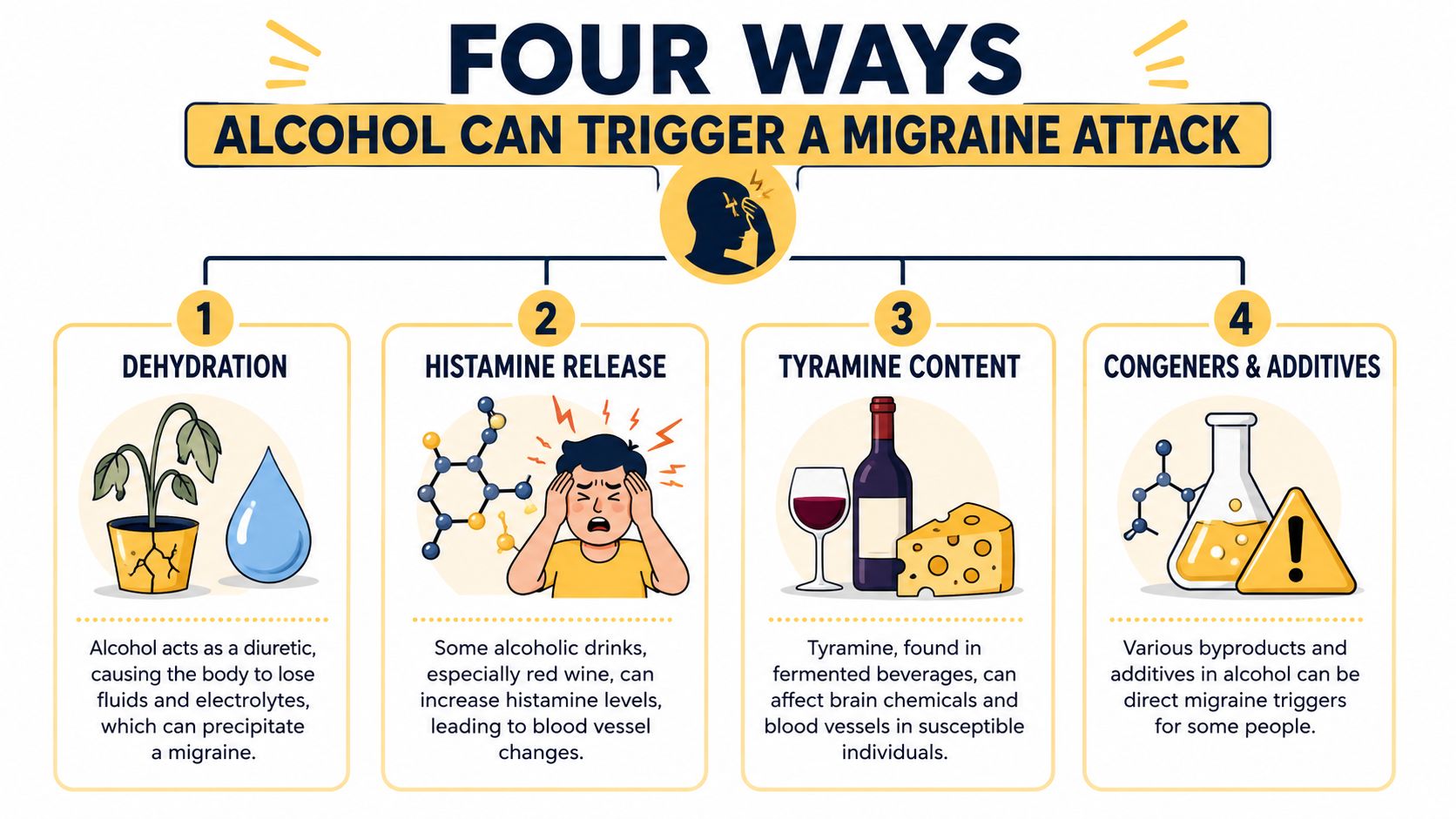
Four Ways Alcohol Can Trigger a Migraine Attack
Alcohol doesn't seem to provoke migraine through a single simple switch. It may affect blood vessels, nerve sensitivity, inflammatory signaling, and the extra compounds that come with specific drinks.
Alcohol can activate migraine pain pathways
Research suggests alcohol can dilate blood vessels by promoting release of CGRP and nitric oxide, and it may directly sensitize the trigeminal nerve system. Effects have been reported within 4 to 6 hours of consumption, which fits with migraine attacks that begin later rather than immediately (mechanisms of alcohol-related headache and migraine).
If that sounds technical, here's the plain-language version. The trigeminovascular system is one of the main pain networks involved in migraine. Think of it as a highly reactive alarm system. Alcohol may make that system easier to set off, especially when your brain is already near its threshold.
Alcohol may be less like an on-off trigger and more like something that lowers the distance between “fine” and “attack.”
Congeners may explain why some drinks hit harder
Congeners are chemical byproducts created during fermentation and aging. Darker drinks tend to contain more of them than clearer spirits. They don't affect everyone the same way, but they may help explain why one drink seems harmless and another feels risky even when the alcohol content looks similar.
This is one reason “alcohol” is too broad to be useful on its own in a migraine diary. Whiskey, red wine, beer, vodka, and a sugary canned cocktail may all land very differently in your body.
Histamine and related compounds can matter
Some drinks contain compounds that may be more relevant than ethanol itself for sensitive people. Red wine gets the most attention here, in part because of substances like histamine, tyramine, and other non-ethanol components that may interact with migraine biology.
If histamine is a topic you've run into before, this guide to histamine and migraine headaches gives more background on why some people react strongly while others don't notice any difference.
A simple example helps. If you can drink vodka with no issue but often get symptoms after red wine, that points away from alcohol alone and toward the full chemical makeup of the drink.
Dehydration lowers your margin for error
Dehydration is a commonly recognized mechanism, but it still matters. Alcohol can increase fluid loss, and for some people migraine becomes more likely when hydration, food intake, and sleep all slip at the same time.
Dehydration by itself doesn't explain every alcohol-related attack. But it can reduce your buffer. A drink after a stressful day, with little water, a skipped dinner, and poor sleep ahead, is a very different situation than a slow drink with food and plenty of fluids.
A few practical clues can point toward dehydration as part of the problem:
- Dry mouth and thirst: You feel obviously dried out before the headache ramps up.
- Lightheadedness: Standing up feels worse than usual.
- Context clues: The attack follows heat, exercise, travel, or a long day with little water.
Are Some Alcoholic Drinks Worse Migraine Triggers
For many people, the better question isn't “Is alcohol a migraine trigger?” It's “Which drinks are more likely to bother me?”
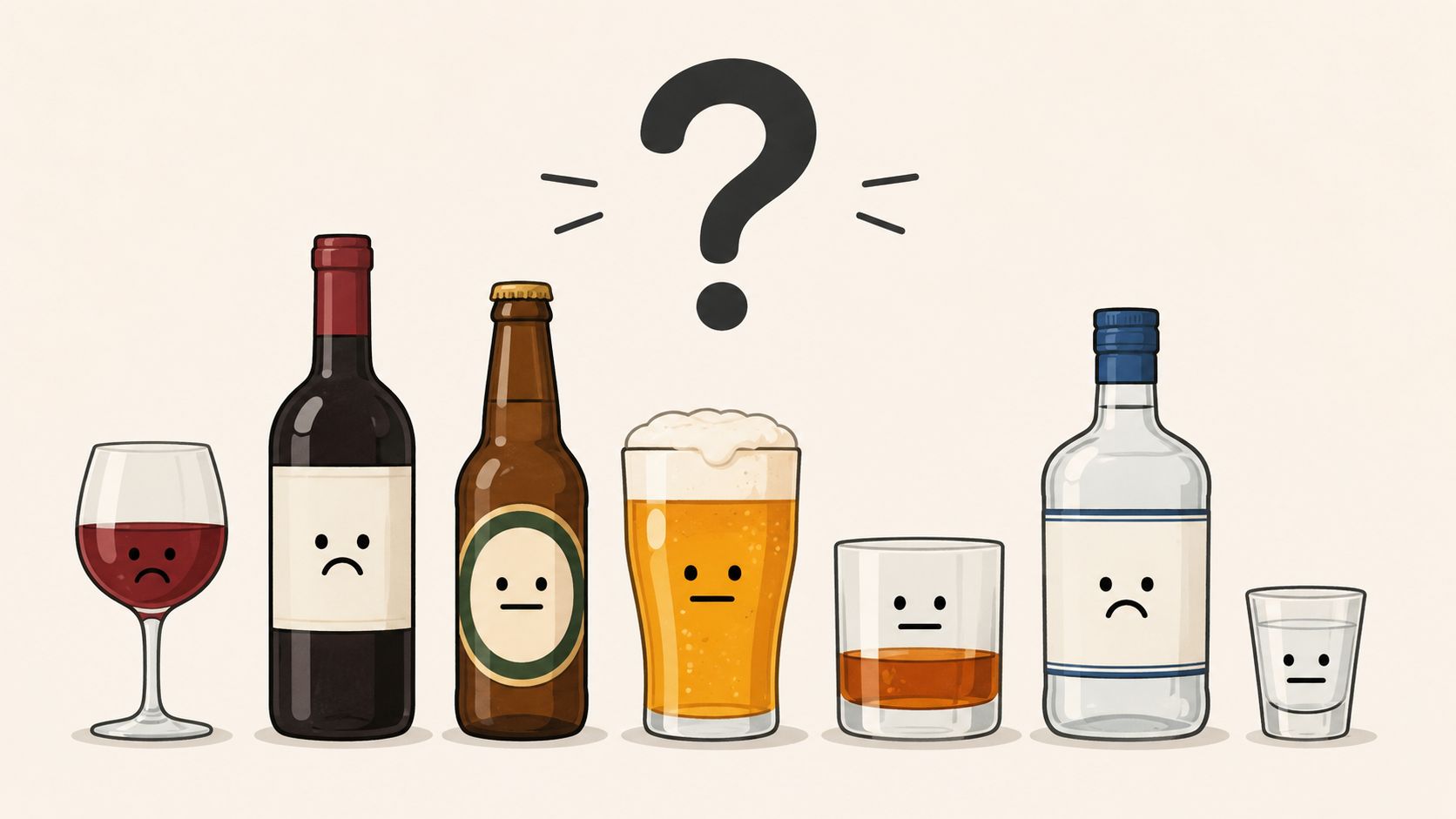
Evidence suggests migraine risk differs by beverage, with red wine more often provoking attacks than vodka, which implies compounds such as histamine, tyramine, and congeners may matter more than ethanol alone for many people (discussion of beverage type and migraine risk).
Why red wine gets so much attention
Red wine comes up again and again in migraine conversations for a reason. It's often reported as more provocative than clearer spirits, and that likely reflects its broader chemical profile, not just the alcohol itself.
That doesn't mean red wine is bad for everyone with migraine. It means red wine is one of the drinks most likely to expose a personal sensitivity if you have one.
A useful test question is not “Can I drink alcohol?” It's “Do I react differently to one category of drink than another?”
You may also find that common food migraine triggers overlap with the same kinds of compounds that show up in certain alcoholic drinks. That overlap can make a meal-and-drink combination more informative than the drink alone.
Beer white wine and spirits
Beer can be tricky because it brings together alcohol, fermentation byproducts, and often a social context where sleep, food timing, and hydration aren't ideal. White wine may bother some people less than red wine, though individual reactions vary. Clear spirits such as vodka are often viewed as lower-risk in comparison surveys and reviews, but lower-risk doesn't mean risk-free.
This short video gives a simple overview of why different drinks can feel so different after the same kind of evening.
A practical way to think about drink choice is to separate variables:
| Drink factor | Why it may matter |
|---|---|
| Color and aging | Darker or aged drinks may contain more congeners |
| Fermentation profile | Wine and beer may contain other compounds that bother sensitive people |
| Mixers and additives | Sweeteners, carbonation, and flavorings can complicate the picture |
| Context | Late nights, rich meals, and poor sleep can amplify risk |
Migraine Attack Versus a Hangover Headache
A migraine attack after drinking and a hangover headache can overlap, but they aren't the same thing.
A migraine attack is a neurological event that may involve throbbing pain, nausea, photophobia (light sensitivity), phonophobia (sound sensitivity), aura, dizziness, or a strong need to lie down. A hangover headache is more closely tied to the aftereffects of alcohol, including dehydration, sleep disruption, and general systemic stress.
How to tell them apart
Here's a simple side-by-side comparison.
| Symptom / Feature | Migraine Attack | Hangover Headache |
|---|---|---|
| Pain quality | Often throbbing or pulsating | Often dull, pressure-like, or diffuse |
| Location | Can be one-sided, but not always | Often feels more generalized |
| Light and sound sensitivity | Common | Can happen, but usually less prominent |
| Nausea | Common | Also common, but often part of overall hangover symptoms |
| Aura | Can occur in some people | Not typical |
| Timing | Can start during drinking or several hours later | Often more obvious the next morning |
| Function | May make normal activity hard or impossible | Usually uncomfortable, but the symptom pattern is different |
Some people get both at once. That's where things get confusing. If you already live with migraine, alcohol may trigger a true migraine attack, and the hangover physiology may pile on top of it.
If the pattern includes aura, marked light or sound sensitivity, nausea, or the same symptom sequence you recognize from your other migraine attacks, it's more likely migraine than “just a hangover.”
When headache after drinking needs urgent care
Seek immediate medical care if you have a sudden severe headache, a headache with fever or stiff neck, new neurological changes such as weakness, confusion, trouble speaking, or vision loss, or a headache after a head injury. Those symptoms need urgent evaluation and should not be brushed off as alcohol-related.
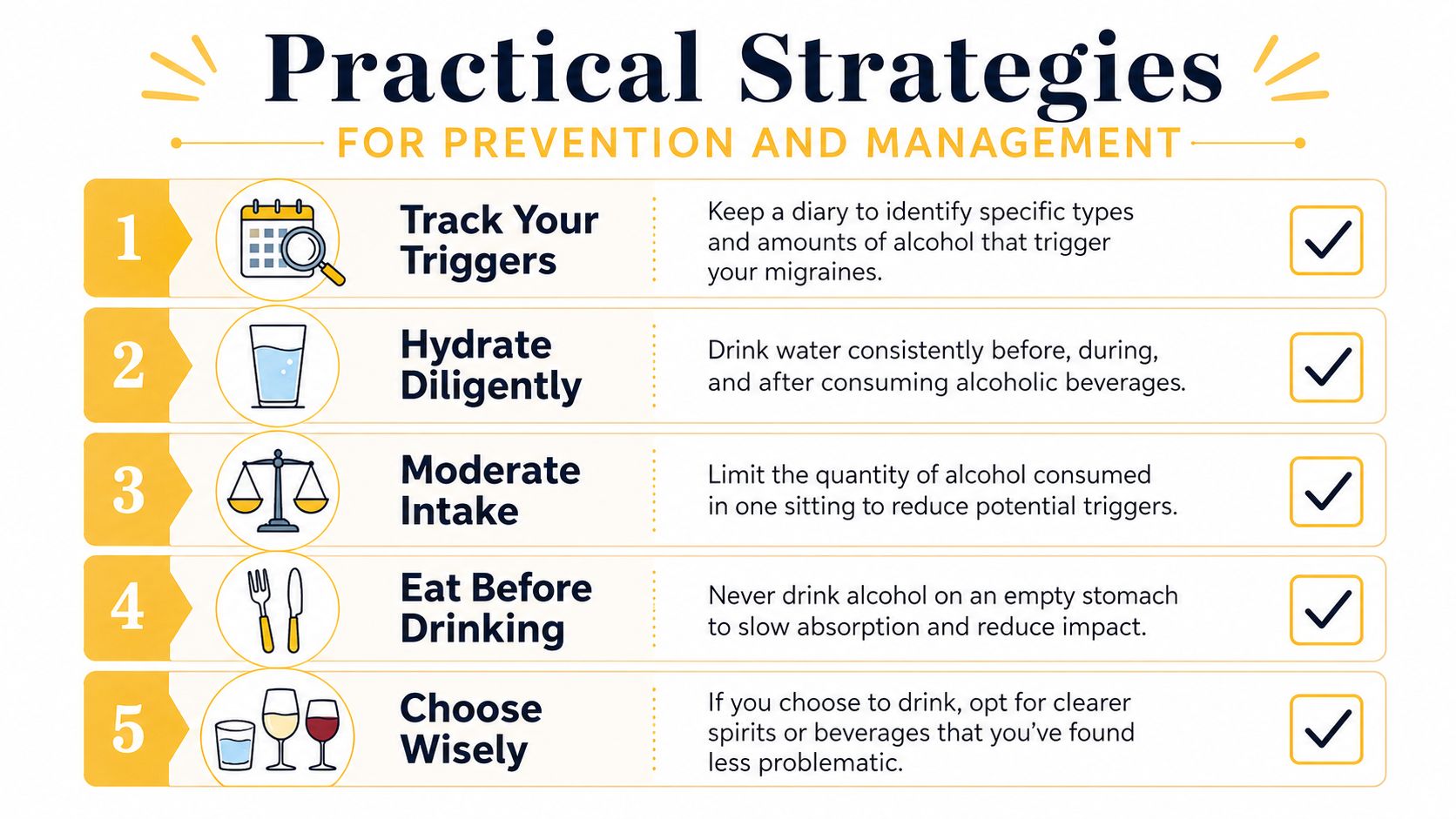
Practical Strategies for Prevention and Management
Because alcohol is a frequent but inconsistent trigger, management often makes more sense than assuming total avoidance for everyone. Retrospective studies report that about one-third of people with migraine identify alcohol as an occasional trigger, while only about 10% report it as a frequent or consistent one (review of alcohol-induced headaches and migraine patterns).
That doesn't mean you should push through reactions. It means the right goal is to lower risk while paying attention to your own pattern.
Lower risk without assuming total avoidance
Some strategies are simple, but they're often the ones people skip in real life.
- Eat first: Drinking on an empty stomach can make alcohol hit faster and harder.
- Hydrate early: Don't wait until you feel thirsty. Water before and during the event is usually easier than trying to catch up later.
- Protect sleep: A drink might be tolerated on a stable night but become a problem when bedtime shifts and sleep quality drops.
- Slow the pace: Spacing drinks out makes it easier to notice your body's early warning signs.
- Choose based on your own history: If one type of drink repeatedly causes trouble, treat that as useful information.
One quiet but important skill is noticing the full setup, not just the drink. “Two beers at a barbecue in the heat” is a different exposure from “one vodka soda with dinner after a calm day.” The more specific you get, the more useful your observations become.
Practical rule: If alcohol is only a problem under certain conditions, manage the conditions first and see whether the pattern changes.
Be careful with medications and alcohol
This article is for informational purposes and is not medical advice. Always consult your healthcare provider or pharmacist about potential interactions between alcohol and any medications you are taking, both prescription and over-the-counter.
That includes migraine-specific medicines, sleep aids, anti-nausea medicines, and anything else that can affect alertness, liver function, stomach irritation, or dehydration. Even if alcohol isn't your migraine trigger, it may still interact poorly with treatment.
How to Know If Alcohol Is Your Personal Trigger
The clearest answer usually doesn't come from memory. It comes from a log.
Recent prospective evidence challenged a common assumption by finding that alcohol intake was not associated with a higher migraine risk the next day in a digital health cohort, which is one reason individualized pattern detection matters more than blanket rules (analysis of whether alcohol is a migraine trigger). Memory tends to over-credit dramatic events and undercount the quiet nights when the same exposure caused nothing.
What to log so the pattern becomes clearer
A useful migraine diary should capture more than “had alcohol.” Try logging:
- The exact drink: red wine, white wine, beer, whiskey, vodka, canned cocktail
- Timing: what time you started drinking and when symptoms began
- Context: stress, missed meals, poor sleep, travel, heat, exercise, hormone timing
- Migraine features: aura, nausea, photophobia, phonophobia, dizziness, neck pain
- What happened next: did the symptoms match your usual migraine pattern or feel more like a hangover?
If you want a structure to follow, this migraine log template can help you record the details that are easiest to forget later.
A good pattern question is specific. Not “Does alcohol trigger me?” but “Does red wine after a short night of sleep tend to precede my attacks?” That's a question your own data can answer much better than general advice can.
If you want an easier way to spot those patterns over time, Relief can help you log attacks, symptoms, and possible triggers quickly so you can see whether alcohol is part of your migraine pattern or just one piece of a bigger picture.


