Histamine, a natural body chemical, can trigger migraine attacks in susceptible people, often when the body's histamine load rises faster than it can be processed. That doesn't mean histamine explains every migraine, but it is a real biological factor for some people and can help make sense of attacks that seem random, food-related, or tied to allergy-like symptoms.
You may be reading this after another attack that didn't seem to follow the rules. You slept well, drank water, skipped obvious triggers, and your migraine still showed up. That kind of unpredictability is exhausting.
For some people, histamine migraine headaches are part of the picture. Histamine is involved in normal body functions, but when too much is released or not cleared efficiently, it may contribute to migraine through inflammation and pain signaling. Research has recognized histamine as migraine-relevant for nearly a century, and a review found that it can efficiently induce migraine attacks in people with migraine through an H1-receptor mechanism that is most likely extracerebral, while also noting that older antihistamine studies were inconsistent and limited by weak trial quality and side effects such as sedation and weight gain in first-generation drugs (2019 review on histamine and migraine).
If you've ever wondered, “Is this food, allergies, stress, or all of the above?”, you're not overthinking it. Histamine sits right in that overlap.
This article is for informational purposes and is not medical advice. Consult a healthcare provider for personalized guidance.
Table of Contents
- That Frustrating Feeling When Migraine Triggers Make No Sense
- What histamine actually does
- Why overload can happen
- How this can turn into migraine pain
- Foods that may add to histamine load
- Alcohol and other DAO blockers
- Environmental and body-level triggers
- Short-term diet changes as a test, not a forever rule
- DAO supplements and antihistamines
- When to stop a restrictive approach
- How long should I try a low-histamine diet
- Are DAO supplements worth trying
- Can histamine issues exist without classic allergies
- How is this different from mast cell disease
- Should I avoid fermented foods forever
- If antihistamines help, does that prove histamine is the cause
That Frustrating Feeling When Migraine Triggers Make No Sense
One of the hardest parts of migraine is how unfair it feels. You can do everything “right” and still end up in a dark room with head pain, nausea, photophobia (light sensitivity), or aura.
Sometimes the missing piece isn't one dramatic trigger. It's a build-up. Histamine migraine headaches are usually thought of that way. Not as one magic explanation, but as a threshold problem where several inputs add up until your system reacts.
Practical rule: If your attacks often cluster around meals, alcohol, seasonal allergies, nasal congestion, flushing, or digestive upset, histamine may be worth discussing with your clinician.
This can be confusing because migraine itself is already a neurological disease with many phases. Prodrome can start before pain. Aura may or may not happen. The headache phase may overlap with neck pain, sinus pressure, or stomach symptoms. Histamine-related symptoms can blur into all of that.
A better question than “Is histamine definitely my cause?” is often, “Does histamine seem to raise my migraine risk?” That question is more realistic, and more useful.
The Histamine and Migraine Connection Explained
What histamine actually does
Histamine is part of everyday body chemistry. It helps coordinate immune responses, supports stomach acid release, and acts as a signaling molecule in the nervous system. In some people with migraine, the issue is not histamine existing at all. The issue is that histamine-related signaling may add stress to a system that is already easy to tip into an attack.
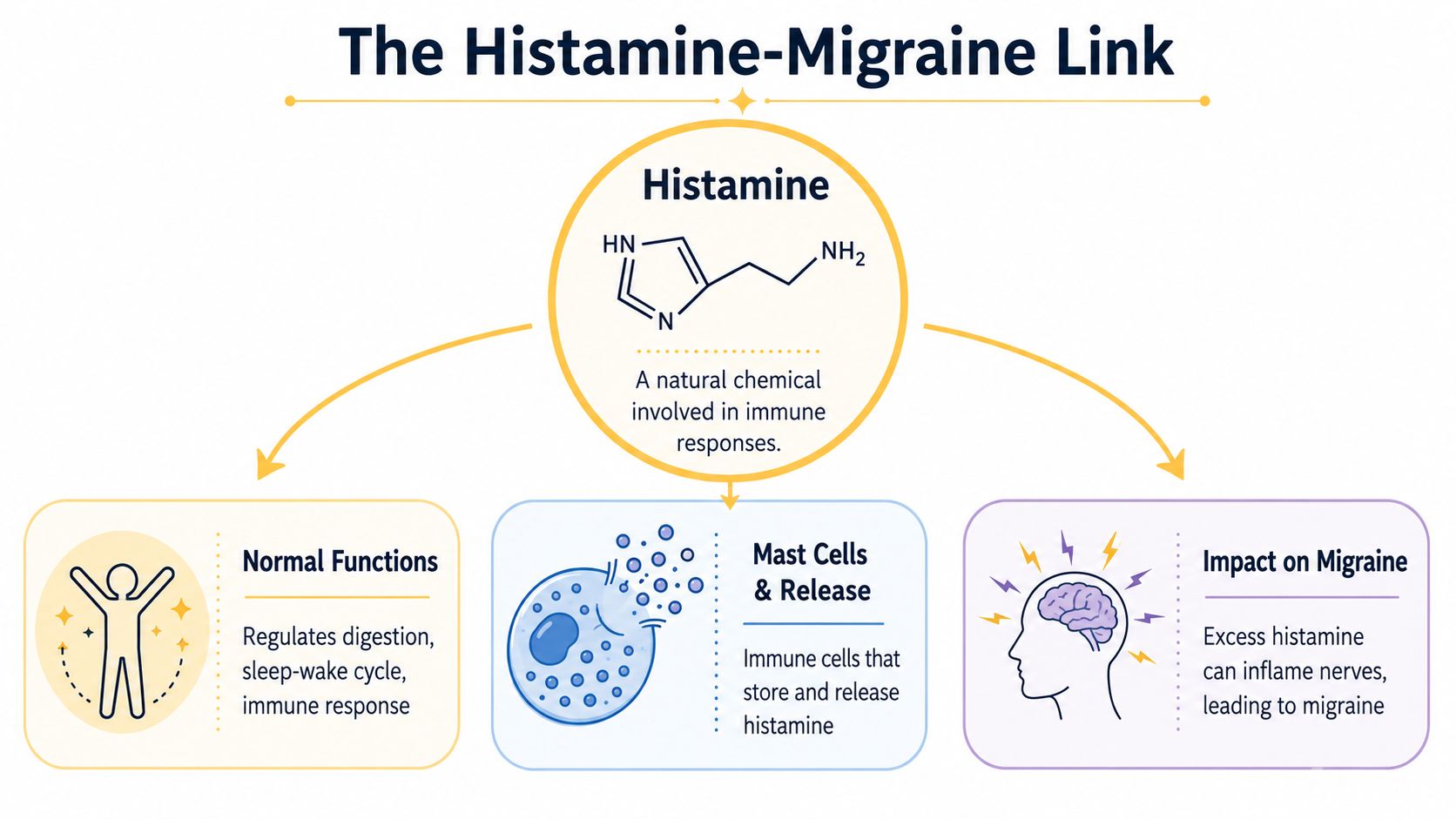
One practical way to understand this is to picture your body balancing input against clearance.
- Input can come from your own immune cells, from alcohol, from certain foods, and from allergy activity.
- Clearance is how your body breaks histamine down. One enzyme involved in handling dietary histamine is DAO, short for diamine oxidase.
- Symptoms can show up when exposure rises faster than your body can comfortably process.
That model helps explain why histamine can matter without being the whole story. It may raise the odds of an attack on a day when your migraine threshold is already lower.
Why overload can happen
A key part of the biology involves mast cells. These immune cells store histamine and release it when the body reacts to certain signals. Researchers have described several ways histamine may be relevant in migraine, including effects on blood vessel permeability, pain signaling, and inflammatory activity around nerves.
If that sounds abstract, bring it back to real life. You sleep poorly, pollen is high, you have wine with dinner, and leftovers the next day seem to finish the job. None of those factors has to be dramatic on its own. Together, they may push your system past what it can handle that day.
This is also why histamine questions can get messy fast. A food may seem safe one week and problematic the next because the surrounding conditions changed.
How this can turn into migraine pain
Neurogenic inflammation means inflammation linked to nerve activity. In migraine, that matters because irritated pain pathways can become more reactive. Histamine is one of several chemicals that may contribute to that process.
You also do not need classic allergy symptoms for histamine to be relevant. Some people notice flushing, nasal congestion, itching, or stomach upset. Others mainly notice migraine features such as throbbing pain, nausea, light sensitivity, or a sense of head pressure.
The practical takeaway is simple. Histamine is best treated as a testable contributor, not a label to force onto every attack. If you decide to experiment, do it in a structured way with a short tracking window, a clear starting point, and a stopping rule. A basic migraine diet plan for tracking patterns without over-restricting can help you test that question without turning every meal into a source of stress.
DAO supplements fit into that same “test, do not assume” mindset. Some people try them before higher-risk meals because DAO helps break down dietary histamine in the gut. The downside is that they do not address histamine your own body releases, they can be expensive, and a good response does not prove histamine is the main driver of your migraine. If a low-histamine trial or DAO experiment has not changed attack frequency or severity after a reasonable, clinician-guided trial, that is usually a sign to stop the restriction and look at other triggers instead.
Common Histamine Triggers Beyond Just Food
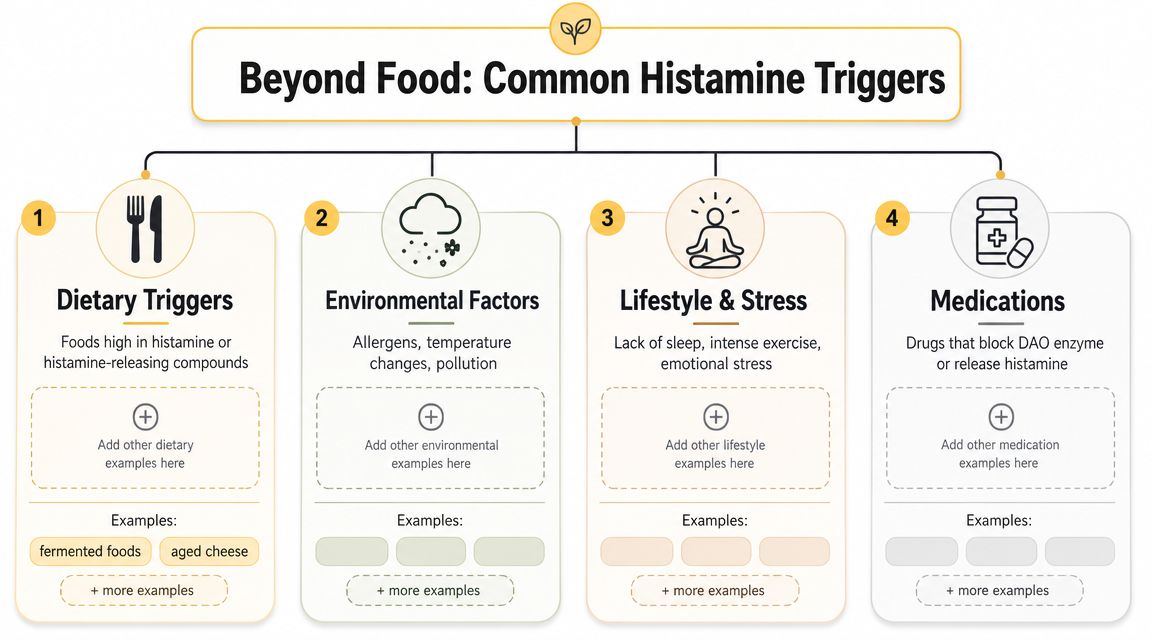
When people first hear about histamine and migraine, they often jump straight to a food blacklist. That's understandable, but it misses the bigger idea. For histamine-sensitive patients, the most useful approach is often reducing overall histamine load from triggers such as high-histamine foods and alcohol, while keeping in mind that histamine desensitization therapy is considered experimental by Aetna because randomized controlled evidence is lacking (Aetna policy on histamine-related headache approaches).
Foods that may add to histamine load
Some people notice trouble with foods that are commonly described as high-histamine or heavily aged, fermented, cured, or stored. Others react more to foods they suspect trigger histamine release. The exact list varies from person to person, which is why broad elimination often becomes frustrating.
Examples people commonly test with a clinician or dietitian include:
- Aged or fermented foods such as aged cheeses, fermented vegetables, cured meats, vinegar-heavy foods, and some leftovers
- Alcoholic drinks that seem to trigger symptoms shortly after drinking
- Certain produce or packaged foods that appear fine one day and not another, especially when your overall trigger load is already high
If you're trying to build a migraine-friendly eating routine, this guide to a migraine diet plan can help you keep the process structured instead of overly restrictive.
Alcohol and other DAO blockers
Alcohol gets special attention for a reason. It may raise the total histamine burden and may also interfere with the body's ability to manage it well. For some people, that turns “I can usually tolerate this” into “this tipped me over.”
Medications can complicate things too. If you suspect a pattern, bring your full medication and supplement list to a healthcare visit rather than stopping anything on your own.
Environmental and body-level triggers
Food is only one part of the picture. Histamine-related migraine patterns may also show up around:
- Seasonal allergies or high-pollen days
- Illness or immune activation
- Stress and disrupted sleep
- Heavy exercise or heat, if those seem to coincide with other symptoms
This is why a single “bad food” list often fails. Your nervous system responds to the whole context, not just dinner.
Could Histamine Be a Factor in Your Migraines
Clues that make histamine worth exploring
Histamine migraine headaches aren't a formal diagnosis in the main headache classification system. Think of histamine as a possible contributor, not a separate disease label.
It may be worth exploring if your migraine attacks seem to appear with a recognizable cluster of non-head symptoms, especially after meals or during allergy flares. Some people notice facial flushing, nasal congestion, stomach upset, itching, or a sense that certain foods trigger not just headache but a whole-body reaction.
A careful diary is often more revealing than memory. You might discover that your attacks aren't tied to one food at all. They happen when multiple factors line up.
A helpful next step is learning your broader migraine risk factors, because histamine may be only one layer of a larger pattern.
If a low-histamine approach doesn't clearly change your attacks, that doesn't mean you failed. It may mean histamine isn't a major driver for you, or that something else is overlapping with it.
Healthcare providers who take this seriously often look at timing, symptom patterns, other allergic or gastrointestinal symptoms, and whether a limited food trial changes anything. The goal isn't to prove a trendy theory. The goal is to see whether this variable helps explain your real-life attacks.
When headache symptoms need urgent care
Seek immediate medical care for any of these red flags:
- Sudden severe headache that peaks fast or feels unlike your usual migraine
- Headache with fever or stiff neck
- New neurological changes such as weakness, confusion, trouble speaking, fainting, or vision loss that is unusual for you
- Headache after a head injury
This article is for informational purposes and is not medical advice. Consult a healthcare provider for personalized guidance.
Evidence-Based Management and Treatment Options
You do not need to choose between "ignore histamine" and "rebuild your whole life around it." A better plan is to test one change at a time, for a defined period, and judge it by what happens to your actual migraine pattern.
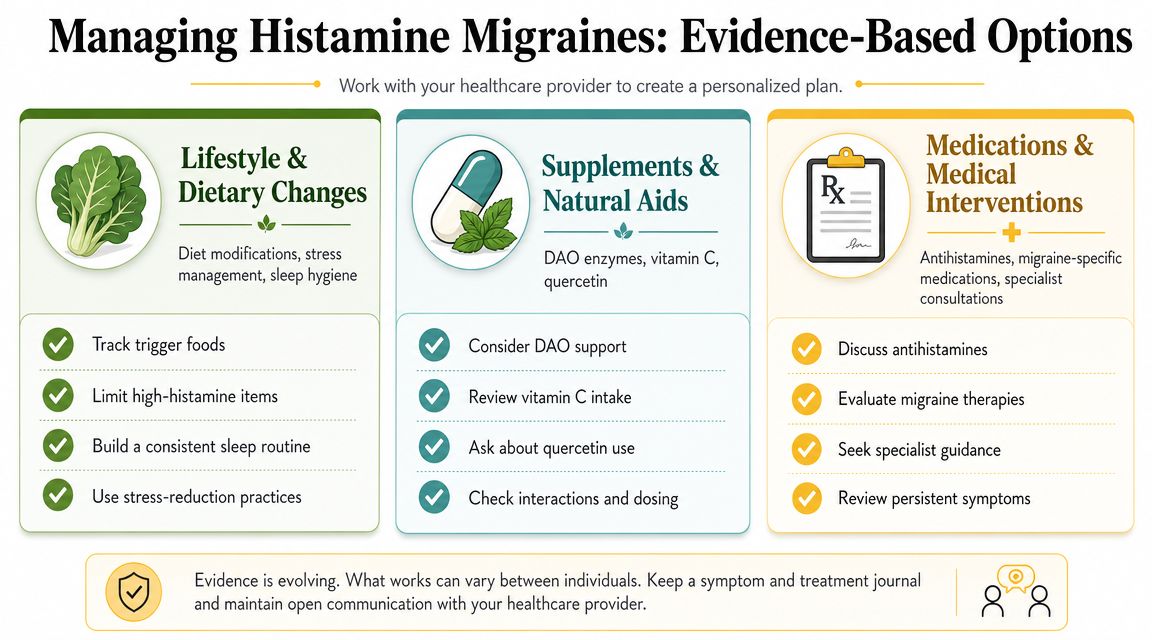
Histamine management works best like a trial run, not a permanent identity. The goal is not to earn a "low-histamine" label. The goal is to answer a practical question: does reducing histamine exposure change your attacks enough to matter in daily life?
Short-term diet changes as a test, not a forever rule
A low-histamine diet is often most useful as a short, structured experiment. If histamine is part of your migraine pattern, lowering the overall load can make the signal easier to see. If nothing changes after a fair trial, that information is useful too.
That time limit matters. Restrictive diets can start out feeling organized and quickly turn into guesswork, under-eating, or anxiety around meals. Histamine can also build up from food storage, leftovers, alcohol, or several moderate exposures in the same day, so a vague "I ate healthier" approach rarely gives clear answers.
A simple comparison helps:
| Approach | What it may help with | Main drawback |
|---|---|---|
| Short, structured elimination | Tests whether histamine seems relevant | Can become too restrictive if continued without guidance |
| Targeted reduction on predictable high-risk days | May help if your pattern clusters around specific meals or situations | Easy to blame histamine for attacks caused by something else |
| Random food avoidance | Feels active in the moment | Usually creates more confusion than useful data |
Before you start, decide what success would look like. Fewer attacks. Lower intensity. Less need for rescue medication. Better function the day after. Without that target, it is easy to keep cutting foods without learning much.
If you want a more organized way to test changes, a migraine tracking app for logging meals, symptoms, and timing can make the pattern easier to judge than relying on memory.
DAO supplements and antihistamines
DAO supplements and diet answer different questions.
Diet lowers the amount of histamine coming in. DAO supplements aim to help break down histamine from food around mealtimes. That means a DAO trial may make the most sense if meals seem to trigger symptoms, especially when fermented, aged, or leftover foods are involved. It does not tell you much about non-food histamine triggers such as allergies, hormonal shifts, poor sleep, or stress.
Antihistamines are a separate tool again. They act on histamine receptors rather than on food breakdown. As noted earlier, histamine has biologic links to migraine, but that does not automatically make antihistamines a reliable migraine prevention strategy for everyone. This is where clinical judgment matters, especially if you also have hives, nasal symptoms, itching, flushing, or other allergic features.
The practical pros and cons are worth spelling out:
- DAO supplements may be useful if you want a meal-focused test without cutting your diet too broadly
- DAO supplements have limits because they do not address every source of histamine and may not help if histamine is not a major driver for you
- Diet changes can clarify patterns but can become hard to sustain if the rules are too broad
- Antihistamines may fit some people with overlapping allergy-type symptoms, but they are not a substitute for a full migraine treatment plan
Migraine-specific care still matters throughout this process. If attacks are frequent, disabling, or changing, food experiments should support proper treatment, not delay it.
When to stop a restrictive approach
Many people need to hear this clearly. You are allowed to stop a restrictive diet that is not teaching you anything.
Restriction should produce information. If it only produces stress, the plan needs work.
A reasonable trial should lead to one of two outcomes. You either see a pattern that is consistent enough to use, or you do not. If your meals are getting more limited but your attacks are still unpredictable, the experiment may be over.
Signs it may be time to reassess include:
- Your safe-food list keeps shrinking with no clear improvement
- You feel tense around eating and spend more time fearing triggers than noticing patterns
- Migraine attacks do not line up consistently with suspected histamine exposures
- Other factors seem just as strong such as sleep loss, menstrual cycle changes, stress, weather, allergies, or skipped meals
- You are becoming nutritionally limited or losing enjoyment of food without a clear payoff
At that point, broad restriction is usually less helpful than a narrower, more systematic plan with a clinician or dietitian. Sometimes the answer is that histamine is one small piece of the puzzle. Sometimes it is not the right lead at all.
This article is for informational purposes and is not medical advice. Consult a healthcare provider for personalized guidance.
How to Track Your Histamine Triggers Effectively
Tracking beats guessing. Histamine-related migraine patterns are hard to see in your head because the trigger may be cumulative, delayed, or mixed with sleep, weather, hormones, stress, or allergy exposure.

A broad low-histamine diet can fail or become unsustainable, and the evidence for a clean cause-and-effect relationship is still evolving. That creates a real need for better tools to tell the difference between diet-responsive migraine and migraine that happens alongside allergies or mast-cell-related symptoms (discussion of the tracking gap in histamine-related migraine).
What to log after meals and attacks
Keep it simple enough that you'll do it.
Record:
- What you ate and drank including leftovers, alcohol, and anything fermented or aged
- When you had it because timing matters
- Migraine phases such as prodrome, aura, headache pain, and postdrome
- Non-head symptoms like flushing, nasal stuffiness, itching, diarrhea, or palpitations
- Context including poor sleep, stress, pollen exposure, illness, and intense exercise
Don't just log “headache.” Log whether it was clearly migraine, whether light or sound sensitivity showed up, and whether nausea was present. That makes your notes much more useful at a medical appointment.
If you want a structured digital log, a migraine tracking app can make it easier to capture patterns consistently.
Here's a short walkthrough that may help you think about tracking in a more systematic way:
How to spot a usable pattern
Don't look for perfection. Look for repeatability.
A useful pattern sounds like this: “I don't react every time, but attacks are more likely when alcohol, leftovers, and high-pollen days stack together.” That's actionable. “Sometimes food seems involved, maybe?” usually isn't.
Track long enough to compare good stretches and bad stretches, then bring the log to your clinician. That turns a vague suspicion into a clear basis for their work.
Frequently Asked Questions About Histamine and Migraine
How long should I try a low-histamine diet
Long enough to learn something, not so long that it becomes your whole life without a clear benefit. If you're cutting many foods and not seeing a meaningful pattern, ask a clinician or dietitian whether it makes sense to reintroduce foods methodically instead of staying restricted.
Are DAO supplements worth trying
They may be worth discussing if your symptoms seem strongly meal-linked and especially if high-histamine foods appear more suspicious than other triggers. But they aren't a guaranteed answer, and they don't replace migraine evaluation or a balanced diet.
Can histamine issues exist without classic allergies
Yes. Some people suspect histamine involvement because attacks seem tied to food, alcohol, flushing, congestion, or digestive symptoms, even without obvious seasonal allergies. That still doesn't prove histamine is the main cause. It just makes it a reasonable avenue to explore.
How is this different from mast cell disease
Mast-cell-related disease is a broader medical issue involving abnormal mast cell activity and can affect multiple body systems. Histamine-related migraine patterns may overlap with that, but they are not the same thing. If you have widespread symptoms beyond migraine, especially recurrent flushing, hives, faintness, or significant gastrointestinal symptoms, bring that full picture to a healthcare professional instead of trying to self-diagnose from food reactions alone.
Should I avoid fermented foods forever
Not necessarily. If fermented foods repeatedly line up with attacks, they may deserve a trial break. But forever-avoidance only makes sense when it's clearly helping and still allows adequate nutrition and quality of life.
If antihistamines help, does that prove histamine is the cause
No. A response to any one tool doesn't automatically identify the full mechanism behind your migraine. It may mean histamine is one part of your threshold picture.
If you want a calmer way to test patterns without relying on memory, Relief can help you log symptoms, triggers, and daily conditions so you can see whether histamine-related patterns are showing up in your life.


