If you've ever felt head pain ramp up before the rain starts, you're not imagining it. Barometric pressure headaches are a real pattern for many people, and in many cases the “headache” during weather changes is a migraine attack or a migraine trigger rather than a simple headache.
That matters, because the right response depends on what kind of pain you're dealing with. Facial pressure, nausea, light sensitivity, neck pain, congestion, dizziness, and brain fog can overlap. When you're already hurting, that overlap gets confusing fast.
This article is for informational purposes and is not medical advice. Consult a healthcare provider for personalized guidance.
Table of Contents
That Feeling When You Know a Storm Is Coming
Some people notice it as a dull pressure behind the eyes. Others get a stiff neck, sudden fatigue, irritability, or that familiar “off” feeling hours before the sky changes. Then the rain starts, and everyone around them says it's coincidence.
That dismissal gets old. If weather seems tied to your attacks, there's a real reason to pay attention.
What people mean by barometric pressure headaches
Barometric pressure is the weight of the air around you. When that pressure changes, especially when it drops before a storm, some people with migraine seem to be more vulnerable to an attack.
The important distinction is this. A weather-related attack isn't always a plain headache. It may involve migraine symptoms such as nausea, light sensitivity, sound sensitivity, dizziness, visual changes, trouble concentrating, or exhaustion before and after the pain phase.
Many people say they can “feel a storm coming.” In migraine care, that idea isn't something to mock. It's a clue.
Headache and migraine aren't the same thing
A headache is a symptom. Migraine is a neurological disease that can include head pain, but also much more than pain. Some attacks come with aura, which can mean temporary visual or sensory symptoms before or during the attack. Some come with postdrome, the drained, foggy feeling that can linger after the pain eases.
That's why weather can be so frustrating. You may think you're dealing with sinus pressure when you are in the early stage of a migraine attack. And if you treat the wrong thing, you can lose valuable time.
The Science Behind Weather and Migraine Attacks
The short answer is that researchers don't think weather affects everyone the same way. But there are plausible biological reasons that pressure changes may act as a trigger in people who are already susceptible to migraine.
What barometric pressure actually means
When weather systems shift, the pressure outside your body changes too. A rapid fall in barometric pressure is the weather pattern most consistently linked with headache and migraine. Clinical commentary notes that attacks often happen during storms or in the 24 to 48 hours before a storm, and one technical review notes drops can exceed 0.5 inches of mercury, about 17 millibars, within a few hours. That change may be large enough to alter pressure gradients in the sinuses and body fluids and irritate cranial nerves and vessels, according to this technical review of barometric pressure changes and headache patterns.
That doesn't mean every storm will trigger you. It means a fast shift in the environment may lower your threshold.
A simple way to think about the biology
A useful mental model is to think of your body as having a very sensitive pressure sensor. Expert discussion describes a plausible pressure-transduction pathway in which atmospheric pressure changes may be detected by the inner ear and vestibular system, relayed through the brainstem and cerebellum, and then interact with migraine pain pathways in the thalamus and brainstem, as explained in this specialist discussion on weather sensitivity and migraine pathways.
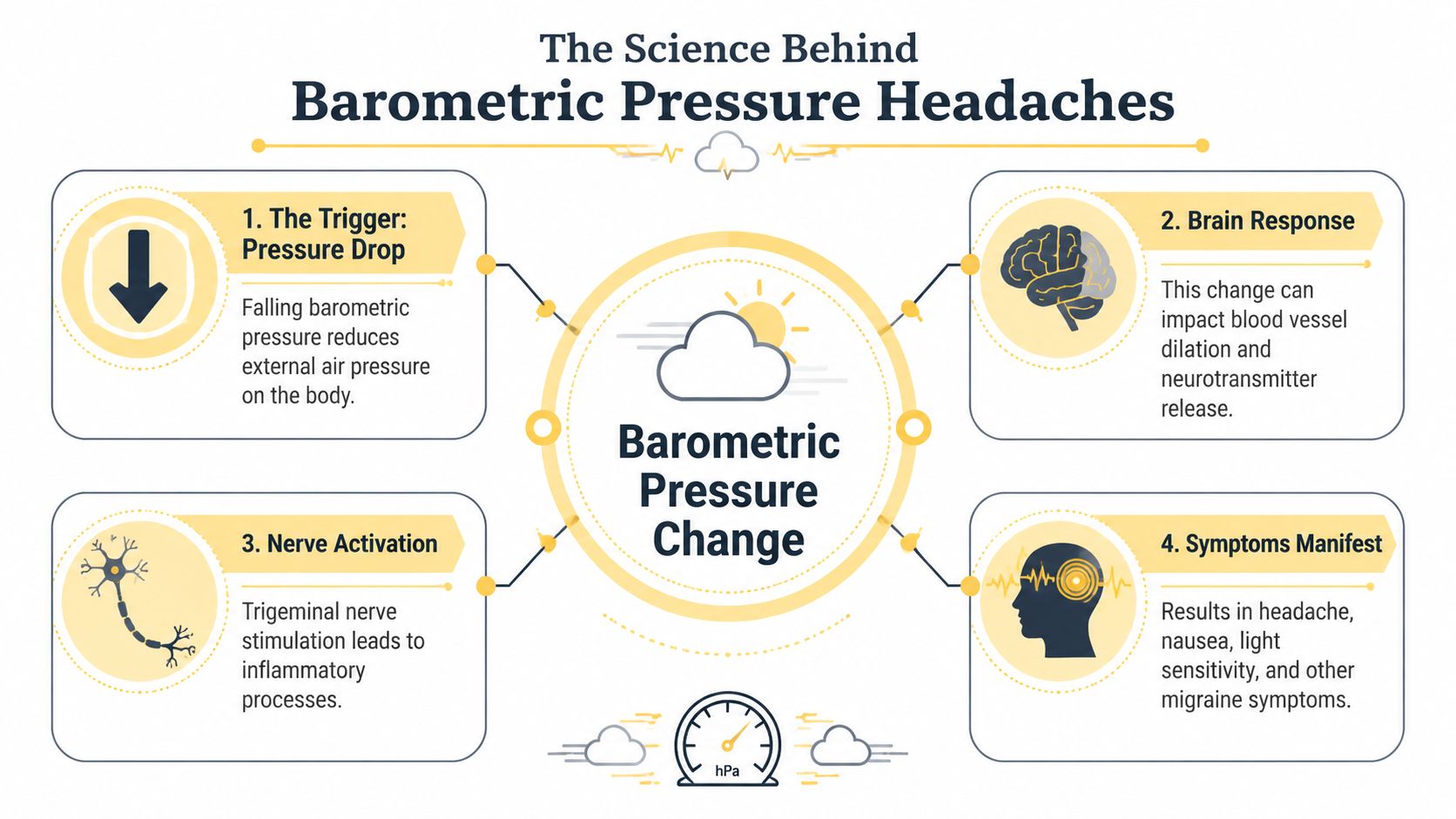
If that sounds abstract, think about what happens on an airplane when your ears need to pop. Your body already notices pressure differences. In migraine, that detection system may be more reactive, or more connected to pain pathways, than in someone who doesn't get attacks.
This also helps explain why weather isn't just about one variable. If pressure shifts at the same time as humidity changes, temperature swings, bright light, poor sleep, or stress, your nervous system may have more to handle at once. If you want a broader overview of those patterns, ReliefMigraine has a useful article on weather-triggered migraines and overlapping environmental triggers.
Practical rule: Think of weather as a possible spark, not the whole fire.
Is It Migraine Sinus or Tension During Weather Changes
This is one of the most annoying parts of weather-related pain. The symptoms can blur together, especially when your face feels full or your head feels tight.
Why these get mixed up
A weather-triggered migraine can look “sinusy” at first. You might feel facial pressure, a heavy forehead, watery eyes, or congestion. But symptoms such as light sensitivity, sound sensitivity, nausea, dizziness, concentration problems, and visual changes are more consistent with migraine than with a simple sinus headache, as outlined in this patient-facing guide on barometric pressure headache symptoms.
Tension headaches can muddy the picture too. They often cause a band-like pressure or squeezing sensation, and people sometimes label any non-throbbing head pain as “just tension.” But if you also have sensory sensitivity, nausea, or a long hangover-like phase after the pain, migraine moves higher on the list.
This article is for informational purposes and is not medical advice. Consult a healthcare provider for personalized guidance.
Migraine vs Sinus vs Tension Headache Symptoms
| Symptom | Migraine Attack | Sinus Headache | Tension Headache |
|---|---|---|---|
| Pain quality | Often throbbing, pulsing, or deep pressure | Pressure or pain in face, cheeks, forehead | Tight, squeezing, band-like pressure |
| Location | Often one side, but can be both sides | Around cheeks, nose, eyes, forehead | Usually both sides, forehead, scalp, or back of head |
| Light or sound sensitivity | Common | Less typical | Usually mild or absent |
| Nausea | Common | Less typical | Uncommon |
| Dizziness or motion sensitivity | Can happen | Less typical | Less typical |
| Aura or visual symptoms | Can happen in some migraine types | Not typical | Not typical |
| Nasal congestion or facial fullness | Can happen and confuse the picture | More expected | Uncommon |
| Neck tightness | Common | Can happen | Common |
| Duration | Can last hours to days | Varies, often tied to sinus illness | Often builds with stress or muscle tension |
| Best clue | Sensory sensitivity, nausea, aura, postdrome | Signs of infection or clear sinus disease | Pressure without classic migraine features |
A few useful clues can help in real life:
- If you have nausea or photophobia: Migraine becomes more likely. Photophobia means light sensitivity.
- If your face hurts and you're congested: Don't assume it's sinus. Migraine can cause facial pain too.
- If the pain feels like a tight band: Tension-type headache may fit better, especially without sensory symptoms.
- If you get aura or postdrome: Those strongly support migraine rather than sinus or tension headache.
For more context on overlapping weather variables, including moisture in the air, ReliefMigraine also has a helpful piece on humidity and headaches.
Proactive Prevention and Lifestyle Strategies
You can't stop a storm front. You can work on your migraine threshold so the same weather shift is less likely to tip you into an attack.
A strong reason to track this carefully comes from a diary-based study. A 2024 study in Headache used 23,213 headache diary entries from 183 participants and found that low barometric pressure, barometric pressure changes, higher humidity, and rainfall were associated with an increased number of headache attacks, according to the Headache diary study on weather and headache frequency. Diary data matters because it reflects day-to-day life, not just memory after the fact.
Think in terms of trigger stacking
For many people, weather isn't a lone trigger. It's one part of a stack.
A pressure drop on a well-rested, low-stress day may be manageable. That same pressure drop after short sleep, skipped meals, dehydration, and a stressful commute may be the final push.
Weather may be the nudge. Sleep loss, stress, and irregular meals often decide how hard that nudge lands.
What you can do on weather shift days
Instead of trying to “fight” the weather, focus on reducing extra strain on your nervous system.
- Protect sleep consistency: Go to bed and wake up as close to your usual times as you can.
- Eat regularly: Long gaps without food can make a vulnerable day worse for some people.
- Stay hydrated: Not as a cure, but as basic support when your body is already under strain.
- Lower sensory load: Sunglasses, quieter spaces, and screen breaks can help on risky days.
- Scale back nonessential stress: If you can move a demanding task, weather-shift days are a good time to do it.
- Review your known triggers: Alcohol, intense exertion, bright light, or travel may be worth avoiding if they're personal triggers for you.
Routine helps more than perfection. You're not trying to create ideal conditions. You're trying to remove enough extra stressors that the weather change doesn't push you over your personal limit.
How to Track and Forecast Your Migraine Risk
Forecasting migraine risk is more useful than arguing with yourself about whether the weather is “really” the cause. Your goal isn't to prove a theory. Your goal is to get enough warning to act earlier.

A 2025 literature review reported that 92.2% of severe migraine attacks in one earlier study occurred when barometric pressure was below 1020 millibars, and it also summarized repeated evidence that low pressure and rapid pressure change are among the most consistent weather variables linked to migraine, according to this systematic review of barometric pressure and migraine severity.
That doesn't give you a universal personal threshold. It does show why watching pressure trends can be useful.
What to log besides the pain itself
If you want patterns you can trust, log the context around the attack too.
- Start time and end time: Even rough timing helps.
- Symptoms beyond pain: Nausea, photophobia, phonophobia, dizziness, aura, neck pain, congestion.
- Weather context: Storms, pressure changes, humidity, rain, big temperature swings.
- Your body's state: Sleep quality, stress, meals, hydration, menstrual cycle if relevant, travel, screen-heavy days.
- What you did early: Rest, caffeine, cold pack, OTC treatment, prescribed acute treatment.
The goal is to spot repeats. Maybe your attacks cluster the day before rain. Maybe pressure changes only matter when sleep was poor. Maybe “sinus headaches” turn out to be migraine because they consistently come with light sensitivity.
Use forecasts as a heads up not a verdict
A weather forecast isn't fate. It's an early warning.
If you know a pressure drop is likely, you can plan a little differently. Keep your essentials with you. Avoid stacking extra triggers. Use your clinician-approved acute plan at the earliest signs if that's part of your care.
For a practical example of how people use weather data in day-to-day migraine planning, ReliefMigraine explains the idea in its guide to a barometric pressure migraine app.
If you want a deeper explanation of the inner-ear and brain pathway behind pressure sensitivity, this video is a good companion:
Your Toolkit for an Active Weather-Related Migraine
Sometimes you do everything “right” and the attack still comes. That's not failure. It means you need a simple plan you can use with as little thinking as possible.
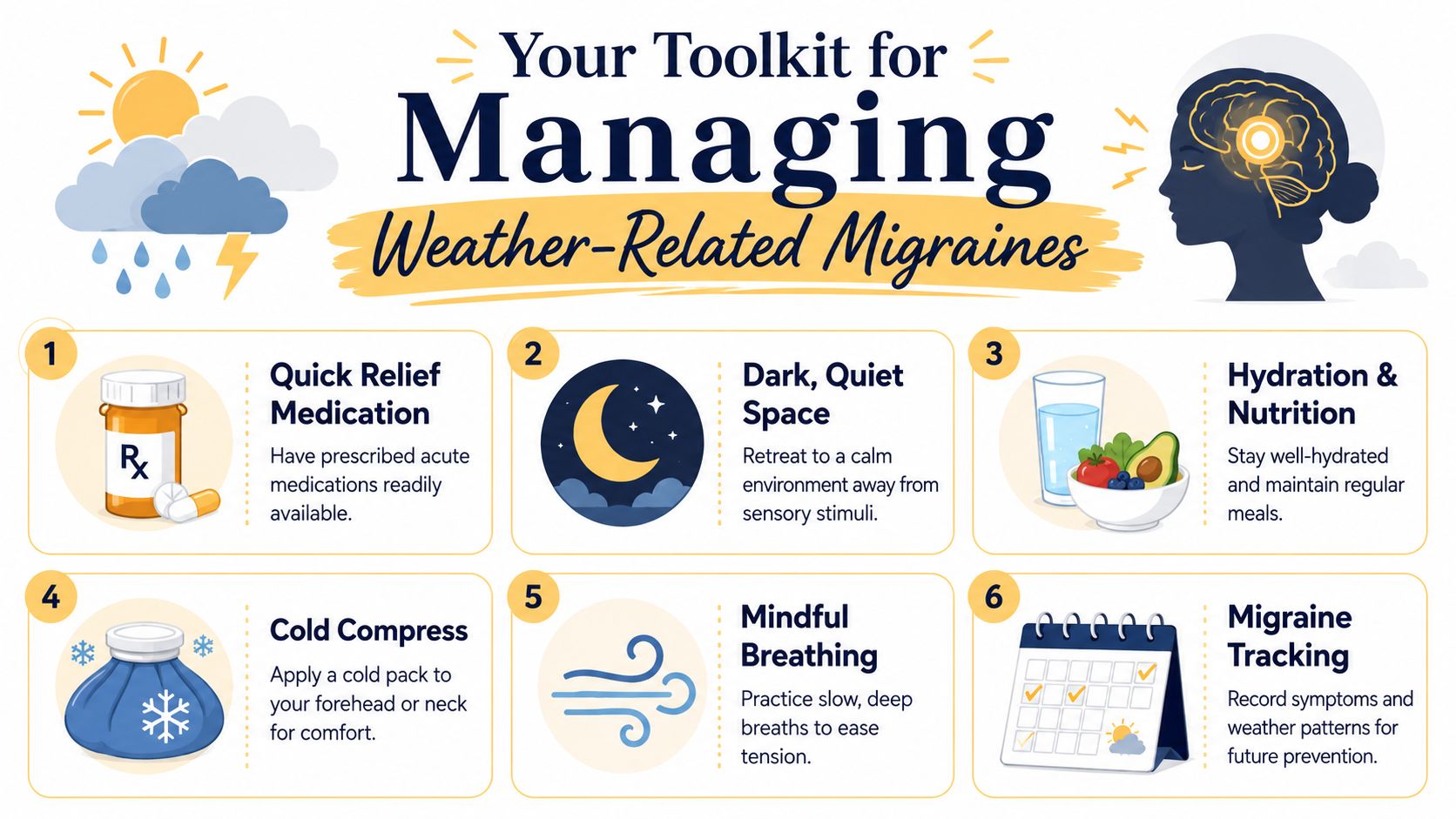
Comfort measures you can start right away
A weather-linked attack often feels worse if you wait and hope it passes. Acting early usually gives you more options.
- Reduce sensory input: A dark, quiet room can help if light and sound are aggravating symptoms.
- Use temperature for comfort: Many people prefer a cold pack on the forehead or back of the neck.
- Keep movement gentle: Rest helps, but if your neck and shoulders tighten, slow stretching may feel better than bracing.
- Hydrate and eat if tolerated: Small, plain, easy-to-manage food and fluids can be easier than a full meal.
- Pause the extra load: Bright screens, heavy workouts, and loud environments often make an active attack harder.
A useful detail about timing is that weather-triggered attacks often show up during storms or in the 24 to 48 hours before a storm arrives, when pressure may be falling quickly, as described in the earlier technical review on pressure changes and headache patterns.
OTC and prescription treatment buckets
This article is for informational purposes and is not medical advice. Consult a healthcare provider for personalized guidance.
Over-the-counter options may help some people when used appropriately. Common categories include NSAIDs or combination pain relievers. The main caution is not to use acute medications so often that they contribute to medication overuse headache. If you're reaching for OTC treatment frequently, it's worth discussing that pattern with a clinician.
Prescription acute treatments are different. These are medications your healthcare provider may prescribe specifically for migraine attacks. The key principle isn't which drug is “best.” The key principle is to follow the plan your clinician gave you and to use it as directed.
Treating early is often more effective than waiting until the pain is fully established.
You may also want to build a physical “migraine kit” in one place so you're not hunting for supplies while in pain. Include your clinician-approved medication, water, a cold pack, earplugs, eye mask, and a short checklist of what helps you most.
When to Partner with a Healthcare Provider
Weather patterns can be real and still not be the whole story. That's why diagnosis matters.
Red flags that need urgent care
Seek immediate medical care for:
- A sudden severe headache: Especially one that peaks very quickly.
- Headache with fever or stiff neck: These symptoms need urgent assessment.
- New neurological changes: Weakness, confusion, trouble speaking, or new vision changes that aren't typical for your known migraine pattern.
- Headache after a head injury: Don't assume it's weather-related.
These are not symptoms to self-sort at home.
Why diagnosis matters with weather triggers
One of the most overlooked questions is whether barometric pressure is the direct cause or a co-trigger. Migraine experts note that the evidence is not definitive, and the best-supported view is a multifactorial trigger model in which weather may interact with sleep, stress, light, humidity, altitude, and individual susceptibility, as discussed in this PubMed-indexed paper on weather and migraine mechanisms.
That nuance matters for treatment. If weather is only one piece of your pattern, a good care plan won't stop at “avoid storms.” A clinician can help you sort out whether you're dealing with migraine, tension-type headache, sinus disease, medication overuse, vestibular symptoms, or a mix.
Bring records if you have them. A short diary with symptoms, timing, and weather context can make that visit much more useful.
If you want a simple way to track symptoms, weather, and possible trigger patterns in one place, Relief can support that process by helping you log attacks and spot risk patterns before the next one starts.


