Yes, humidity can trigger headaches and migraine attacks for some people, and the clearest research signal is that a 26.5% increase in relative humidity was linked to 28% higher odds of migraine attack onset during the warm season, from April to September. If you're staring at a thick, sticky forecast and wondering whether that heavy air could be part of why your head hurts, your suspicion isn't irrational.
You wake up already feeling off. The room feels damp. Your face feels puffy, your neck is tight, and light seems sharper than usual. By lunch, you're not just dealing with a headache. You might be dealing with a migraine attack, which is a neurological disease that can involve head pain, nausea, photophobia (light sensitivity), sound sensitivity, dizziness, and symptoms that start before the pain does.
That difference matters. Not every weather-related headache is migraine, and not every migraine attack is caused by weather. But humidity and headaches do seem to be connected for some people, especially when humidity shifts rather than just staying high all day.
People often get confused because the internet frames humidity as a single trigger with a single explanation. The science is messier than that. For some people, humidity may affect sinus pressure, hydration, sleep, and the way the brain responds to environmental stress. For others, humidity may barely matter at all.
Table of Contents
- That Heavy Air Feeling Is Real and So Is Your Headache
- The strongest evidence points to shifting conditions
- What your body might be reacting to
- Why the pattern feels inconsistent
- Start by changing the air around you
- On sticky days, make the day easier on purpose
- Use layers instead of hunting for one fix
That Heavy Air Feeling Is Real and So Is Your Headache
You step outside on a hot, sticky afternoon, and within an hour your head starts to throb. That pattern is familiar for a reason. Research has found that humidity can be linked with migraine onset for some people, and the link appears to be stronger in warmer months than across the whole year, as noted earlier in this guide.
That seasonal piece matters. It helps explain why humidity can feel like a trigger one week and seem irrelevant the next. Your nervous system may be reacting to a mix of conditions, not a single weather number in isolation. Humidity is often part of the setup, especially when it rises alongside heat or arrives with a broader weather shift.
A useful way to picture it is a sensitive car alarm. Some systems stay quiet through almost anything. Others go off when several small changes happen close together. For one person, humid air may do very little. For another, a muggy day in July after poor sleep can be enough to push an already sensitive brain toward migraine.
Weather-related pain can show up as migraine, sinus pain, or a tension-type headache. Those are different conditions, and they can feel similar at first. If weather changes also leave you with ear pressure or popping, this guide on headache with ears popping may help you sort out what else could be going on.
Humidity can be real and still be inconsistent. That is common with migraine triggers.
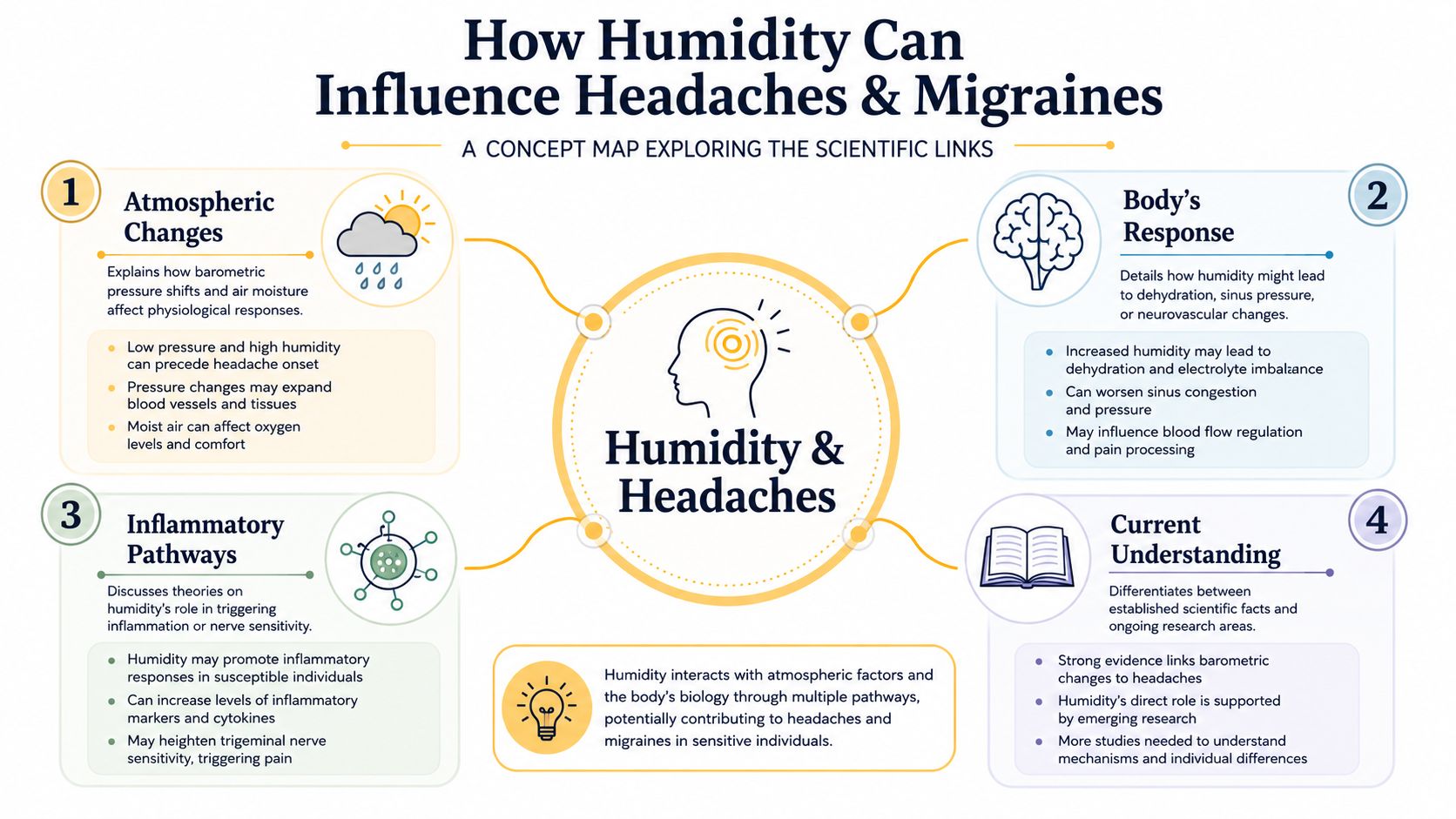
How Humidity Can Influence Headaches and Migraines
The strongest evidence points to shifting conditions
Humidity often acts less like an on-off switch and more like one part of a changing weather pattern. Many people seem to react when humidity rises, falls, or arrives alongside heat and other atmospheric changes, rather than from a single humidity number by itself.
That idea helps make sense of a frustrating pattern. Two days can show similar humidity in the weather app and feel completely different in your body. A warm, sticky day after poor sleep may hit much harder than a humid day when you've eaten well, stayed cool, and your system is calm.
Research reflects that complexity. A review of weather and migraine studies found mixed results overall, and the strongest prospective finding linked higher relative humidity with higher odds of migraine onset during warm seasons, not consistently across the whole year [PubMed Central review on weather and migraine].
If weather shifts also leave your ears full or popping, pressure changes may be part of the pattern too. ReliefMigraine's guide on headache with ears popping can help you sort out that clue.
What your body might be reacting to
Humidity changes can affect several body systems at once. That is one reason the trigger can feel vague. The headache is real, but the path to it may be indirect.
Heat strain and fluid loss
Humid air slows sweat evaporation, which is your body's cooling system. If that cooling system works poorly, you can overheat faster, sleep worse, and lose fluids without recovering well. For some people, the problem is not humidity alone. It is the chain reaction that follows.
Nasal and sinus irritation
Some people feel congested, heavy, or achy around the forehead, cheeks, and eyes when humidity shifts. That can resemble a sinus headache, but migraine can also cause facial pressure and nasal symptoms. The overlap creates confusion, especially during storms or muggy weather.
A more sensitive migraine brain
Migraine brains tend to notice change. During prodrome, the early phase before head pain, you might yawn more, feel unusually tired, get neck stiffness, or notice food cravings. A swing in humidity may be one more nudge that pushes an already sensitive nervous system closer to an attack.
A practical way to picture this is a dimmer switch, not a light switch. Humidity can raise the background load on your system, especially in summer, and other factors decide whether symptoms stay manageable or tip into a full migraine.
Practical rule: If humidity seems related to your attacks, log the full weather setup and what your body was doing that day, including heat exposure, sleep, hydration, congestion, and early migraine symptoms.
Why the pattern feels inconsistent
Weather-related headaches rarely come from one ingredient. Humidity often travels with higher temperatures, storm fronts, indoor air changes, and shifts in barometric pressure. That makes it hard to point to one culprit, even when the pattern feels obvious to you.
This is also why a trigger can seem personal. One person's nervous system reacts strongly to sticky summer air. Another person's symptoms show up only when humidity changes quickly after a pressure shift. Someone else notices no effect at all. Recent research supports that more nuanced view. The question is often not "Is humidity bad?" It is "What kind of humidity change, in what season, and alongside what other stressors, tends to set off symptoms for you?"
Is Humidity One of Your Personal Triggers
Humidity can act more like a pattern than a single cause. Some people feel worse during sticky summer stretches. Others notice symptoms when the air shifts quickly from dry to damp, or when muggy weather arrives with heat, poor sleep, congestion, or dehydration. That is why weather sensitivity can feel inconsistent from one attack to the next.
As noted earlier, research suggests weather is a trigger for many people with migraine, but not for everyone. The more useful question is usually narrower. Do your symptoms tend to show up after a certain kind of humidity change, in a certain season, and with a certain mix of other stressors?
What to track on humid days
To identify your triggers, track the full context of your symptoms.
A good log works like putting puzzle pieces on the table at the same time. One piece by itself may not mean much. Several pieces that keep appearing together can reveal a pattern.
- Timing: Write down when symptoms begin relative to the weather shift. Was it before a storm, during the muggiest part of the afternoon, after time outdoors, or the following morning?
- Speed of change: Note whether humidity climbed fast, dropped fast, or stayed high for hours. For some people, the swing matters more than the number itself.
- Season and temperature: Record whether it was a hot summer day, a cool rainy day, or a warm indoor environment with poor airflow. Humidity often behaves differently depending on the setting around it.
- Early symptoms: Include yawning, fatigue, neck stiffness, irritability, food cravings, light sensitivity, or brain fog. These can signal that a migraine process had already started before head pain appeared.
- Pain features: Record where the pain sits, whether it feels throbbing, pressing, or heavy, and whether routine movement makes it worse.
- Associated symptoms: Include nausea, dizziness, sound sensitivity, nasal congestion, watery eyes, or facial pressure.
- Context: Add sleep quality, stress, missed meals, allergy symptoms, heat exposure, and hydration. Triggers often stack rather than act alone.
If you are not sure whether your symptoms fit migraine or another headache type, ReliefMigraine's migraine or headache quiz can help you sort through the pattern in a more structured way.
Symptom checker
| Symptom | Migraine | Sinus Headache | Tension-Type Headache |
|---|---|---|---|
| Pain location | Often one side, but can be both sides | Around cheeks, forehead, eyes | Usually both sides, band-like |
| Pain quality | Throbbing, pulsing, or pressure | Pressure or fullness in the face | Dull, tight, pressing |
| Light sensitivity | Common | Less typical | Can happen, but usually milder |
| Nausea | Common in many attacks | Less typical | Uncommon |
| Worse with movement | Often yes | Sometimes when bending forward | Usually not markedly worse |
| Nasal congestion | Can happen during migraine and confuse the picture | Common | Less typical |
| Neck tightness | Common before or during attack | Can happen, but less defining | Common |
| Aura | May occur in some people. Aura means reversible neurological symptoms such as visual zigzags, blind spots, or tingling before or during an attack | Not typical | Not typical |
If your "sinus headaches" come with light sensitivity, nausea, or a need to lie down in a dark room, migraine is worth discussing with a clinician.
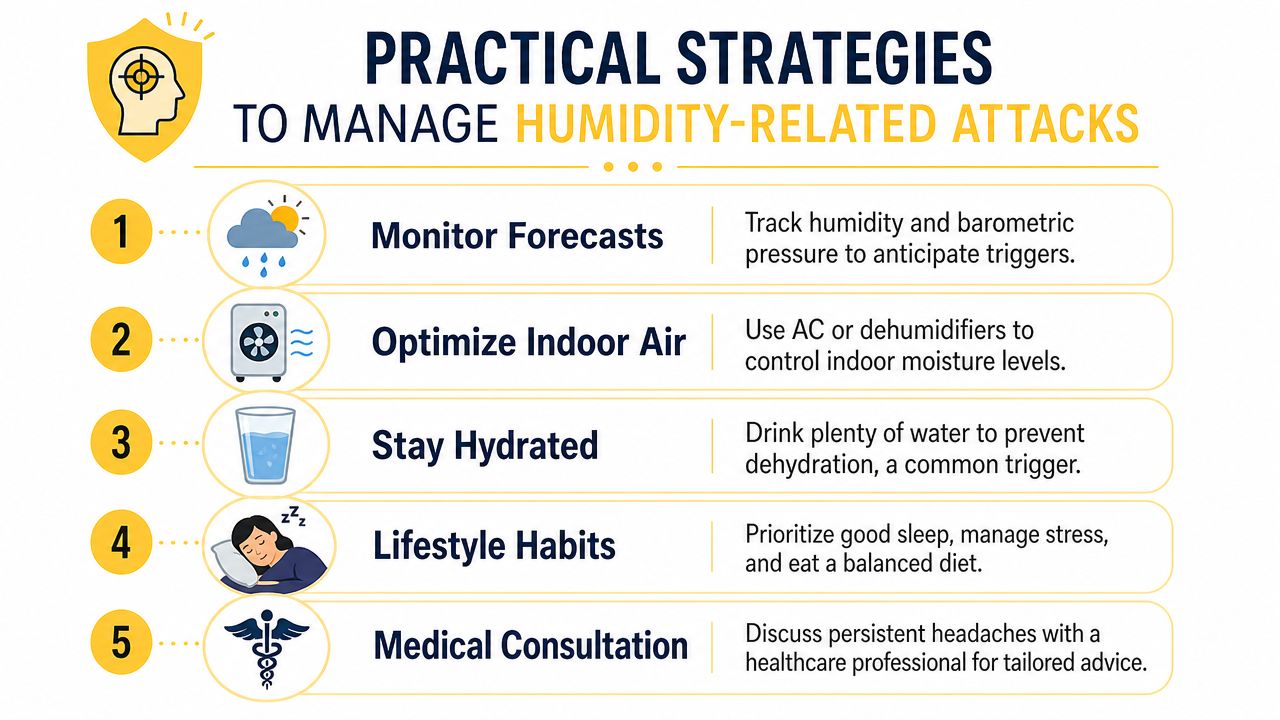
Practical Strategies to Manage Humidity-Related Attacks
Managing humidity-sensitive attacks works best when you treat weather as one part of the load on your nervous system. For some people, the problem is not only "high humidity." It is the swing into sticky air, the combination of humidity with heat, or the way indoor air starts to feel heavy and stagnant after the weather changes.
Start by changing the air around you
Indoor air can either calm things down or add one more irritant. If a room feels damp, stuffy, warm, or poorly ventilated, your body may read that environment as extra strain. Research on indoor environmental conditions has linked out-of-range humidity and temperature with greater headache burden [PubMed Central study on indoor environmental factors and headache].
You do not need perfect numbers on a monitor all day. You need a space that feels easier to be in.
- Use air conditioning or a dehumidifier: Lowering indoor moisture can make humid weather feel less oppressive.
- Improve airflow: Fans, vents, or a different room can help stale air feel more tolerable.
- Check repeat trouble spots: Bedrooms, bathrooms, and enclosed work areas often hold moisture longer than the rest of the home.
- Pay attention to musty smells: Persistent dampness, mold, or poor ventilation may be keeping your baseline irritation higher than you realize.
If pressure changes also tend to show up around the same time, this guide on tracking barometric pressure and migraine patterns can help you connect the dots more clearly.
A short explainer can help if you want ideas you can test at home.
On sticky days, make the day easier on purpose
Humidity-related attacks often build the way a crowded backpack gets heavier one item at a time. The air feels thick, your body works harder to cool itself, sleep may have been worse the night before, and a normal day suddenly asks too much of a sensitive system.
That is why a "lighter day" strategy helps.
- Hydrate early in the day: Start before you feel depleted.
- Keep meals regular: A predictable eating schedule gives your brain one less stress signal to deal with.
- Protect the night before humid weather: A cooler room and a steady bedtime routine can lower the chance that weather changes hit an already tired system.
- Cut back on heat exposure: Move errands earlier, take breaks sooner, and cool down before you feel overheated.
- Reduce sensory strain if early symptoms start: Sunglasses, a hat, and quieter spaces can help when an attack is building.
Sometimes the best prevention is reducing the number of small stressors arriving at once.
Use layers instead of hunting for one fix
Humidity management usually works as a set of small adjustments. Each one may seem modest on its own, but together they can lower the odds that a weather shift turns into a full attack.
Home and routine changes
These include indoor humidity control, airflow, pacing, regular meals, and protecting sleep. They help lower background strain during weather shifts.
Over-the-counter treatment
Some people use nonprescription pain relief at the start of an attack. Follow the label, and check with a clinician or pharmacist if you have frequent headaches, other medical conditions, or questions about what is safe for you.
Prescription care
If attacks are frequent, disruptive, or changing, a healthcare professional can help you sort through acute treatment, prevention, or both.
Tracking tools
Relief can log symptoms alongside local weather factors such as humidity, barometric pressure, temperature, wind, and air quality. That kind of record is useful because patterns often come from changes in several conditions at once, not from humidity alone.
Using Forecasting to Stay One Step Ahead
You wake up to air that feels thick before you even step outside. By afternoon, the forecast shows rising humidity, warmer temperatures, and a storm chance later tonight. If weather shifts are part of your pattern, that is useful information early in the day, when small choices still have room to help.
Forecasting gives you lead time. That matters because weather-related attacks do not always line up neatly with the hour the forecast changes. The body can react to a cluster of changes, then tip into symptoms later, especially if sleep, stress, heat, or dehydration are already adding strain.

Why looking ahead helps
Humidity is rarely the whole story by itself. For many people, the more meaningful signal is change. A jump in humidity during hot weather may hit differently than the same humidity level on a cool day. Seasonal context matters too. Your body may handle a muggy spring day differently than a muggy day after weeks of summer heat.
That is why forecasts are more useful when you read them like a pattern, not a single number. Rising humidity, a pressure shift, hotter temperatures, and poor sleep can work like several small hands pushing on the same door.
Turn weather data into personal patterns
A forecast can show that humidity is climbing. Your own history shows whether that kind of climb tends to matter for you, and under what conditions.
Try a simple routine:
- Check for changes across the day: Focus on whether humidity is rising or dropping, and whether temperature or storm conditions are shifting with it.
- Match the forecast to your past attacks: Notice whether symptoms tend to show up during sticky heat, before rain, after sudden weather swings, or only when weather changes combine with other stressors.
- Make one or two early adjustments: You might move outdoor plans, protect your sleep that night, keep meals regular, or make sure treatment is easy to reach.
- Review patterns over time: Repeated timing is more useful than one memorable bad day. This is how you separate coincidence from a real trigger pattern.
If pressure changes also seem to show up in your attacks, this guide to a barometric pressure migraine app can help you decide what to track together.
Forecasting works best as a way to reduce surprises. You are not trying to predict pain with certainty. You are learning when your body may need a little more support.
When to See a Doctor About Your Headaches
Weather-triggered pain can be real without being harmless by default. Some headache symptoms need urgent medical attention, no matter what the forecast says.
Seek immediate medical care if you have:
- A sudden, severe headache: Especially one that peaks very quickly or feels unlike anything you've had before
- Headache with fever or stiff neck: This can signal a serious medical problem
- Neurological changes: Such as confusion, weakness, fainting, trouble speaking, new vision changes, or one-sided numbness
- Headache after a head injury: Even if the injury seemed minor at first
Make a non-emergency appointment if your headaches are getting more frequent, more intense, changing in pattern, or not responding to self-care or over-the-counter measures. It's also worth checking in if you think you've been having "sinus headaches" but the symptoms fit migraine more closely.
This article is for informational purposes and is not medical advice. Consult a healthcare provider for personalized guidance.
If you want a clearer picture of whether humidity is part of your migraine pattern, Relief can help you track symptoms alongside local weather so you can spot patterns earlier and plan with fewer surprises.


