Headache with ears popping often comes down to pressure changes. Sometimes that pressure is physical, in the Eustachian tubes or sinuses. Sometimes it's part of migraine itself, and ear pressure can show up during an attack in ways that feel confusingly similar to an ear problem.
If you're dealing with this right now, you're not overthinking it. That combination can feel strange, distracting, and hard to interpret. One minute it seems like a clogged ear. The next minute your head hurts and you're wondering whether this is allergies, a cold, a sinus issue, jaw tension, or a migraine attack. Sorting that out matters, because the most helpful next step depends on which kind of pressure you're feeling.
This article is for informational purposes and is not medical advice. Consult a healthcare provider for personalized guidance.
Table of Contents
- That Unsettling Pop Behind Your Headache
- The pressure valve your body uses
- Why ear problems can feel like head pain
- Eustachian tube dysfunction
- Sinus congestion and infections
- Barometric pressure and altitude changes
- TMJ dysfunction
That Unsettling Pop Behind Your Headache
A lot of people describe headache ears popping the same way. There's pressure, then a crackle or pop, then a dull ache or sharper pain that makes it hard to tell where the problem is starting.
The tricky part is that two different systems can create a very similar feeling. One is structural pressure, where the ear, nose, throat, or nearby tissues aren't equalizing pressure well. The other is neurological pressure, where migraine changes how your brain and nerves process sensory signals, including sensations in and around the ear.
Practical rule: If the popping came on with a cold, allergies, sinus congestion, altitude change, or recent flight, a pressure problem in the ear or sinuses becomes more likely. If it comes with light sensitivity, nausea, sound sensitivity, motion sensitivity, or a familiar migraine pattern, migraine moves higher on the list.
That distinction gets missed all the time. Many people assume popping means the ear must be the cause. Sometimes it is. But sometimes the ear feeling is just one piece of a migraine attack, much like neck pain, brain fog, or dizziness can be.
If your symptoms have been brushed off before, that frustration makes sense. Ear symptoms can look “too ENT” for a headache visit and “too headache-related” for an ear visit. What helps is looking at the full pattern instead of any one symptom in isolation.
How Your Ears and Head Are Physically Connected
The pressure valve your body uses
Your Eustachian tube is a small passage that connects the middle ear to the back of the throat. It operates much like a pressure valve. Its job is to open briefly when you swallow, yawn, or chew so air pressure stays balanced on both sides of the eardrum.
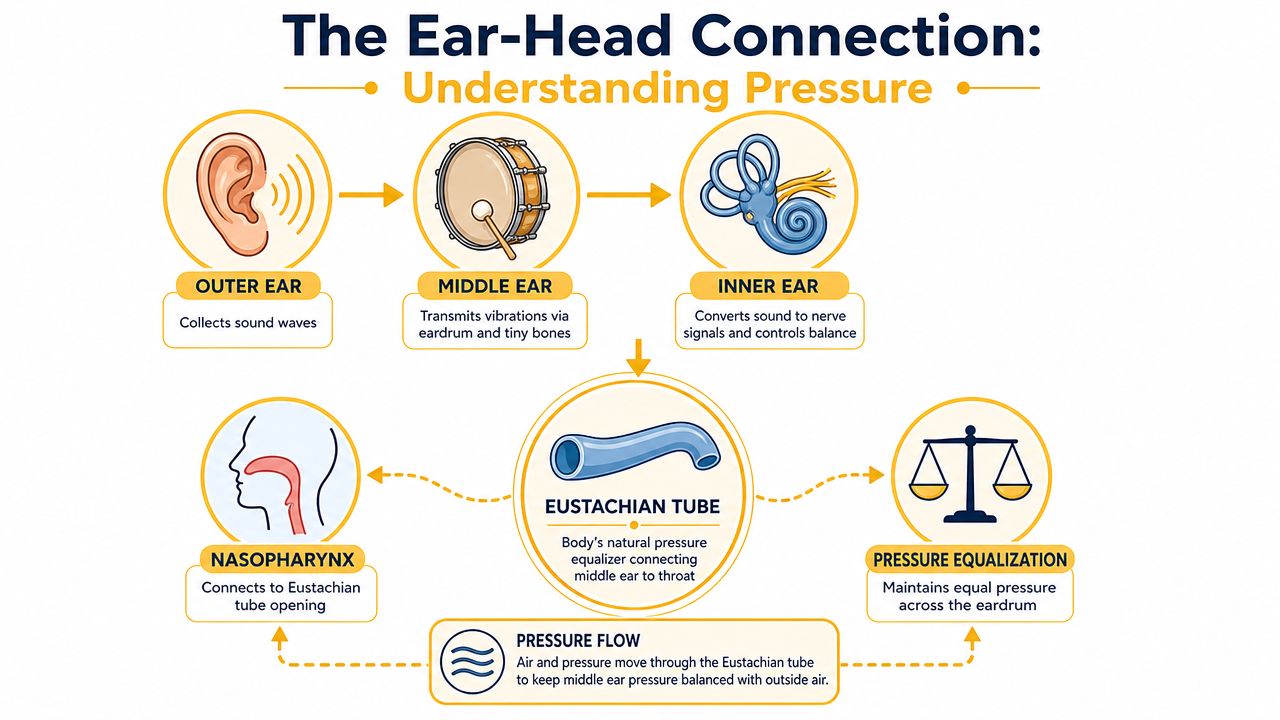
When that tube works smoothly, you usually don't notice it. When it doesn't, you may feel fullness, muffled hearing, pressure, or popping. If congestion from a cold, allergies, sinus irritation, or a pressure change blocks the tube, the middle ear can't equalize well and the sensation becomes obvious.
Why ear problems can feel like head pain
The ear isn't isolated. It sits near the jaw, the sinuses, and several nerve pathways that can refer pain into the temple, side of the head, face, or behind the eye. That's one reason an ear issue can feel like a headache instead of a classic “earache.”
Clinical reporting summarized in an urgent-care review estimates that 15% to 40% of patients with ear-related conditions also report referred pain that shows up as headache, and roughly one quarter of patients seeking medical help for secondary headaches have an ear or sinus problem as the root cause (urgent-care review of ear pain and headache overlap).
A simple example helps. If the middle ear is under pressure, your body doesn't always label that sensation neatly. You might feel it as temple pain, a heavy forehead, pain behind one ear, or a vague “my head feels off” sensation.
Pressure doesn't always stay where it starts. The body often “spreads” the feeling through nearby nerves and tissues, which is why ear and head symptoms can blur together.
Common Causes of Headache with Ear Popping
Eustachian tube dysfunction
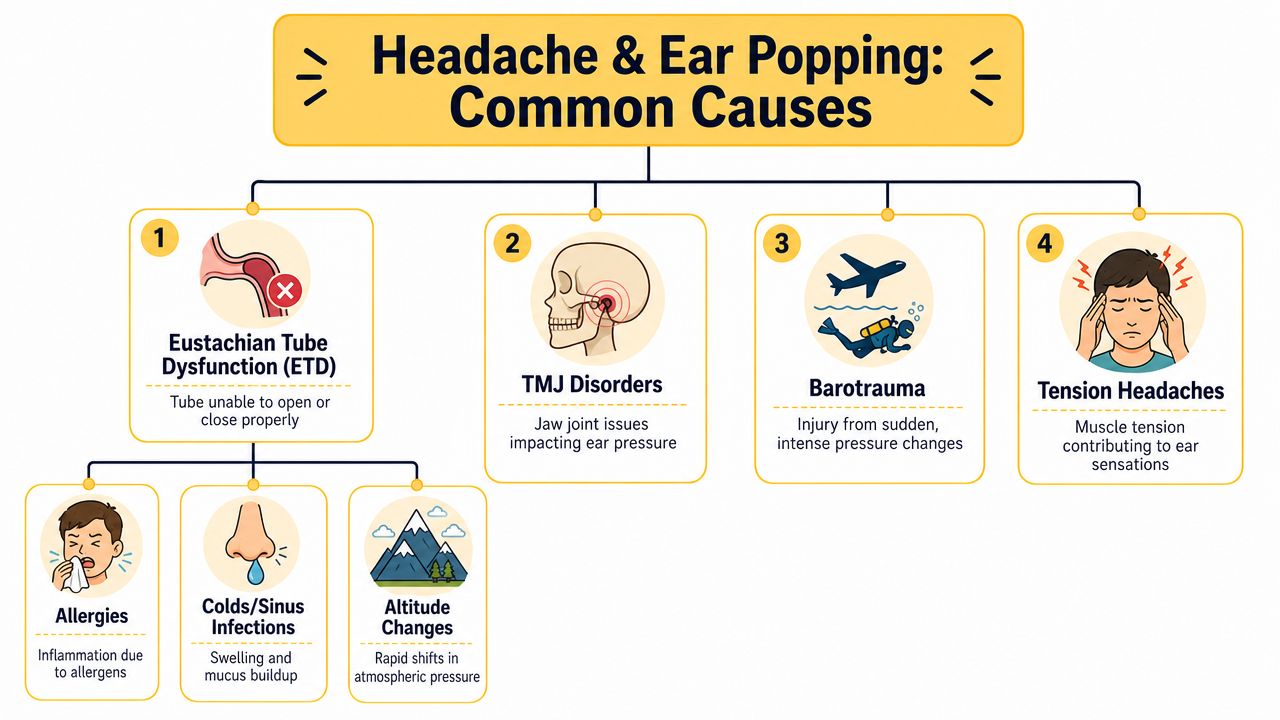
The most common explanation is Eustachian tube dysfunction, often shortened to ETD. This happens when the tube connecting the middle ear to the back of the nose doesn't open and close normally, so pressure regulation gets sloppy or stuck. Congestion from colds, allergies, or sinus inflammation can block the tube and lead to popping, fullness, and sometimes headache or ear pain (overview of ear popping and Eustachian tube dysfunction).
Typical clues include:
- Fullness or blockage: Your ear feels stuffed, underwater, or slow to “clear.”
- Muffled hearing: Sounds seem dulled, especially on one side.
- Temporary relief with swallowing or yawning: The tube may open briefly, then close again.
- Recent congestion: A cold, allergy flare, or sinus irritation often shows up first.
If your symptoms seem worse during allergy season, it may help to also look at common allergy-related patterns in this article on histamine and migraine headaches.
Sinus congestion and infections
Sinus pressure can also create the headache-and-popping combination, especially if the nose feels blocked and your face feels heavy. In that case, the pressure tends to sit in the cheeks, forehead, around the eyes, or along the bridge of the nose.
The popping usually comes from nearby swelling affecting pressure balance rather than from the sinuses making noise themselves. If there's also thick nasal drainage, facial tenderness, or symptoms that build during a cold, a sinus-related cause moves higher on the list. Ear infections can add fluid behind the eardrum, which can also create crackling or popping sensations.
Barometric pressure and altitude changes
Some people notice ear popping and headache during flights, mountain drives, weather shifts, or elevator rides in tall buildings. That's because outside pressure changes faster than the middle ear can adjust.
This usually feels mechanical. Your ears may resist clearing, then pop suddenly. The headache can feel pressure-like rather than throbbing. If the timing lines up closely with travel or obvious weather change, that clue matters.
TMJ dysfunction
The temporomandibular joint, or TMJ, sits close to the ear canal. When the joint or surrounding jaw muscles are irritated, you might feel pain in front of the ear, temple headache, jaw clicking, or a sense of ear pressure even when the ear itself is normal.
A few clues point in this direction:
- Jaw soreness: Especially when chewing, yawning, or waking up
- Clicking or popping in the jaw: Different from ear popping, but often confused with it
- Temple pain: A tight, achy feeling at the sides of the head
- Clenching or grinding: Many people notice this at night or during stress
When the pain gets worse with chewing or jaw movement, think beyond the ear itself.
Could Your Ear Popping Be Part of a Migraine Attack?
Why migraine can create ear symptoms
This is the part many people don't get told. Migraine is a neurological condition, not just a bad headache. It can affect sensory processing, pain pathways, balance, sound sensitivity, and autonomic functions. That means a migraine attack can create ear fullness, popping, distorted sound, dizziness, or pressure without there being a blocked tube or infection.
Research has been moving in that direction. A 2022 review reported that in a cohort of patients with vestibular migraine, 63% experienced ear pressure during attacks, supporting the idea that ear symptoms can be part of migraine physiology rather than only an ear disorder (review of vestibular and auditory manifestations of migraine).
This matters if you keep getting ear pressure with migraine features but repeated ear exams don't show much. It may not mean “nothing is wrong.” It may mean the wrong system is getting the blame.
If you're not sure whether what you're feeling is part of prodrome, aura, or the main attack itself, this guide to migraine warning signs can help you compare the timing.
Symptom clues that can help you tell them apart
Here's a simple comparison. It won't diagnose the cause, but it can make your pattern easier to describe to a clinician.
| Symptom Clue | More Likely an ENT/Structural Issue | More Likely a Migraine Symptom |
|---|---|---|
| Timing | Starts with a cold, allergies, recent flight, altitude change, or congestion | Starts with or around migraine features such as nausea, photophobia, sound sensitivity, dizziness, or brain fog |
| Ear feeling | Blocked, stuffed, muffled, may improve briefly with swallowing or yawning | Fullness, pressure, popping, or sound distortion that doesn't clearly respond to clearing maneuvers |
| Pain pattern | Pressure or pain centered in ear, face, or sinus areas | Head pain with migraine traits, often one-sided, pulsating, or linked to movement sensitivity |
| Other symptoms | Fever, drainage, nasal symptoms, hearing change, persistent local pain | Light sensitivity, motion sensitivity, nausea, aura, recurrent similar episodes |
| Pattern over time | Often tied to illness or environmental pressure changes | Often recurrent, with a personal trigger pattern such as sleep disruption, weather shifts, stress, or hormonal changes |
If your ear symptoms keep showing up in the same time window as your migraine symptoms, treat that pattern as meaningful data.
Home Remedies and When to See a Healthcare Provider
Some headache ears popping episodes are short-lived and improve as pressure settles. Gentle self-care can help you get through the uncomfortable part while you watch the pattern.
Gentle things you can try at home
Try the lowest-force options first.
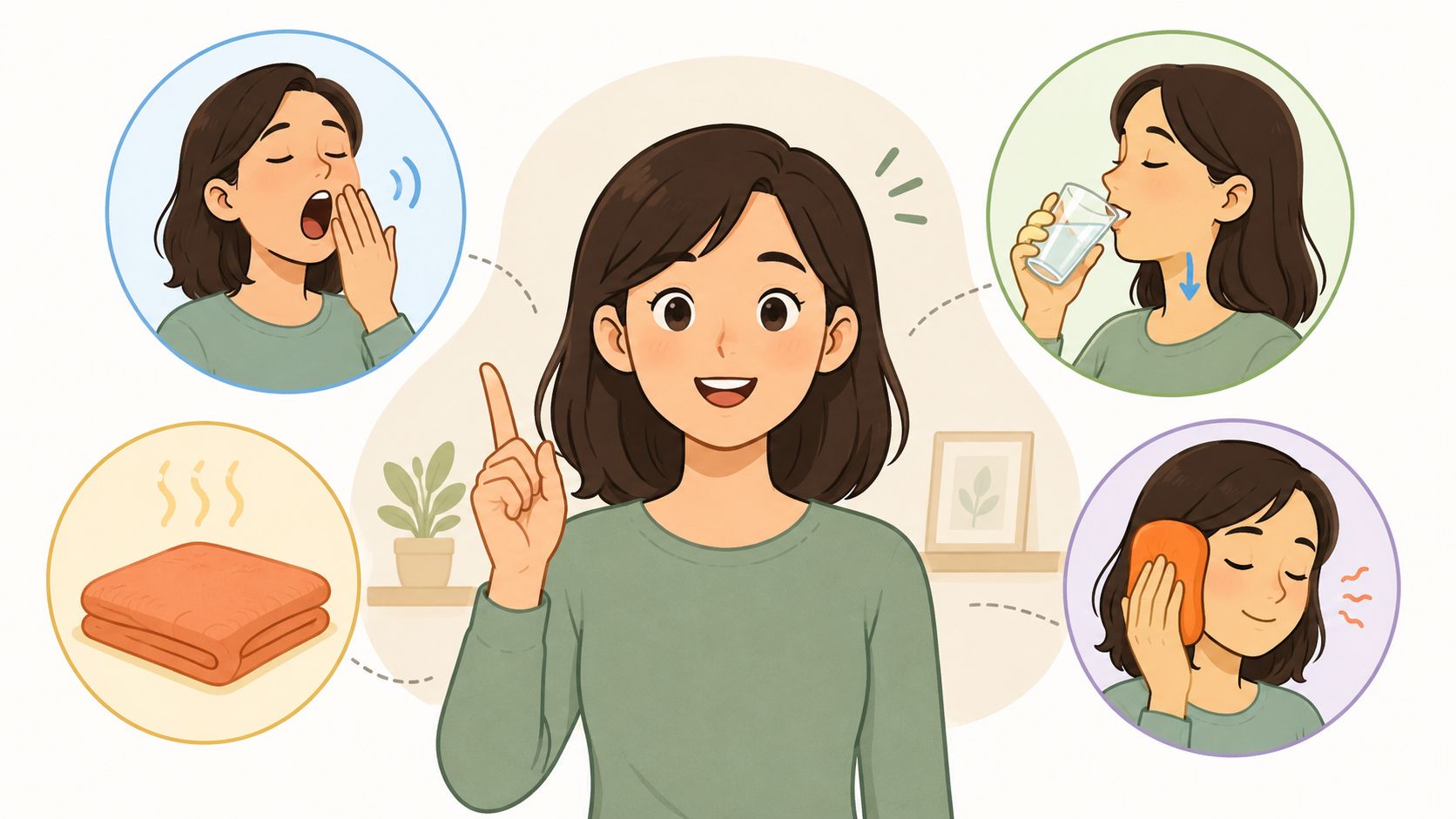
- Swallow or yawn repeatedly: This may help the Eustachian tube open naturally.
- Sip water: Frequent swallowing can be more effective than one big attempt to “pop” the ear.
- Use saline nasal spray: This may reduce dryness and mild congestion around the back of the nose.
- Apply a warm compress: Gentle warmth near the ear or jaw can ease surrounding tension.
- Rest in a calm environment: If migraine might be involved, lowering light and noise can help while you monitor the rest of your symptoms.
Avoid forceful blowing, aggressive ear clearing, or ear candles. Those can irritate the area and make things worse.
If the pattern seems connected to muscle tension or head pain management strategies, some people also discuss non-drug options like those covered in this overview of TENS machine use for headache.
A short demonstration can make the gentler options easier to picture:
When you should get checked
While many cases are minor, some combinations should not be brushed off. Authoritative patient guidance notes that sudden hearing change, fever, severe pain, or drainage from the ear warrant medical evaluation, and the differential can include conditions such as middle-ear infection or mastoiditis (guidance on ear popping and warning signs).
Seek prompt medical care if you have:
- Sudden hearing loss or major hearing change
- Fever with ear pain or pressure
- Drainage from the ear
- Ongoing or severe pain
- New dizziness that feels intense or disabling
- Symptoms that keep returning without a clear explanation
Seek immediate medical care for a sudden severe headache, headache with fever and stiff neck, neurological changes, or headache after a head injury.
This article is for informational purposes and is not medical advice. Consult a healthcare provider for personalized guidance.
Tracking Your Symptoms to Uncover Patterns
When symptoms sit between two worlds, ear problem and migraine problem, tracking becomes one of the most useful things you can do. Not because you should have to diagnose yourself, but because patterns often tell the story better than memory does.
Write down what happened before the episode. Include ear fullness or popping, the side it happened on, headache location, sound sensitivity, light sensitivity, dizziness, congestion, jaw pain, weather shifts, altitude changes, sleep, and stress. If you're someone who gets recurrent migraine, that record can help a clinician see whether the ear symptom belongs to the migraine pattern or points elsewhere.
That's especially important because migraine-related ear symptoms are gaining recognition, and one study on migraine-associated ear pain found that migraine treatment improved ear pain in 87% of patients. That's a strong reminder that ear symptoms sometimes improve when the migraine pattern is identified and treated correctly, not just when the ear is treated on its own.
A tool like Relief can make this easier by logging symptoms alongside weather and other triggers, so you can spot whether your ear popping tends to show up with congestion, pressure changes, or a broader migraine pattern.
If headache with ears popping keeps leaving you unsure what your body is trying to tell you, tracking the full pattern over time can make those symptoms easier to understand and easier to discuss with a healthcare provider.


