When your head is pounding and you're scanning the internet for a TENS machine headache answer, you usually want two things fast. Can this help, and could it make things worse? The honest answer is that electrical stimulation may help some people with migraine or certain headache patterns, but only when the device, placement, and safety rules match the problem. Generic advice like “put the pads where it hurts” isn't good enough for head pain.
This article is for informational purposes and is not medical advice. Consult a healthcare provider for personalized guidance.
Table of Contents
- Choosing Your TENS settings
- Placement for tension-type headache
- Placement for migraine
- Timing and what a session should feel like
- When TENS is a poor idea
- Red flag symptoms that need urgent care
- A simple decision check before you start
Understanding TENS for Headache and Migraine Relief
A TENS machine is a small device that sends mild electrical pulses through the skin through adhesive electrodes. People often use it for body pain. For headaches and migraine, the idea is more specific. The stimulation has to reach the right nerve distribution, not just the sore area.
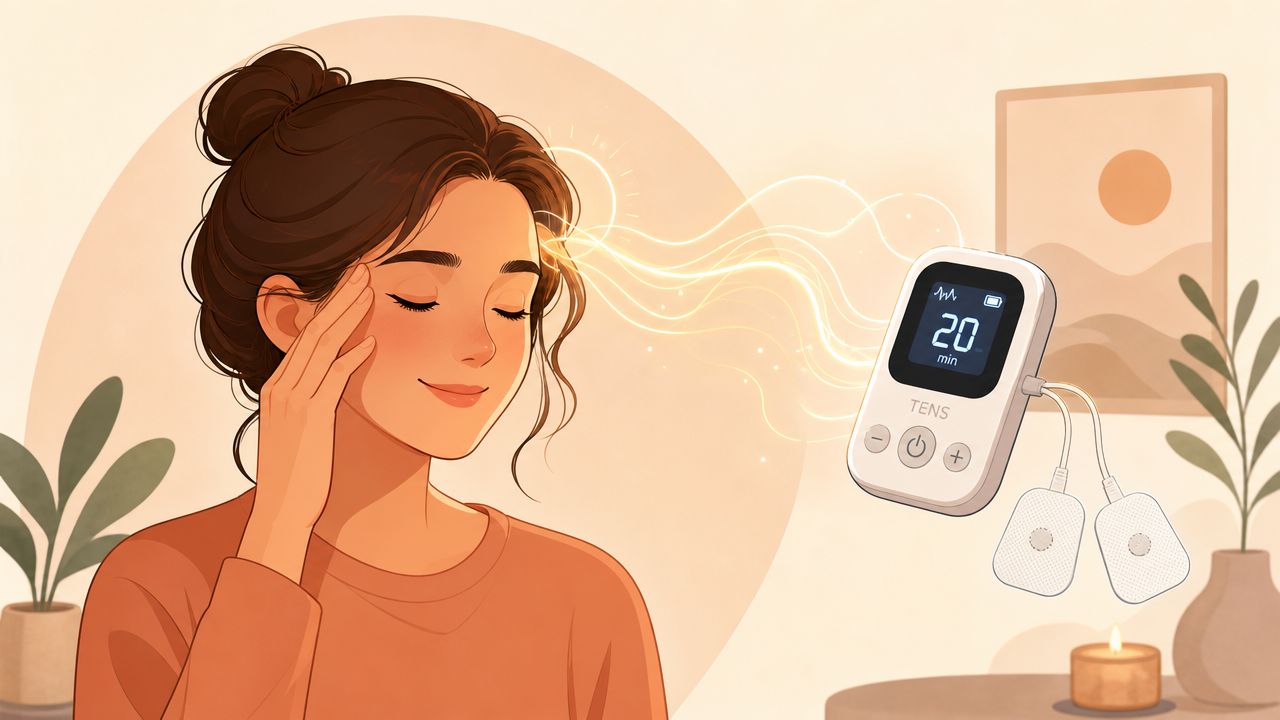
What a TENS device actually does
Two common explanations are used to describe why electrical stimulation may reduce pain.
First is the gate control theory. In simple terms, a non-painful input like tingling may interfere with pain signals traveling to the brain. That doesn't mean the migraine process disappears. It means the device may change how pain is being processed or perceived in that moment.
Second is endorphin release. Endorphins are the body's own pain-relieving chemicals. Some stimulation patterns are thought to support that response, which is one reason settings matter.
Practical rule: A helpful TENS session should feel noticeable but tolerable. It shouldn't feel sharp, burning, or alarming.
Why head pain is different from other pain
Many people get tripped up on this point. A general-purpose TENS machine used for a sore shoulder isn't automatically equivalent to a migraine device.
The strongest quantitative evidence in migraine comes from a 2018 meta-analysis of four randomized controlled trials including 276 total patients. It found significant reductions in monthly headache days and painkiller intake, along with higher responder rates and greater satisfaction with real TENS than sham TENS. The same paper also said the evidence quality was still considered low because of study limitations.
That combination matters. There is real signal here, but not certainty.
For migraine, experts often focus on stimulation around branches of the ophthalmic nerve, which is part of the trigeminal system involved in migraine pain. That's very different from placing pads randomly on the scalp because “that's where it hurts.”
A useful way to think about it is this short comparison:
| Device type | Typical purpose | Best thought of as |
|---|---|---|
| General TENS unit | Broad pain relief | A general tool that may or may not fit head pain well |
| Migraine-specific neuromodulation device | Targeted migraine use | A more specialized tool designed around migraine nerve pathways |
If you're considering a TENS machine for headache relief, keep your expectations realistic. It may become one part of your toolkit, especially if you're trying to reduce reliance on medication or want a non-drug option. But success usually depends on matching the device and placement to the headache pattern, not just turning it on and hoping for the best.
The Scientific Evidence for Using TENS on Migraines
Migraine is not the same as a generic headache. It can involve throbbing pain, nausea, photophobia (light sensitivity), phonophobia (sound sensitivity), aura in some people, and a postdrome “hangover” phase after the main attack. That distinction matters because migraine studies don't only test whether electrical stimulation feels pleasant. They test whether it changes migraine burden in a meaningful way.
What the better studies suggest
One important milestone involved the Cefaly external trigeminal nerve stimulation device. In a clinical study reported by EMPR, 81% of migraine sufferers experienced relief. In that study, patients used the device for 20 minutes a day over at least two-thirds of a required 60-day consecutive treatment period, and researchers found that headache pain intensity during migraine attacks was significantly reduced. That result stood out because earlier studies had focused more on prevention than on acute pain relief during an attack.
Cefaly is also a reminder that not every electrical stimulation device is interchangeable. It is a non-drug external trigeminal nerve stimulation device and is prescription-only in the U.S. according to that same report.
If your attacks leave you wiped out for hours or days afterward, it helps to understand the whole arc of a migraine episode, not just the pain itself. This guide on how long migraine recovery can take can help you place any symptom relief in the bigger picture.
Why the evidence is promising but limited
The science here is encouraging, but it isn't a blank check.
Different studies use different devices, different pad placements, different stimulation settings, and different patient groups. Some people have episodic migraine, others have chronic migraine, and some have prominent neck pain while others have scalp sensitivity or aura. Those differences can change how tolerable and useful electrical stimulation feels.
Some people do get measurable relief. Others feel very little, or feel worse if the placement or intensity is wrong.
That's why I wouldn't present TENS for migraine as a cure or a sure bet. A more accurate view is this: electrical nerve stimulation is a legitimate area of migraine treatment research, and some devices and protocols appear more credible than a random over-the-counter experiment. But your outcome depends on matching the right method to the right person.
If you try it, evaluate it like a clinician would. Was the sensation tolerable? Did pain intensity change? Did associated symptoms such as light sensitivity or nausea shift at all? Did the session leave you calmer, irritated, or unchanged? Those details tell you more than a simple yes-or-no impression.
A Practical Guide to Using a TENS Machine for Your Headache
Good results usually come from careful setup, not brute force. If you're trying a TENS machine for headache relief, think in terms of precision, comfort, and observation.
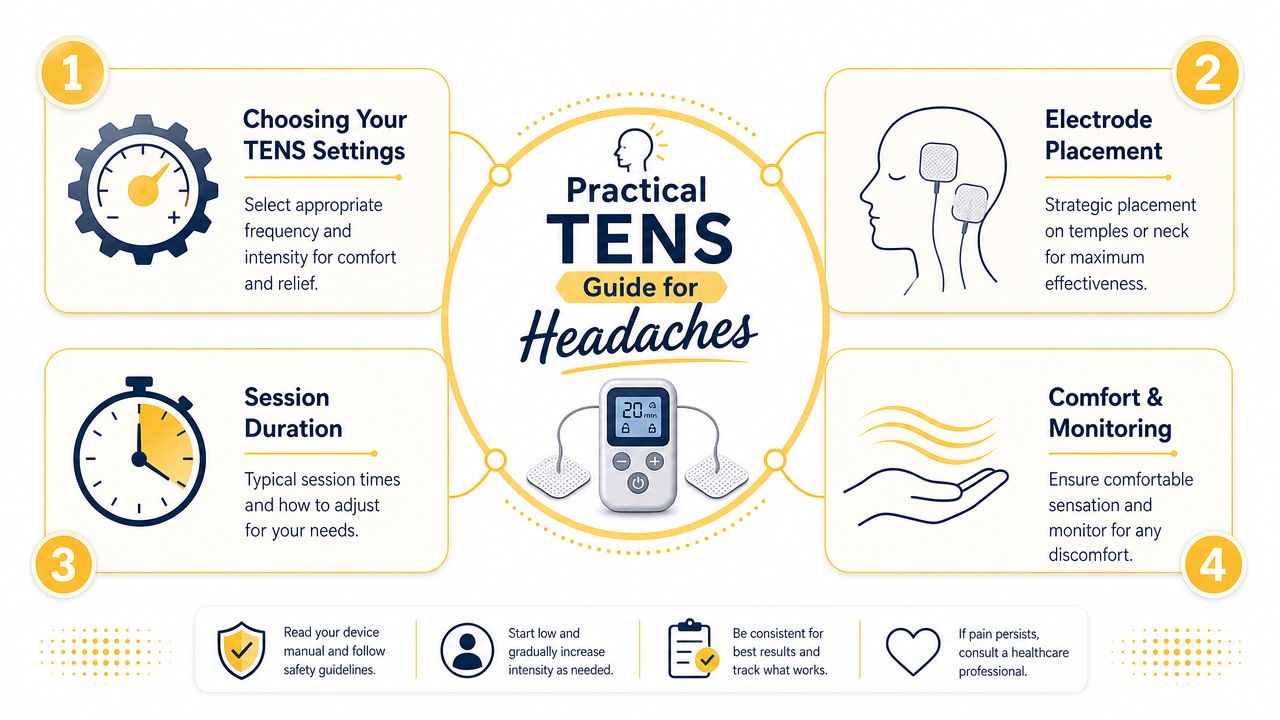
A visual guide can make the basics easier to scan when you're not feeling your best.
Choosing Your TENS settings
Settings matter more than many people expect. According to a review summarized in this evidence update on TENS for migraine and headache, efficacy depends heavily on correct nerve targeting, appropriate frequency, and avoiding common mistakes like poor electrode placement or using damaged skin. The same review notes that higher frequencies (>90 Hz) are typically used for acute relief, while lower frequencies (~2 Hz) are more often used in preventive schedules. It also summarized a review where active TENS reduced pain 53.8% of the time versus 11.5% with placebo TENS.
What should you do with that in real life?
- Start low: Begin with low intensity and increase slowly until you feel a clear tingling sensation.
- Aim for comfortable stimulation: You want strong awareness, not pain, not a jolt, and not muscle clenching in the wrong area.
- Match the goal: If you're trying to calm pain during an active episode, the pattern may differ from a preventive routine used between attacks.
Placement for tension-type headache
If your headache feels band-like, pressure-heavy, or tied to upper neck and shoulder tightness, many people start by focusing on the neck and shoulder region, not the face.
A practical approach is to place pads on muscle areas that feel tense rather than directly over bony points or highly sensitive spots. Keep the skin clean and intact. If the area is numb, irritated, or broken, stop there and don't apply electrodes.
A few placement habits help:
- Use symmetry when possible: Place pads in a balanced way over the involved muscle region.
- Avoid the front of the neck: This area is not the place to experiment.
- Don't chase every sore point: More pads and more intensity don't automatically mean better relief.
Placement for migraine
Migraine is different. The same evidence update notes that migraine protocols often target branches of the ophthalmic nerve, which is why migraine-specific devices often sit on the forehead or trigeminal territory rather than on random painful sites.
If you're using a device specifically designed for migraine, follow its placement instructions exactly. If you're using a general TENS unit, don't assume scalp placement is safe or useful just because your pain is in your temple or forehead. That's one of the biggest reasons people get poor results or become more irritated.
This short demonstration may help you think through setup and handling before you try anything yourself:
Placement is treatment. If the placement is off, the session may tell you nothing useful about whether electrical stimulation can help you.
Timing and what a session should feel like
The “right” session is not the strongest one. It's the one you can tolerate without dread.
During a session, the feeling should be a steady tingling or pulsing sensation that remains acceptable throughout. If you become tense, flinch, or want to rip the pads off, dial it down or stop.
Use this quick checklist while you're testing the method:
| Check | What you want |
|---|---|
| Sensation | Tingling or pulsing, not burning |
| Skin | Intact, non-irritated, normal sensation |
| Placement | Deliberate, not random |
| Response | Less pain, less tension, or at least no worsening |
If you have migraine with aura, marked scalp sensitivity, or a pattern where touch itself feels aggravating, be extra cautious. A theoretically helpful tool can still be a poor fit for your nervous system on a given day.
Critical Safety Rules and When to Avoid TENS
This is the part many articles gloss over, and it shouldn't be optional. For a TENS machine headache solution, safety comes before curiosity.
The online gap is real. The Migraine Trust notes that not all TENS machines are designed specifically for migraine, and the broader evidence base for electrical nerve stimulation in migraine remains limited and heterogeneous. That matters most for people who are trying to decide if they should use it at all, especially with aura, scalp sensitivity, implanted devices, or neck pain that may worsen with poor placement.
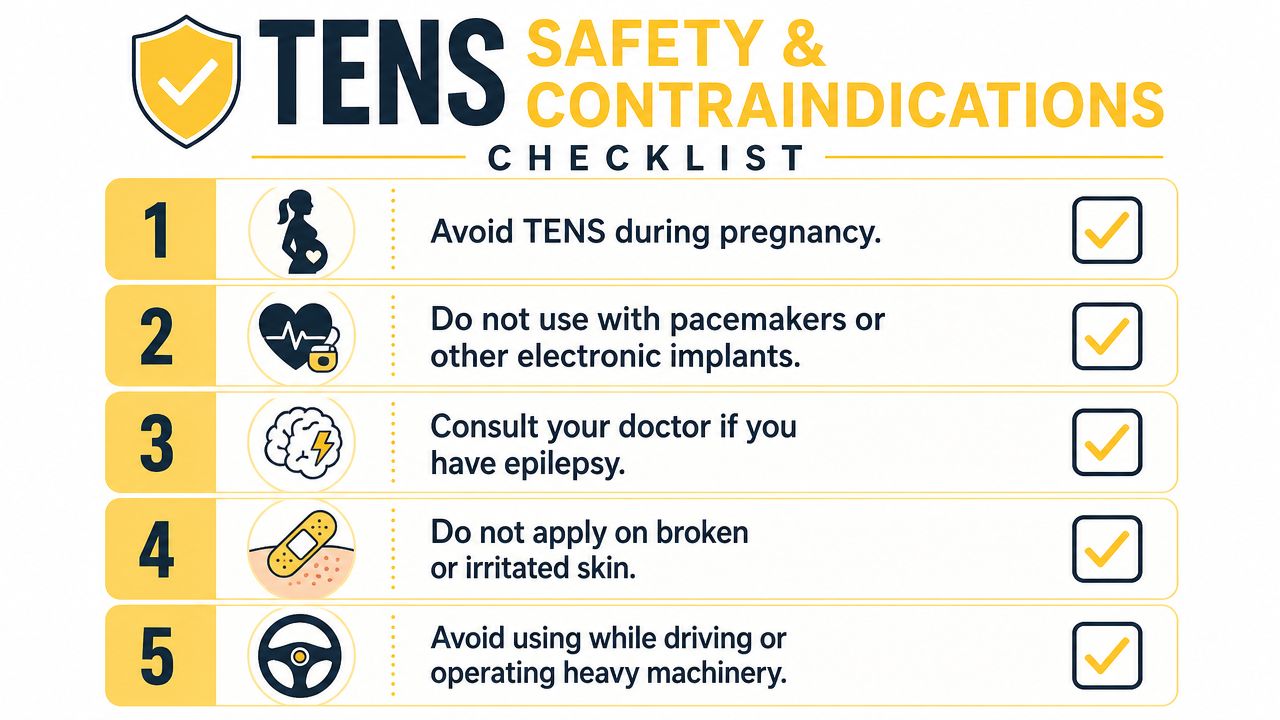
When TENS is a poor idea
Don't use electrical stimulation casually on the head or neck if you're already unsure about the diagnosis, the device, or the placement. That's not being overcautious. That's being sensible.
Be especially careful, and seek professional guidance first, if any of these apply:
- You have an implanted electronic device: If you have a pacemaker or another implanted device, don't experiment on your own.
- You have unusual sensitivity: If your scalp is very tender, touch worsens symptoms, or tingling quickly becomes distressing, the session may aggravate rather than relieve.
- Your neck pain is a major driver: Poor placement around the neck can make a bad situation worse.
- You have broken, irritated, or numb skin: Electrodes belong only on healthy skin with normal sensation.
- You're not using a migraine-specific device for migraine areas: A generic unit and a migraine neuromodulation device are not the same thing.
People who are sorting through broader pattern triggers may also benefit from reviewing common migraine risk factors, because an electrical device won't solve a worsening pattern driven by sleep disruption, hormonal shifts, or environmental triggers.
Red flag symptoms that need urgent care
Some headaches should never be managed at home with a gadget first.
Seek immediate medical care if you have:
- A sudden severe headache: A thunderclap onset is an emergency.
- Headache with fever or stiff neck: This needs urgent assessment.
- Neurological changes: New weakness, confusion, trouble speaking, fainting, or major vision changes need immediate care.
- Headache after a head injury: Get medical help promptly.
This article is for informational purposes and is not medical advice. Consult a healthcare provider for personalized guidance.
A simple decision check before you start
Ask yourself three questions.
- Do I know what kind of head pain this is? Migraine, tension-type headache, neck-driven pain, and emergency headaches are not the same.
- Is the device built for this area? “Electrical stimulation” is a category, not a guarantee.
- Will I stop if it clearly worsens symptoms? You need that boundary before you start, not after.
If you're feeling uncertain, that's already useful information. Uncertainty is a reason to pause and get guidance, not a reason to push through.
Troubleshooting Your TENS Unit for Better Results
A disappointing first try doesn't always mean the method is useless. It often means something in the setup is off.
If you feel nothing helpful
Check the basics first. Are the electrodes still sticky and making full skin contact? Is the battery charged? Did you place the pads with a plan, or just where pain felt strongest?
If the device is working but relief is absent, try one change at a time instead of changing everything at once.
- Adjust intensity slowly: Too low may do nothing. Too high may make you tense.
- Reconsider placement: Headache relief usually depends on the right nerve or muscle target, not the most painful point.
- Think about headache type: A neck-heavy tension pattern and a migraine attack often need different strategies.
If it stings, burns, or irritates your skin
That sensation usually means “stop and reassess,” not “push through.”
Remove the pads and inspect the skin. If the area is red, irritated, or painful, don't reapply to that spot until it has settled. Clean skin before use, avoid lotions under electrodes, and replace worn pads when adhesion starts to fail.
If the machine keeps shutting off, check the obvious causes first. Loose lead wires, poor pad contact, or low battery are common culprits. If the device repeatedly behaves unpredictably, don't keep troubleshooting during an active migraine when you're already overloaded. Pause and revisit it later when you can test calmly.
How to Know If TENS Is Working for You
This is the most personal part of the process. A TENS session doesn't have to create dramatic relief to be useful. It may still earn a place in your migraine toolkit if it reliably softens pain, reduces neck tension, or makes an attack more manageable.

What to track after each session
A simple log is often more informative than memory. Record:
- Headache type and timing: Was this a migraine attack, a tension-type headache, or neck-related pain?
- Settings and placement: Note where you placed the pads and how strong the stimulation felt.
- Before and after symptoms: Track pain intensity, nausea, photophobia, phonophobia, neck tightness, and whether touch sensitivity changed.
- Your overall impression: Did you feel calmer, more irritated, sleepy, unchanged, or clearly better?
If you want a simple way to organize those patterns, a dedicated migraine tracking app can make the comparisons much easier over time.
What counts as a useful result
You're looking for repeatable benefit, not perfection.
A useful result might mean the pain eases somewhat, the headache doesn't escalate as quickly, you use fewer rescue measures, or recovery feels less brutal afterward. A poor result means no meaningful change after careful trials, or worse, the stimulation reliably makes you more uncomfortable.
The question isn't “Does TENS work in general?” The better question is “What happens in my body when I use it this way, for this kind of attack?”
If you track several sessions and the pattern is consistently neutral or negative, that's still valuable information. It means you can stop treating the device like an unanswered question.
If you want help spotting those patterns without keeping notes by hand, Relief can help you log symptoms, triggers, timing, and recovery so it's easier to see whether TENS is helping your migraines over time.


