Barometric pressure changes are a real migraine trigger for many people. In a 2023 PubMed study, the strongest barometric signal was a pressure decrease 6 hours before headache onset (gain = 11.7, p < 0.001), which is exactly why a barometric pressure migraine app can be useful for planning ahead instead of getting blindsided.
You might know this feeling already. The air feels heavy, a storm is moving in, and before the rain even starts you notice the familiar warning signs. Maybe it's neck tension, light sensitivity, irritability, or that hard-to-explain sense that your brain is shifting into migraine mode.
If that's you, you're not imagining it. And you don't need another article that just says weather can be a trigger, then leaves you there. What matters is what you can do with that forecast when you have work, childcare, errands, social plans, or a day you can't afford to lose.
A barometric pressure migraine app isn't a cure, and it can't control the weather. What it can do is help you spot risk earlier, compare it with your own history, and make smarter daily decisions around timing, rest, medication planning, and expectations. This article is for informational purposes and is not medical advice. Consult a healthcare provider for personalized guidance.
Table of Contents
That Feeling When the Weather Is About to Turn
A lot of people with migraine become amateur meteorologists without meaning to. You notice the pressure in your head before you notice the pressure in the sky. Then someone else says, “Maybe it's just stress,” and you're left second-guessing yourself.
That disconnect is exhausting. Migraine is a neurological condition, not “just a bad headache,” and weather sensitivity can be one part of it. A migraine may involve symptoms like nausea, photophobia (light sensitivity), phonophobia (sound sensitivity), aura, dizziness, or brain fog. A headache is only one possible part of the attack.
You don't need to prove your symptoms to the weather report. You need tools that help you recognize your own pattern.
One common point of confusion is that pressure-related symptoms can overlap with sinus or ear pressure feelings. If your ears pop or feel blocked when the weather shifts, that can add to the confusion. ReliefMigraine has a helpful article on headache and ears popping that may help you sort out what you're feeling.
Why this matters in everyday life
Forecasting only helps if it changes what you do next. If an app tells you conditions are becoming risky, that should help you answer practical questions like:
- Work planning: Should you move your hardest task earlier in the day?
- Travel decisions: Is this the day to pack rescue items and build in downtime?
- Social plans: Do you want a flexible plan instead of a long, loud evening?
- Self-care timing: Should you be more careful about hydration, meals, sleep, and overstimulation?
For many people, the biggest benefit isn't prediction in a dramatic sense. It's reducing surprises.
The Scientific Link Between Pressure Changes and Migraine
What barometric pressure actually means
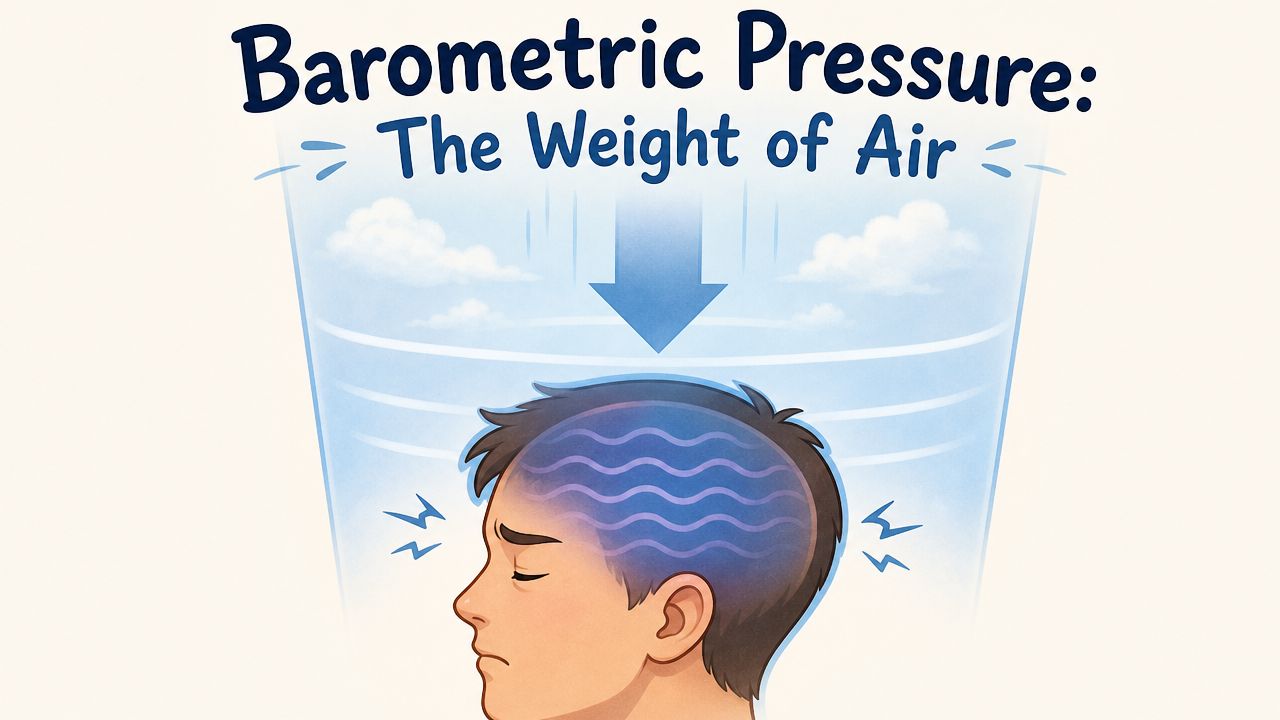
Barometric pressure is the weight of the air around you. When that pressure changes, your body has to adjust. It is a gentle squeeze on everything around you that isn't always constant.
Some people with migraine seem especially sensitive to that shift. The exact biology isn't fully settled, but the basic idea is straightforward: a changing physical environment can irritate a nervous system that is already prone to migraine.
A simple analogy helps here. If you've ever seen a balloon respond to changes in pressure, you already understand the principle. Your head isn't a balloon, of course, but your sinuses, surrounding tissues, and pain-sensitive nerve pathways may all respond to changes in the atmosphere.
What the research found
One of the most useful pieces of evidence comes from a 2023 PubMed study on headache occurrence and weather factors. The study found that low barometric pressure, barometric pressure changes, higher humidity, and rainfall were all associated with more headache episodes. The strongest reported barometric signal was a pressure decrease 6 hours before headache onset (gain = 11.7, p < 0.001). The same study also reported that low pressure and pressure-change patterns stayed significant in both statistical and deep-learning models.
That doesn't mean every storm causes a migraine, or that pressure is the only trigger that matters. It does mean barometric pressure is measurable enough to be worth tracking instead of dismissing as coincidence.
Practical rule: If weather seems to affect you, pay attention to the hours before an attack, not only the moment symptoms become obvious.
Where readers often get stuck
People often ask, “If pressure can trigger migraine, why don't I get an attack every time the weather changes?” Because triggers usually aren't on-off switches. They're part of a bigger threshold picture.
If your brain is already stressed by poor sleep, missed meals, hormonal shifts, sensory overload, or another trigger, a pressure drop may be enough to push you into an attack. If your baseline is steadier, the same weather pattern may not do much that day.
The prodrome, which is the early warning phase before the main pain phase for some people, can make this even trickier. You may feel tired, moody, foggy, or unusually sensitive before the headache pain starts. If you only log the pain itself, you may miss the fact that the weather shift showed up hours earlier.
If your attacks are frequent or changing, it may also help to understand broader causes and patterns. ReliefMigraine's guide on what causes chronic migraines gives a useful bigger-picture view.
How Migraine Forecasting Apps Actually Work
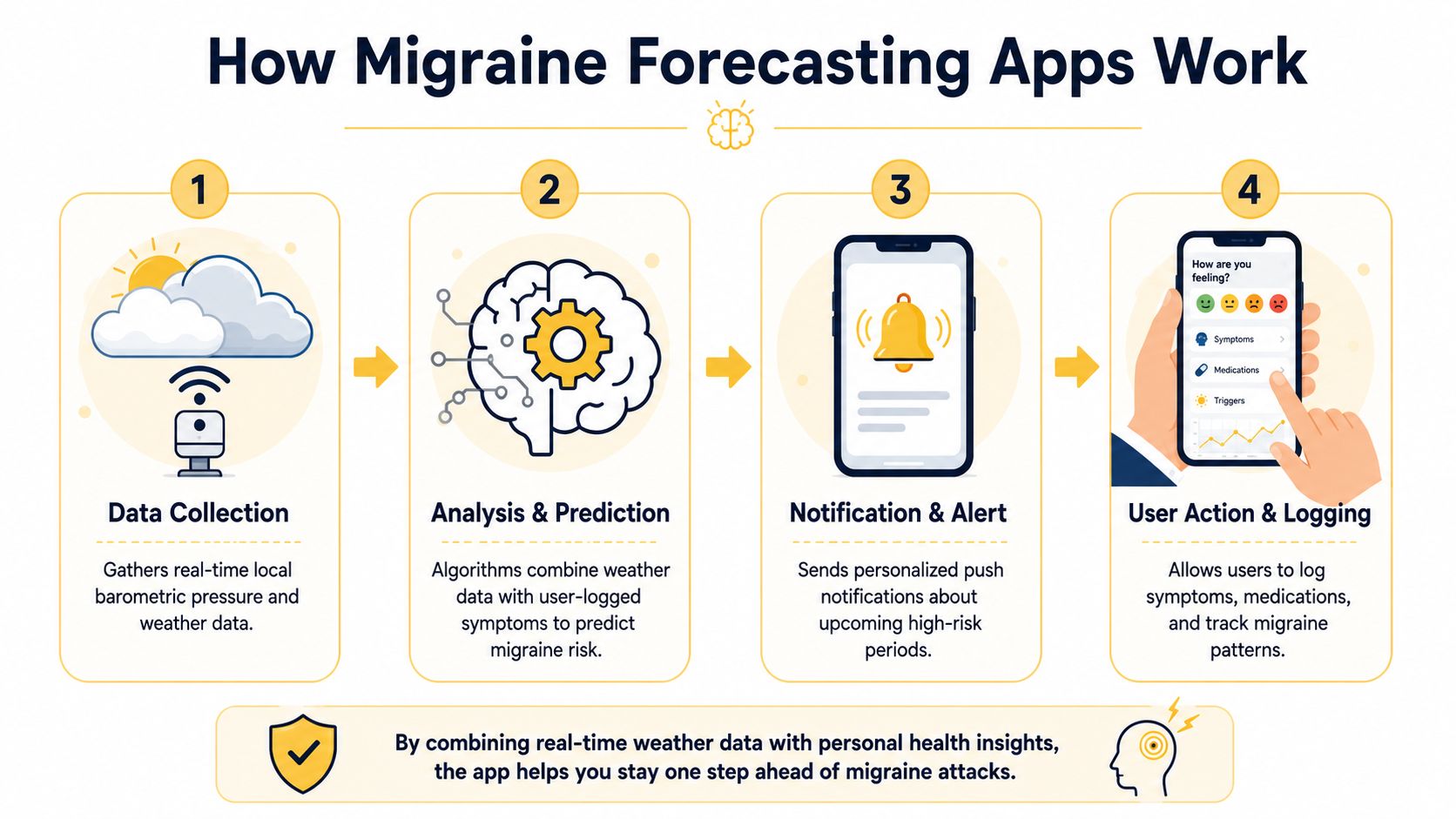
A barometric pressure migraine app usually starts with local weather data, then adds your symptom history. That sounds simple, but the difference between a basic weather display and an effective forecasting tool is personalization.
From weather data to personal risk
Weather-linked migraine tools are designed around timing. Current migraine weather apps commonly offer hourly and 24-hour pressure graphs, along with 7-day forecasts and historical trend views, as shown in the Pressure Pal app listing. That design matters because pressure shifts can happen quickly enough to change what you do with the next few hours.
A solid app doesn't stop at “pressure is falling.” It tries to answer a more useful question: “When pressure falls like this, what tends to happen to you?”
That usually involves a few steps:
- Collect local conditions such as barometric pressure and nearby weather patterns.
- Store your logs including attack timing, symptoms, and medication use.
- Compare the two over time so the app can see whether certain conditions repeatedly show up before attacks.
- Alert you when a familiar pattern returns so you can prepare.
Why graphs matter more than a single forecast number
A single pressure reading doesn't tell you much by itself. What often matters is movement. Is pressure dropping fast? Did it start overnight? Has it been unstable for hours?
That's why pressure graphs can be more useful than generic “bad weather today” alerts. They help you connect the shape of the change with your own experience.
Here's a short visual explainer if you want a quick overview of this idea in action.
A forecasting app also works better when it pays attention to early symptoms. If you log yawning, neck pain, mood changes, food cravings, or light sensitivity, the app can compare the forecast with your own migraine warning signs instead of relying on weather alone. ReliefMigraine's article on migraine warning signs can help you spot those earlier signals.
Choosing the Right App What to Look For
A good forecast is only useful if it changes what you do next. The right app helps you answer practical questions: Should I carry rescue medication today? Is this the best afternoon for a long meeting? Do I want a backup plan for dinner if the pressure starts dropping?
A useful app does more than show pressure
Pressure by itself is just a weather number. For migraine planning, the better question is whether the app helps you connect that number, and changes in it, to your own pattern over time.
Healthify's description of Migraine Insight points toward that more practical model. It highlights weather, barometric pressure, sleep, steps, and location tracking with pattern analysis and clinician-facing reports. It also refers to exposure hit rate, which is the idea of checking how often attacks follow a pressure change compared with your usual baseline, as described in Healthify's overview of migraine tracking features.
That matters because weather is easy to blame. A better app helps you test the suspicion instead of treating every storm front like proof.
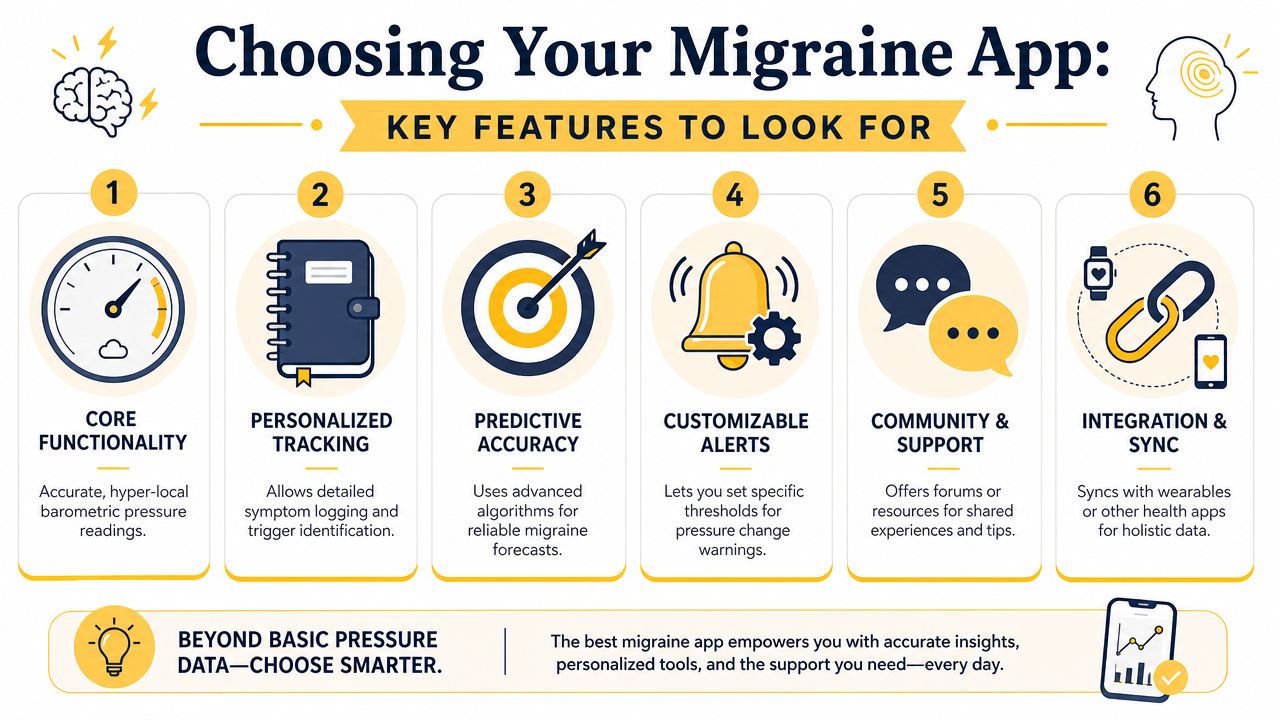
Look for features like these:
- Detailed logging: You should be able to record attack timing, symptoms, possible triggers, and medications without friction.
- Trend views: The app should let you compare attacks with pressure shifts across days and weeks, not just show today's conditions.
- Custom alerts: Some people need a heads-up the night before. Others only want an alert when a familiar risk pattern shows up.
- Context beyond pressure: Sleep loss, stress, activity, and other exposures can stack together, much like several small weights adding up on the same shelf.
- Shareable summaries: Clear reports make it easier to have a useful conversation with a clinician about patterns, timing, and treatment decisions.
A good migraine app should help you rule triggers in and out, not just make weather look suspicious.
Generic weather app vs personalized migraine app
The difference becomes clearer when you compare what each type of app is built to do.
| Feature | Generic Weather App | Personalized Migraine App |
|---|---|---|
| Pressure display | Shows current conditions | Connects pressure changes to your logged attacks |
| Forecast view | General weather outlook | Risk-oriented view tied to your history |
| Symptom tracking | Usually none | Logs symptoms, timing, and medications |
| Trigger analysis | Not built for migraine | Looks for recurring trigger patterns |
| Alerts | Weather alerts for everyone | Alerts based on your likely risk |
| Doctor visits | Little clinical value | Can support more specific conversations |
If your main goal is planning, prioritize the app that turns forecast data into decisions. You want something that helps you spot your risk window early enough to adjust your day, not just confirm why you feel bad after the fact.
Turning Forecasts into Actionable Daily Plans
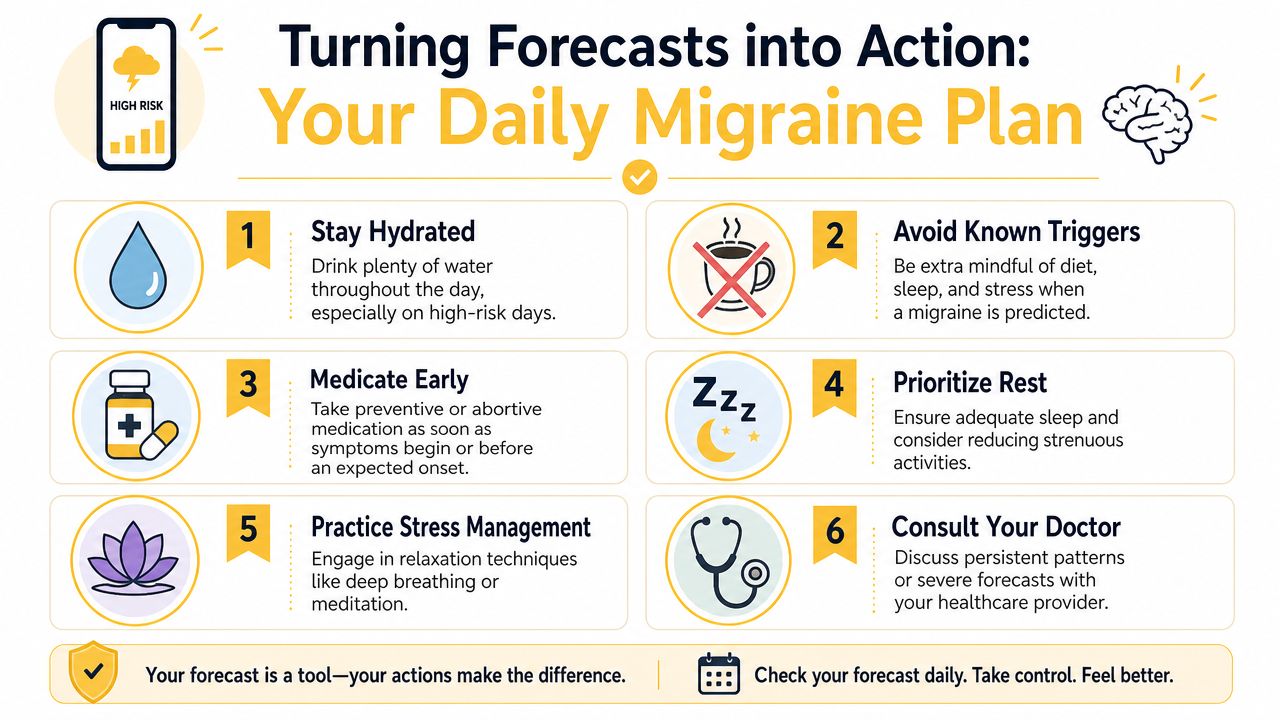
At this stage, a barometric pressure migraine app either becomes useful or becomes background noise. A forecast should help you make decisions, not just feel doomed.
What to do on a higher-risk day
If your app shows a pattern that often lines up with your attacks, think in terms of reducing load on your nervous system.
- Protect the basics: Keep meals regular, stay hydrated, and avoid cutting sleep short.
- Lower extra strain: If possible, reduce bright light, loud environments, skipped breaks, and unnecessary stress.
- Pack for the day you might have: Bring water, sunglasses, earplugs, any clinician-recommended medications, and whatever comfort items help you function.
- Watch for prodrome signs: If you know your early symptoms, don't ignore them because the pain hasn't started yet.
A forecast isn't an order. It's a prompt to stack the odds in your favor.
How to plan work social events and medication conversations
The most practical use of migraine forecasting is often scheduling. If the risk window seems highest in the afternoon, you might put focused work earlier in the day. If a storm system is moving through before a dinner out, you might choose a flexible plan, a quieter venue, or an earlier exit option.
For work, the goal is not to announce your forecast to everyone. It's to use your better hours better. That can mean doing the cognitively heavy task first, keeping your calendar lighter, or avoiding back-to-back commitments when you already know your system may be less forgiving.
For social plans, you don't have to cancel everything at the first warning. You can create a softer version of the plan. Drive yourself instead of carpooling. Sit where light and noise are easier to manage. Make it okay to leave early.
On high-risk days, the smartest move is often not doing less. It's deciding what matters most and protecting your capacity for that.
Medication planning also belongs here, with care. A forecast may help you recognize when to be especially attentive to early symptoms and when to discuss timing patterns with your doctor. But it should not replace medical guidance, and this article isn't giving personalized medication advice.
One more important point: pressure might not be the whole story. Weather-related attacks can also involve temperature, humidity, and air quality, and individual responses vary substantially, as discussed in Business Insider's reporting on migraine tracking and environmental triggers. If your forecasted pressure looks normal and you still get an attack, that doesn't mean the app failed. It may mean another part of the environment, or another trigger entirely, mattered more that day.
Making the App Work for You and Your Doctor
The most useful migraine data is boring at first. A few entries don't tell you much. Consistent entries start to show patterns.
What to log so patterns become useful
Try to log more than the worst attacks. Mild symptoms count. Prodrome symptoms count. Medications count. Timing matters a lot.
A practical log usually includes:
- Attack timing: When symptoms began, not just when you finally had to stop what you were doing
- Symptoms: Pain, nausea, aura, photophobia, dizziness, brain fog, neck pain
- Context: Sleep disruption, stress, meals, weather exposure, travel, menstruation if relevant to you
- Response: What you took or did, and whether it helped
Bring those patterns to appointments. A clinician can do much more with “My attacks often follow this kind of pressure change and tend to start with light sensitivity and neck pain” than with “I think weather bothers me.”
When to seek immediate medical care
Some symptoms should not be tracked at home while you wait and see. Seek immediate medical care for:
- Sudden severe headache
- Headache with fever or stiff neck
- New neurological changes, such as weakness, confusion, trouble speaking, or vision loss
- Headache after a head injury
This article is for informational purposes and is not medical advice. Consult a healthcare provider for personalized guidance.
Tracking can't control the forecast, but it can help you understand your own patterns and walk into workdays, appointments, and social plans with fewer surprises. If you want one place to log symptoms and compare them with hour-by-hour environmental risk, Relief is designed to support that kind of day-to-day migraine planning.


