
Chronic migraine usually isn't caused by one single thing. It's defined as headache on 15 or more days per month for more than three months, with at least 8 days showing migraine features, and it often develops through a mix of genetic vulnerability plus risk factors like high attack frequency, medication overuse, sleep problems, anxiety, depression, and obesity that can make the brain more sensitive to pain over time.
If you're reading this after another canceled plan, another dark room, or another day of wondering why your migraines seem to be taking over more of your month, your frustration makes sense. Many people are told to “avoid triggers” as if that fully explains what's happening. It doesn't. A trigger can spark one attack, but chronic migraine is more often a process. For some people, repeated attacks and certain risk factors gradually lower the brain's threshold for pain until migraine becomes much more frequent.
This can feel personal, but it isn't a character flaw, and it isn't a failure to “manage stress better.” Chronic migraine is a real neurological condition. Understanding what causes chronic migraines starts with one important shift: stop looking for one villain, and start looking at the pattern.
Table of Contents
- Living With the Constant Threat of a Migraine Attack
- Why the definition matters
- Migraine is not the same as headache
Living With the Constant Threat of a Migraine Attack
You wake up and do a quick scan before your feet hit the floor. Is the pain already there? Is the nausea starting? Did the weather shift overnight? Can you take on meetings, errands, childcare, or a commute, or do you need a backup plan before the day even begins?
That constant calculation is exhausting. It's even harder when people around you think migraine is “just a headache,” when you know it can include nausea, light sensitivity, sound sensitivity, brain fog, dizziness, aura, and the wiped-out feeling that can linger after the pain eases.
Chronic migraine isn't your fault. In many people, it develops over time as the brain becomes more sensitive to repeated attacks and other stressors.
A lot of readers get stuck on one question: “What did I do to cause this?” Usually, that's the wrong frame. Chronic migraine rarely comes from one food, one weather front, one bad week, or one missed night of sleep. It's more like a pileup. Genetics may load the system. Frequent attacks, acute medication overuse, poor sleep, stress, and other health conditions can keep pushing it until the nervous system becomes easier to activate.
That's why some people go from occasional attacks to feeling like migraine is always nearby. The condition changes your life, but learning how that progression happens can help you talk with a clinician more clearly and focus on the factors that are actionable.
What Exactly Is Chronic Migraine
Chronic migraine has a specific medical definition. According to the American Migraine Foundation's explanation of chronic migraine, it means headache on 15 or more days per month for over three months, with at least 8 of those days having migraine features. The same source notes that chronic migraine affects an estimated 3% to 5% of the U.S. population and represents about 7.7% of people who experience migraine.
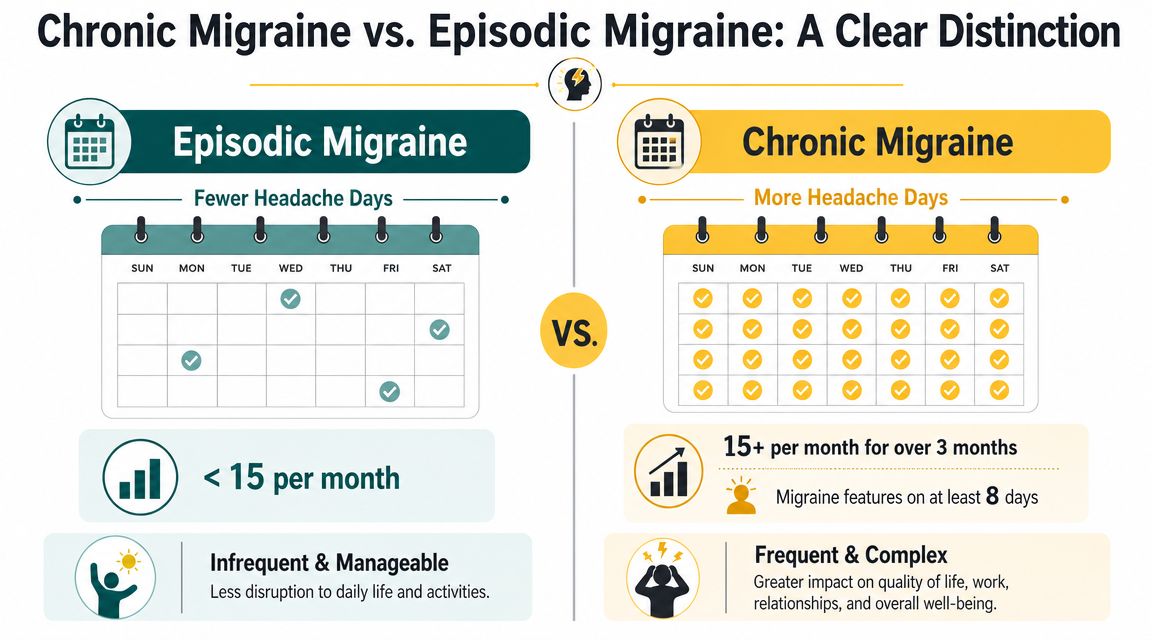
Why the definition matters
People often say “I have chronic headaches” when they mean frequent head pain. That's understandable, but chronic migraine is narrower than that. The diagnosis depends on how often headaches happen and whether enough of those days have migraine features.
Those features can include:
- Nausea or vomiting
- Photophobia, which means light sensitivity
- Phonophobia, which means sound sensitivity
- Aura in some people, such as visual or sensory symptoms before or during an attack
- Postdrome, the drained or foggy feeling after the main attack
A person can also have a headache day that feels different from their “classic migraine” but still falls within chronic migraine patterns if enough days show migraine features.
Migraine is not the same as headache
Many readers find it confusing. Migraine is a neurological disease. Head pain is one part of it, but not the whole thing. A headache is a symptom. Migraine can involve changes in sensory processing, attention, mood, balance, and energy before, during, and after the attack.
Here's a simple way to understand:
| Term | What it means |
|---|---|
| Headache | Pain in the head |
| Migraine | A neurological condition that can include headache plus symptoms like nausea, light sensitivity, sound sensitivity, aura, and fatigue |
| Chronic migraine | Migraine occurring on a very high number of monthly headache days based on the formal criteria |
Practical rule: If your “headaches” are happening often and many come with nausea, light sensitivity, sound sensitivity, or other migraine symptoms, it's worth discussing chronic migraine specifically, not just “frequent headaches,” with a clinician.
That wording matters. It can shape what questions your clinician asks and what treatment options get discussed.
What Happens in Your Brain During Chronic Migraine
The science can sound intimidating, but the core idea is simple. In chronic migraine, the brain's pain system can become more reactive over time.
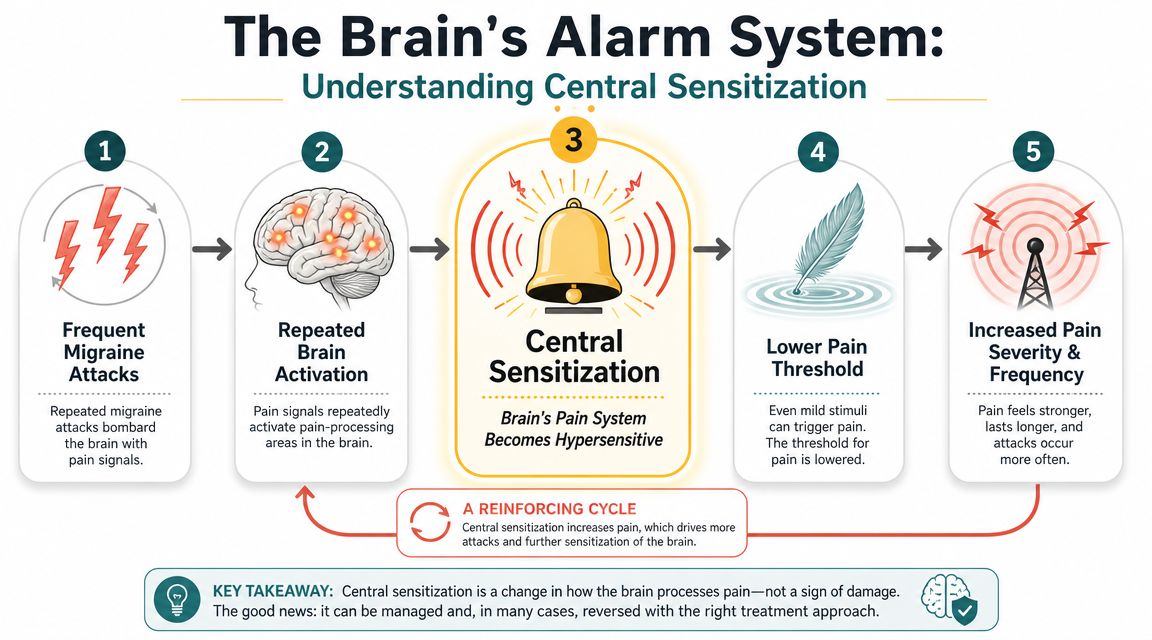
Your pain alarm becomes easier to set off
A useful analogy is a smoke alarm that starts out normal, then becomes so sensitive that burnt toast, steam, or a little dust can set it off. Migraine can work in a similar way. Repeated attacks may contribute to central sensitization, a term used to describe changes in how the nervous system processes pain.
Instead of reacting only to bigger stressors, the brain may begin responding to smaller ones. That can help explain why light feels harsher, sound feels sharper, touch can feel uncomfortable, and attacks may happen more often than they used to.
Clinical reviews describe this process as changes in pain-processing networks rather than a single root cause. That matters because people often search for one missing answer, when the more accurate explanation is a nervous system that has become easier to trigger.
Why some people are more vulnerable
Not everyone with episodic migraine develops chronic migraine. One reason is genetic predisposition. A major review in The Journal of Headache and Pain on migraine genetics and triggers reports migraine heritability at about 42%, notes that more than 100 genes may be associated with risk, and found stress to be the most commonly reported trigger in large cohorts, cited by 62% in one study of 494 patients and 58% in a study of 71,877 migraineurs.
Some inherited variants linked with migraine risk include CACNA1A, ATP1A2, and SCN1A. You do not need to memorize those names. The practical takeaway is that some brains are more susceptible.
That's also why family history comes up so often in migraine conversations. It doesn't mean your future is fixed. It means your nervous system may need more protection from the factors that drive progression.
- Genetics shape vulnerability. They may influence how excitable the nervous system is.
- Repeated attacks add wear. Frequent migraine activity can reinforce that hypersensitive state.
- Everyday stressors matter more in a sensitized brain. Sleep disruption, stress, dehydration, weather shifts, or medication overuse may have a bigger effect once the system is already on edge.
When people say, “Nothing changed, but now I'm getting migraines all the time,” the missing piece is often that the threshold changed.
This is one reason willpower doesn't fix chronic migraine. You're not failing to cope. Your nervous system may be reacting differently than it used to.
How Episodic Migraine Becomes Chronic
A common experience goes like this: you used to get a migraine once in a while, recover, and move on. Then the gaps between attacks start shrinking. A headache-free day no longer feels like a reset. It feels like a pause.
That shift is called chronification. It describes the process in which episodic migraine becomes chronic over time. The key question is not which single thing triggered today's attack. The more useful question is which patterns are keeping your brain's pain system on high alert month after month.
A review in Nature Reviews Neurology on progression from episodic to chronic migraine highlights several factors linked with this progression, including frequent attacks to begin with, overuse of acute medications, obesity, major stress, and untreated conditions such as depression or anxiety. The practical message is clear. Chronic migraine often develops through repeated pressure on a sensitive nervous system, not from one isolated trigger.
Early on, the change can be hard to spot. Migraine still looks occasional from the outside. But the pattern underneath is different. Recovery becomes less complete, the nervous system stays irritated longer, and smaller disruptions can set off symptoms more easily. A smoke alarm that once rang only during a real fire starts reacting to burnt toast.
A visual overview can help make that pattern easier to spot.
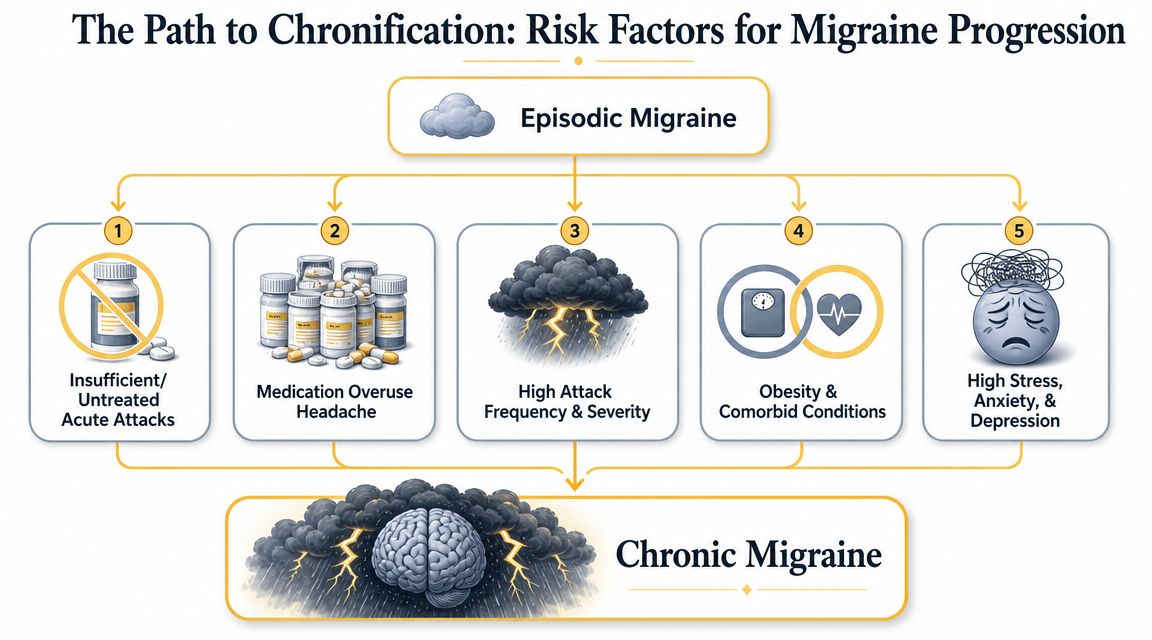
Risk factors that raise the chance of progression
Some of the main drivers are surprisingly ordinary, which is one reason chronic migraine can feel confusing and unfair.
High attack frequency
Frequent migraine days give the brain less time to settle back to baseline. Over time, repeated activation may reinforce a state of heightened sensitivity.Overuse of acute headache medication
This is often misunderstood. Rescue medicines can be helpful, but using them too often can feed medication-overuse headache and make the overall cycle harder to break. Many people end up in this pattern because they are trying to keep working, parenting, or getting through the day.Depression and anxiety
These conditions can affect pain processing, sleep, stress load, and how hard it is for the nervous system to recover after an attack. This is biology, not a character flaw.Sleep disorders and snoring
Poor sleep can keep the brain in a more reactive state. If sleep apnea, insomnia, or fragmented sleep is part of the picture, treating it may reduce some of the pressure driving progression.Obesity
Research repeatedly links obesity with a higher risk of migraine becoming more frequent over time.
Some readers also notice that food-related patterns become more obvious as migraine frequency rises. In some cases, histamine sensitivity may be part of that picture, especially if attacks cluster around certain meals, alcohol, or leftovers. Our guide to histamine migraine headaches explains how that pattern can overlap with a sensitized migraine brain.
What you can influence and what you can't
Some risk factors are outside your control. Family history, hormone-related biology, and your past migraine pattern all matter. They help explain why two people can live through the same stressful month and have very different outcomes.
Other factors are more modifiable, especially with support from a clinician.
| Less changeable | More modifiable |
|---|---|
| Genetic predisposition | Medication overuse patterns |
| Sex-related biological factors | Sleep habits and sleep disorders |
| Past migraine history | Stress support and recovery habits |
| Some environmental exposures | Hydration, regular meals, routine |
| Untreated anxiety or depression |
If you have been blaming yourself, pause there for a moment. Chronic migraine is not proof that you handled your earlier attacks the wrong way. It usually reflects a gradual change in how reactive the brain has become.
This clinician video gives a helpful overview of how progression can happen:
One useful way to spot chronification is to look for accumulation rather than a single culprit. Are headache days increasing over months? Are you needing acute treatment more often? Is sleep less reliable than it used to be? Has stress become a steady background condition instead of a short-term spike? Those trends often explain more than any one trigger ever could.
Common Triggers That Complicate Chronic Migraine
Once a brain is more sensitive, everyday exposures can matter more. That doesn't mean those exposures “caused” chronic migraine by themselves. It means they can complicate life with it.
A broad summary in SingleCare's migraine statistics review notes that U.S. migraine prevalence has stayed relatively stable for 30 years, with 11.7% to 14.7% overall, 17.1% to 19.2% in women, and 5.6% to 7.2% in men, while migraine-related disability has increased. The same summary highlights common triggers and risk factors such as stressful life events, sleep disorders, medication overuse, obesity, weather changes, and barometric pressure shifts. That stable prevalence is one reason clinicians focus so much on progression and sensitivity, not just on one modern exposure.
A trigger is not the same as a cause
This distinction helps a lot.
A cause of chronification is something that raises the chance migraine becomes more frequent over time. A trigger is something that may set off an individual attack in a person who is already vulnerable.
For example, a pressure drop before a storm might trigger today's attack. That same pressure drop probably isn't the full explanation for why your migraines have become near-daily. Those are different layers of the problem.
Common trigger categories
Some patterns show up often, but they're still individual. You do not need a universal “never eat this again” list.
Environmental factors
- Weather and barometric pressure changes can matter for some people.
- Heat, humidity, air quality, and pollen may stack on top of an already sensitive system.
- Strong sensory input such as bright light, noise, or strong odors can tip an attack into motion.
Lifestyle patterns
- Sleep disruption is a major one. Too little sleep, inconsistent sleep, or poor-quality sleep can all matter.
- Hunger and dehydration can lower your tolerance for other triggers.
- Caffeine changes can be a problem in either direction for some people.
- Stressful life events often act less like one-time triggers and more like a constant amplifier.
Hormonal shifts
- Some people notice migraine changes around the menstrual cycle or other hormone fluctuations. If that sounds familiar, this guide to hormonal migraine prevention may help you think more clearly about patterns to discuss with a clinician.
A useful question isn't “What are all migraine triggers?” It's “Which combinations tend to show up before my attacks?”
That's also why food lists can be so frustrating. One person reacts to a specific food or additive. Another doesn't. If you suspect a pattern, track it before cutting out large categories of foods.
If histamine is on your radar, you might also find this article on histamine and migraine headaches useful. The point isn't to assume one answer. It's to get more precise about your own pattern.
Getting a Clear Diagnosis and When to Seek Help
If your migraines are becoming more frequent, getting a structured evaluation can be a relief in itself. A diagnosis visit usually focuses on pattern recognition. Your clinician wants to know how often headache happens, how many days have migraine features, what symptoms come with attacks, what medications you use, and whether any other condition could be contributing.
This article is for informational purposes and is not medical advice. Consult a healthcare provider for personalized guidance.
What a diagnosis visit usually includes
Most visits include a conversation about your headache history plus a physical and neurological exam. Depending on your symptoms, your clinician may ask about aura, nausea, photophobia, phonophobia, sleep quality, caffeine, stress, menstrual pattern, family history, and medication use.
Bring a simple record with:
- Headache frequency and which days felt like migraine
- Symptoms such as nausea, aura, dizziness, light sensitivity, or sound sensitivity
- Medication use including over-the-counter and prescription acute treatments
- Possible patterns related to sleep, meals, stress, hormones, or weather
- Function such as missed work, canceled plans, or trouble concentrating
Imaging is not always needed. Sometimes it is ordered because the pattern is new, unusual, or includes concerning features.
Red flag symptoms that need urgent care
Some headache symptoms need immediate medical attention, not a routine appointment.
Seek immediate medical care for a sudden severe headache, headache with fever or stiff neck, new neurological changes such as weakness or confusion, or headache after a head injury.
Also seek urgent help if a headache feels dramatically different from your usual attacks, especially if it comes on fast or is paired with symptoms that worry you.
A lot of people with migraine hesitate because they don't want to overreact. If a symptom falls into one of those red-flag categories, this is not the time to wait it out alone.
Actionable Strategies for Managing Chronic Migraine
Managing chronic migraine works best when you treat it like a system, not a single problem. One attack may be set off by a skipped meal or a storm front. Chronic migraine is different. It means the brain has become easier to tip into attack mode, and the job is to lower that overall sensitivity while also reducing the things that keep piling onto it.
That distinction matters in real life. If you only chase individual triggers, it can start to feel like everything is dangerous. A more useful plan asks two questions: What tends to spark an attack today? And what may be keeping my nervous system stuck in a frequent-attack pattern over time?
People often need a few pieces working together. Higher attack frequency, inconsistent sleep, caffeine swings, stressful life events, snoring or poor sleep, and frequent use of acute pain medicine can all add load to a brain that is already migraine-prone. The goal is to create more recovery time between attacks and reduce the chance that short-term flares turn into an ongoing cycle.
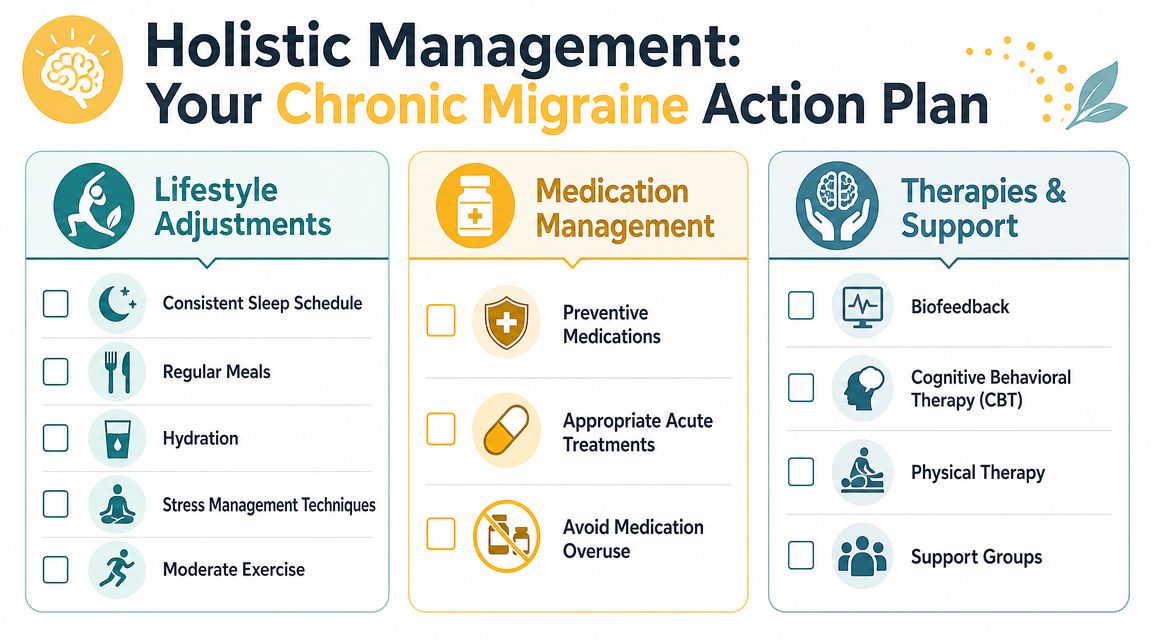
Lifestyle changes that support a steadier brain
Consistency helps because the migraine brain often reacts poorly to sudden shifts. It works a bit like a smoke alarm set too sensitive. The answer is not to eliminate all smoke from life. It is to reduce the constant false alarms.
A few habits are often worth focusing on first:
- Keep sleep regular. Try to go to bed and wake up at similar times, including weekends when you can.
- Protect meals and hydration. Long gaps without food or fluids can make attacks easier to trigger.
- Watch caffeine patterns. For many people, the swing matters as much as the amount.
- Reduce sensory overload where possible. Screen breaks, lower light, noise control, and pacing can reduce strain during vulnerable periods.
- Use realistic stress tools. Stress does not mean migraine is “just stress,” but therapy, breathing exercises, schedule changes, and recovery time can lower the background pressure on your system.
Hormones can also shape how often attacks show up. If your migraines cluster around your cycle, a plan for hormonal migraine prevention may help you discuss timing-based strategies with your clinician.
Medication and therapy options to discuss
Migraine treatment usually has two jobs. One is to stop or reduce an attack once it starts. The other is to make attacks happen less often over time.
| Type | Goal |
|---|---|
| Acute treatment | Treat an attack once it starts |
| Preventive treatment | Reduce how often attacks happen and how severe they are |
Many individuals encounter a challenge: acute medicines used too often can start feeding the cycle instead of just treating it. That does not mean you caused your migraine. It means your treatment plan may need adjusting so relief today does not create more headache days next month.
Prescription options vary from person to person. Some people need a better acute treatment. Others need preventive medicine, a sleep evaluation, physical therapy, or support for anxiety and depression that are increasing the overall burden. If neck pain, posture, or muscle tension seem tied to your attacks, physical therapy may be part of the plan. If snoring or unrefreshing sleep are part of the picture, untreated sleep problems are worth checking.
Behavioral therapies can help too. Cognitive behavioral therapy and biofeedback do not “talk away” migraine. They can reduce stress reactivity, improve coping, and help some people lower the number of factors pushing their nervous system toward attack.
The goal is fewer attacks, less severe attacks, and more predictable recovery time.
One practical tool some people use is a tracking app. For example, Relief can log attacks, symptoms, medications, and environmental factors like weather, air quality, and pollen, which can help you and your clinician spot patterns that are hard to see from memory alone.
How Tracking Helps You Identify Your Patterns
Chronic migraine gets confusing when everything feels connected. You slept badly, skipped lunch, had a stressful meeting, the weather changed, and then the migraine hit. Tracking helps you sort out which factors repeat.
A useful migraine log includes the day and time, severity, symptoms, aura if present, medication used, sleep, meals, hydration, stress level, and possible environmental exposures. Over time, patterns can become clearer. Maybe pressure drops matter more than you thought. Maybe the bigger issue is stacking stress with missed meals. Maybe your attack frequency is rising before you fully notice it.
If you want to sharpen your awareness of early symptoms too, this article on migraine warning signs can help you track more than pain alone.
The more clearly you can describe your pattern, the easier it becomes to make targeted changes and have a productive conversation with your clinician.
If you want a simple way to track symptoms and spot personal patterns, Relief can help you log attacks, medications, and environmental signals so you can better understand what tends to happen before your migraines.


