Seeking a migraine or headache quiz indicates you're probably in the middle of a familiar kind of uncertainty. The pain is real, your day is off track, and you're left wondering whether this is "just a headache" or something more specific. A quiz can't diagnose you, but it can help you spot patterns that make your next step clearer.
That matters because migraine isn't the same thing as a generic headache. Migraine is a neurological condition, and for many people it brings symptoms that go far beyond head pain, such as nausea, light sensitivity, sensory changes, and a wiped-out feeling before or after the attack. This article is for informational purposes and is not medical advice. Consult a healthcare provider for personalized guidance.
Table of Contents
- If you answered yes to 0 or 1
- If you answered yes to 2
- If you answered yes to 3
- Why impact matters as much as pain
That Blinding Pain Is It a Migraine or Just a Bad Headache
You wake up with pounding pain behind one eye. Coffee doesn't help. Your screen feels harsh. You cancel a meeting, then spend the next hour wondering if you're overreacting or missing something important.
A lot of people know this feeling. In U.S. data, about 1 in 5 adult women and 1 in 10 adult men have experienced migraine or severe headache, with prevalence peaking in adults aged 18 to 44, according to Miles for Migraine's summary of national statistics. If this keeps disrupting work, family plans, or basic concentration, you're not alone.
The confusing part is that headache is a broad symptom, while migraine is a specific condition. A tension headache, a migraine attack, and a cluster headache can all involve head pain, but they don't feel the same and they don't behave the same way.
You don't need to "tough it out" before taking your symptoms seriously.
That's where a migraine or headache quiz can help. Not as a final answer. As a first sorting tool.
A good quiz doesn't ask you to diagnose yourself. It asks about patterns. Did light bother you? Did you feel sick to your stomach? Did the pain stop you from functioning like yourself? Those questions often reveal more than trying to rate pain alone.
Why people hesitate to ask
Many adults downplay head pain because they've had it before, because they can still push through part of the day, or because the word migraine feels too dramatic. But migraine can look different from person to person. Some people have aura, which means sensory disturbances before or during an attack, such as visual changes. Others never do.
Some people have throbbing pain. Others describe pressure, stabbing, heaviness, or a strange "brain fog" feeling around the attack.
The 3-Question Migraine Self-Assessment Quiz
This short self-check is based on the ID Migraine screener, a validated clinical tool used as a first-pass symptom screen. It isn't a diagnosis, and it doesn't replace medical care. It does help you notice whether your pattern sounds migraine-like.
How to use the quiz
Think about your headaches over the last 3 months. Answer each question with a simple yes or no. Don't overthink it. Go with the pattern that fits best.
If your headaches vary, answer based on the attacks that concern you most.
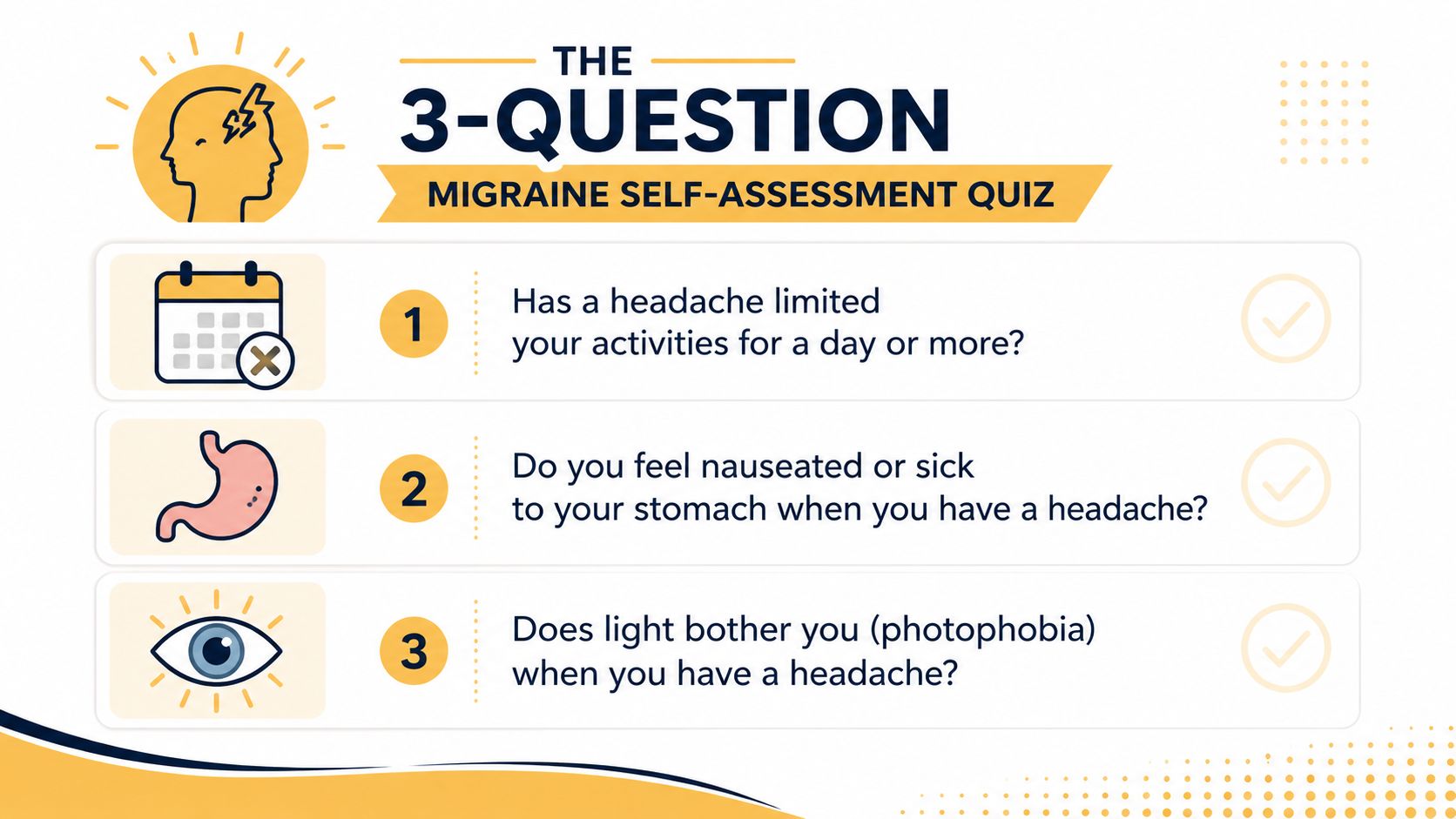
The three questions
Did a headache limit your ability to work, study, do chores, or handle your usual activities for a day or more?
When you had a headache, did you feel nauseated or sick to your stomach?
When you had a headache, did light bother you? This symptom is called photophobia, which means light sensitivity.
These questions matter because migraine often affects more than pain level. It can reduce function, upset your stomach, and make normal light feel overwhelming.
Practical rule: If a headache changes how you function, not just how you feel, that's worth paying attention to.
According to the American Migraine Foundation page on headache tests, answering yes to 2 of the 3 ID Migraine questions corresponds to a 93% chance of migraine, and answering yes to all 3 raises that to at least 98%. That's why this quiz is useful. It's simple, but it isn't random.
A few things can still make results less clear:
- Your symptoms change from one attack to another. Some migraine attacks come with nausea. Others don't.
- You call every head pain episode the same thing. That's common, especially if you've never tracked symptoms closely.
- You focus only on location. People often assume migraine must be one-sided. It can be, but symptom pattern matters more than that single detail.
If you answer these questions and feel stuck, that's not failure. It usually means you need more context, not more guesswork.
Understanding Your Quiz Results What Do They Mean
Your score isn't a label. It's a clue.
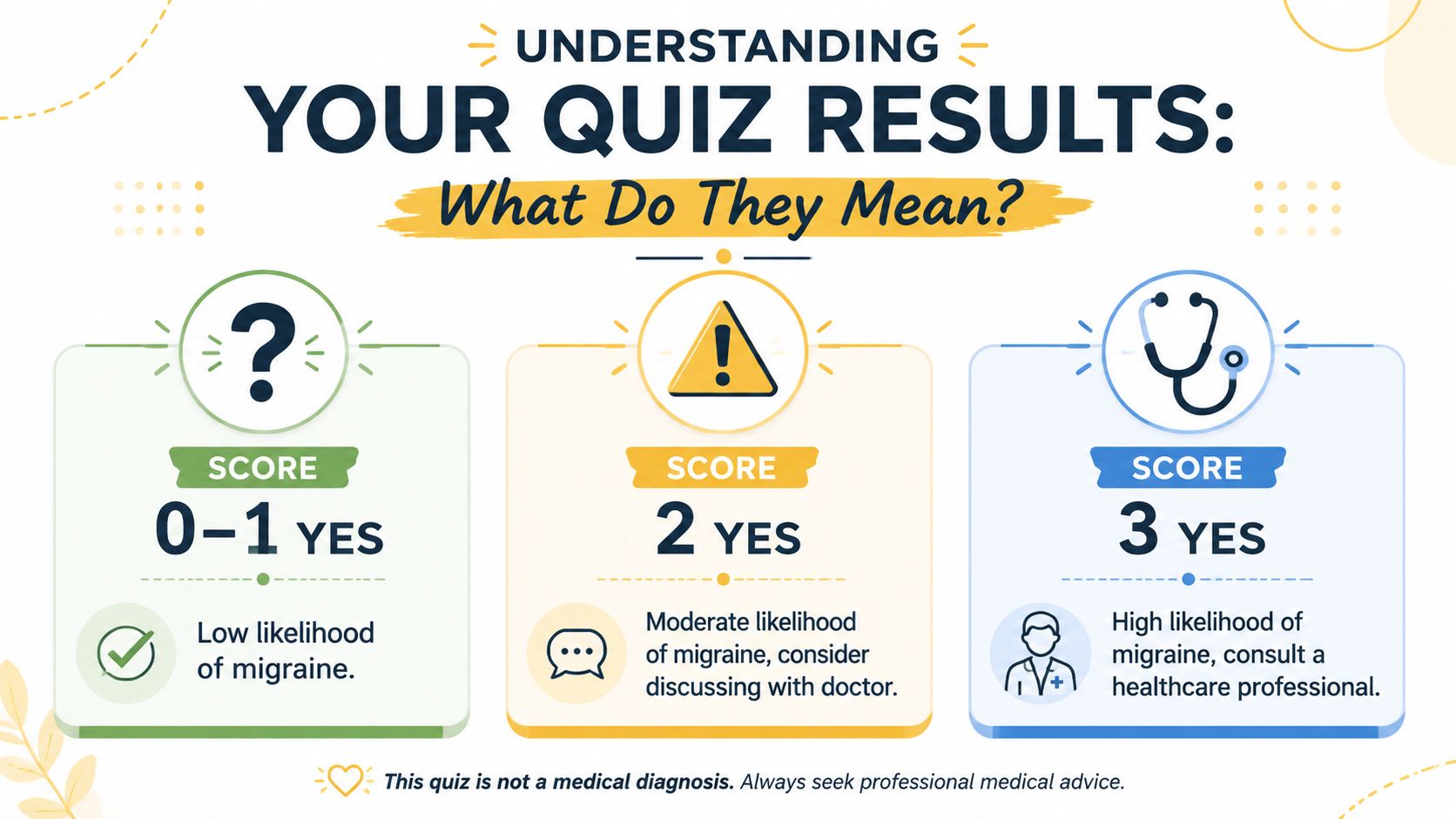
If you answered yes to 0 or 1
This pattern suggests a lower likelihood of migraine based on this particular screener. That doesn't mean your headache isn't important. It means your symptoms don't strongly match this specific three-question pattern.
You might still be dealing with another headache type, an atypical migraine pattern, or headaches that need a fuller medical review. If your attacks are recurring, changing, or hard to describe, write down what happens before, during, and after them.
If you answered yes to 2
This is the point where the quiz becomes especially useful. As noted in the earlier section, 2 yes answers on the validated screener correspond to a high likelihood of migraine.
That still isn't a diagnosis. But it's strong enough that bringing your symptom pattern to a primary care clinician or headache specialist makes sense. If you want a helpful next step, keep a brief log for a few weeks and note whether your attacks include nausea, photophobia, sound sensitivity, visual changes, or major interruption to daily life.
If you answered yes to 3
This result points even more strongly toward a migraine pattern. It tells you that your headaches don't just hurt. They also interfere with function and come with classic associated symptoms.
If this sounds familiar, it may help to review common migraine warning signs and symptom patterns before your next appointment so you can describe what happens more clearly.
A screening result is most useful when you pair it with a symptom history, not when you treat it like a final verdict.
Why impact matters as much as pain
People often judge headaches by one question: "How bad is the pain?" Clinicians often need a broader picture. They want to know how much your headaches affect work, focus, energy, mood, and routine.
Validated tools help measure that. The HIT-6 uses 6 items scored from 36 to 78, and higher scores reflect greater daily impact. Another tool, the MSQ v2.1, has 14 items across role function and emotional function domains on a 0 to 100 scale after rescaling, as described in this review of migraine patient-reported outcome instruments.
That focus on impact matters because migraine burden isn't just about frequency. In one validation study, people with episodic migraine had odds of reporting one higher level of headache impact severity that were 8.6 times greater than non-migraine headache sufferers, while chronic migraine patients had odds 13.4 times greater. The same study found that the mean HIT-6 score difference between episodic and chronic migraine corresponded to about 5.5% of the full scale range, showing that chronic migraine is meaningfully more disabling on standardized measures, as reported in this Headache Impact Test validation study.
Migraine vs Tension Headache vs Cluster Headache
A quiz can point you in a direction. It can't teach the whole vocabulary of headache types. That's where comparison helps.
Headache type symptom comparison
| Symptom Feature | Migraine | Tension Headache | Cluster Headache |
|---|---|---|---|
| Pain quality | Often throbbing or pulsating, but not always | Often pressing, tight, or band-like | Often severe, piercing, or burning |
| Location | Often one side, but can affect both sides | Often across forehead, temples, scalp, or back of head | Often around or behind one eye |
| Function | Commonly disrupts routine activity | May be distracting but often less disabling | Can be extremely disruptive and hard to sit through |
| Associated symptoms | May include nausea, photophobia, phonophobia, aura, and postdrome | Usually fewer associated symptoms | Often comes with eye watering, nasal symptoms, agitation, or restlessness |
| Aura | Can occur in some people. Aura means temporary sensory symptoms such as visual changes | Not typical | Not typical |
| Sound sensitivity | Common. This is called phonophobia | Can happen, but isn't usually the defining feature | May occur, but cluster patterns are usually identified by other features |
| Pattern | Episodes can vary person to person | Often linked with muscle tension, stress, posture, or strain | Usually follows a distinct repeated pattern during active periods |
A few terms matter here:
- Aura means reversible neurological symptoms that happen before or during an attack, often visual but sometimes sensory or language-related.
- Photophobia means light sensitivity.
- Phonophobia means sound sensitivity.
- Postdrome is the drained, foggy, off-balance phase that can follow a migraine attack.
Why people mix them up
The overlap is real. A migraine can feel like pressure instead of pounding. A tension headache can become intense after a rough day. Cluster headache can be mistaken for sinus or eye pain at first.
People also get confused because they expect all migraine attacks to look textbook-perfect. They don't. Some people never have aura. Some have neck pain first. Some mainly notice stomach upset and sensory overload.
A few clues tend to push the pattern toward migraine:
- You need to stop what you're doing because normal activity feels hard or impossible.
- Light or sound becomes intrusive, even at levels that usually wouldn't bother you.
- The attack has phases, such as warning symptoms before the pain or a washed-out feeling after.
- Your symptoms don't stay limited to pain. You may feel nauseated, mentally slowed, or unusually sensitive.
Cluster headache often stands apart because people describe a very focused, severe pain around one eye and a strong sense of agitation. Tension headache often feels steadier and less loaded with sensory symptoms.
If your symptoms don't fit neatly into one box, that's common. Headache medicine relies a lot on pattern recognition over time.
Red Flag Symptoms When to Seek Immediate Medical Care
Most recurring headaches are not emergencies. Some are. Don't use a migraine or headache quiz to sort out a possible emergency.
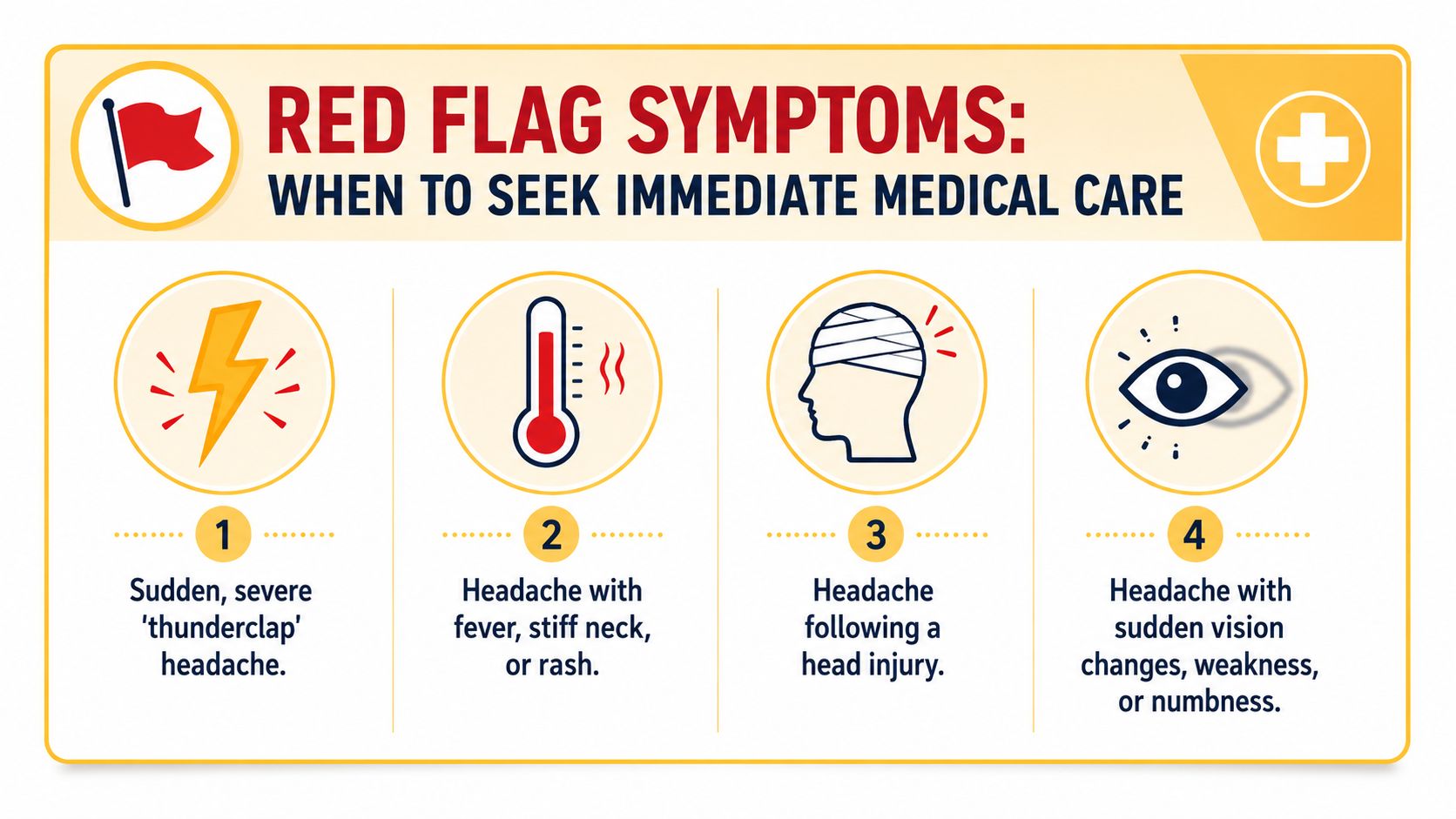
Get urgent help right away if
Seek immediate medical care if you have any of these:
- Sudden severe headache that reaches maximum intensity fast, especially if it feels like the worst headache of your life
- Headache with fever, stiff neck, or rash
- Headache after a head injury
- Headache with new neurological changes, such as weakness, numbness, confusion, fainting, seizure, slurred speech, or sudden vision changes
This is not the time to wait for a diary to fill up or to retake a quiz. These symptoms need prompt medical evaluation.
New neurological symptoms plus headache should be treated as urgent until a clinician says otherwise.
When to make a routine medical appointment
A non-emergency appointment is still a good idea if your headaches are becoming more frequent, changing pattern, causing repeated missed work or family responsibilities, or no longer responding to what used to help.
This article is for informational purposes and is not medical advice. Consult a healthcare provider for personalized guidance.
Beyond the Quiz Practical Steps for Tracking and Management
A one-time quiz can give you a useful snapshot. It can't tell you what reliably leads into your own attacks.
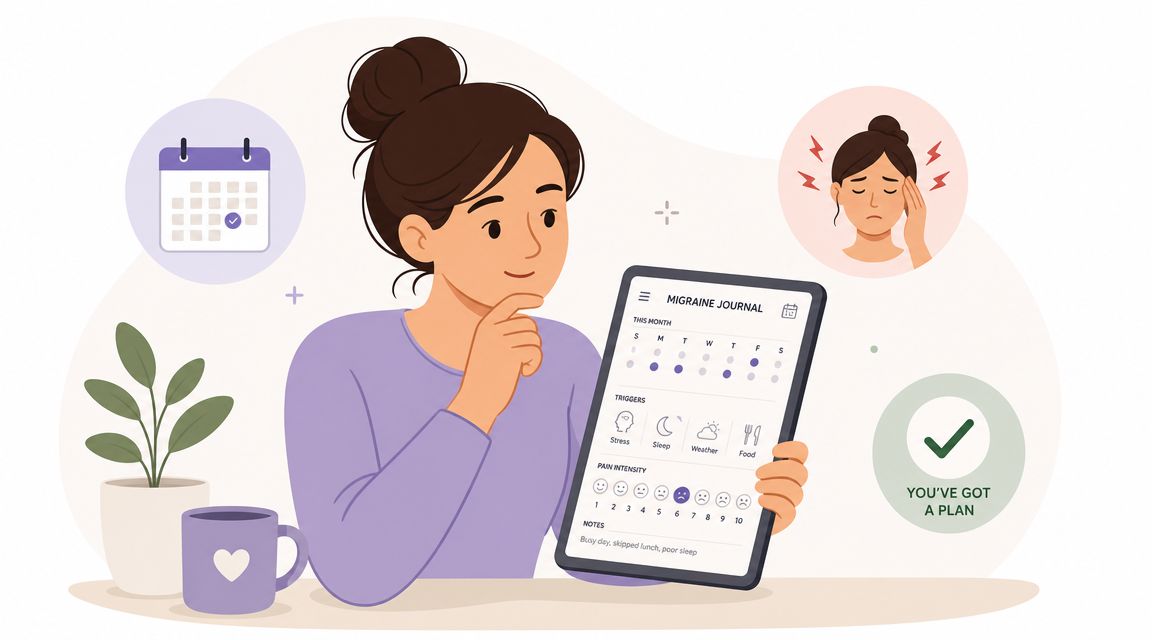
Many people start with a generic trigger list. Stress. Sleep changes. dehydration. Weather. Certain foods. Hormonal shifts. That can be a useful brainstorm, but it often creates false confidence. As discussed in Healthline's overview of migraine trigger quizzes and tracking, trigger reporting is highly individual and timing can be misleading, so a diary or app is more useful than a one-time checklist for finding personal patterns.
What to track after the quiz
Keep it simple enough that you'll do it. A notebook works. An app works too.
Track these basics:
- When it started and when it ended
- What the pain felt like, such as throbbing, pressure, stabbing, or heavy
- Where it was located, including whether it moved
- Associated symptoms, like nausea, light sensitivity, sound sensitivity, aura, dizziness, or brain fog
- How much it interfered with work, driving, screens, errands, meals, sleep, or exercise
- What was happening before it began, such as a poor night of sleep, skipped meal, stressful day, travel, weather change, or an unusual exposure
- What you tried, including rest, darkness, fluids, over-the-counter options, or prescribed treatment
- What seemed to help or not help
If you're curious about food-related patterns, broad labels don't always help much. A more focused question often works better, especially with topics like histamine and migraine headaches, where timing, quantity, and other overlapping triggers can blur the picture.
How to think about triggers more accurately
A trigger isn't always a cause. Sometimes what looks like a trigger is an early symptom.
For example, you might crave a certain food before an attack and assume that food caused it. Or you might notice that stress and migraine happen on the same day, when the underlying setup began with poor sleep the night before. Tracking helps separate correlation from causation.
Here are a few ways to make your notes more useful:
- Look for repetition, not one-offs. A single bad day doesn't prove much.
- Notice timing. Ask what happened in the day before the attack, not just the hour before.
- Record your normal days too. Otherwise, you'll only collect data during bad episodes.
- Use the same terms each time. Consistent language makes patterns easier to see later.
This short video gives another practical view of how migraine symptoms and patterns can show up in daily life:
If you prefer digital tracking, some people use notes apps, spreadsheet logs, or dedicated migraine tools. Relief is one option that combines symptom logging with weather, air quality, and pollen context so you can look for personalized patterns over time. That's a support tool, not a replacement for medical care.
From Confusion to Clarity Your Path Forward
If you've made it this far, you already have something useful. A better frame for what you're experiencing.
A migraine or headache quiz works best when you treat it as a beginning. It helps you notice whether your symptoms match a common migraine pattern. After that, true progress usually comes from describing your attacks clearly, watching for red flags, and tracking what happens in your daily life.
If your headaches have become frequent, hard to manage, or hard to explain, a clinician can help sort through the pattern. If you're trying to understand why they keep happening, looking at longer-term patterns may help more than retaking the same quiz. This is especially true when you're dealing with recurring attacks and want to understand what causes chronic migraines.
This article is for informational purposes and is not medical advice. Consult a healthcare provider for personalized guidance.
If you want a simple way to keep track of symptoms, triggers, and patterns over time, Relief can support that ongoing process.


