Yes, migraines can cause numbness, and for many people it happens as part of migraine aura. Nearly 25% of patients diagnosed with migraine experience aura symptoms, which can include limb numbness, and that sensory aura often starts as tingling before turning into localized numbness that resolves within about 60 minutes according to StatPearls on migraine with aura.
If you're reading this because your hand, face, or tongue suddenly felt strange during a migraine attack, you're not overreacting. Numbness is scary. It can make even people with years of migraine experience wonder if something more dangerous is happening.
The hard part is that both things can be true at once. Migraine-related numbness is a real, documented neurological symptom, and it can still be important to rule out emergencies like stroke, especially if the pattern is new, sudden, or unusual for you. This article is for informational purposes and is not medical advice. Consult a healthcare provider for personalized guidance.
Table of Contents
That Frightening Feeling of Numbness During a Migraine
You might know your usual migraine pattern well. Maybe it's throbbing pain, nausea, photophobia, which means light sensitivity, or a need to lie still in a dark room. Then one day your fingers start tingling, your cheek feels odd, or part of your mouth goes numb, and suddenly this doesn't feel like your “normal” migraine anymore.
That reaction makes sense. Numbness has a way of cutting straight through reassurance.
What sensory aura can feel like
For many people, this symptom is part of a sensory aura. Aura is a temporary neurological disturbance that can happen before the headache phase or alongside it. In some attacks, the aura is visual. In others, it affects sensation, speech, or both.
A common description goes something like this: first a prickly, pins-and-needles feeling, then a spreading heaviness or numb patch. It may affect a hand, arm, face, or one side of the mouth. The sensation can feel unsettlingly wrong, even when it follows a migraine pattern.
Practical rule: If numbness during a migraine has happened before in the same gradual way, that history matters. If it's new, abrupt, or different from your usual aura, don't brush it off.
Why this symptom causes so much panic
People often get dismissed when they describe neurological migraine symptoms. They hear “it's just a headache,” even though migraine is not the same thing as a basic headache. Migraine is a neurological condition that can include aura, nausea, sound sensitivity, cognitive slowing, and sensory changes like numbness.
The fear is not irrational. Numbness overlaps with symptoms people associate with stroke. That's why learning the pattern matters so much. Migraine aura tends to build and move. Stroke symptoms are more often sudden.
If facial tingling is part of what you're noticing, ReliefMigraine's guide to headache with facial tingling can help you put that symptom in context with other migraine features.
Understanding Numbness in Common Migraine with Aura
A lot of articles jump straight to hemiplegic migraine when they mention numbness. That's one reason people panic. It leaves out something important. Numbness can happen in common migraine with aura too.
Numbness is not limited to rare migraine types
Sensory aura is not reserved for rare migraine subtypes. According to Ubie Health's review of migraine numbness, sensory auras, including gradual numbness, occur in 25-30% of typical migraine-with-aura cases, not just rare hemiplegic types. The same source notes that this symptom is frequently misunderstood, and some data suggest 70% of facial numbness in migraine patients is misdiagnosed as sinus issues.
That misunderstanding creates a miserable loop. You feel a real neurological symptom. You search online. Most of what you find talks about rare conditions or vague sinus pressure. Neither explanation fits what you're experiencing.
The pattern matters more than the body part
What often points toward migraine aura is how the symptom unfolds.
Common migraine-related numbness often follows a pattern like this:
- It starts with tingling: Many people notice pins and needles before numbness.
- It spreads gradually: The feeling may begin in the fingers, move up the hand or arm, and then reach the face.
- It changes as it moves: Tingling can fade into numbness rather than staying the same from start to finish.
- It resolves: The sensation usually passes instead of staying fixed.
That gradual “march” is one of the biggest clues. Stroke symptoms usually don't drift from one area to another in a slow sequence. They tend to appear suddenly.
Sensory aura can be dramatic without meaning permanent damage. Temporary does not mean imaginary.
People also get confused about where numbness “should” happen. In migraine aura, it doesn't have to stay neatly in one limb. Some people feel it in the face, lips, or tongue. That can be especially alarming, but the moving pattern is often more informative than the location alone.
How a Migraine Triggers Numbness in Your Brain
The sensation may show up in your hand or face, but the process starts in the brain. That matters, because it helps explain why migraine numbness can feel so specific and still be temporary.
A slow wave, not a random glitch
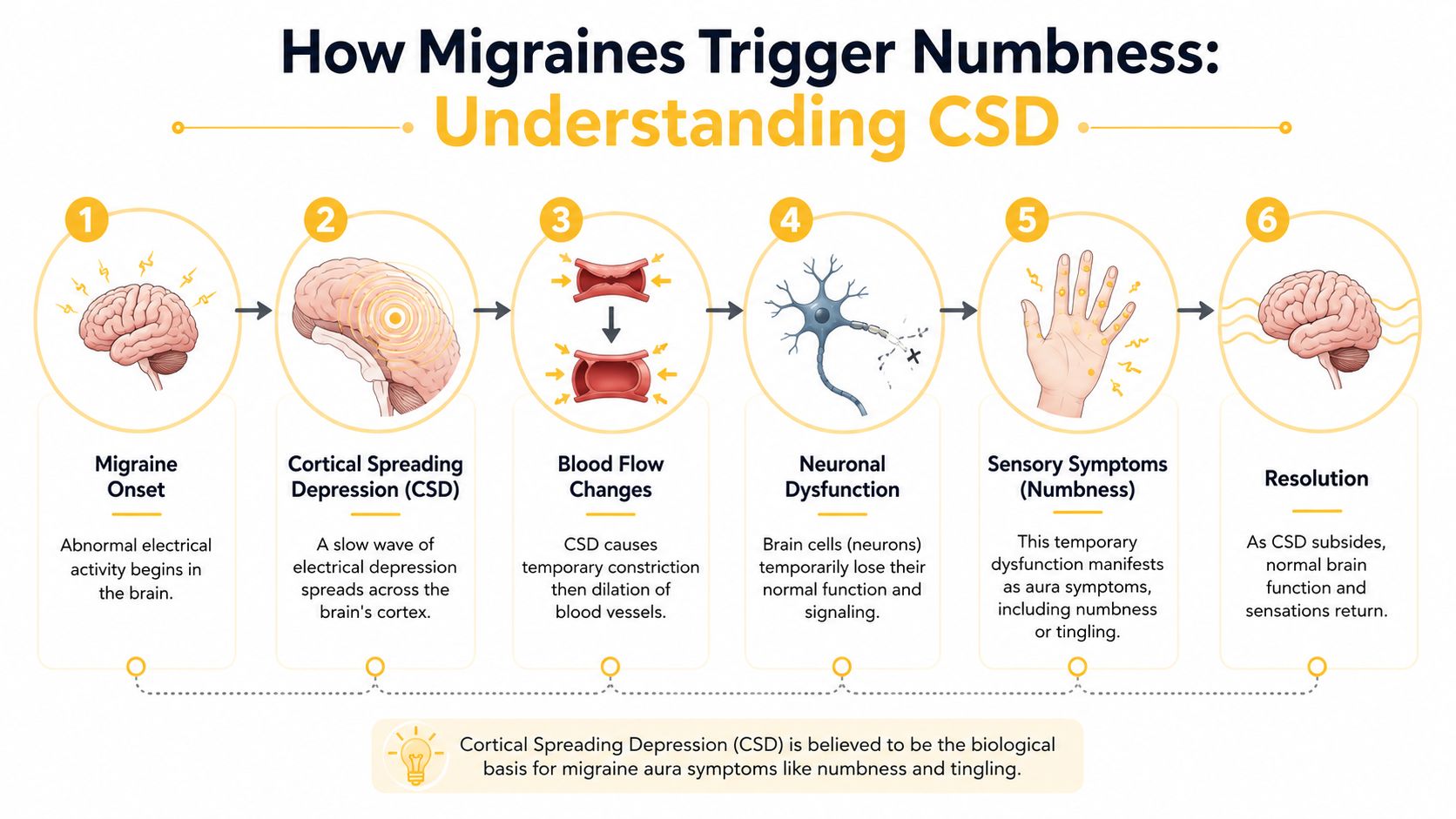
One leading explanation is cortical spreading depression, often shortened to CSD. A simple way to picture it is as a slow wave of altered electrical activity moving across the brain's outer layer. As that wave passes through areas involved in sensation, it can temporarily disrupt normal signaling.
According to Migraine World Summit's explanation of numbness as a migraine symptom, the gradual spread of numbness from the fingers to the face aligns with this CSD process. That wave also stimulates the trigeminal nerve, which contributes to the abnormal skin sensations people feel during sensory aura.
Why the sensation seems to travel
This is why migraine numbness often doesn't appear all at once. It can seem to move. One area tingles first. Then another feels numb. Then the original spot starts to improve.
That sequence can feel eerie if you don't know what's happening. But neurologically, it fits. If the brain area handling one part of the body is affected first, and nearby areas are affected next, the sensations may appear to travel in the body even though the event is unfolding in the brain.
A short visual can make that easier to grasp:
Here are a few plain-language ways to understand:
- A map problem: Your brain contains organized sensory maps of your body. Temporary disruption in those maps can create real numbness.
- A timing problem: Symptoms change as the wave moves, so tingling and numbness may overlap.
- A reversibility problem: Once the disturbance settles, sensation often returns to normal.
When a symptom has a mechanism, it often becomes a little less frightening. Migraine aura is disruptive, but it follows neurological rules.
When Numbness Is a Sign of Hemiplegic Migraine
There is a migraine subtype where numbness comes with something more than altered sensation. That subtype is hemiplegic migraine.
What makes hemiplegic migraine different
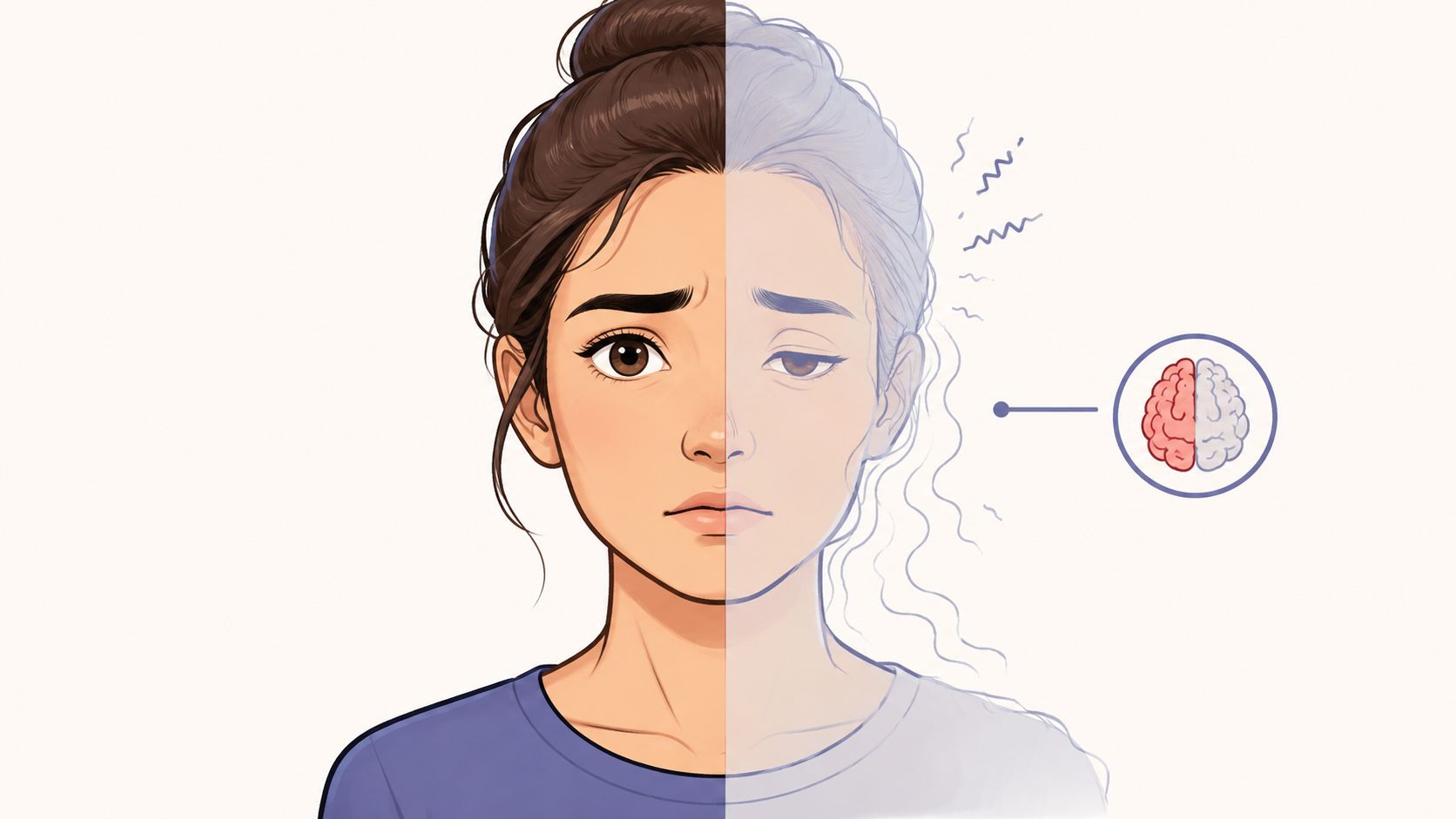
The key difference is motor weakness during the aura phase. This isn't just “my arm feels weird.” It's closer to “my arm feels heavy and harder to move,” often on one side of the body.
According to Cleveland Clinic's overview of hemiplegic migraine, this condition is extremely rare, with estimates suggesting only 0.04% of the population meets the criteria. The same source notes that a simple clue can be difficulty raising one arm over the head, reflecting the one-sided weakness that helps distinguish it from sensory aura alone.
If you want a fuller overview of that subtype, ReliefMigraine's article on what a hemiplegic migraine is explains how motor symptoms fit into the broader picture.
When weakness changes the picture
Caution is paramount. Temporary weakness, numbness, speech trouble, and visual changes can mimic stroke. Even if you've had migraine before, new one-sided weakness deserves urgent medical evaluation.
A few clues that raise concern for hemiplegic migraine or another neurological issue:
- True weakness: One arm won't lift normally, drifts, or feels markedly harder to move.
- One-sided involvement: Symptoms cluster on one side of the face and body.
- Speech change: Words become difficult to form or understand.
- A very different pattern: The attack doesn't feel like your established migraine pattern.
Migraine-related numbness often does not signify hemiplegic migraine. That point matters. But it would be unsafe to ignore weakness just because migraine can also cause neurological symptoms.
Migraine Numbness vs Stroke Symptoms What to Look For
This is the comparison needed in the moment. Not to diagnose yourself, but to decide whether you should wait, call your clinician, or get emergency help now.
Symptom Comparison Migraine Aura vs Stroke or TIA
| Symptom Feature | Migraine Aura | Stroke or TIA |
|---|---|---|
| Onset | Usually builds gradually | Often begins suddenly |
| Spread | May move from one area to another, such as fingers to face | Often appears all at once |
| Sensation pattern | Tingling may shift into numbness | Numbness is more often abrupt |
| Timing | Often temporary and self-limited | May persist or leave ongoing deficits |
| Tongue or mouth involvement | Can occur in migraine aura | Less typical |
| Weakness | Usually absent in common sensory aura | May occur suddenly and prominently |
| Familiarity | May match your past aura pattern | Often feels new, abrupt, or alarming |
A migraine aura often behaves like a sequence. Something starts. It spreads. It changes. Then it resolves.
A stroke or transient ischemic attack, often called a TIA, more often behaves like a switch flipping. Symptoms appear abruptly. There may be facial droop, sudden weakness, trouble speaking, confusion, or sudden vision loss. You should not try to sort that out alone if it's happening in real time.
If numbness appears suddenly instead of gradually, treat that as an emergency until a clinician says otherwise.
Red flags that need emergency care
Seek immediate medical care if you have any of these:
- Sudden severe headache: Especially a thunderclap-style headache that peaks fast.
- Headache with fever or stiff neck: This can point to something other than migraine.
- New neurological changes: Sudden weakness, facial droop, confusion, new speech trouble, or sudden vision change.
- Headache after head injury: Especially with neurological symptoms.
- A brand-new aura pattern: New numbness or weakness that you've never had before.
This is not optional. If you're having stroke-like symptoms, call emergency services or go to the emergency department.
A practical way to think about it is this:
Migraine aura tends to announce itself. Stroke tends to interrupt everything at once.
Another important point is duration. In common sensory aura, numbness often clears relatively quickly. If numbness lingers, worsens, or is paired with sudden weakness or major speech difficulty, get checked right away.
If you regularly have aura and your pattern changes, bring that up even if symptoms resolve. Familiar symptoms can still evolve over time, and your clinician may want to review whether anything else needs to be ruled out.
How Doctors Diagnose and Treat Migraine Numbness
When you tell a clinician that migraines cause numbness for you, the first job is usually not to “confirm the internet.” It's to make sure something more urgent or less common isn't being missed.
This article is for informational purposes and is not medical advice. Consult a healthcare provider for personalized guidance.
What a medical evaluation usually includes
A doctor will usually start with your symptom story. They may ask when the numbness starts, how fast it spreads, what body parts are involved, how long it lasts, whether you also get visual aura or speech symptoms, and whether the pattern is the same each time.
They'll often do a neurological exam as well. Depending on your history, especially if symptoms are new or atypical, they may order imaging such as a CT scan or MRI to rule out stroke or another neurological cause.
Doctors also pay attention to context. Useful details include:
- Attack timing: Did the numbness come before the headache, during it, or without head pain at all?
- Symptom order: Did tingling come first, then numbness?
- Associated symptoms: Visual changes, nausea, light sensitivity, speech trouble, or weakness all help shape the picture.
- Pattern change: A long history of the same aura pattern is different from a first-ever event.
Treatment options doctors may discuss
Once a clinician is confident the episodes fit migraine with aura, treatment usually falls into a few buckets.
Lifestyle approaches
These don't “cure” migraine, but they can help reduce attacks for some people. Doctors often talk about regular sleep, hydration, meals, stress management, and consistent routines. If certain weather patterns, skipped meals, poor sleep, or bright light seem tied to attacks, tracking those patterns can be useful.
Over-the-counter options
Some people use nonprescription pain relief early in an attack, if their clinician says that's appropriate for them. The key issue is not to overuse acute medication, because frequent use can sometimes create rebound problems.
Prescription treatments
Doctors may discuss one treatment used during an attack and another used preventively if attacks are frequent, severe, or disruptive. The best option depends on your health history, aura pattern, other conditions, and how disabling your migraine is. There isn't one universal “best” prescription.
Emerging and specialist care
If numbness, aura, or other neurological features are complicated, a primary care clinician may refer you to a neurologist or headache specialist. That can be especially helpful when symptoms mimic other disorders or when standard treatment hasn't worked well.
Bring a written record to the appointment. Clinicians can make much better decisions when they can see what happened, in what order, and how often.
Tracking Your Symptoms to Find Clarity and Control
Migraine is personal. Two people can both have migraine with aura and still have very different warning signs, body symptoms, and recovery patterns. That's why tracking matters so much when numbness enters the picture.
What to log after a numbness episode

A good symptom log doesn't need to be complicated. It just needs to be consistent.
After an episode, try recording:
- Where it started: Fingers, lips, cheek, tongue, arm, or leg.
- How it moved: Stayed in one spot, climbed up the arm, crossed into the face, or shifted in another pattern.
- What came with it: Visual aura, headache pain, nausea, sound sensitivity, speech difficulty, or weakness.
- How long it lasted: Write down the full time course as best you can remember.
- What happened beforehand: Sleep changes, stress, meals, weather shifts, physical exertion, or missed medication.
If you want a simple structure, this migraine log template can help you capture the details that matter without overthinking it.
Why pattern tracking matters
Tracking does two things at once. First, it helps you notice whether your numbness follows a repeatable migraine pattern. Second, it gives your clinician something concrete to review, instead of relying on memory during a short appointment.
That can reduce confusion around questions like:
- Is this always preceded by tingling?
- Does it always affect the same side?
- Does it happen only with certain attacks?
- Is the pattern changing over time?
A written record turns a frightening symptom into information you can use.
When you're dealing with something as unsettling as numbness, clarity helps. Not perfect certainty. Just enough structure to spot patterns, ask better questions, and know when a symptom is staying within your usual migraine pattern or stepping outside it.
Relief can help you log symptoms, triggers, and attack timing in seconds, then connect those entries with weather, air quality, and pollen patterns so you can better understand what tends to happen before your migraines start.


