
Coconut water might help some migraines, mainly if dehydration is part of the problem. The strongest measured hydration result in recurrent headache research came from increasing water intake by 1.5 liters per day, which was associated with 21 fewer headache hours over 2 weeks, but that result wasn't clearly statistically significant, and coconut water itself is not a proven migraine treatment.
When you're in pain, nauseated, light-sensitive, and scrolling for one thing that might settle your head, "drink coconut water" can sound both hopeful and suspicious. That instinct is fair. Some people do feel better after it. Some feel worse. The useful question isn't whether coconut water is a miracle. It's whether it helps your migraine pattern, or whether it's one more drink that works only when you're already dehydrated.
This article is for informational purposes and is not medical advice. Consult a healthcare provider for personalized guidance.
Table of Contents
That Glimmer of Hope in a Coconut Shell
A lot of people with migraine know this moment. Someone swears a simple home remedy stopped their attack, and for a second you let yourself think, maybe this one will be different.
That doesn't make you gullible. It makes you tired of hurting.
Coconut water sits in that exact category. It sounds plausible because it contains fluid and electrolytes, and hydration does matter for some people with migraine. But that plausibility has limits. WebMD notes there's no good scientific evidence supporting coconut water's therapeutic uses beyond hydration, which means any migraine benefit is most believable when dehydration helped trigger the attack in the first place.
The part that makes sense
If you've been sweating, skipped fluids, exercised hard, vomited, traveled, or gone too long without drinking, coconut water may help because it supports rehydration. That's a very different claim from saying it treats migraine itself.
Migraine is a neurological condition. A migraine attack can involve throbbing head pain, nausea, photophobia (light sensitivity), sound sensitivity, aura, dizziness, and a wiped-out postdrome phase afterward. A dehydration-related headache and a migraine can overlap, but they aren't the same thing.
Coconut water makes the most sense when dehydration is one of the moving parts, not when you're looking for a standalone fix for migraine biology.
The part people often skip
"Natural" doesn't automatically mean low-risk. Some people notice that coconut water helps settle them. Others find that it seems to trigger symptoms, especially if sugar swings or dietary sensitivities are part of their pattern.
So the balanced answer is simple. Coconut water can be worth considering as a hydration tool. It isn't a proven cure, and it isn't a universal fit.
The Critical Link Between Hydration and Migraine
Dehydration is one of those triggers people often underestimate because it sounds too basic. But basic doesn't mean unimportant.
Why fluids can matter
Your brain and nervous system depend on a steady internal environment. When fluid intake falls behind, several things can shift at once. Blood volume may drop. Electrolyte balance can change. Nerve cells don't love that instability, and in some people with migraine, that added stress seems to lower the threshold for an attack.
You don't need a perfect physiology lecture to use this. Think of hydration as maintenance for a system that's already sensitive. If your body is running low on fluid, migraine management gets harder.
A lot of prevention habits work this way. They don't "cure" migraine, but they reduce strain on a trigger-sensitive system. That's also why everyday routines like sleep regularity, meal timing, and hydration show up so often in practical migraine care. ReliefMigraine's guide on how to prevent migraines naturally fits that broader approach well.
What the evidence actually supports
The strongest research base here is for water, not coconut water. In a systematic review of diet and migraine, one randomized trial found that increasing water intake to 1.5 liters per day was associated with 21 fewer headache hours over 2 weeks versus control, though the confidence interval crossed zero and the effect wasn't statistically significant. Another analysis in the same review reported a 13 mm improvement on a 0 to 100 mm visual analog scale at 12 weeks, again without clear statistical significance, as summarized in this systematic review on diet and migraine.
That matters because it keeps the logic honest. Hydration may help. Water has been studied. Coconut water is often discussed as an electrolyte option, but it hasn't earned the same migraine-specific evidence.
Practical rule: If coconut water helps you, the most likely explanation is hydration support, not a special anti-migraine property unique to coconuts.
How Coconut Water Might Help a Migraine Attack
Coconut water gets attention because it isn't just fluid. It's a beverage that contains potassium, sodium, magnesium, and carbohydrates, and that's enough to make people wonder whether it might do more than plain water.
Why people reach for it
For someone who feels wrung out, sweaty, depleted, or a little shaky during or after an attack, coconut water can seem easier to tolerate than a full meal. Some people also prefer it over brightly colored sports drinks with lots of additives.
The theoretical appeal looks something like this:
- Fluid replacement helps if the attack started after low intake, heat, travel, exercise, or vomiting.
- Sodium can support fluid retention better than plain water alone in some situations.
- Potassium and magnesium are involved in normal nerve and muscle function.
- Carbohydrates may feel helpful to someone who hasn't eaten and is dealing with that hollow, drained feeling.
That doesn't prove migraine benefit. It just explains why the idea isn't random.
Where the theory stops
The problem is that theory and outcomes aren't the same. A drink can look helpful on paper and still fail in real life if the trigger wasn't dehydration, if sugar worsens symptoms, or if nausea makes any beverage unappealing.
Coconut water also occupies an awkward middle ground. It may be more useful than plain water for someone who needs both fluid and electrolytes, but less useful than a lower-sugar electrolyte option for someone whose attacks are tied to blood sugar fluctuations.
So if you're asking whether coconut water helps a migraine attack, the best current answer is conditional. It may help when rehydration is the main need. It doesn't have good evidence as a migraine-specific intervention.
Anecdotal Reports vs Clinical Evidence
If you've searched coconut water migraines online, you've probably seen two extremes. One person calls it a lifesaver. Another says it set off a brutal attack.
Both things can be true for different people.
Why stories spread so fast
Anecdotes are compelling because they're immediate. They sound like real life because they are real life, for that person. In a publicly visible Mayo Clinic community discussion, one user reported that after drinking about 1/2 a glass of coconut water, their migraine was gone in about 45 minutes. Other comments in similar patient spaces report the opposite, with coconut water or coconut products described as triggers. You can see that split in the Mayo Clinic community discussion about coconut water and migraine.
That doesn't make the positive story fake. It means it isn't enough to establish a treatment effect.
What anecdote can and cannot tell you
Anecdotes can help you generate a question. They can't settle it.
Here are a few reasons a personal story can mislead, even when it's sincere:
- Migraine attacks change on their own. Symptoms sometimes peak and ease without any clear reason.
- More than one thing may have changed. Rest, darkness, food, caffeine, medication, or time itself may have contributed.
- Migraine triggers vary widely. A drink that's calming for one person may be activating for another.
- Memory compresses events. During pain, it's hard to separate "I drank this" from "then I started improving."
A good anecdote says, "This might be worth testing carefully." It doesn't say, "This works for migraine."
The bigger issue is the evidence gap. Public conversation about coconut water is much louder than the clinical research. Right now, there isn't strong trial-based consensus showing coconut water is an effective migraine treatment. That's why cautious experimentation makes more sense than confidence.
Potential Risks and When to Be Cautious
Lifestyle articles often stop at "it's hydrating, so go ahead." For migraine, that's not enough.
Sugar and migraine patterns
Some people tolerate coconut water well. Some don't. One major trade-off is carbohydrate load. If your migraine pattern is sensitive to fasting, rebound hunger, sweet drinks, or blood sugar swings, coconut water may be a poor fit even if it looks healthy on the label.
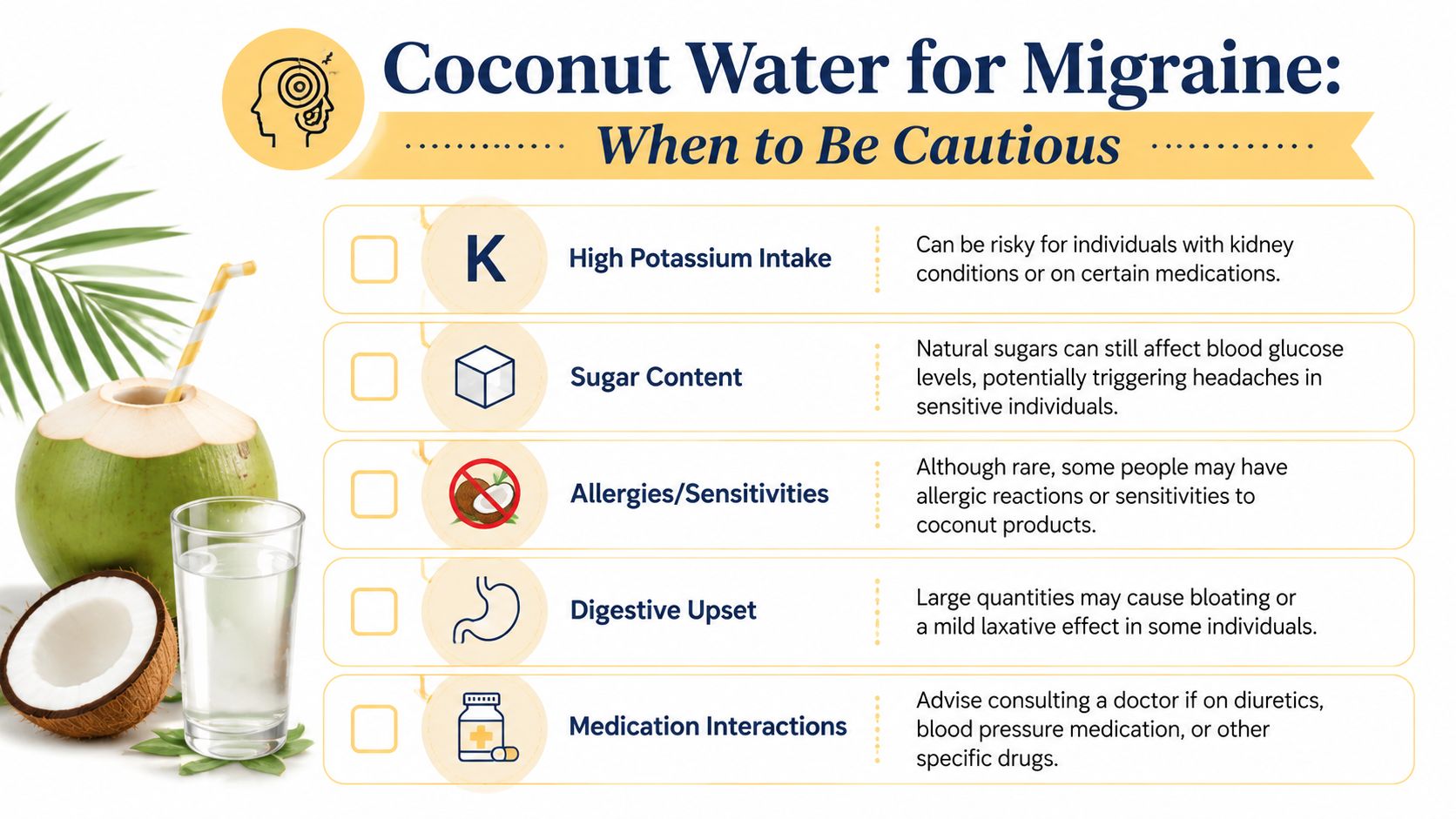
A 2024 UCSF review summarized in MedicalXpress noted that drinking enough water may help prevent migraines and reported that adults with recurrent headaches felt better after three months of increased water intake. The same practical takeaway applies here. The vehicle matters. A high-sugar drink isn't the right hydration strategy for everyone with migraine, as covered in this UCSF review summary on hydration and recurrent headaches.
If histamine also seems to be part of your trigger picture, broader food-and-drink pattern tracking matters more than any single "healthy" beverage. ReliefMigraine's article on histamine and migraine headaches is useful context for that kind of detective work.
Potassium and health conditions
Coconut water is also high in potassium. That's not automatically bad, but it can be a problem for people with kidney disease or for people taking certain medications who have been told to monitor potassium intake.
This isn't a rare technicality to ignore. If you've ever been advised to watch your electrolytes, don't treat coconut water like flavored water.
When to skip it entirely
A cautious approach makes sense if any of these apply:
- You notice sugar sensitivity. Sweet drinks seem to bring on symptoms, shakiness, or a second crash.
- You have kidney disease or electrolyte restrictions. Potassium may matter more than hydration marketing suggests.
- Coconut products have bothered you before. A previous food reaction is a useful clue.
- You want an acute rescue for a full migraine attack. Coconut water isn't a replacement for a treatment plan discussed with your clinician.
If a drink helps only on the days you're clearly dehydrated, that's useful information. It still doesn't make the drink a migraine remedy.
Coconut Water vs Other Hydration Options
The most useful comparison isn't "good or bad." It's "best for what?"
A practical comparison
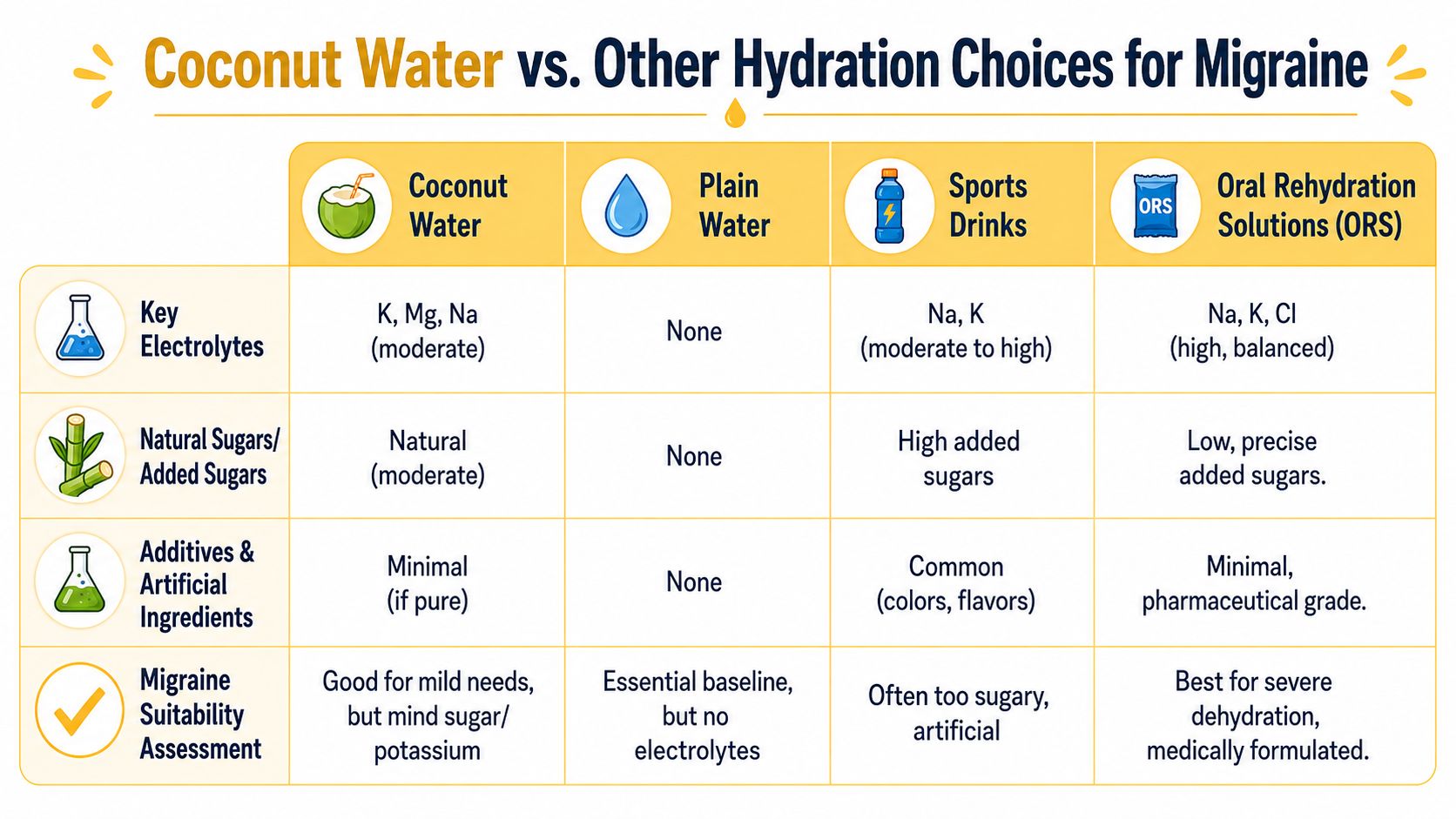
| Option | What it does well | Main drawback | Best fit |
|---|---|---|---|
| Plain water | Simple baseline hydration | No electrolytes | Daily routine hydration |
| Unsweetened coconut water | Fluid plus potassium, sodium, magnesium, carbohydrates | May not suit people sensitive to sugars or potassium | Mild dehydration when you tolerate it well |
| Sweetened sports drinks | Easy access, fluid plus electrolytes | Often too sugary or full of additives for some people | Situational use, not ideal for everyone |
| Oral rehydration solutions or electrolyte powders | More targeted rehydration approach | Taste and ingredients vary, some people still need to watch labels | Vomiting, GI losses, or more significant dehydration |
The key unanswered question remains whether coconut water helps migraine itself, or just a dehydrated body that happens to also be having a migraine. That's exactly why this comparison matters. MigreLief's discussion of hydration drinks for migraine reflects that uncertainty and the mixed user experience around coconut water.
A simple way to choose:
- Use plain water when you're just behind on fluids.
- Consider coconut water if you want a more natural electrolyte option and know sugar doesn't bother you.
- Consider a low-sugar electrolyte product if you need rehydration support but coconut water tends to feel too sweet.
- Use more medically structured hydration options if vomiting or heavier fluid loss is part of the picture.
How to Test Coconut Water for Yourself
If you're curious, test it like an experiment, not like a desperate guess.

A safer way to experiment
Some lay advice suggests 12 oz, but that isn't based on migraine-specific trials. More careful guidance is to start much smaller, especially if you have blood sugar sensitivity, kidney disease, or a history of diet-related triggers, as discussed in this lay guidance on what drink helps a headache.
A practical self-test looks like this:
- Pick an unsweetened option. Read the label. Avoid brands with extra sugars if sweet drinks already seem risky for you.
- Test tolerance on a non-migraine day first. You want to know whether the drink itself causes symptoms.
- Try it only when dehydration is plausible. For example, after heat exposure, travel, sweating, or low intake.
- Log timing carefully. Record when you drank it, what symptoms were already happening, whether you also ate, rested, used caffeine, or took medication.
- Watch for delayed effects. Some triggers don't hit immediately.
If you prefer structure, a simple symptom journal works. A dedicated tracker can make patterns easier to spot over time. Relief lets you log symptoms, triggers, medications, and timing, and its migraine log template can help you track whether coconut water correlates with improvement or with symptom flares.
Track this, not just pain: nausea, light sensitivity, thirst, shakiness, hunger, vomiting, and whether you were likely dehydrated before the attack.
For a visual walk-through on tracking migraine patterns and triggers, this overview may help:
What needs medical attention
Coconut water is not a substitute for medical care. Seek immediate medical care for a sudden severe headache, headache with fever or stiff neck, new neurological changes, or headache after a head injury.
And if you're getting frequent migraine attacks, new aura symptoms, repeated vomiting, or worsening disability, bring that pattern to a healthcare professional. You deserve better than trial-and-error alone.
If you want a clearer picture of whether coconut water is helping, doing nothing, or acting like a trigger, Relief can support that tracking by logging symptoms, timing, triggers, and environmental patterns in one place.


