
You wake up already doing the math. Did you sleep enough? Was it the late lunch, the stressful meeting, the weather shift, the second coffee, or all of it together? For those seeking how to prevent migraines naturally, the short answer is this: build prevention as a system, not a list of random remedies. The most useful natural approach combines tracking your personal patterns, keeping a steady daily routine, and testing a small number of evidence-backed options for prevention.
That matters because migraine prevention is different from trying to get through an attack once it starts. A lot of advice online blurs those two things. The more helpful direction in migraine education has shifted toward low-burden routines like consistent sleep, hydration, and stress regulation, instead of promising that one supplement or one “trigger food” rule will solve everything, as noted by Dysautonomia Clinic's overview of natural migraine prevention.
Migraine is not “just a headache.” It can involve prodrome symptoms that happen before the pain phase, aura in some people, and symptoms like nausea, sensitivity to light (photophobia), sound sensitivity, dizziness, and the drained feeling that can linger after the attack. If you're exhausted by how unpredictable it feels, that exhaustion makes sense.
This article is for informational purposes and is not medical advice. Consult a healthcare provider for personalized guidance.
Table of Contents
- You Deserve a Life with Fewer Migraine Days
- What to track first
- How to spot patterns without blaming the wrong thing
- Start with stability, not perfection
- Use SEEDS as your prevention backbone
- What a manageable routine actually looks like
You Deserve a Life with Fewer Migraine Days
If you've ever canceled plans, dimmed every light in the room, or tried to function through nausea and pounding pain while pretending you're fine, you already know migraine can take over far more than your head. It affects work, family, exercise, sleep, and the basic ability to trust your own schedule.
Natural prevention can help, but it works best when you stop thinking in terms of “the cure” and start thinking in terms of reducing your risk load. For some people, that means fewer attacks. For others, it means less severe attacks, fewer stacked triggers, and more warning before a bad day fully arrives.
Practical rule: Prevention is usually about making your body less easy to tip into an attack, not finding one magical fix.
That's why rigid, one-size-fits-all lists tend to fail. “Never eat chocolate again” is memorable advice, but it's often not useful advice. Migraine is highly individual, and the pattern is often delayed. What matters is what tends to happen in your body when sleep slips, meals move, stress spikes, or the weather shifts on top of everything else.
A realistic natural plan usually has three parts:
- Track what's happening: Notice patterns in symptoms, routines, food, stress, and environment.
- Stabilize the basics: Build more consistency into sleep, meals, hydration, movement, and recovery.
- Add selective tools: Consider supplements or diet changes carefully, and only as part of a bigger prevention strategy.
Some people need medication too. There's no failure in that. Natural prevention and medical care can work together.
Your First Step is Becoming a Migraine Detective
You wake up with that familiar pressure behind one eye and immediately start guessing. Was it the glass of wine two nights ago? The storm rolling in? The late lunch yesterday? After enough attacks, that guessing game gets exhausting.
A better first step is to build a record you can use. Migraine prevention works better when you treat it like pattern recognition. You track what your body is doing, what your routine looked like, and what was happening around you so you can spot rising risk before a full attack lands.

What to track first
Start simple. A usable diary beats an ambitious one you abandon after four days.
Track the few inputs that tend to shift migraine risk for many people:
- Sleep timing: Bedtime, wake time, poor sleep, waking during the night, or sleeping much later than usual.
- Meals and hydration: Skipped meals, delayed meals, low fluid intake, alcohol, or a big change in caffeine.
- Stress and letdown: Busy days, conflict, travel, intense concentration, and the crash that can follow a stressful stretch.
- Early symptoms: Yawning, neck pain, food cravings, mood changes, brain fog, light sensitivity, or nausea before head pain starts.
- Environmental factors: Weather changes, air quality, pollen, heat, bright light, strong smells, and long screen exposure.
- Attack details: When symptoms began, pain severity, associated symptoms, aura if you have it, what you took, and how long recovery lasted.
That last part matters. Prevention gets easier when you stop asking only, “What caused this?” and start asking, “What pattern was building?”
How to spot patterns without blaming the wrong thing
Migraine triggers are often cumulative. One short night of sleep may not cause a problem. Add a missed meal, a stressful afternoon, and a drop in barometric pressure, and the same nervous system may cross its threshold.
This is why rigid trigger lists frustrate so many people. Chocolate may seem guilty one week and harmless the next because it was never the whole story. The useful question is whether a factor raises your risk on its own, or mostly becomes a problem when it stacks with other stressors.
Sometimes the “trigger” is your first warning sign. Craving a food before an attack is different from that food causing the attack.
I usually suggest looking for repetition before making big changes. If a pattern shows up once, note it. If it shows up five or six times, it deserves attention. That approach helps you avoid cutting out foods, canceling activities, or blaming the wrong habit based on one bad day.
Use your notes to ask sharper questions:
- What tends to show up 12 to 48 hours before an attack?
- Which combinations show up more often than single factors?
- Are attacks tied more to schedule disruption than to one specific food?
- Do certain weather or air-quality conditions make other triggers hit harder?
If you want a clearer framework for what belongs on that list, this guide to migraine risk factors can help you organize what you're seeing.
The goal is not to become perfect. It is to become observant enough to build your own system. Once you know your baseline, you can start forecasting rough days, protect the basics earlier, and spend less time reacting after the pain has already started.
How to Build a Migraine-Resistant Daily Routine
The most reliable natural prevention habits are not glamorous. They are repetitive, ordinary, and surprisingly effective when you do them often enough.
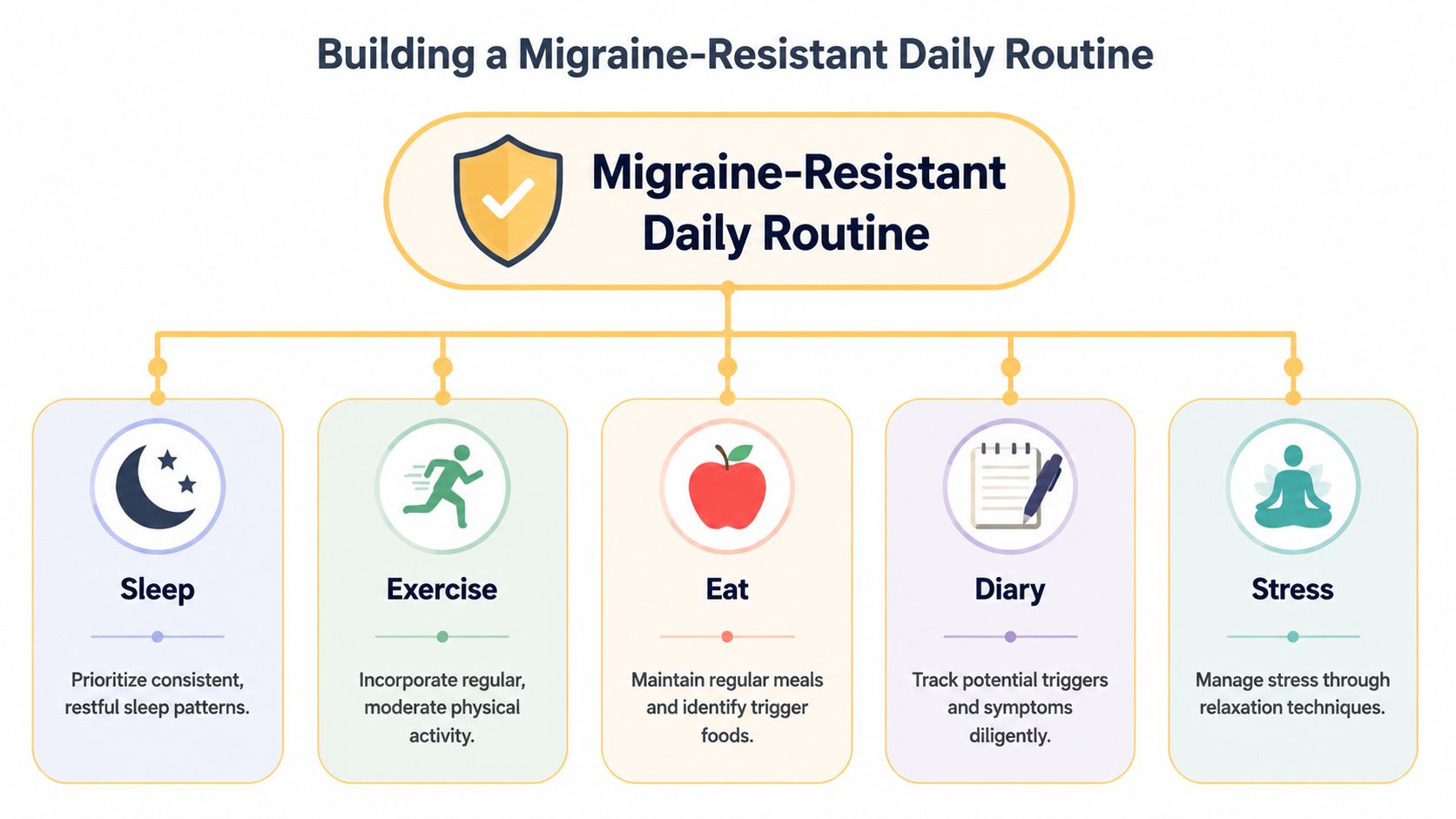
A highly regular routine is a foundational strategy in migraine prevention. The SEEDS framework, which stands for Sleep, Exercise, Eat, Diary, Stress, is commonly used to organize those habits, and major clinical guidance emphasizes regular meals, hydration, and routine as part of lowering migraine risk, as summarized by Nuvance Health's review of natural migraine prevention strategies.
Start with stability, not perfection
The goal is not to become the healthiest person on the internet. The goal is to become more predictable to your own nervous system.
Migraine often dislikes abrupt changes. Sleeping in for hours on the weekend, forgetting lunch, going from no exercise to intense exercise, or swinging between dehydration and over-caffeination can all create instability. Many people do better when their days become a little less jagged.
Use SEEDS as your prevention backbone
Sleep
Aim for a consistent sleep and wake window, including weekends when possible. Good sleep hygiene is associated with lower headache frequency and duration, and that matters even if your sleep isn't perfect every night.
If you can only change one thing this week, start with wake time. A steady wake time often anchors the rest of the routine.
Exercise
Mount Sinai notes that aerobic movement such as walking, jogging, running, and cycling is associated with a decrease in migraine attacks, and broader reviews support regular exercise as protective. That does not mean punishing workouts.
Try gentle, repeatable movement instead:
- Walk most days: A walk is easier to repeat than an ambitious plan you abandon after three days.
- Keep intensity moderate: If intense exertion seems to trigger attacks for you, lower the ceiling and build slowly.
- Use movement as prevention, not compensation: Exercise helps most when it's regular, not when it comes in bursts after inactivity.
Here's a helpful visual overview before you choose your version of a routine:
Eat
Regular meals matter more than a “perfect” food philosophy. Mayo Clinic and the NHS both emphasize eating at about the same time and not skipping meals as part of migraine risk reduction.
Keep this simple:
- Eat on schedule: Even a basic backup snack can be better than pushing too long without food.
- Plan for busy days: Put something migraine-safe for you in your bag, desk, or car.
- Notice caffeine timing: For many people, inconsistency is more destabilizing than the existence of caffeine itself.
Diary
Tracking belongs inside the routine, not outside it. You don't need a long nightly ritual. A quick daily check-in is enough if you do it consistently.
Stress
Stress isn't just a mood issue. It changes sleep, muscle tension, hydration, appetite, and recovery. That's why behavioral approaches like relaxation, mindfulness, cognitive strategies, and biofeedback are widely used in prevention.
A calm nervous system is easier to protect than one that is constantly catching up.
What a manageable routine actually looks like
If you're overwhelmed, use the “one anchor per category” method:
SEEDS areaOne realistic anchorSleepWake within a similar window each dayExerciseTake a steady walk you can repeatEatDon't skip your first mealDiaryLog symptoms and routines once dailyStressSpend a few minutes unwinding before bed
This is the trade-off many overlook. A dramatic reset feels motivating, but it usually collapses. A boring routine is easier to maintain, and maintenance is what gives natural prevention a chance to work.
Navigating Supplements and Diet for Migraine Prevention
You finally get a few steadier days, then a supplement recommendation, a food trigger list, and five conflicting rules show up in your feed. That kind of noise is exhausting when your real question is simpler. What is worth trying, and how do you test it without turning prevention into a second job?
Start with this. Supplements and food changes work best as parts of a system you can observe. The goal is not to collect more migraine advice. The goal is to test one input at a time, track the result, and keep only what lowers your attack burden.
The most commonly discussed supplements for prevention are magnesium, riboflavin (vitamin B2), and CoQ10. The evidence is stronger for some than for others, and response varies from person to person. Mayo Clinic's migraine trigger and prevention guide summarizes several of these options along with common trigger patterns.
This article is for informational purposes and is not medical advice. Consult a healthcare provider before starting supplements, especially if you're pregnant, breastfeeding, have kidney or gastrointestinal conditions, or take other medications.
What's worth considering
“Natural” has limits.
A non-prescription option may still cause side effects, interact with medications, or do nothing for your specific migraine pattern. Some people also stop too early. A prevention trial often needs a few weeks of consistency before you can judge it fairly, as described in Aviva Romm's review of natural migraine prevention.
That delay matters. If you change the dose every few days, add multiple products at once, or judge a supplement by one bad week, you make your own tracking harder to trust.
Common supplements for migraine prevention
SupplementWhat to knowKey considerationMagnesiumCommonly used in prevention plansMay be worth discussing if deficiency, poor intake, or constipation-prone medication use is part of the picture.RiboflavinOften used to reduce attack frequency over timeBetter suited for prevention than for relief during an active attack.CoQ10Sometimes used as an added prevention layerReasonable to discuss if you want to test a non-prescription option in a structured way.GingerMore often used for symptom support, especially nauseaKeep expectations realistic. It is not a full prevention strategy by itself.Fish oilSometimes discussed alongside broader diet changesMore useful as part of an overall nutrition pattern than as a stand-alone fix.
A few practical rules make these trials more useful:
- Add one thing at a time: If you start three supplements together, you cannot tell what helped or what caused the problem.
- Track the right outcomes: Watch frequency, severity, recovery time, and how disabled you feel, not just whether a migraine happened.
- Set a review date: Decide in advance when you will assess whether the trial is worth continuing.
- Keep the plan boring: A small number of repeatable changes is easier to evaluate than a rotating stack of bottles.
If a supplement helps, your log should show a pattern, not just a hopeful impression.
Food tracking beats food fear
Food can matter, but blanket restriction often creates stress, under-eating, and confusion. Mayo Clinic lists common trigger categories people often monitor, including aged cheese, chocolate, caffeine, alcohol, and processed meats. That does not mean those foods are universal triggers. It means they are reasonable things to test if your own record points in that direction.
The better question is more specific. Which foods, meal timing patterns, portion sizes, or combinations seem to lower your threshold?
That shift changes everything. Instead of labeling a food “bad,” you start looking for context. Some people react to caffeine inconsistency more than caffeine itself. Others do fine with a food on a low-stress, well-rested day and struggle when the same meal lands on top of poor sleep, dehydration, heat, or a pressure change.
That is why I usually suggest treating diet as a personal data project, not a moral test. If you want a structured way to start, this guide to building a migraine diet plan can help you test patterns without making meals feel tense all day.
One diet caution is worth keeping in mind. A gluten-free approach makes clear sense for people with celiac disease, but it should not be treated as a default migraine solution for everyone else, as noted earlier in the article. Use your tracking to earn your restrictions. Don't volunteer for extra rules without a reason.
Using Forecasts and Data to Stay Ahead of Attacks
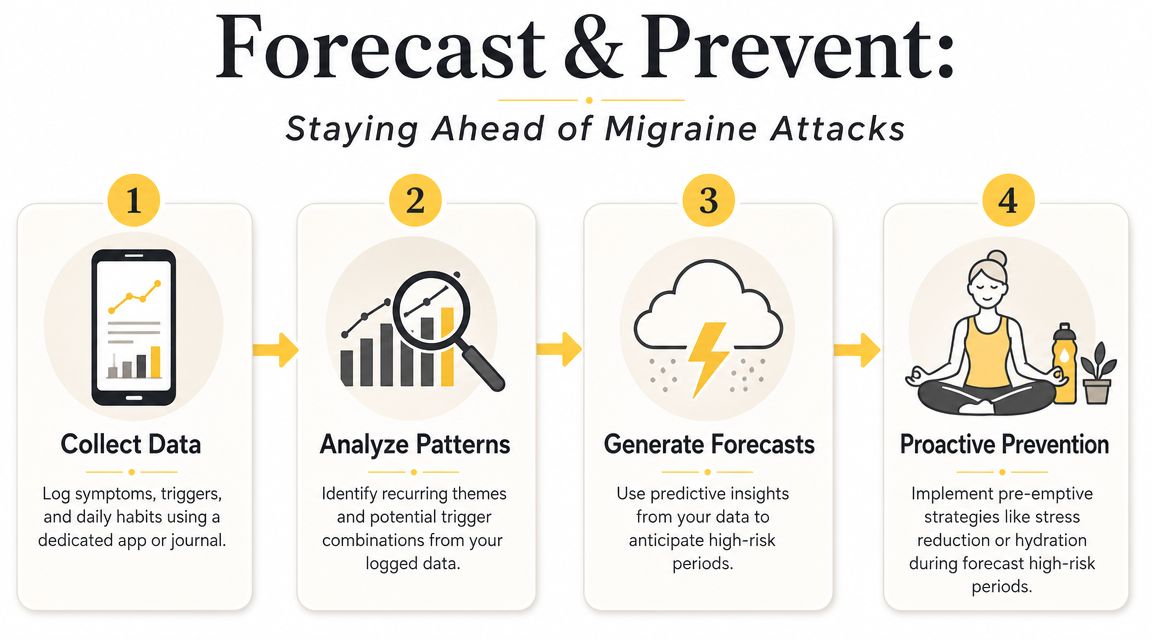
The key shift happens when you stop using tracking only as a diary of suffering and start using it as a forecast tool.
A migraine log shows history. A prevention system shows risk. When you combine your personal patterns with environmental signals, you can often tell when your threshold is getting lower before an attack is fully underway.
Why forecasting works better than guessing
Many people already know weather, air quality, heat, or rapid routine changes seem to matter. The problem is that memory turns that into vague suspicion. Data makes it usable.
For example, you might learn that weather shifts are only a problem when they land on top of poor sleep and a delayed lunch. That's much more actionable than saying “weather triggers me.”
One tool built for that kind of pattern recognition is Relief's migraine tracking app, which combines logged symptoms and habits with local conditions like weather and air quality to help surface risk patterns over time.
How to act on a high-risk day
Forecasting only helps if it changes behavior.
On a higher-risk day, your goal is not to do more. It's to remove extra load from the system. That might mean:
- Protect sleep: Avoid the late-night push if you can.
- Front-load hydration: Don't wait until you already feel off.
- Keep meals regular: A predictable eating schedule can reduce one more source of instability.
- Lower exposure to known personal triggers: If bright light, alcohol, or hard workouts tend to stack badly on weather days, that's the day to ease off.
- Create recovery space early: Build in breaks, dark-room rest, or stress downshifting before symptoms escalate.
The point of a forecast isn't to make you anxious. It's to help you make smaller, smarter choices before your brain gets overwhelmed.
That's the difference between reactive and proactive migraine care. You're no longer asking, “Why did this happen again?” You're asking, “What can I do today to lower the chance that everything piles up?”
When to Talk to a Doctor About Your Migraines
Natural prevention can be powerful, but it has limits. If your attacks are becoming more frequent, more disruptive, or harder to recover from, it's time to bring a clinician into the process if you haven't already.
That's especially true if you've built a reasonable routine, tracked patterns carefully, and still feel like migraine is running the show. Your notes are not wasted effort. They're exactly the kind of information that can help a doctor see patterns faster and make better decisions with you.
When a routine isn't enough
Schedule a medical visit if:
- Your migraine pattern has changed: New timing, new associated symptoms, or a clear increase in burden.
- Attacks interfere with daily life often: Work, family, sleep, or basic functioning keep getting disrupted.
- You're unsure whether it's migraine or another type of headache: Precision matters because headache disorders are not all managed the same way.
- You're relying on short-term relief too often: That can complicate the picture and deserves medical review.
- You want help building a prevention plan: Natural strategies and medical treatment can complement each other.
A clinician can also help you think through migraine subtype differences, including migraine with or without aura, vestibular migraine, and other patterns that may need more specific management.
Red flags that need immediate care
Seek immediate medical care if you have:
- A sudden, severe headache: Especially one that peaks fast or feels unlike anything you've had before.
- Headache with fever or stiff neck
- Neurological changes: New weakness, confusion, trouble speaking, fainting, or other concerning changes.
- Headache after a head injury
These symptoms need urgent evaluation. Do not try to self-manage them as a typical migraine.
Getting medical care is not giving up on natural prevention. It's the opposite. It means you're taking your symptoms seriously and using every appropriate tool available.
If you want a simple way to track symptoms, routines, and environmental patterns in one place, Relief can support that process and help you spot the signals that matter to your own migraine pattern.


