
Yes, exercise can help migraines for many people. Research shows regular aerobic exercise can reduce migraine frequency by about 40% after 8 to 12 weeks, but the wrong kind of workout, especially if it's too intense or poorly timed, can also trigger an attack.
That contradiction is why the usual advice to “just exercise more” can feel so frustrating. If you live with migraine, not just a general headache, you already know your brain and nervous system can react strongly to stress, light, sound, sleep disruption, hormones, and sometimes physical exertion too.
So the question isn't just “does exercise help migraines.” It's what kind of movement helps your body, how much is enough, and how can you avoid crossing the line into trigger territory.
This article is for informational purposes and is not medical advice. Consult a healthcare provider for personalized guidance.
Table of Contents
- Why the advice feels so confusing
- What a safer mindset looks like
- What usually works best
- Activities to approach more carefully
- Comparing Exercise Types for Migraine Management
The Exercise Paradox for Migraine Sufferers
You might have had this experience. A clinician, friend, or article tells you exercise is good for migraine prevention. Then you go for a run, take a hard class, or push through a workout, and your head starts pounding on the way home.
That doesn't mean you failed. It means the advice was incomplete.
Migraine is a neurological disorder, and it's different from a typical headache. A migraine attack can involve prodrome symptoms before pain starts, aura for some people, nausea, dizziness, photophobia (light sensitivity), sound sensitivity, and a wiped-out postdrome afterward. A body that's prone to migraine often does better with predictability than sudden physical stress.
Why the advice feels so confusing
Exercise can act in two very different ways.
On one side, regular movement may help calm some of the systems involved in migraine. On the other, exercise can become a trigger if it brings on overheating, dehydration, skipped meals, abrupt exertion, or a rapid jump in intensity.
Practical rule: Don't think of exercise as automatically good or bad for migraine. Think of it as a dose-sensitive tool.
That's why your goal isn't to become the fittest person in the room. Your goal is to find a repeatable routine your nervous system tolerates.
A lot of people with migraine already know some of their major patterns, like poor sleep, stress, weather changes, or hormonal shifts. If that sounds familiar, it can help to understand your broader migraine risk factors before blaming exercise alone.
What a safer mindset looks like
A more useful starting point is this:
- Choose steady movement instead of all-out effort.
- Build slowly instead of making up for lost time.
- Watch timing if you notice attacks cluster around certain parts of your day.
- Treat warning signs seriously instead of trying to “push through.”
That approach doesn't promise a cure, because exercise doesn't cure migraine. It gives you something better. A realistic way to test whether movement can become part of your prevention plan without making life harder.
How Gentle Movement Can Calm a Migraine Brain
Here's the counterintuitive part. Exercise does not usually help in the middle of an attack. Its real value is in what it does between attacks, if your body can tolerate the dose.
A review in Headache found that regular aerobic exercise was linked to fewer migraine attacks over time (Headache journal review). Separate reporting on patients already using preventive medication also found that people who exercised more often had fewer headache days, as described by Neurology Advisor's coverage of the study.
That helps explain the paradox many people feel. A workout can trigger a migraine on one day, yet a well-paced routine can make attacks less frequent over the long run.

Why the migraine brain may respond to movement
Migraine brains tend to be more reactive. Gentle, repeatable movement may lower that reactivity over time, a bit like turning down the sensitivity on an alarm that goes off too easily.
Researchers have proposed a few reasons. Exercise appears to increase the body's own pain-regulating chemicals, including endorphin-like and cannabinoid-like signals. It may also influence CGRP and other pain pathways involved in migraine. You do not need to memorize the chemistry. The practical point is simpler. The right amount of movement may teach your nervous system to stay steadier.
This is one reason consistency often beats intensity. A calm 20 minute walk done regularly can be more useful for migraine prevention than a hard session that leaves you overheated, underfed, and wiped out.
Why gentle movement often works better
Gentle exercise can also help through side doors.
It may ease stress, improve sleep quality, reduce body tension, and support mood. Those changes matter because migraine rarely lives in isolation. It is often shaped by the rest of your routine, including hydration, meal timing, and what you eat before and after activity. If food is one of your variables, a migraine-friendly diet plan can make your exercise experiments easier to interpret.
A useful way to frame this is to treat movement like medicine. Too little may do nothing. Too much may flare symptoms. The goal is to find the amount that helps without stirring up the same brain you are trying to calm.
That is why “gentle movement” is not a backup plan. For many people with migraine, it is the smart starting point.
Choosing Your Best Exercises for Migraine Prevention
The best migraine exercise is often the one that looks almost too easy to count.
A sensitive migraine brain usually does better with movement that is steady, rhythmic, and easy to predict. Sudden effort can feel like slamming the gas pedal in a car with touchy brakes. Smooth acceleration tends to work better.
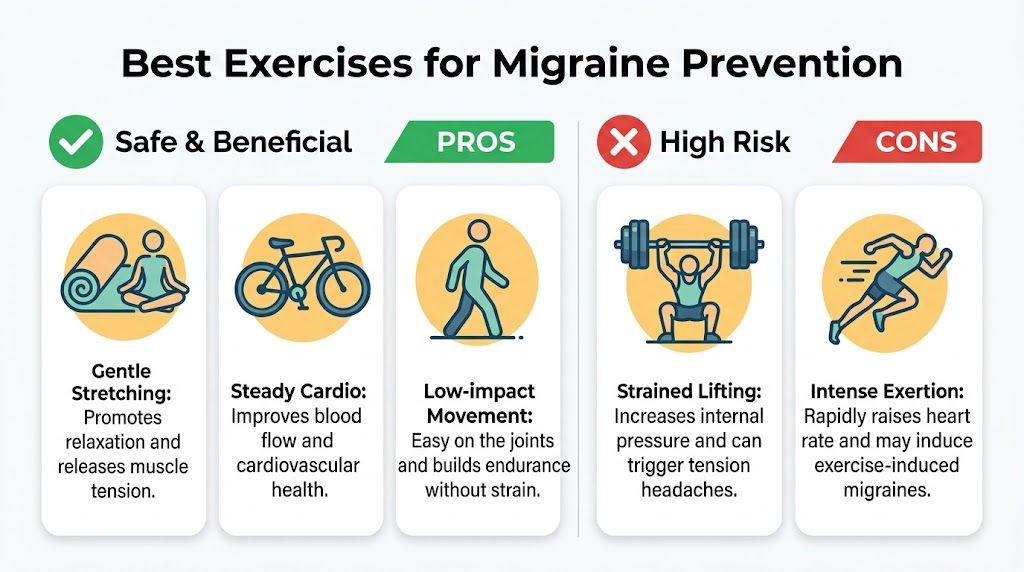
Here's a visual overview first.
What usually works best
Aerobic activities are usually the safest place to begin because you can control the pace and keep your breathing fairly even. As noted earlier, structured aerobic exercise has some of the strongest support for migraine prevention. For people who tolerate it well, harder training may help more. The catch is that migraine care is rarely about what works in theory. It is about what your nervous system can repeat without flaring.
That is why the goal is not to pick the “best” exercise on paper. The goal is to find your best-fit exercise in real life.
Good starting options often include:
- Walking outdoors or on a treadmill: Easy to pace, easy to shorten, easy to repeat several times a week.
- Stationary cycling or road cycling at a steady pace: Rhythmic, adjustable, and less jarring than stop-and-go workouts.
- Swimming or water aerobics: Low impact and soothing for some people, though chlorine, bright light, or heat may still matter.
- Gentle yoga or stretching: Helpful for body tension, recovery days, and learning how your body signals strain before it becomes a problem.
Food timing can change how a workout feels. If you are testing exercise and migraine at the same time, it helps to keep meals predictable too. A migraine diet plan that fits your routine can make your patterns easier to spot.
A short video can also help if you prefer seeing examples rather than reading about them.
Activities to approach more carefully
Some workouts are harder to dose well when you are still learning your limits. The common trouble spots are abrupt effort, breath-holding, overheating, and long sessions that leave you drained for the rest of the day.
That does not mean these activities are off-limits forever. It means they are better treated like a careful experiment than a default plan.
Examples that can be riskier for some people include:
- Heavy weightlifting: Straining and holding your breath can raise pressure fast.
- Sprint intervals from a low fitness baseline: Sharp jumps in effort can provoke symptoms before your body has adapted.
- Hot classes or overheated environments: Heat stacks onto dehydration and fatigue.
- Long, exhausting sessions: The workout may end, but the sleep disruption, hunger, and soreness can keep pushing your system afterward.
If an activity leaves you dizzy, overheated, depleted, or headachy afterward, the problem may be the pacing, conditions, or recovery plan.
Comparing Exercise Types for Migraine Management
Lower-Risk Activities (Go-To Options)Higher-Risk Activities (Approach with Caution)Walking with a steady pace and easy breathingSprinting without gradual conditioningCycling at moderate intensityHeavy lifting with straining or breath-holdingSwimming with controlled effortVery intense circuits that spike effort fastGentle stretching or yogaHeated workouts if heat worsens symptomsLow-impact cardio you can stop easilyAll-out sessions when you're under-slept or dehydrated
Finding Your Therapeutic Dose of Exercise
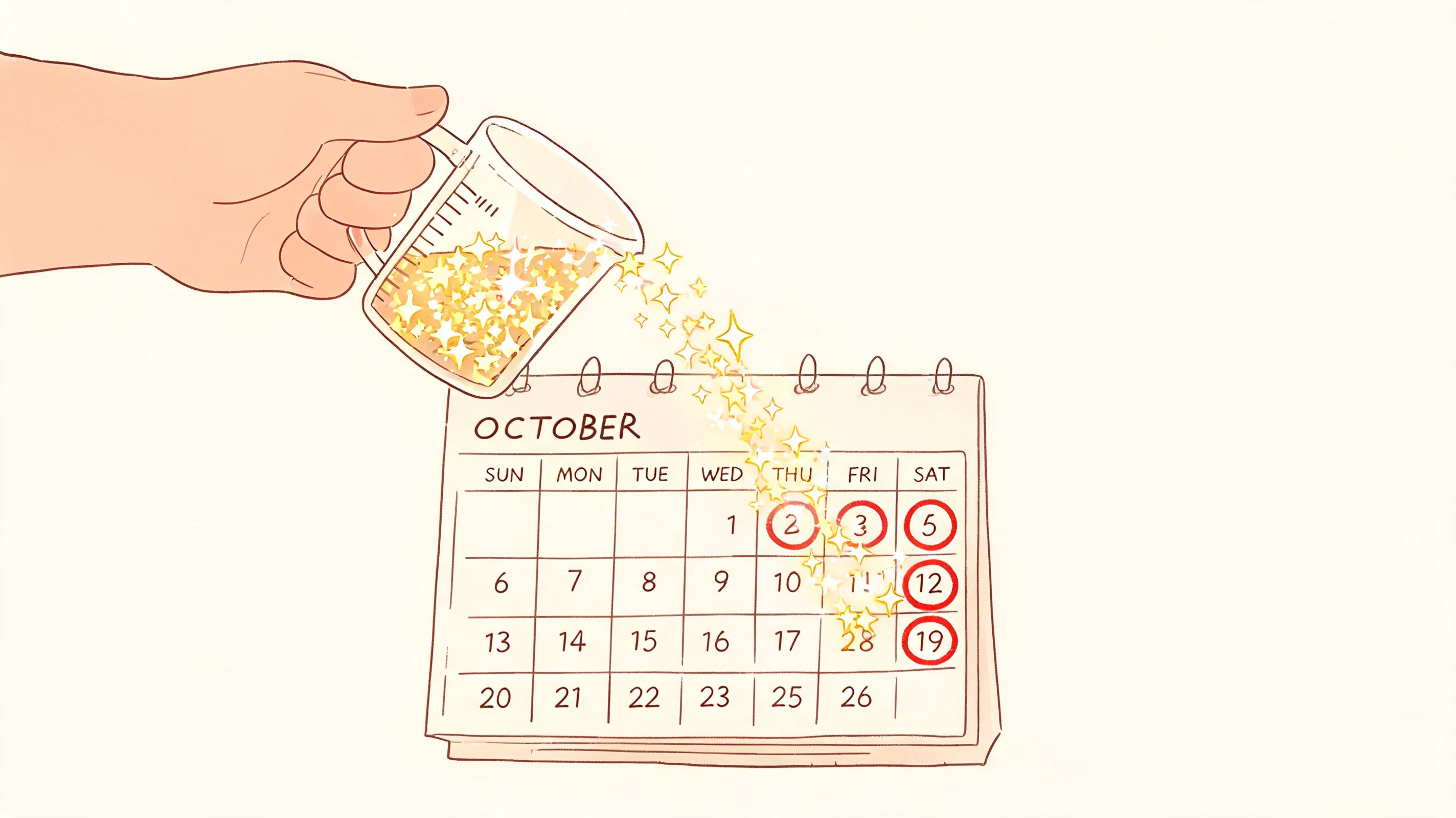
A lot of people quit too early because they assume exercise only “counts” if it's hard. Migraine research suggests something more encouraging. There appears to be a useful minimum, a helpful target range, and a point where more isn't necessarily better.
According to a meta-analysis summarized by the Migraine Disorders Collaborative article on exercise dose, significant pain reduction begins at 200 total minutes of moderate exercise, and the optimal benefits for migraine frequency and intensity appear between 900 and 950 total minutes. That works out to roughly three 30-minute sessions per week over 10 to 11 weeks.
How much is enough to matter
That minimum matters because it gives you a realistic first target. You don't need marathon training. You need a routine you can repeat often enough for your nervous system to recognize it as normal, not threatening.
The same analysis found a ceiling effect too. Once total exercise time went past 950 minutes, benefits showed diminishing returns.
What that looks like in real life
A few practical ways to translate that into your week:
- Starting low: Short walks that add up over time can still move you toward that minimum threshold.
- Choosing repeatability: Three moderate sessions per week is often more useful than one heroic workout followed by a crash.
- Protecting recovery: If you feel wrung out after every session, you may be overshooting your therapeutic zone.
More exercise isn't automatically better for migraine management. A sustainable dose is often the better dose.
That idea can be freeing. If you've been avoiding exercise because you thought it required intense commitment, the evidence points in a different direction. Steady, moderate effort is enough to matter.
A Practical Guide to Starting Safely
If exercise has triggered migraine for you before, caution makes sense. The answer isn't to ignore that fear. It's to lower the chance of triggering an attack while you figure out what your body tolerates.
The strongest evidence is about prevention. During an active migraine attack, the evidence is thin and mixed. The American Migraine Foundation notes in its article on migraine and exercise benefits that high-quality studies are scarce, strenuous activity can worsen symptoms for many people, and most experts recommend rest, though some people find very gentle stretching helps with muscle tension.
Before you exercise
A safer setup usually looks ordinary. That's a good thing.
Try this checklist:
- Warm up gradually: Ease in instead of jumping straight to hard effort.
- Eat consistently: If skipping meals is a trigger for you, don't start a workout depleted.
- Hydrate ahead of time: Don't wait until you already feel off.
- Watch the environment: Heat, glare, strong smells, and poor sleep can stack with exercise.
- Pick a lower-risk day: If you're already deep in prodrome, your window may be smaller.
Prodrome means the early phase before the main attack. For some people, that includes yawning, food cravings, irritability, neck pain, fatigue, or trouble concentrating. If those signs are familiar, it's often smarter to scale down than push harder.
If a migraine seems to be starting
The old fitness advice to push through doesn't fit migraine very well.
A better response is usually:
- Stop and assess if you notice warning signs.
- Reduce stimulation by moving to a calmer, cooler space.
- Rest instead of forcing intensity.
- Try only very gentle stretching if that feels soothing and doesn't worsen symptoms.
One more important distinction. A post-exercise headache is not always migraine, and migraine is not the same as an ordinary exertional headache. If the pattern is new, more severe, or confusing, a clinician can help sort that out.
When to get urgent medical care
Seek immediate medical care for any of these red flags:
- Sudden severe headache: Especially a thunderclap-style onset.
- Headache with fever or stiff neck
- New neurological changes: Such as weakness, confusion, or trouble speaking.
- Headache after a head injury
Those symptoms need prompt medical evaluation.
Personalize Your Plan by Tracking Your Triggers
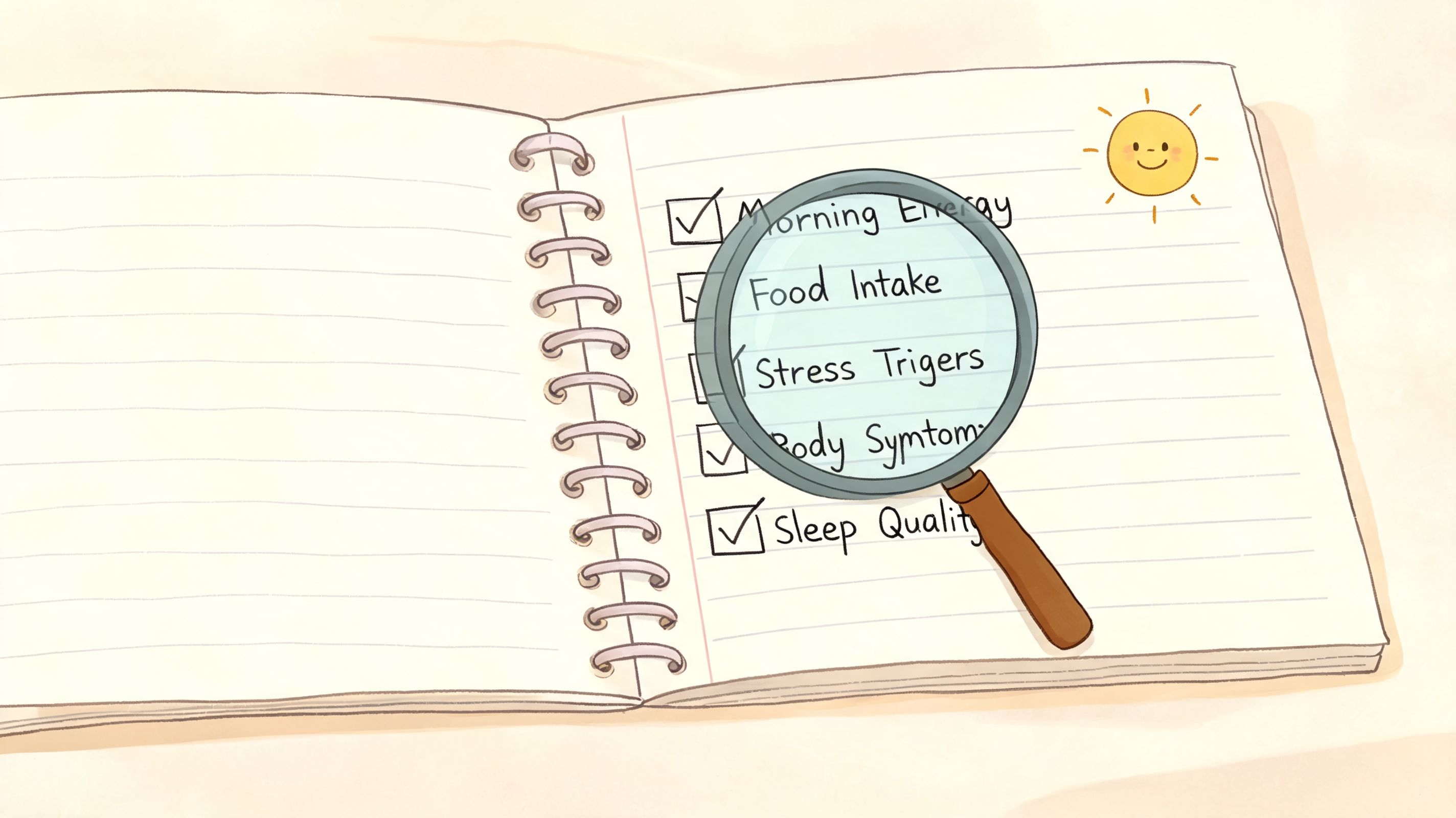
The most useful exercise plan is the one your body can live with. That means turning broad advice into personal evidence.
One person may feel great after a brisk walk. Another may do better with cycling than walking because of heat exposure, hills, or neck tension. Someone else may discover that exercise is fine unless it happens after poor sleep or during a sharp weather swing.
A simple one-week starter plan
You don't need a perfect program to begin. You need a testable one.
A gentle starter week might look like this:
- Day 1: 15 to 20 minutes of easy walking
- Day 2: Rest or gentle stretching
- Day 3: 15 to 20 minutes of steady cycling or walking
- Day 4: Rest
- Day 5: Gentle yoga or a short walk
- Day 6: Rest or repeat the activity that felt best
- Day 7: Review your notes
What to log after each session
Keep the tracking simple enough that you'll do it.
Write down:
- What you did: Walking, cycling, yoga, swimming
- How long you moved: A rough duration is fine
- How hard it felt: Easy, moderate, hard
- What happened afterward: No symptoms, mild head pain, full migraine attack, fatigue, nausea
- Possible overlap factors: Sleep, meals, hydration, stress, weather, and menstrual cycle if relevant to you
A dedicated migraine tracking app can make that much easier than trying to remember patterns in your head. Over time, the point is to find your safe exercise zone, the kind of movement, timing, and intensity that supports prevention without provoking symptoms.
If you want help spotting those patterns faster, Relief can help you track symptoms, triggers, and daily conditions so your exercise choices become more personal and less like guesswork.


