
Yes, weather can cause migraine headaches for a significant portion of people, though it isn't universal and it usually isn't the only trigger involved. Between 30% and 50% of people with migraine identify weather changes as a trigger, especially shifts in barometric pressure, humidity, and temperature.
If you've ever felt a migraine building before a storm, or noticed that a weirdly humid day leaves you foggy, nauseated, and light-sensitive, you're not imagining it. A lot of people with migraine feel dismissed when they say they can “sense” the weather changing. The science is more nuanced than “rain causes pain,” but it does support the basic experience: for some nervous systems, weather is a real trigger.
Migraine is also not the same thing as a regular headache. A migraine attack can include head pain, but it may also involve aura (temporary neurological symptoms such as visual changes or tingling), photophobia (light sensitivity), nausea, sound sensitivity, and a wiped-out postdrome after the pain eases. Weather can interact with that whole system.
What matters most, in many cases, isn't just the forecast itself. It's the change in the forecast. A stable hot day may be easier for your body to handle than a sharp pressure drop before a storm or a sudden humidity spike.
Table of Contents
- Are You a Human Barometer? Answering the Weather Migraine Question
- Why weather feels obvious but is hard to prove
- Weather is often one trigger in a stack
- Barometric pressure and the trigeminal nerve
- Temperature and heat load
- Humidity sunlight and the body's stress response
- Stable conditions and changing conditions are not the same
- A better way to think about weather migraine risk
- Track smarter, with change in mind
- Use forecasts as an early warning tool
- Lower the total load on your system
Are You a Human Barometer? Answering the Weather Migraine Question
You wake up with that familiar pressure behind your eyes. By afternoon, the sky breaks open and the rain starts. It's easy to think, “I knew it.”
That “human barometer” feeling is common among people with migraine, and it isn't just folklore. Studies indicate that 30% to 50% of people with migraines identify some type of weather change as a trigger, making weather the most commonly reported migraine source, with barometric pressure among the most frequently cited culprits, as explained in PBS NewsHour's coverage of weather and migraine.
What trips people up is that weather-triggered migraine isn't simple. It's not as neat as “rain gives me a migraine” or “heat always does it.” You might feel fine on one humid day and awful on another. You might get symptoms before a storm arrives. You might also have days when the weather changes and nothing happens.
You're not overreacting if weather seems to affect your migraine. But you'll usually need a more precise explanation than “bad weather.”
That precision matters because it helps you do something useful with the pattern. If you only track “stormy” or “sunny,” you may miss what's provoking your attacks.
It also helps to put weather in context with your other triggers. If you're not sure what else might be contributing, ReliefMigraine's guide to what causes migraine headaches is a helpful companion.
This article is for informational purposes and is not medical advice. Consult a healthcare provider for personalized guidance.
The Link Between Weather Changes and Migraine Attacks
Some people are convinced weather is a trigger. Some studies support that. But the strongest research also shows why weather migraine can feel obvious in daily life and still be hard to predict with precision.

Why weather feels obvious but is hard to prove
Research suggests weather matters, but not in a simple one-to-one way. Scientific consensus indicates that weather alone accounts for about 20% of migraine attack triggers, and one key study found that only 13% of studied migraineurs were definitively weather-sensitive, according to this PMC review on meteorological factors and migraine.
That doesn't mean the other people were mistaken. It means migraine is messy. Your nervous system may react to sleep loss, stress, skipped meals, hormonal changes, sensory overload, or weather in combination. A weather shift may be the final nudge rather than the whole cause.
Weather is often one trigger in a stack
Think of migraine threshold as a bucket. Stress fills it. Poor sleep fills it. Bright light fills it. Then a pressure drop arrives and the bucket spills over.
That's one reason weather can feel inconsistent. The same weather change that triggers an attack on a high-stress, low-sleep day might do nothing on a calmer day when you're hydrated and rested.
A few practical implications follow from that:
- Don't assume weather is your only trigger. If you focus on the forecast and ignore sleep, meals, and stress, your pattern will stay muddy.
- Don't dismiss weather either. Even when it isn't the sole cause, it can still be a meaningful part of your attack pattern.
- Don't expect perfect prediction. Research shows weather can correlate with attacks without making short-term prediction reliable enough on its own.
The useful question usually isn't “Is weather real?” It's “What kind of weather change matters for me, and what else tends to be happening at the same time?”
That shift in thinking is where tracking becomes more helpful and less frustrating.
Understanding Your Triggers from Pressure to Humidity
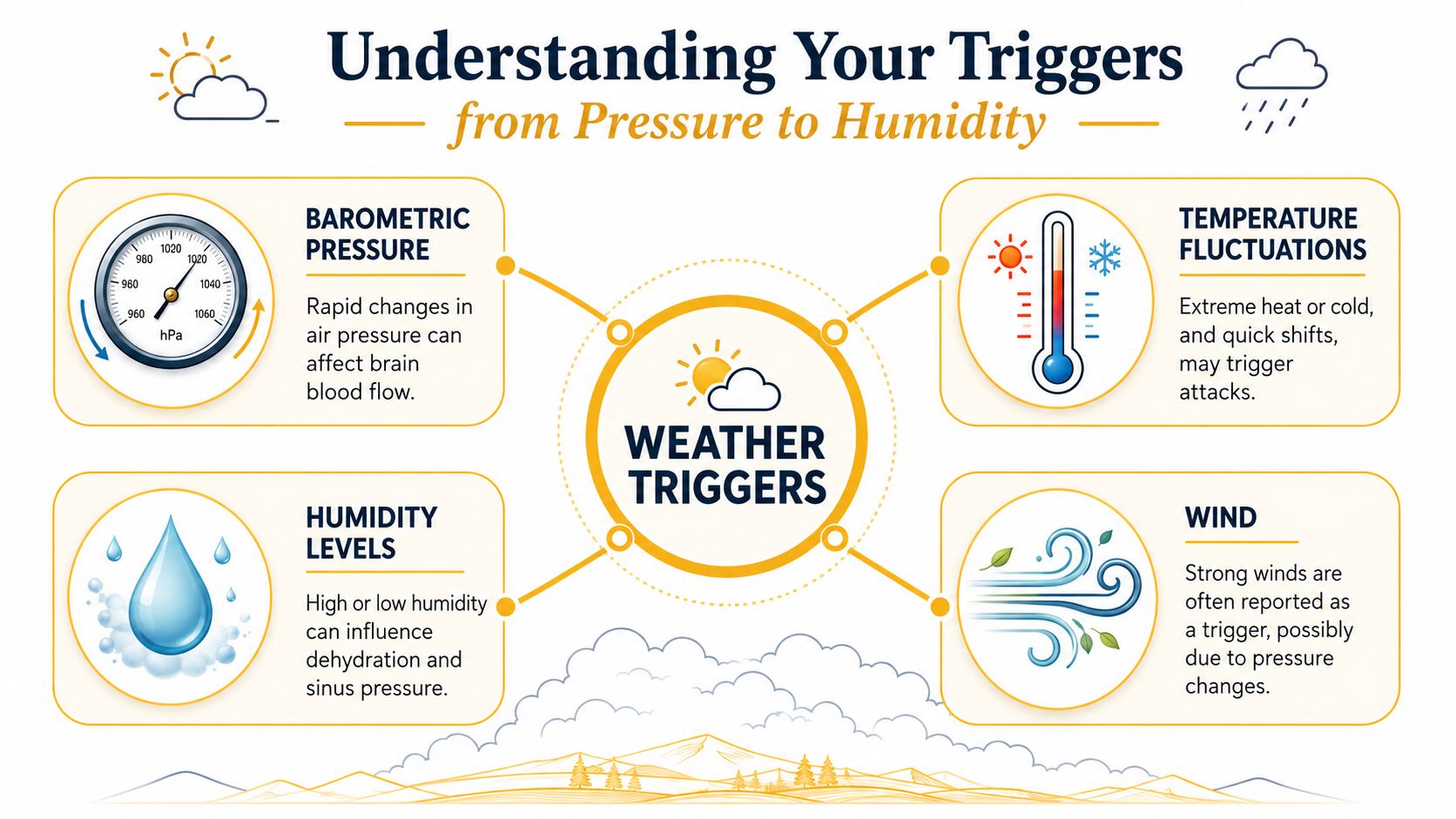
A weather app might show the same rainy icon on two different days, yet only one of them ends with a migraine attack. That mismatch is why it helps to stop treating "weather" as a single trigger. Pressure, temperature, humidity, and light can each matter in different ways, and your pattern may depend on how quickly they shift rather than the number itself.
Barometric pressure and the trigeminal nerve
Barometric pressure is the weight of the air around you. Before storms and weather fronts, that pressure can change fast. For some people with migraine, those shifts seem to irritate an already sensitive system.
One possible explanation involves pressure differences across air-filled spaces such as the sinuses. If your body does not adjust smoothly, nearby pain-sensitive tissues may get irritated. That may also stir up the trigeminal nerve, which helps process facial sensation and plays a central role in migraine pain.
A small study of hospitalized migraine patients reported attacks clustering during a narrow range of lower atmospheric pressure, and the researchers discussed possible links to trigeminal sensitization and serotonin-related pathways in a review on meteorological factors and migraine.
If storms seem to affect you, it can help to read more about the overlap between moisture in the air and head pain in ReliefMigraine's guide to humidity and headaches.
Temperature and heat load
Temperature can influence migraine through several routes at once. Heat can disturb sleep, increase dehydration risk, and make exertion feel harder. A sharp cool-down can also be stressful, especially when a front moves through and several weather variables change together.
The practical question is often less "Was it hot?" and more "Did the temperature swing quickly, and what else changed with it?" A stable warm week may be easier for your body to handle than a day that flips from cool to hot while humidity rises and pressure drops.
That is why tracking context helps.
If you tend to feel worse in summer, note whether your attacks show up after heat exposure, after poor sleep in a hot room, or on days when the temperature changes rapidly. Those patterns point to different problems and different fixes.
Humidity sunlight and the body's stress response
Humidity often gets blamed as if high numbers alone are the problem. The research is more nuanced. A recent NIH analysis found that a sizable increase in relative humidity was associated with higher odds of migraine onset, which fits the broader idea that sudden atmospheric changes can be more provocative than steady conditions.
Humidity can also make heat feel heavier, increase sweating, and leave you behind on fluids without realizing it. For someone already near their migraine threshold, that extra strain can matter.
Sunlight adds another layer. If you have photophobia, bright light can intensify nausea, eye pain, or head pain. It may act less like a standalone weather trigger and more like another demand on a sensitive brain during an unstable weather day.
Here is a simple way to sort the pieces:
| Weather factor | What you notice | Why it may matter |
|---|---|---|
| Pressure change | Symptoms before rain or storms | Fast atmospheric shifts may irritate pain-sensitive pathways and trigeminal signaling |
| Heat | Throbbing, fatigue, nausea, dehydration | Heat can disrupt sleep, increase fluid loss, and add physical stress |
| Humidity | Heaviness, "storm headache," overheating | Rising humidity can worsen heat stress and may matter most when it changes quickly |
| Bright sunlight | Squinting, eye pain, rising nausea | Light can aggravate photophobia and sensory overload |
Why Sudden Shifts Matter More Than the Forecast
A lot of advice online treats weather as an absolute condition. Too hot. Too cold. Too humid. Too windy. That's often too blunt to be useful.
Stable conditions and changing conditions are not the same
A stable hot day and a rapidly changing day can feel completely different to your body. The first may be uncomfortable but predictable. The second asks your nervous system to adapt fast.
That's why the rate of change matters so much. According to this NIH-hosted PMC analysis, the common advice to avoid “high humidity” is incomplete because a rapid swing, such as a 26.5% increase in relative humidity, significantly increases migraine odds. The issue isn't just the number on the weather app. It's the abrupt shift.
Practical rule: Track the swing, not just the setting.
This also helps explain why people often say they can feel a storm coming before it starts raining. The body may be reacting to the atmospheric change leading up to the event, not the rain itself.
A better way to think about weather migraine risk
Instead of asking, “Is it hot today?” ask questions like:
- Did pressure change quickly overnight?
- Did humidity jump sharply this morning?
- Is a front moving in after a stable stretch?
- Am I also short on sleep, stressed, or dehydrated?
That framework is more useful than trying to avoid broad categories like “summer weather” or “cold days.” Many people tolerate stable conditions better than transition days.
If weather regularly seems to trigger you, your best clues may come from timing. Did symptoms start before the temperature peaked? Before rain arrived? Right after humidity changed? Those details matter more than a generic label like “bad weather.”
Practical Steps for Planning Around Weather Triggers
A weather trigger plan works best when it feels ordinary. You check the forecast, notice a fast swing is coming, and make a few small adjustments before your nervous system has to work harder to adapt. That is the practical goal here.

Track smarter, with change in mind
Many headache diaries are too broad to be useful for weather patterns. A note like “stormy” or “headache all day” captures that something happened, but not what your body was reacting to first.
A better log works like replaying the first few dominoes. You are trying to spot the shift that happened before symptoms built.
Try recording:
- Symptom timing: When did the earliest signs begin, such as yawning, fatigue, food cravings, mood change, or neck stiffness?
- Attack features: Pain location, nausea, light sensitivity, sound sensitivity, aura, dizziness, and how long recovery took.
- Weather movement: Whether pressure, humidity, or temperature changed quickly over several hours, not just whether the day was hot, cold, or rainy.
- Daily context: Sleep, meals, hydration, stress, alcohol, intense exercise, and extra screen time.
If you want a starting point, use this migraine log template for tracking symptom timing and weather changes.
Use forecasts as an early warning tool
Forecasts help most when you treat them like a heads-up, not a prediction that an attack is guaranteed. Stable heat or steady cold may be easier for some people than a day when several conditions shift in a short window.
As noted earlier, research and reporting on weather-related headache patterns suggest that hotter days can be linked with more headaches. For planning, the more useful question is often, “Is the weather changing fast?” rather than “Is today warm?”
On days that look more provocative, keep your response simple:
- Protect sleep: Keep bedtime and wake time as consistent as you can.
- Hydrate earlier: Start fluids sooner if heat or humidity is climbing.
- Eat on time: A missed meal can pile onto a weather-related trigger day.
- Reduce extra strain: Use sunglasses, seek shade, or scale back outdoor exertion if those factors tend to stack with weather shifts.
- Keep treatment close: Have your usual plan and approved medications available before symptoms ramp up.
A short explainer can help if you want a visual walkthrough of weather-aware migraine planning:
Lower the total load on your system
Weather rarely acts alone. A fast pressure drop on a well-rested, hydrated, low-stress day may be manageable. The same shift after poor sleep, dehydration, and a skipped lunch can hit differently.
That pattern matters because it gives you room to act. You cannot stop a front from moving in, but you can make the rest of the day less demanding on your brain and body.
What often helps:
- Regular sleep
- Consistent meals
- Adequate fluids
- Stress reduction
- A lighter schedule on likely trigger days
On a changeable weather day, aim to remove one added stressor. That small adjustment is often more realistic, and more useful, than trying to control everything.
This approach will not prevent every migraine attack. It can make weather patterns easier to understand and easier to plan for, which is often the first real improvement.
When to Talk to a Doctor About Your Headaches
Weather-triggered migraine can be real and still deserve medical review. If your pattern is changing, getting more disruptive, or no longer responding to your usual care plan, a clinician should know.
This article is for informational purposes and is not medical advice. Consult a healthcare provider for personalized guidance.
Get urgent care for red flag symptoms
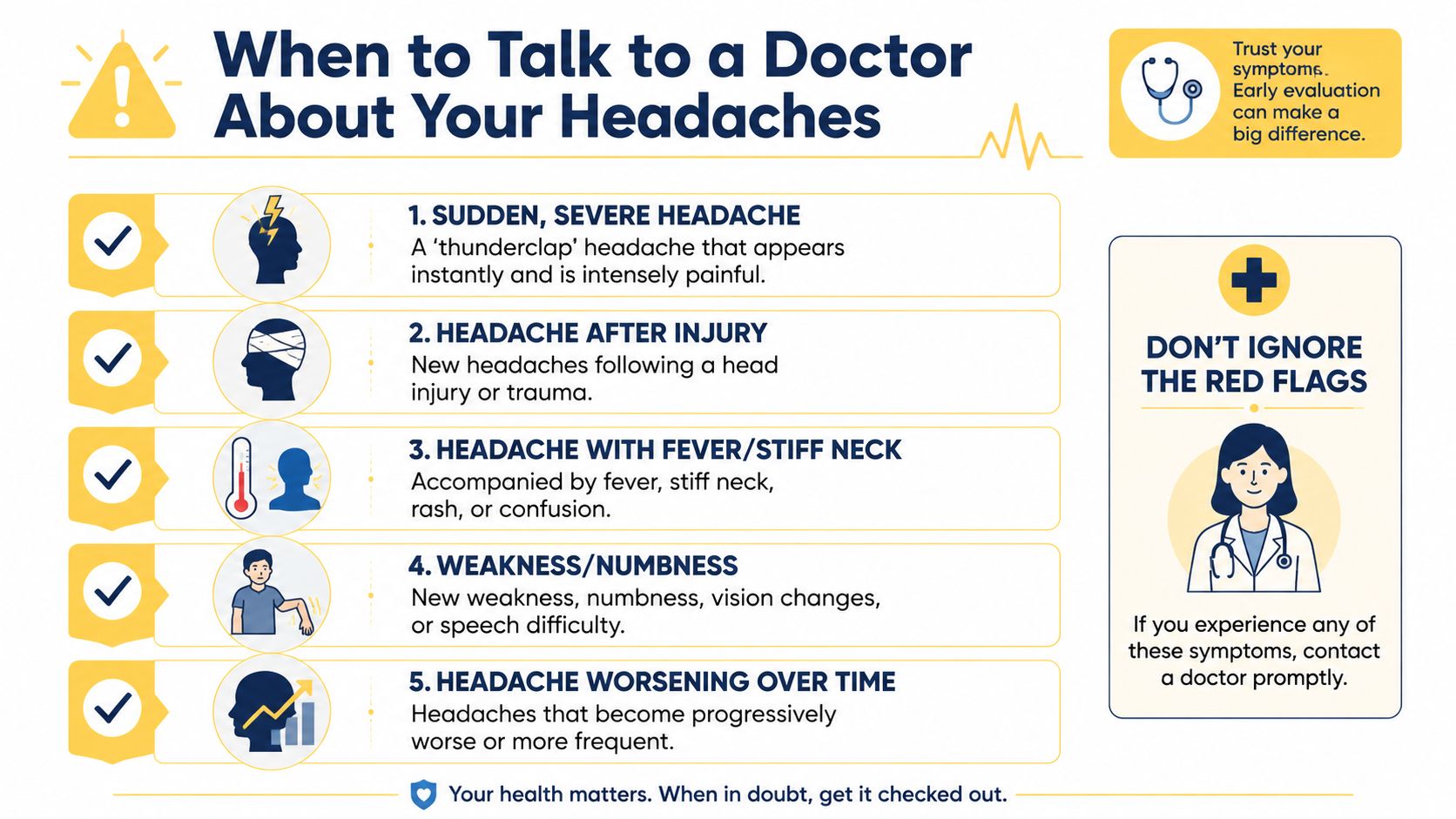
Seek immediate medical care if you have any of these:
- Sudden severe headache: A thunderclap headache that reaches intense pain very quickly.
- Headache with fever or stiff neck: Especially with confusion, rash, or feeling very unwell.
- Neurological changes: New weakness, numbness, vision loss, double vision, fainting, or trouble speaking.
- Headache after a head injury: Even if you think it may “just” be a migraine.
Those symptoms need prompt evaluation. Don't wait to see if they pass.
Make a routine appointment when patterns change
Schedule a non-urgent visit if your headaches or migraine attacks are becoming more frequent, more severe, or harder to manage. It's also worth checking in if you're getting new symptoms, relying on pain relief more often, or no longer sure what your pattern means.
Bring a log if you have one. A good symptom history can help your clinician separate migraine from other headache disorders and decide whether you need changes in lifestyle strategies, over-the-counter options, prescription treatment, or further evaluation.
Migraine can show up in different forms, including migraine with or without aura, vestibular migraine, chronic migraine, and less common forms such as hemiplegic migraine. If your symptoms don't fit your usual pattern, don't assume weather explains everything.
If you want a simple way to spot whether pressure swings, humidity changes, air quality, or pollen line up with your attacks, Relief can help you track symptoms and see patterns over time.


