Migraine is a complex neurological condition, not just a bad headache, and there isn't one single cause. It happens because of a mix of genetics, brain chemistry, hormone changes, and individual sensitivity, which is also why women are about 3 times more likely than men to experience migraines and why migraine often starts around puberty and is most common between ages 35 and 45.
If you're reading this while trying to figure out why your attacks keep happening, you're not failing at this. A lot of people with migraine spend years searching for one culprit. The coffee. The weather. The skipped lunch. The stressful meeting. Sometimes one factor matters, but often the actual answer is more frustrating and more useful at the same time: migraine has an underlying biological cause, and triggers are what tip that biology into an attack.
That distinction matters. The underlying cause answers why me. Triggers help explain why now. Once you separate those two ideas, migraine starts to make more sense, and it becomes easier to track what helps.
This article is for informational purposes and is not medical advice. Consult a healthcare provider for personalized guidance.
Table of Contents
- Your Search for a Single Migraine Cause Ends Here
- Migraine affects more than pain
- The main phases of a migraine attack
- Your brain may have a lower migraine threshold
- The process starts in the nervous system
- Biology is not destiny but it is real
Your Search for a Single Migraine Cause Ends Here
A lot of migraine advice makes people feel like detectives who just haven't looked hard enough. If you could only find the one trigger, you'd finally fix it. That sounds neat, but it doesn't match how migraine usually works.
For many people, there isn't one single cause sitting in plain sight. There is an underlying migraine-prone nervous system, and then there are outside inputs that can push that system past its limit. Some people call that limit a migraine threshold. When enough strain piles up, an attack starts.
Practical rule: A trigger is not the same thing as the root cause. A bright light, a rough night of sleep, or a hormone shift may trigger an attack, but they don't fully explain why your brain is vulnerable to migraine in the first place.
That difference can feel strangely relieving. It means your attacks are not a character flaw, and they aren't proof that you're careless or weak. Migraine is a medical condition shaped by real biology.
It also explains why the same thing doesn't trigger you every time. You might tolerate red wine, stress, or missed sleep on one day and then get hit on another. That's often because migraine behaves less like a simple on-off switch and more like a bucket that slowly fills.
A helpful way to think about it is this:
- Underlying cause: Your nervous system is more likely to generate migraine.
- Trigger: Something adds enough stress or change to set off an attack.
- Threshold: The point where your brain can no longer compensate.
If you've been asking what causes migraine headaches, the most honest answer is that you need both parts of the picture. You need to understand the neurological condition itself, and you need to learn what tends to push your own system over the edge.
Why a Migraine Is Not Just a Bad Headache
Many people say "migraine headache" when they really mean severe head pain. But migraine is broader than pain alone. It's a neurological attack that can affect vision, balance, digestion, mood, concentration, and sensitivity to the world around you.
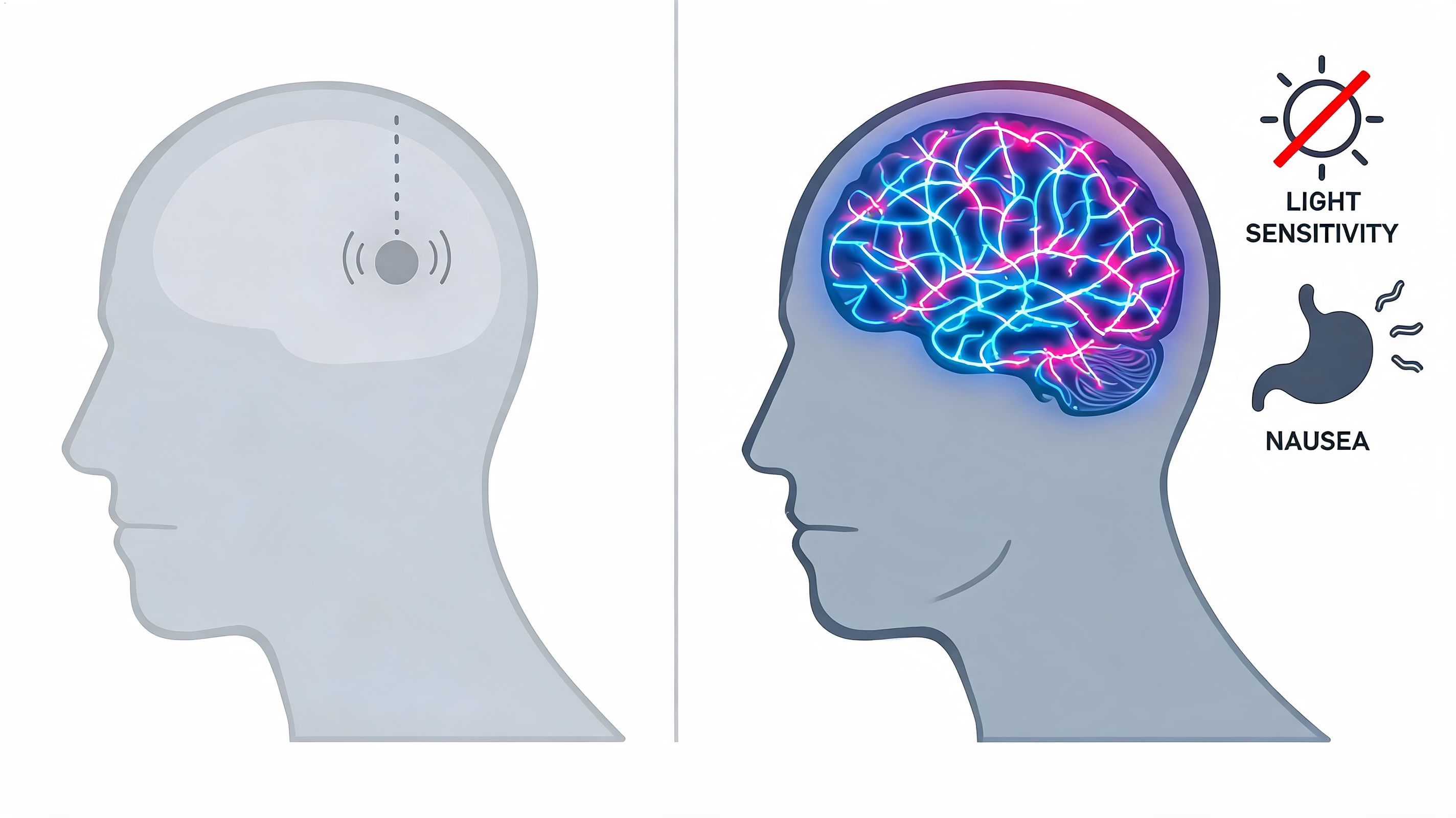
Migraine affects more than pain
A tension-type headache often feels like pressure or tightness. Migraine can include throbbing pain, but it may also bring nausea, photophobia (light sensitivity), phonophobia (sound sensitivity), or dizziness. Some people have aura. Some don't. Some have little head pain and still have a classic migraine attack.
That variation is one reason people get dismissed. If your symptoms don't match someone else's version of migraine, it can seem confusing. But migraine comes in different forms, and your pattern may shift over time.
Migraine is a whole-brain event, not just a painful spot in your head.
The main phases of a migraine attack
Many attacks unfold in stages, though not everyone has every phase.
- Prodrome: This is the early warning period that can happen hours or even days before the main attack. You might notice fatigue, irritability, food cravings, neck discomfort, or trouble focusing.
- Aura: Aura refers to temporary neurological symptoms, often visual. Some people see flashing lights, zigzag lines, blind spots, or notice tingling or speech trouble. Aura can happen before pain or during it.
- Attack phase: This is the phase commonly associated with migraine. It may include head pain, nausea, vomiting, sensitivity to light or sound, or worsening with activity.
- Postdrome: After the worst part passes, individuals often feel drained, foggy, sore, or emotionally flat. This is sometimes called the "migraine hangover."
A practical reason to learn these terms is that they help you identify patterns earlier. If you know your prodrome signs, you may notice that an attack started before the pain did. That's useful information when you're trying to understand what causes migraine headaches in your own life.
The Underlying Cause A Uniquely Wired Brain
The best current explanation of migraine starts with the brain, not the blood vessels. Modern clinical references describe migraine as a neurovascular syndrome driven by abnormal brain excitability, involving the brainstem, trigeminal pain pathways, and brain chemicals such as serotonin, with both genetics and environmental factors affecting susceptibility, as explained by Mayo Clinic's overview of migraine causes.
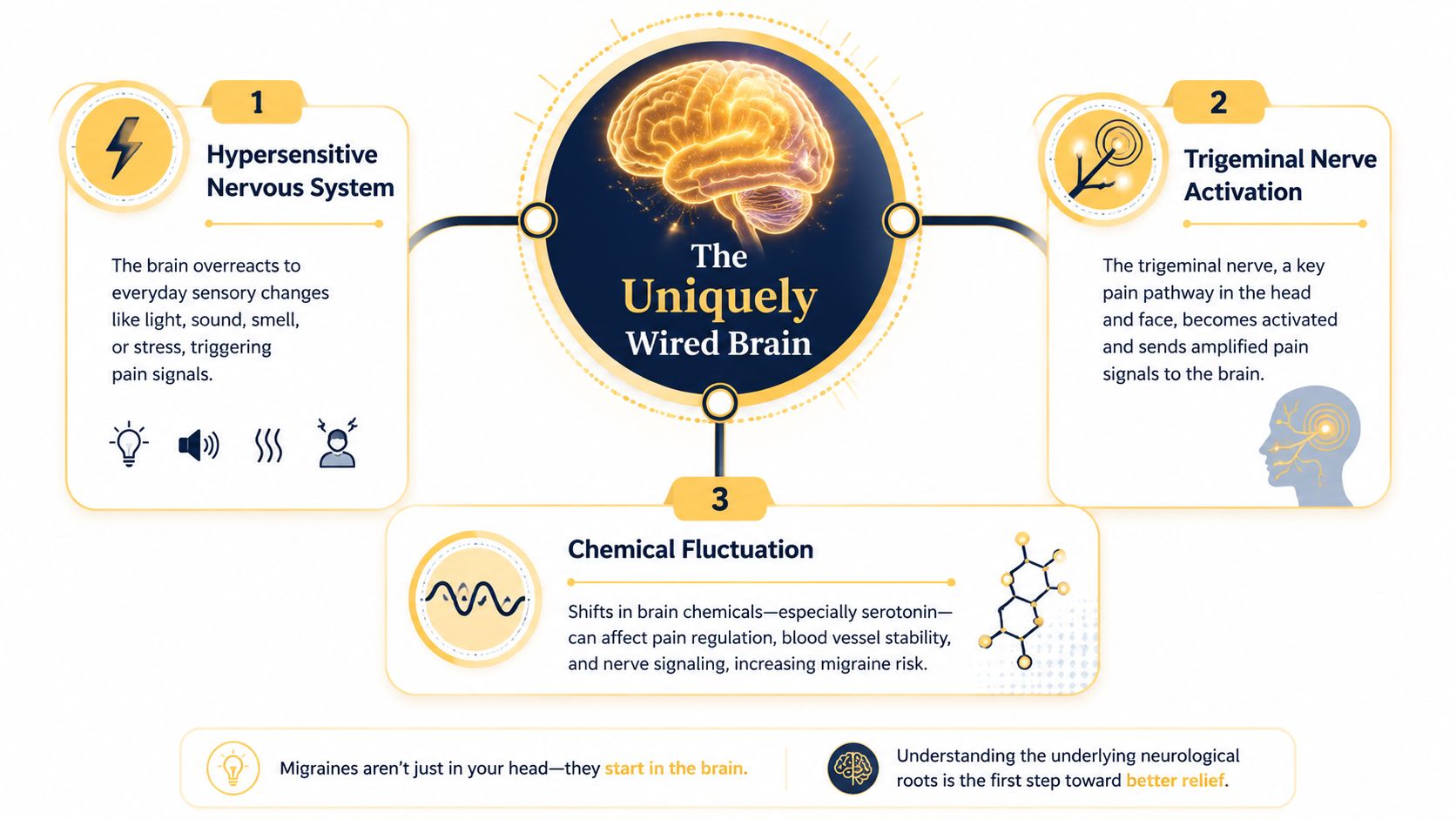
Your brain may have a lower migraine threshold
A useful analogy is a very sensitive alarm system. In some people, the alarm only goes off during major disruption. In a person with migraine, the system may react to smaller changes or to several moderate changes happening at once.
That doesn't mean your brain is broken. It means it may be more reactive to shifts in sleep, stress, hormones, sensory input, or routine. This helps explain why migraine can look unpredictable from the outside while still following patterns inside your body.
Some people inherit more of that sensitivity. If migraine runs in your family, that isn't surprising. Genetics can influence how excitable your brain is and how easily your pain pathways become activated.
The process starts in the nervous system
Many people often get confused regarding the cause of migraines. For years, migraine was often described mainly as a blood vessel problem. Current understanding is more precise. The key problem begins in neural signaling.
Here's the plain-language version of the chain reaction:
- The brain becomes overexcitable. Certain brain regions and pathways become more sensitive.
- Pain pathways switch on. The trigeminal system, a major facial and head pain pathway, gets involved.
- Chemicals shift. Changes in neurotransmitters and other signaling molecules help amplify the attack.
- Inflammatory signaling follows. That contributes to the throbbing, miserable pain many people feel.
By the time your head hurts, the process has often been underway for a while. That's one reason migraine can feel like it "came out of nowhere" when it really didn't.
If you've ever thought, "Nothing caused this," it may be because the pain was the middle of the story, not the beginning.
Biology is not destiny but it is real
Understanding this can reduce a lot of self-blame. You didn't create migraine by being too stressed, too sensitive, or too bad at self-care. The underlying wiring is real.
What you can influence is the load placed on that system. That's why identifying migraine risk factors that shape vulnerability over time can be so useful. You may not be able to remove the condition itself, but you can often learn what lowers or raises your threshold.
Common Migraine Triggers That Can Tip the Scale
You get through a busy day, skip lunch without meaning to, sleep poorly, then wake up to bright sun reflecting off the windshield. By afternoon, a migraine hits. It is easy to ask, "So which one caused it?"
Usually, that is the wrong question.
Triggers help explain why now. The underlying neurological tendency explains why you are susceptible in the first place. A useful way to picture it is a scale. Your brain already has a certain load on it. Triggers add weight. When enough piles up, the system tips into an attack.
Researchers and clinicians commonly group migraine triggers into a few broad categories: environmental input, daily routine changes, hormones, and exertion. The American Migraine Foundation's overview of common migraine triggers describes many of the same patterns people report in real life.
Environmental triggers
A migraine-sensitive brain can react strongly to sensory input that other people barely notice. That does not mean the reaction is exaggerated or imagined. It means the brain is processing incoming signals with a lower margin for stress.
Common examples include:
- Bright light: sun glare, fluorescent bulbs, and intense screens
- Loud or layered noise: restaurants, open offices, concerts, or constant background sound
- Weather changes: storms, pressure shifts, heat, or rapid temperature swings
- Strong sensory input: smells, visual clutter, or motion can be a factor for some people
Context matters here. A bright store might be fine after a restful night and a normal breakfast, then feel unbearable on a day when your system is already strained.
Lifestyle triggers
These often work behind the scenes. Instead of one dramatic event, the problem can be a gradual drop in your migraine threshold over several hours or days.
Stress is one of the best-known examples. The American Migraine Foundation's page on stress and migraine explains that stress is a frequent trigger and can interact with sleep, muscle tension, and changes in routine. For many people, it is not stress alone. It is stress plus short sleep, stress plus missed meals, or stress plus sensory overload.
Other common patterns include:
- Irregular sleep: too little sleep, oversleeping, poor sleep quality, or a changing schedule
- Changes in eating patterns: skipped meals, delayed meals, dehydration, or eating very differently than usual
- Alcohol or caffeine: some people tolerate them well, while others react to the amount, timing, or withdrawal
- Physical exertion: hard exercise, especially with heat, dehydration, or poor recovery
Food deserves a careful approach. Broad elimination plans often create more confusion than clarity. A better starting point is targeted tracking and a migraine diet plan based on personal patterns, rather than assuming one "bad" food explains every attack.
Hormonal triggers
Hormones sit close to the line between cause and trigger. They are part of your biology, and changes in hormone levels can also shift the timing of attacks.
The World Health Organization notes in its fact sheet on headache disorders that migraine is more common in women and often changes across life stages affected by hormones. Mayo Clinic also notes, as covered earlier, that estrogen changes can trigger attacks for some people.
That helps explain why migraine patterns may change during:
- Menstrual cycles
- Pregnancy
- Perimenopause and menopause
- Starting, stopping, or changing hormonal contraception
If your migraines cluster around the same part of your cycle, that pattern is useful information. It does not mean hormones explain everything. It means you may have a predictable window when your threshold is lower.
Causes vs. Triggers At a Glance
Factor TypeWhat It IsExampleUnderlying causeThe biological tendency that makes your brain susceptible to migraineAn inherited, more excitable nervous systemTriggerA factor that can set off an attack when your threshold is already lowBright light after poor sleepTrigger stackingSeveral smaller factors combining into one attackStress plus weather change plus missed lunchModifierSomething that changes how vulnerable you are over timeHormone shifts or ongoing sleep disruption
The goal is not to build a list of things to fear. The goal is to learn which combinations tend to tip your system. That is where personalized tracking becomes so useful. It connects the long-term "why me" with the day-to-day "why now."
How to Identify Your True Migraine Triggers
You get a migraine on Thursday and blame the coffee. The next week you drink the same coffee and nothing happens. That kind of inconsistency is what makes migraine so maddening.
Usually, the goal is not to find one villain. It is to figure out which mix of conditions lowers your brain's threshold enough for an attack to start. Your underlying biology is the "why me." Your triggers are the "why now." Tracking helps connect those two pieces.
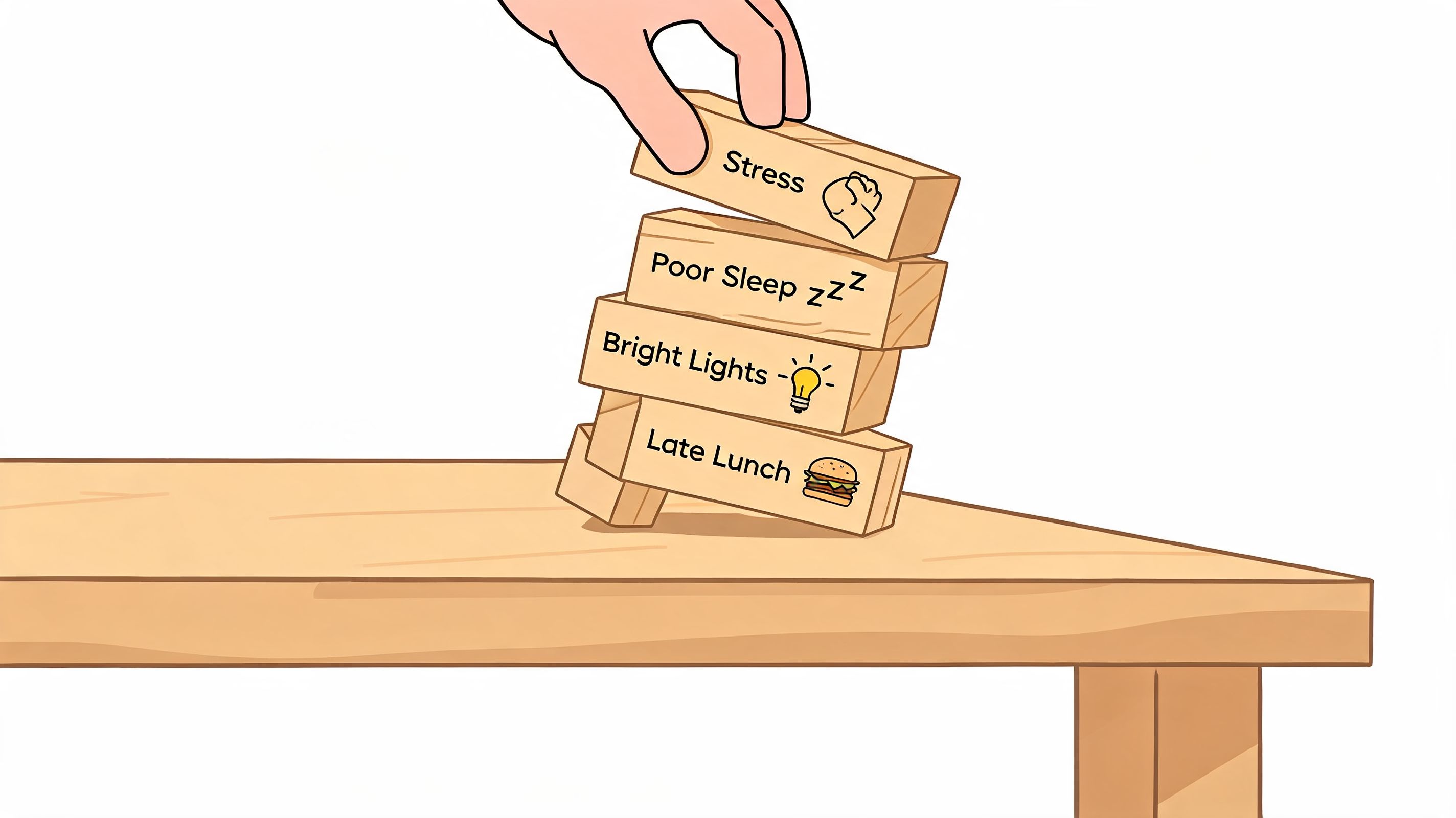
Why memory alone usually fails
Looking back after the pain starts feels logical, but migraine often begins long before the headache becomes obvious. You may have slept poorly, skipped lunch, pushed through a tense day, and noticed light sensitivity hours before you connected any of it. By then, your memory tends to grab the most recent event and label it the cause.
Stress shows why this is so tricky. It may matter a lot for you, or only when it combines with poor sleep, hormone shifts, or sensory overload. As noted earlier, stress is a common trigger. On its own, though, that fact does not tell you whether stress starts your attacks, lowers your threshold, or merely shows up alongside other factors.
A better approach is to track both migraine days and non-migraine days. That comparison gives you something memory cannot. Context. Without it, almost everything starts to look suspicious.
What usually works: Track patterns across time, not just whatever happened right before the pain.
What to track for better pattern detection
Start small and stay consistent. A simple record you can keep for six weeks is more useful than a detailed system you abandon after three days.
Helpful categories include:
- Early and later symptoms: prodrome signs, aura, pain level, nausea, light sensitivity, postdrome
- Sleep: bedtime, wake time, restless sleep, unusually long sleep
- Stress load: your general stress level and whether it stayed high for several days
- Meals and hydration: skipped meals, long gaps between eating, low fluid intake
- Hormonal timing: cycle phase, bleeding days, contraception changes if relevant
- Environment: weather shifts, humidity, pressure changes, air quality, bright light exposure
- Activity: travel, intense exercise, long screen days, crowded or overstimulating settings
A useful rule is to log facts, not theories. Write "slept 5 hours" or "storm moved in" instead of "weather caused migraine." That keeps your notes clean enough to spot real patterns later.
Relief can help by turning those daily entries into a clearer picture. Relief's migraine tracking app combines symptom logging with local weather and air quality context, which makes it easier to compare attacks with outside conditions instead of relying on guesswork.
If you want a quick visual explainer, this video gives a useful overview of the trigger-pattern mindset:
You do not need to identify every trigger at once. One repeatable pattern, such as poor sleep plus bright light or late meals during your cycle, can give you a practical place to start. That is often enough to make migraine feel less random and a little more manageable.
When You Should See a Doctor for Headaches
Some headaches are not "wait and see" situations. Even if you think you get migraine, certain symptoms need urgent medical attention.
This article is for informational purposes and is not medical advice. Consult a healthcare provider for personalized guidance.
Red flags that need urgent care
Seek immediate medical care for any of the following:
- Sudden severe headache: A headache that reaches maximum intensity very quickly
- Headache with fever or stiff neck: Especially if you also feel confused or very ill
- New neurological changes: Weakness, trouble speaking, fainting, confusion, or vision changes that are new, severe, or not typical for you
- Headache after head injury: Even if it seems delayed
- A major change in your usual pattern: Especially if the headache feels completely different from your established migraine symptoms
A sudden severe headache, headache with fever or stiff neck, neurological changes, or headache after head injury needs immediate medical evaluation.
When to book a non-emergency visit
You don't need an emergency to deserve care. Make an appointment if your headaches are becoming more frequent, more disruptive, harder to manage, or if you're unsure whether what you're experiencing is migraine at all.
A clinician may ask about:
- Your symptom pattern: what happens before, during, and after attacks
- Frequency and severity: how often attacks happen and how much they affect daily life
- Family history and hormone patterns
- Current medications and self-treatment
- Your headache diary or tracking data
That last piece matters. A basic record of symptoms, timing, and possible triggers can make the visit much more productive. It helps a clinician look for migraine features, rule out other problems, and talk through treatment options that may include lifestyle changes, over-the-counter tools, or prescription care.
Your First Steps Toward Fewer Migraine Days
The most useful shift is this one: stop searching for one perfect answer and start looking for your pattern. Migraine usually comes from an underlying neurological tendency plus specific attack triggers. When you understand both, you have something practical to work with.
A few first steps can help:
- Keep your routine steadier: Consistent sleep and regular meals often matter more than extreme lifestyle changes.
- Track stress: Stress isn't always avoidable, but noticing buildup can help you spot vulnerable periods earlier.
- Watch for trigger stacking: One factor may be harmless alone and a problem only when combined with others.
- Look for timing patterns: This is especially important with hormones, travel, poor sleep, and weather shifts.
- Talk with a clinician about treatment options: Management may include lifestyle approaches, over-the-counter options, prescription treatments, or a combination.
You do not need to solve migraine all at once. You need a clearer picture of your own threshold, your own triggers, and your own early warning signs. That is often where control begins.
If you want help turning scattered symptoms into clearer patterns, Relief can support that process by letting you log attacks, symptoms, and likely triggers alongside environmental conditions so you can better understand what tends to set off your migraines.


