
If you're starting amitriptyline for migraine prevention, the usual starting dose is 10 mg at night, then it's often increased slowly if needed. That “low and slow” approach matters because migraine benefit is often reached at lower doses than the doses used for depression.
If you're reading this while staring at a new prescription and wondering, “Is this dose normal?” you're not overthinking it. Starting a preventative can bring a strange mix of hope, skepticism, and fatigue. You want fewer migraine days, but you also don't want to feel knocked out, foggy, or stuck on a medication plan you don't understand.
Amitriptyline is one of those medicines that often raises extra questions because many people know it first as an antidepressant. In migraine care, though, it's commonly used as a preventative, meaning it's taken regularly to try to reduce how often attacks happen and how severe they become over time. It is not meant to stop a migraine already in progress.
This article is for informational purposes and is not medical advice. Consult a healthcare provider for personalized guidance.
If your attacks are frequent enough that you're wondering whether they count as chronic migraine, this plain-language guide on the definition of chronic migraine can help you frame that conversation with your clinician.
Table of Contents
- Think of it like a volume knob
- Why the dose is lower than people expect
- What this means for your expectations
- The first week can feel strange
- Common early experiences
- A useful way to think about the first few weeks
- What titration actually means
- A sample schedule your doctor might use
- Why the goal is the lowest effective dose
- What changes you might notice first
- What to track while you wait
- Side effects that deserve a call sooner
- Health conditions your doctor needs to know about
- Medication interactions are not a small detail
- Red flag symptoms that need urgent care
Starting a New Migraine Preventative
Beginning a preventative often feels less dramatic than taking an acute medication, but emotionally it can be harder. You're being asked to commit to something nightly, wait, and trust a process that may move slowly. That's difficult when migraine already steals enough of your time.
For the dosage of Amitriptyline for migraines, the common starting point is 10 mg at night, with increases made in small steps over time if needed, according to UK headache guidance from Torbay and South Devon NHS. That same guidance notes that the dose is usually adjusted gradually until the lowest effective dose is found, commonly in the 20 to 30 mg nightly range, with some people going higher if they tolerate it well.
Why doctors start low
This often surprises people. A tiny tablet can feel almost too small to matter.
But in migraine prevention, the aim isn't to rush to a high dose. It's to find the smallest amount that helps without creating side effects that make daily life worse. That's why you'll often hear versions of the same message in clinic: start low, take it at night, and don't judge it too fast.
Practical rule: The “right” dose isn't the highest one. It's the lowest dose that gives enough benefit with side effects you can realistically live with.
Why nighttime matters
Amitriptyline is commonly taken at night because it can make some people sleepy. For many, that's part of the plan. Taking it in the evening may make early side effects easier to tolerate than if you took it in the morning and had to work, drive, parent, or function through a meeting-heavy day.
That doesn't mean the adjustment is effortless. It means the process is designed to be gentler.
How Amitriptyline Works for Migraine Prevention
Amitriptyline can be confusing because the label on the bottle doesn't explain why it's being used for migraine. If your doctor prescribed it, they're not saying your migraine is “just stress” or “all in your head.” They're targeting the nervous system.
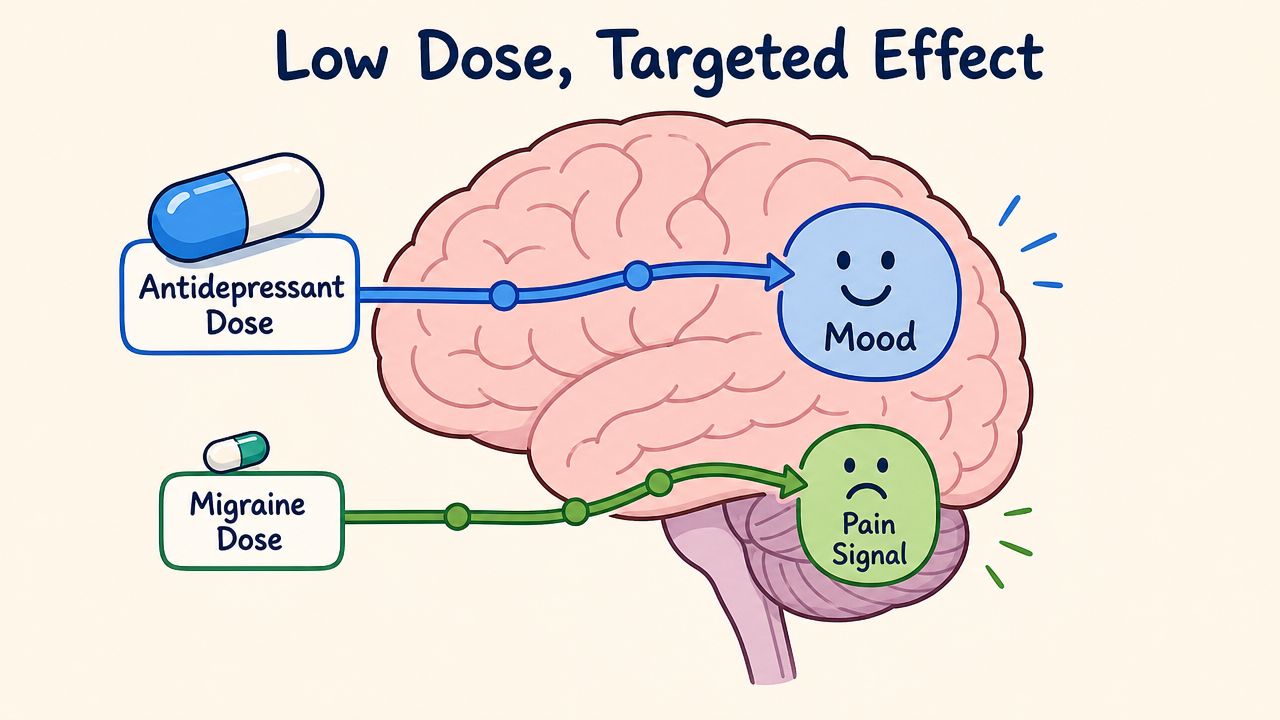
Think of it like a volume knob
Migraine involves a brain and nervous system that can become unusually sensitive. A simple way to think about amitriptyline is that it may help turn down the “volume” on that sensitivity. Not silence it completely. Not erase migraine forever. Just lower the system's tendency to amplify pain and related symptoms.
That's why it's used as a preventative. It's meant to reduce the chance or intensity of future attacks, not rescue you from one that has already started.
Why the dose is lower than people expect
This is another common point of confusion. People hear “antidepressant” and assume migraine doses must match depression doses.
In practice, migraine prevention usually uses much lower doses and slower adjustments. That's one reason the starting dose is often small and the pace can feel cautious. The doctor is trying to balance two things at once: enough medication to calm migraine activity, but not so much that the side effects become the main story.
A medication can have one name and more than one job. In migraine care, the job is prevention.
What this means for your expectations
Amitriptyline is not like taking an acute treatment and waiting for your pain to drop within hours. You're looking for patterns over time. Fewer attacks. Less severe attacks. Better sleep for some people. A little more predictability in a condition that often feels anything but predictable.
That slower payoff is frustrating, especially if you've already tried several things. But it also means you shouldn't measure success by asking only, “Did I feel different the first night?” A better question is, “What's changing over the next stretch of weeks?”
Your Starting Dose and What to Expect
For many adults, the first prescription for migraine prevention is 10 mg at night. That isn't a random tradition. A large retrospective cohort study in specialty headache practice found that initial doses ranged from 2.5 mg to 50 mg daily, but 63% of 178 patients were started on 10 mg daily, and about 75% had beneficial outcomes overall, supporting cautious low-dose prescribing in real-world migraine care (PubMed study on amitriptyline dosing in headache practice).
The first week can feel strange
Some people take the first tablet and feel almost nothing. Others notice sleepiness, dry mouth, or a heavy “morning after” feeling pretty quickly. None of that automatically means the medication is wrong for you, and none of it proves it will be right for you either.
Early side effects often create the most anxiety because they're immediate, while the migraine benefit takes longer to judge. That mismatch can tempt people to quit before they've really had a fair trial. If the side effects feel disruptive, it's worth contacting your prescriber rather than deciding on your own that the whole plan has failed.
Common early experiences
The most talked-about early issues are practical, not dramatic.
- Sleepiness: Many people feel drowsy, which is why the medication is usually taken at night.
- Dry mouth: Annoying, common, and easy to underestimate until you're waking up thirsty.
- Morning grogginess: Some people describe this as a “hangover” feeling.
- Constipation or sluggishness: A slower gut can show up early for some people.
These effects can ease as your body adjusts, but the experience varies. If you already feel wiped out by migraine, even a mild extra layer of fatigue can matter a lot.
A useful way to think about the first few weeks
Don't expect the opening dose to answer every question. The first phase is often more about tolerance than about clear migraine prevention.
Ask yourself:
- Can I take this consistently at night?
- Are the side effects manageable, improving, or getting in the way?
- Am I seeing even subtle changes in sleep, next-day function, or attack pattern?
That kind of observation gives your clinician something real to work with at follow-up.
Finding Your Effective Dose Through Titration
“Titration” sounds technical, but the idea is simple. It means raising the dose gradually instead of jumping quickly. For migraine, that slow climb is often the safest and most practical way to find a dose that helps.
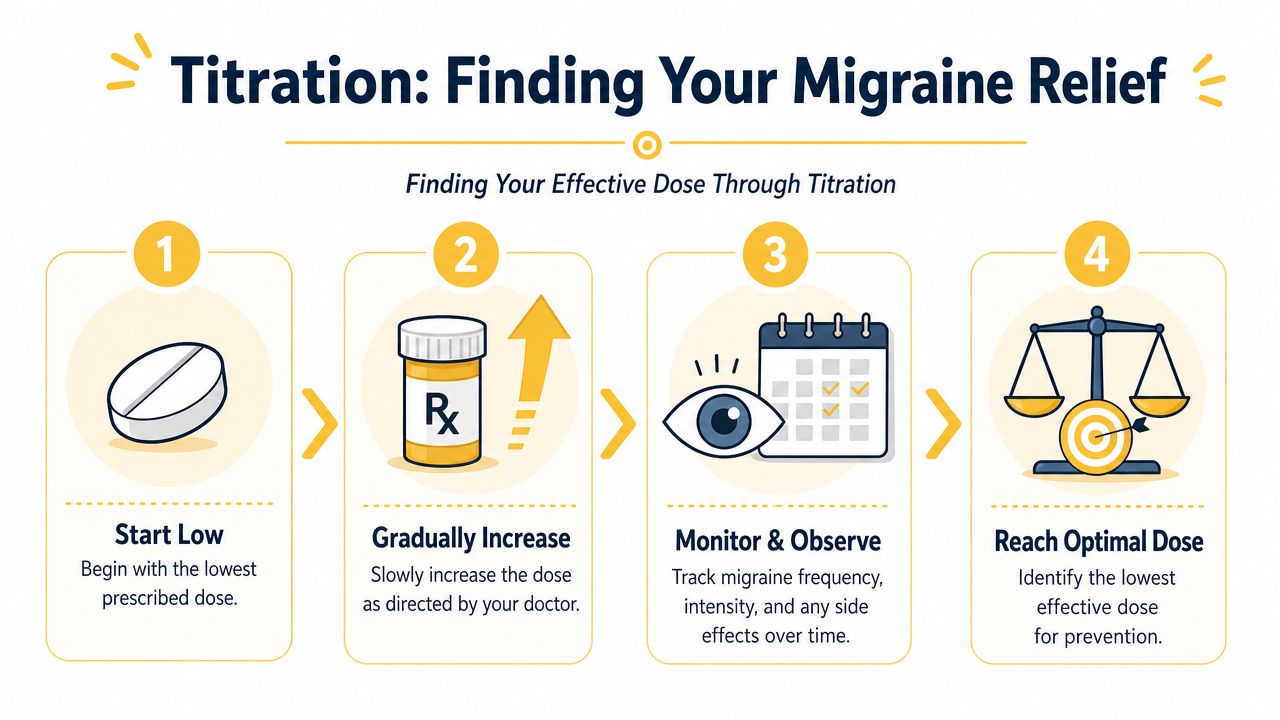
What titration actually means
The reason titration matters is straightforward. If you increase too fast, side effects can hit before your body has time to adapt. If you never increase when needed, you may stay at a dose that's tolerated but not effective enough.
UK NHS guidance describes a typical pattern of starting at 10 mg at night, increasing after 7 to 14 nights to 20 mg, then raising by 10 mg every 7 to 14 nights if needed. Some patients may go to 40 to 50 mg, and some guidance notes the maximum dose for migraine prevention can be higher in selected cases (NHS guidance on how and when to take amitriptyline for pain and migraine).
That doesn't mean everyone follows the same ladder. It means your doctor is usually looking for a careful middle path between “too much too soon” and “not enough to judge.”
A sample schedule your doctor might use
Here's a simple example of the kind of titration schedule a clinician might use. This is not a personal dosing plan. It's just a way to show how gradual the process often is.
| Time Period | Nightly Dose | Notes |
|---|---|---|
| First 7 to 14 nights | 10 mg | Starting dose, watching mainly for tolerance |
| Next 7 to 14 nights | 20 mg | Increase if needed and if side effects are manageable |
| Following 7 to 14 nights | 30 mg | Continued trial if migraine control is still limited |
| Later adjustment if needed | 40 to 50 mg | Used for some people when benefit is incomplete and tolerability is acceptable |
If you want a simple way to log dose changes, attack timing, and side effects between appointments, a printable headache diary PDF can make patterns easier to spot.
Why the goal is the lowest effective dose
This is the part many people miss. Titration is not a race toward the top dose. It's a search.
A good outcome might look like this: your migraine frequency starts easing at a lower dose, side effects stay tolerable, and you don't need to go higher. Another person may need a larger dose before they notice enough benefit. Both situations are normal.
The best dose is the one that helps enough without making you feel worse in a different way.
That's why your notes matter. If your clinician asks, “How did you do after the increase?” try to answer with specifics instead of a global “fine” or “bad.” For example:
- Migraine pattern: “I still had attacks, but they seemed less intense.”
- Function: “I was groggy in the mornings for several days, then it eased.”
- Sleep: “I fell asleep more easily, but waking up was harder.”
- Tolerance: “Dry mouth was annoying but manageable. Constipation was not.”
Those details help your doctor decide whether to hold, increase, reduce, or rethink the medication.
Monitoring Side Effects and Benefits Over Time
Once you're past the first prescription and the first few nights, the primary task becomes observation. Not hypervigilance. Just structured noticing. Migraine can distort memory, especially when you're tired and trying to compare this month to last month from sheer impression alone.
What changes you might notice first
Benefit doesn't always arrive in a dramatic way. Some people don't suddenly realize, “My medication is working.” Instead, they notice they've had a slightly better stretch. Or a migraine that would usually flatten them seems less intense. Or they recover faster.
That's why it helps to track several layers, not just attack count.
- Migraine frequency: Are attacks happening less often?
- Attack severity: Are they milder when they do happen?
- Duration: Do they seem shorter or easier to recover from?
- Associated symptoms: Are nausea, photophobia, or postdrome symptoms changing?
- Daytime function: Can you work, parent, socialize, or think more clearly?

If you need a clearer way to describe how bad attacks are, using a simple migraine severity scale can make your notes much more useful at follow-up.
What to track while you wait
A basic tracking routine beats a perfect one you never keep up with. You don't need a spreadsheet worthy of a clinical trial.
A practical log can include:
- Dose and date: Record when the dose changed.
- Sleep effects: Note whether you felt sedated, slept better, or woke groggy.
- Daily side effects: Dry mouth, constipation, dizziness, blurred vision, appetite changes, or anything else you notice.
- Migraine details: Start time, duration, symptoms, intensity, and whether you needed acute medication.
- Life impact: Missed work, canceled plans, reduced concentration, or a day spent recovering.
Short notes done consistently are more useful than detailed notes done once.
Side effects that deserve a call sooner
Some side effects are common and manageable. Others shouldn't be brushed off. If something feels intense, unusual, or worrying, contact your prescriber.
Bring up things like:
- pronounced daytime sedation
- severe constipation
- trouble urinating
- blurred vision that concerns you
- a racing or irregular heartbeat
- major mood changes
You don't need to decide on your own whether a symptom “counts.” Your job is to notice it and report it.
This article is for informational purposes and is not medical advice. Consult a healthcare provider for personalized guidance.
Important Safety Considerations for Amitriptyline
Amitriptyline isn't a casual add-on. Before you start it, your doctor needs the full picture of your health history and everything else you take. Not the shortened version. The full one.
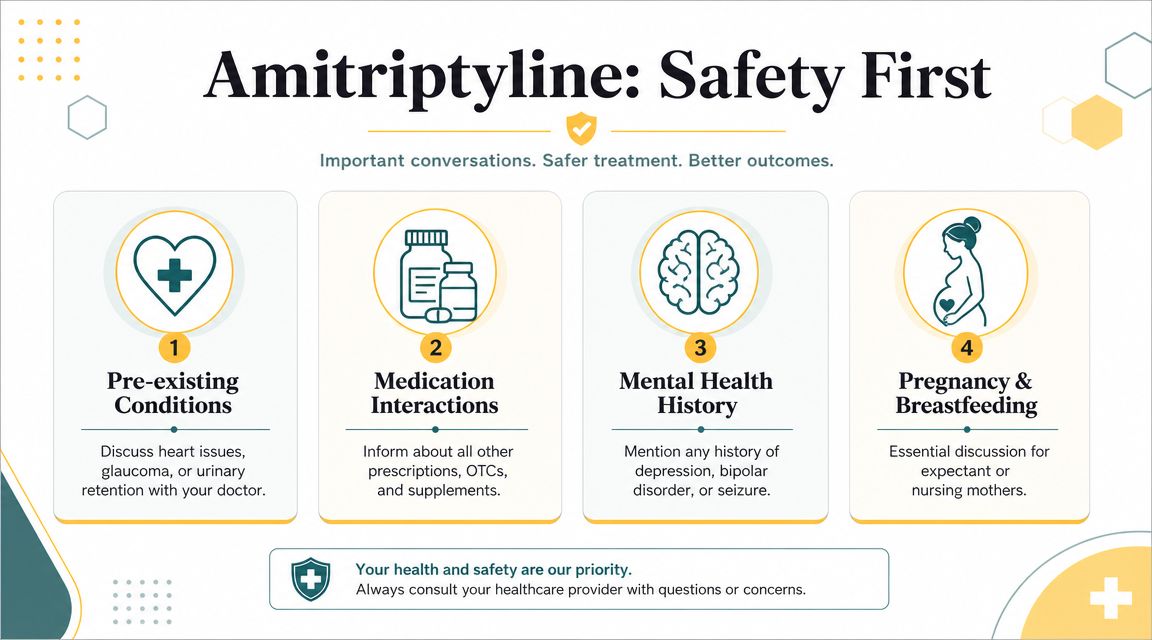
Health conditions your doctor needs to know about
Some pre-existing conditions can affect whether amitriptyline is a good fit or how cautiously it should be used. Heart rhythm issues are especially important to mention. So are glaucoma, urinary retention, seizure history, bipolar disorder, pregnancy, and breastfeeding.
Older adults may also need extra caution because sedating and anticholinergic effects can hit harder. That doesn't automatically rule the medication out. It means the decision deserves care.
Medication interactions are not a small detail
Tell your clinician about all prescription drugs, over-the-counter medicines, and supplements. That includes things you take only occasionally.
A lot of medication problems happen not because a doctor chose the wrong treatment, but because a key detail never made it into the conversation. If you take something for sleep, allergies, anxiety, nausea, pain, mood, or another neurological condition, bring it up. Even if it seems unrelated.
Bring the bottle list, not your memory.
Red flag symptoms that need urgent care
It's also important to separate a familiar migraine attack from symptoms that need immediate medical attention. Seek urgent medical care right away for:
- Sudden severe headache: A thunderclap headache or the worst headache of your life
- Headache with fever or stiff neck: Especially if it feels unlike your usual migraine
- New neurological changes: Weakness, confusion, fainting, trouble speaking, or new vision loss
- Headache after head injury: Even if the pain seems delayed
Those symptoms should not be written off as “probably just migraine.”
This article is for informational purposes and is not medical advice. Consult a healthcare provider for personalized guidance.
Partnering With Your Clinician for Success
The dosage of Amitriptyline for migraines usually isn't something you “figure out” in one visit. It's a process of trying a starting dose, watching closely, and adjusting carefully. The most useful mindset is not “How high can I go?” but “What's the lowest dose that helps enough?”
That makes you an active part of treatment, not a passive recipient of it. Your observations about sleepiness, dry mouth, constipation, morning function, attack severity, and overall quality of life are part of the decision-making.
When you walk into follow-up with clear notes, your clinician can do more than ask whether it's “working.” They can see what changed, when it changed, and whether the benefits seem worth the tradeoffs.
Relief can support that process by helping you track migraine symptoms, severity, triggers, and medication patterns in one place, so your next conversation with your clinician is based on real data instead of exhausted guesswork.


