Which headache diary PDF will you keep using after a bad week, a busy month, and a half-forgotten follow-up appointment?
Most templates look similar at first glance, but they do different jobs. Some are built for day-by-day attack detail. Some make monthly patterns easier to spot. Some are easier for adults managing their own care, while others are clearer for parents tracking a child's symptoms.
The right diary is the one that matches how you need to track. A daily log helps when medication timing, pain severity, and symptom progression matter. A calendar-style sheet is often better for seeing frequency, missed school or work, and cycle-related patterns over time. That trade-off matters more than design.
This guide sorts headache diary PDFs by use case so you can choose faster. It also shows what a filled-out entry can look like, because many people stop before they start, perceiving the form as more complicated than it is. If you are deciding between paper and digital tracking, a migraine tracking app comparison can help clarify which format fits your routine.
Printed diaries still have a place. They are easy to bring to appointments, easy to hand to a caregiver, and often easier to stick with than a tool that asks for too much detail every day. The best PDFs in this list are the ones that make useful tracking feel manageable, not like another job.
Table of Contents
1. National Headache Foundation – Headache Diary (PDF)
The National Headache Foundation Headache Diary PDF is the kind of form that works well when you want a visit-ready log without extra clutter. It gives you the core fields typically asked about in appointments, including timing, intensity, symptoms, triggers, medication, and response.
This is a good starting point if you're overwhelmed and need a simple printable you can use today. It doesn't try to be a symptom journal, lifestyle planner, and calendar all at once.
Why it works
The tabular layout is compact, which matters more than people think. If a diary takes too long to fill out during prodrome, aura, pain, or postdrome, many people stop using it.
What works well here:
- Fast entry: You can jot down start and finish times, pain level, likely triggers, and what you took without writing paragraphs.
- Appointment-friendly: The page is easy to print, carry, and hand to a clinician.
- Good default choice: If you don't yet know what level of detail helps you, this is a safe middle ground.
The trade-off is space. If your attacks include changing symptoms over hours, or if you're trying to track work impact, menstrual-cycle links, or medication patterns in more detail, you may outgrow it.
Practical rule: If you miss entries because the form feels like homework, switch to a simpler diary, not a more detailed one.
If you eventually want something more flexible than paper, a migraine tracking app can make it easier to log the same core fields without reprinting pages.
2. Mayo Clinic – Patient Headache Diary (PDF)
Need a diary that tells you exactly what to record, even on the days you can barely think straight?
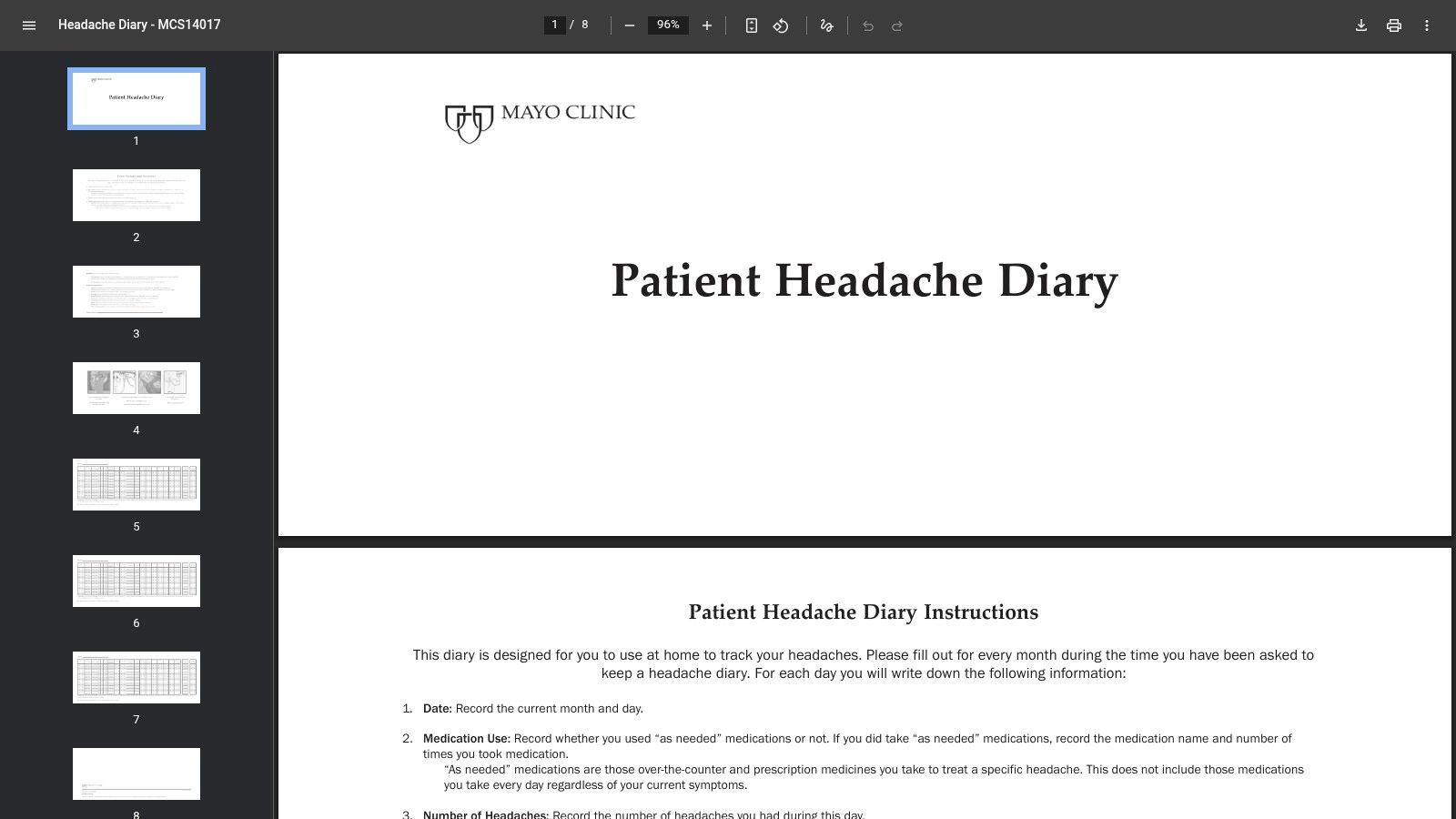
The Mayo Clinic Patient Headache Diary is a strong fit for adults who want a strict daily log instead of a more open-ended symptom journal or a monthly calendar. That distinction matters. Some PDFs are better for spotting broad patterns across weeks. This one is better for capturing the core facts of each headache in a repeatable way.
The form stays narrow on purpose. You log the date, whether you used medication, how many headaches you had that day, severity on a 0 to 10 scale, and duration in hours. It also gives practical rules that reduce guesswork, such as recording anything under an hour as 1 hour and listing separate headaches separately.
Best for adults who want a repeatable daily log
If you're comparing headache diary PDFs by use-case, this is the structured daily-entry option. It works well for people who do better with fixed boxes than with writing notes in the margins, and for follow-up visits where a clinician wants clean, comparable records over time.
A filled-out entry might look like this:
Date: 12
Medication use: Yes
Number of headaches: 2
Severity: 6 and 8
Duration: 3 hours and 1 hour
That kind of plain entry removes a lot of uncertainty. You do not have to decide what to mention each day. You record the same fields every time, which makes patterns easier to review later. If pain ratings are hard to judge, this migraine pain scale guide can help you use the 0 to 10 field more consistently.
The trade-off is visibility. You get solid event-by-event tracking, but not much room for context like sleep disruption, menstrual timing, missed work, food triggers, or sensory symptoms that changed during the attack. If prevention habits are part of what you're trying to sort out, pair a diary like this with a simple routine review, such as these natural migraine prevention strategies.
For someone who wants structure and low decision fatigue, that limitation may be acceptable. For someone trying to investigate why headaches are changing, it can feel too tight.
3. Boston Children's Hospital – Headache Diary (PDF)
The Boston Children's Hospital Headache Diary PDF is built for families, and that shows in a good way. It keeps the prompts clear enough for caregivers while still capturing the details a pediatric clinician is likely to want.
For a child or teen, a diary has to be easy for the adult helping them and tolerable for the person having the attack. This form respects that reality.
Best for caregivers who need clarity fast
The layout makes it easier to log what happened without turning the process into an interrogation. You can document date, time, severity, triggers, medication, and relief in a way that stays readable when school schedules, activities, and symptoms are all changing.
This type of diary tends to work best when:
- A parent or caregiver is filling it out: The prompts reduce guesswork.
- You need consistency for pediatric visits: The fields stay focused on clinically useful details.
- You want a printable routine: One page can be copied and reused without much setup.
The limitation is depth. If you're trying to track school absence, sensory symptoms like photophobia, or whether nausea and dizziness change during the attack, there isn't much room to narrate.
Children and teens also need prevention support beyond tracking alone. If lifestyle routines are part of the conversation in your household, this guide on how to prevent migraines naturally can help frame what to discuss with a clinician.
4. Children's Healthcare of Atlanta (CHOA) – Headache Diary (PDF)
The Children's Healthcare of Atlanta Headache Diary PDF is another pediatric option, but it feels even more stripped down than Boston Children's. That's not a criticism. For some families, simpler means sustainable.
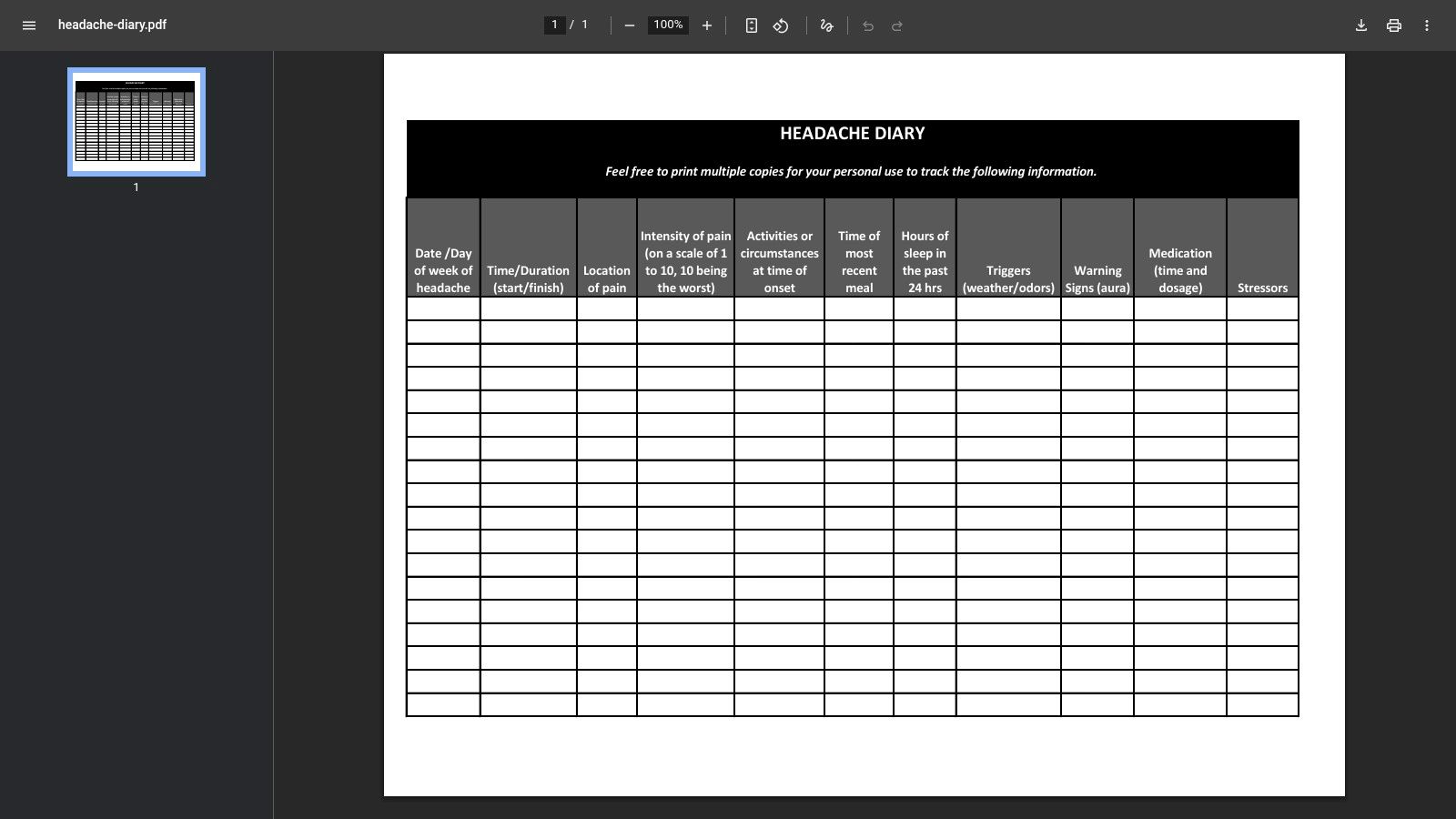
This form is useful when you want something a school nurse, caregiver, or parent can understand at a glance. The fields focus on date, time, severity, triggers, and medication.
Where it fits best
CHOA's version is a practical handoff tool. If multiple adults are helping track the same child's symptoms, a straightforward sheet lowers the chance that entries become inconsistent.
It works especially well for:
- Shared tracking: Parents, guardians, and school staff can all use the same format.
- Short appointments: You can bring a few pages and give a clinician a quick snapshot.
- Lower-friction logging: Less writing usually means fewer missed days.
Its main drawback is that it won't help much with cycle spotting over a longer stretch. If headaches or migraine attacks seem tied to weekly routines, school stress, sleep shifts, or menstruation, a calendar-style tracker often shows that pattern faster.
The best pediatric diary isn't the most detailed one. It's the one the family can keep up with for weeks, not just three motivated days.
5. University of Michigan C.S. Mott Children's Hospital – Headache Calendar (PDF)
Need a diary that shows patterns without asking a tired child or parent to write a mini-report every day? The University of Michigan C.S. Mott Children's Hospital Headache Calendar PDF is one of the better picks for that job.
Instead of chasing every symptom detail, this template gives you a month-at-a-glance view. That makes it easier to spot trends tied to school days, sleep changes, sports, travel, illness, or the start of a new medication. For families trying to answer, "How often is this happening?", a calendar usually gets you there faster than a page of daily notes.
Best for monthly pattern spotting
This PDF fits a very specific use case. Use it when frequency matters more than narrative.
A filled-out entry might look like this: on the 3rd, you mark a 2 for a mild headache after soccer practice. On the 4th and 5th, you mark 0. On the 6th, you note a 4, write "poor sleep," and add that ibuprofen helped within an hour. By the end of the month, those quick marks can reveal patterns that are hard to see in memory alone.
It works especially well for:
- Counting headache days: A symbol, color, or pain score is often enough.
- Showing a clinician the month clearly: Frequency is easier to review in calendar form.
- Pairing with a second tracker: Use this for the overview, then keep a more detailed log for severe or unusual days.
The trade-off is straightforward. A calendar can miss nuance. If a child has multiple attacks in one day, changing symptoms, or inconsistent medication response, the boxes can feel too small very quickly.
That does not make it a lesser tool. It makes it the right tool for a narrower purpose. In practice, families often do better with a format they can maintain for several weeks than with a detailed diary they abandon after four days. If the goal is pattern recognition first, this calendar does that well.
6. The Migraine Trust (UK) – Keeping a Migraine Diary (PDF/Word)
The Migraine Trust diary page is useful because it gives you more than a blank form. You get guidance and downloadable formats in both PDF and Word, which is helpful if standard printables never quite fit how your attacks unfold.
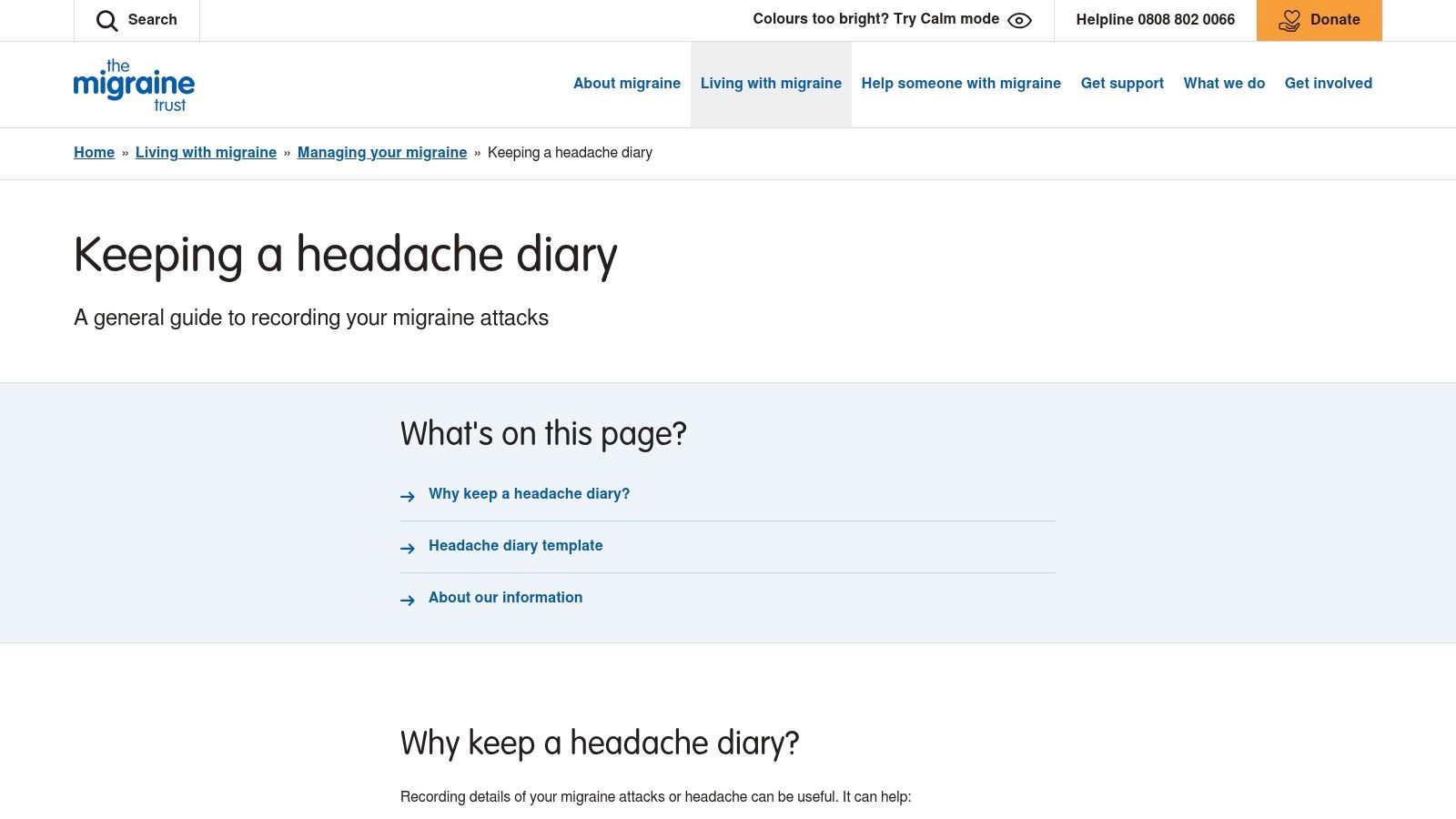
This is one of the better options for people who need a little explanation before they can track consistently. That's common. Many people abandon a diary because they aren't sure what belongs in it.
Best for people who want guidance with the template
The monthly format is good for seeing broad patterns, but the bigger advantage is flexibility. Being able to use a Word version means you can adapt the form if fixed boxes don't match your reality.
That matters because static templates often don't handle changing migraine patterns well. Guidance from the American Migraine Foundation notes that it's often better to start with only a few core fields and expand later, while also recognizing that some people may want to track medication response, menstrual cycles, and self-care in a more customized way on their headache diary guidance page.
If you've repeatedly quit detailed diaries, this type of resource can help you reset and simplify.
7. National Migraine Centre (UK) – Headache Diary (PDF)
The National Migraine Centre headache diary page feels close to what many specialist clinics want to review. It doesn't invite long storytelling. It asks for the details that help a clinician interpret attacks over time.
That makes it a good fit if your diary's main audience is a neurologist, headache specialist, or any clinician who wants structured notes rather than personal journaling.
Best for specialist-style review
The compact layout encourages regular use, which is often more valuable than perfect detail. If every entry is brief but consistent, patterns are easier to review.
This kind of diary is helpful when you want to track:
- Severity over time: Useful when you're judging whether treatment changes are helping.
- Symptoms and medication together: Clinicians often want those side by side.
- A month's worth of entries in one place: Easier to print or email.
The downside is tight space. If your attacks involve aura, vertigo, pronounced postdrome symptoms, or several medication decisions in one day, the form may feel cramped.
A specialist doesn't need your diary to be elegant. They need it to be consistent enough to show trends.
8. Migraine Canada – Printable Migraine Diary Templates (PDFs)
The Migraine Canada printable migraine diary templates stand out because they don't assume one layout works for everyone. You get multiple template styles, including more detailed logs and more visual monthly options.
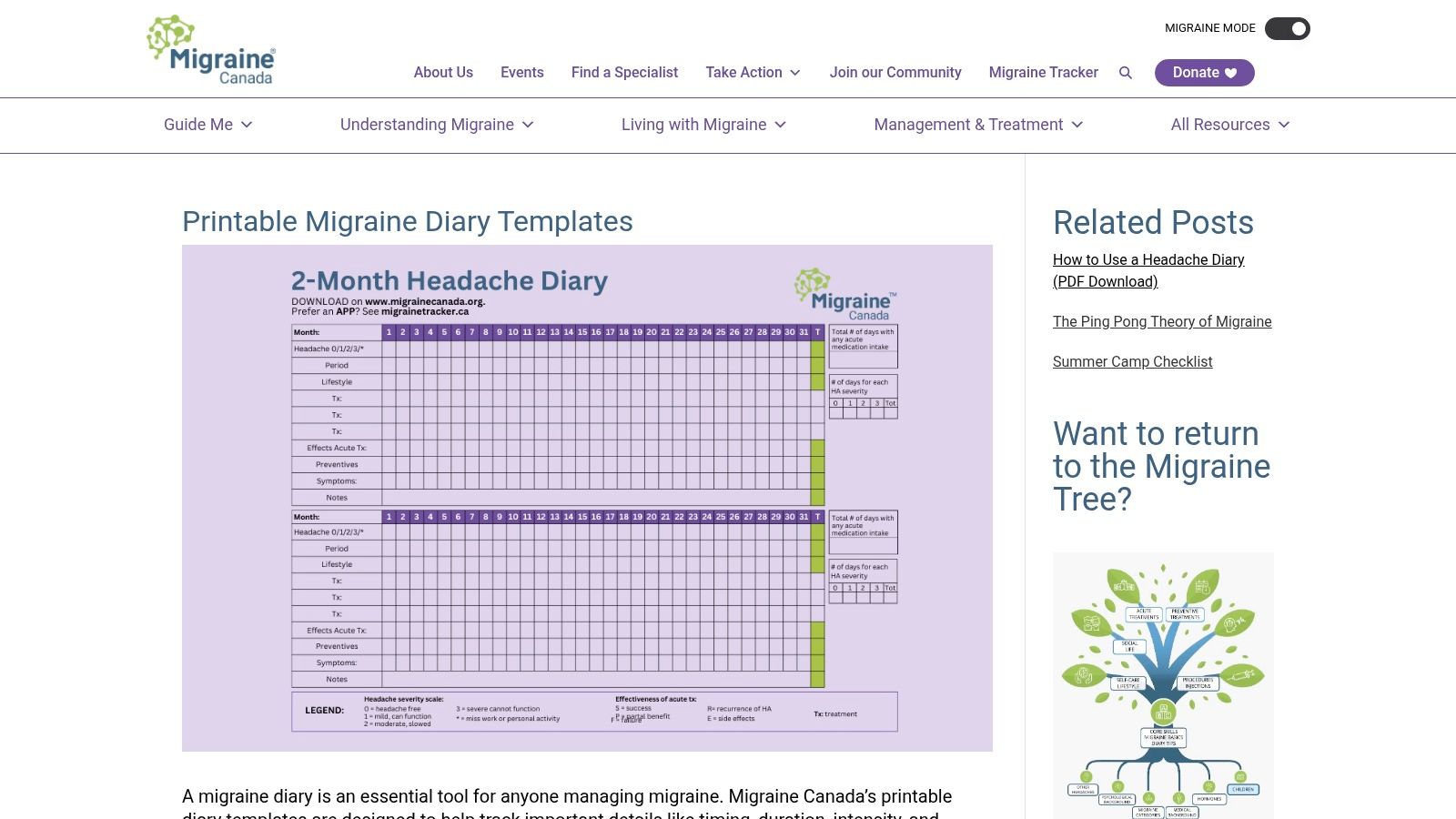
That's valuable if you've already learned something important about yourself. Some people need per-attack detail. Others only need a calendar and medication notes.
Best if one format never seems to fit
The practical upside here is choice, but choice can also become the problem. If you keep switching formats every week, your record gets harder to compare over time.
A good way to use this set is to pick one primary format for a full month, then reassess. If you need more detail after that, add one or two fields rather than changing everything.
This flexibility lines up with how digital tools have evolved too. A review of commercially available headache diary apps found that 66% of 38 apps supported exporting diary data, often by email or PDF, which shows how important portable, shareable records have become. PDF still matters because it keeps your log easy to print, send, or bring to an appointment.
9. InformedHealth (IQWiG/NCBI Bookshelf) – Migraine Diary Template (PDF)
The InformedHealth migraine diary template page on NCBI Bookshelf is a good choice if credibility is your first filter. Some people feel more comfortable using a diary when it comes from an evidence-review context rather than a generic printable site.
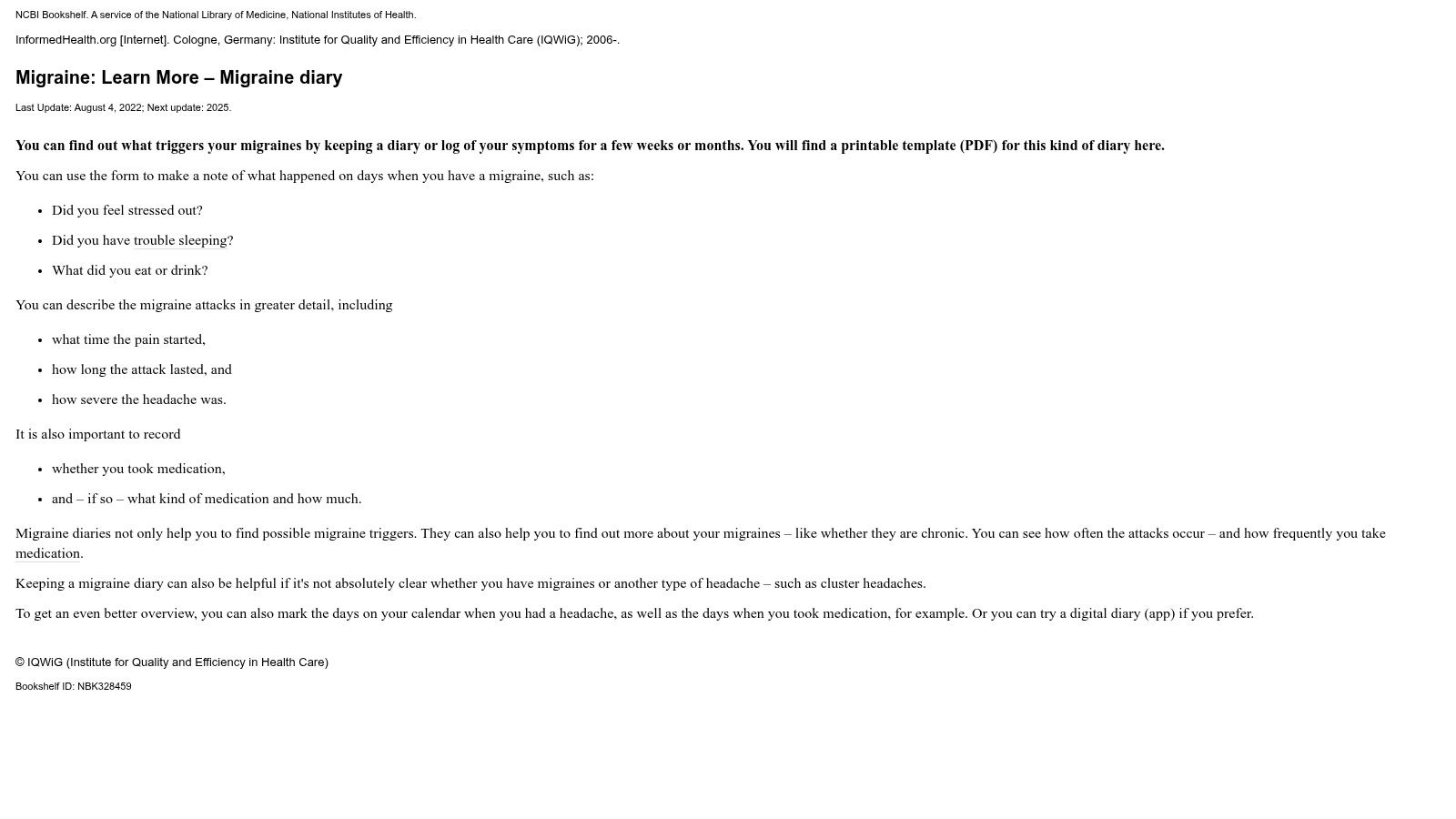
This template is straightforward. It emphasizes timing, severity, medication, and likely triggers without overcomplicating the page.
Best for research-minded users
If you like to understand why you're tracking something, this option feels reassuring. The instructions are concise, and the form stays close to the fields that clinicians typically use.
One trade-off matters more now than it used to. Privacy questions often get ignored in headache diary conversations. A NIH/PMC analysis of headache diary apps found that many apps collect medical information, that 57% stored diary data on provider servers, and that some shared information with third parties. If you're moving from a paper PDF to a cloud-based workflow, it's worth pausing to ask where that data goes and who controls it.
Paper isn't always more convenient, but it can be easier to understand from a privacy standpoint.
10. University of New Hampshire Health & Wellness – Headache Diary (PDF)
What if the missing clue is not the headache itself, but the six to twelve hours before it started?
The University of New Hampshire Health & Wellness Headache Diary PDF stands out because it is built for that question. Instead of only logging pain level, timing, and medication, it pushes you to record the daily conditions around an attack, including meals, caffeine, sleep, and related context. That makes it one of the stronger PDFs here for people who are still trying to sort out patterns.
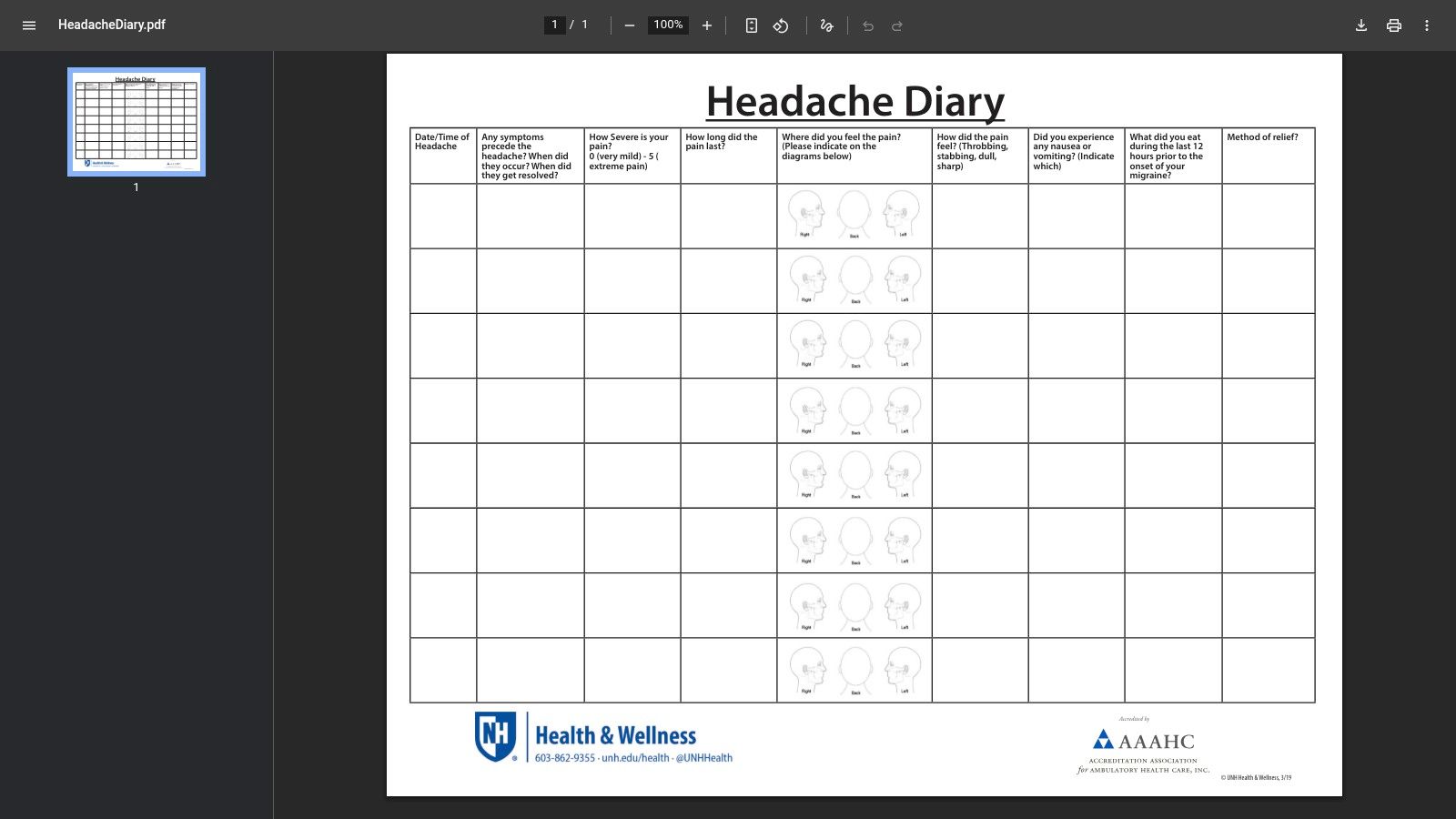
Best for trigger hunting
This is the PDF I would hand to someone who keeps saying, "I know something is setting these off, but I can't tell what." It gives more structure around pre-headache habits than a basic daily log, without turning the page into homework.
A filled-out entry might look like this:
- Date: Tuesday, 7/16
- Headache started: 2:30 p.m.
- Severity: 7/10
- Sleep the night before: 5 hours
- Meals: coffee only until noon, late lunch
- Possible triggers: skipped breakfast, poor sleep, stressful morning meeting
- Medication taken: ibuprofen at 3:00 p.m.
- Relief: partial improvement by 4:30 p.m.
That kind of entry is useful because it shows clusters, not certainty. Poor sleep alone may not trigger an attack every time. Add missed meals and stress, and the pattern becomes more convincing over a few weeks.
What this diary does well:
- Captures pre-attack context. You can track what was happening before onset, not just after pain begins.
- Stays printable and simple. The form is detailed enough to be useful but still realistic for daily use.
- Helps with pattern review. It is easier to compare repeated combinations such as short sleep plus caffeine changes or missed meals plus stress.
The trade-off is real. A trigger-focused diary can tempt people to blame every headache on one food, one drink, or one bad night of sleep. Migraine patterns are often messier than that. This PDF works best if you review it for repeated combinations and timing, rather than trying to declare a trigger after one rough day.
It also fits a specific use case in this list. If you want a monthly frequency view, the calendar-style options above are better. If you want a daily worksheet that helps you investigate what happens before an attack, this one is a stronger pick.
Top 10 Headache Diary PDFs Comparison
| Template | Core features & format | UX / Quality (★) | Best for (👥) | Unique strength (✨ / 🏆) | Price (💰) |
|---|---|---|---|---|---|
| National Headache Foundation – Headache Diary (PDF) | One-page daily table: start/finish, 1–10 intensity, triggers, meds, response | ★★★★ | 👥 Adults & clinic visits | 🏆 Clinician-endorsed, print-and-bring | 💰 Free PDF |
| Mayo Clinic – Patient Headache Diary (PDF) | Structured daily fields for severity, duration, triggers, treatments | ★★★★★ | 👥 Primary care & neurology patients | 🏆 Trusted health-system layout, balanced detail | 💰 Free PDF |
| Boston Children's Hospital – Headache Diary (PDF) | Child-friendly daily log with prompts for caregivers | ★★★★ | 👥 Children / caregivers / pediatric neurology | ✨ Clear caregiver prompts, pediatric-focused | 💰 Free PDF |
| Children's Healthcare of Atlanta (CHOA) – Headache Diary (PDF) | Clean single-page printable pediatric log: date, time, severity, meds | ★★★★ | 👥 Families & schools | ✨ Simple for photocopying & school use | 💰 Free PDF |
| University of Michigan C.S. Mott – Headache Calendar (PDF) | Month-per-page calendar to mark headache days & severity | ★★★★★ | 👥 Users tracking frequency & cycles | 🏆 Excellent month-at-a-glance trend spotting | 💰 Free PDF |
| The Migraine Trust (UK) – Keeping a Migraine Diary (PDF/Word) | Monthly templates + guidance; available PDF & Word | ★★★★★ | 👥 Anyone wanting guidance (UK-friendly) | ✨ Template + clear instructions; editable Word | 💰 Free download |
| National Migraine Centre (UK) – Headache Diary (PDF) | Date-by-date entries for severity, symptoms, meds (clinic-ready) | ★★★★ | 👥 Specialist clinic patients | 🏆 Clinic-tested, easy to submit to providers | 💰 Free PDF |
| Migraine Canada – Printable Diary Templates (PDFs) | Multiple styles: calendar + detailed logs + tips | ★★★★ | 👥 Users who want format choice | ✨ Multiple templates to suit tracking style | 💰 Free downloads |
| InformedHealth (IQWiG/NCBI Bookshelf) – Migraine Diary (PDF) | Research-informed template with concise instructions | ★★★★ | 👥 Research-minded / evidence-focused users | 🏆 Evidence-backed guidance & clean layout | 💰 Free PDF |
| University of New Hampshire Health & Wellness – Headache Diary (PDF) | Daily log with prompts for sleep, food, caffeine & 12‑hr pre-attack | ★★★★ | 👥 Users exploring lifestyle triggers | ✨ Prompts for meals/sleep to spot lifestyle links | 💰 Free PDF |
Final Thoughts
What makes a headache diary PDF worth using after the first hard week of tracking?
Usually, it comes down to fit. A headache diary PDF works as a translation tool. It turns scattered, easy-to-forget details into something you can review with a clinician, a caregiver, or yourself a month later.
The trade-off is simple. A detailed form can capture more context, but a simpler one is easier to keep up with when attacks are frequent and energy is low. In practice, consistency beats perfection. A basic record of date, severity, duration, and medication use is often more useful than an ambitious template you abandon after three days.
That is also why the best option in this list depends on the job you need it to do, not which PDF looks the most thorough.
- Use a daily log for appointment prep, especially if you need per-attack detail.
- Use a monthly calendar if your main goal is spotting frequency, cycles, or clustering.
- Use a pediatric form if parents, school staff, or multiple caregivers need one shared format.
- Use an editable template if standard checkboxes miss your symptoms, routine, or treatment plan.
- Use a trigger-focused diary if you are actively testing patterns around sleep, meals, caffeine, menstruation, or stress.
If the process still feels vague, a filled-out example usually helps more than another explanation. One entry can be enough to show what “good enough” looks like: date, start time, pain level, likely trigger, medicine taken, and whether it helped. That practical piece matters because many people stop tracking for the same reason they stop other health logs. The form feels unclear, too demanding, or both.
Paper PDFs still have a place. They are easy to print, share, annotate by hand, and bring to visits. Digital tools can be easier to maintain over time because they reduce friction. The better option is the one you will find yourself using during a bad week, not the one that sounds ideal on paper.
This article is for informational purposes and is not medical advice. Consult a healthcare provider for personal guidance. Seek urgent medical care for a sudden severe headache, headache with fever or stiff neck, neurological changes, or headache after a head injury.
The best headache diary PDF is the one you can stick with, the one that matches your use case, and the one that helps you walk into your next appointment with a clear record instead of a foggy memory.
If you want the simplicity of a diary with less paper friction, Relief helps you log symptoms, triggers, medications, and attack severity in seconds while also showing how weather, air quality, and pollen may line up with your migraine patterns over time.


