
When someone asks, “What number is your migraine pain on a scale from 0 to 10?” the honest answer is often, “That's not the whole story.” A migraine pain scale is useful, but it isn't meant to capture every part of an attack. It's a shorthand that helps you describe your pain in a way a doctor, a family member, or a tracking app can follow over time.
That matters because migraine is an invisible experience. You may be dealing with head pain, nausea, light sensitivity, brain fog, aura, and the inability to function, all at once. A number won't say everything. But the right number, used consistently, can still say something important.
This article is for informational purposes and is not medical advice. Consult a healthcare provider for personalized guidance.
Table of Contents
- That Frustrating Question What a Migraine Pain Scale Really Is
- Migraine is not just head pain
- The phases change what the number means
- The 0 to 10 numeric rating scale
- The four point verbal scale
- Migraine Pain and Impact Scale Conversion
- Build your own anchor points
- Track the moment not just the memory
- Add context so the number stays useful
- Turn logs into a short doctor summary
- Know when a migraine needs urgent care
- Use tracking to spot patterns not just collect numbers
That Frustrating Question What a Migraine Pain Scale Really Is
You're in urgent care, or on a telehealth call, or texting someone to say you can't make it. Then comes the question: “On a scale of 0 to 10, how bad is it?”
That question can feel almost insulting when your attack includes pounding pain, nausea, blurred thinking, and the need to hide in a dark room. You're trying to compress a full neurological event into one number.
Still, the number has a job. A migraine pain scale is not a perfect measurement. It's a translation tool. It turns your internal experience into a shared language that other people can understand quickly enough to act on.
Practical rule: Your pain rating doesn't have to be perfect. It has to be consistent enough to compare one attack with another.
The reason this matters is simple. If your ratings mean the same thing each time, you can start answering useful questions. Is this month worse than last month? Are your attacks becoming more disabling? Does a treatment seem to help at the peak of pain, or only after hours of rest?
Two scales show up most often:
- The 0 to 10 numeric scale, where 0 means no pain and 10 means pain as bad as it could be
- The four-point verbal scale, which uses words like none, mild, moderate, and severe
Both can help. But numbers usually give you more room to notice smaller changes.
That's one reason the scale matters so much for migraine. In the Lilly Migraine Impact Report, respondents with migraine rated their worst migraine pain at an average of 8.6 out of 10. Among people who had experienced both, childbirth was rated 7.3 out of 10. That comparison helps explain why many people struggle when a clinician treats migraine like “just a headache.”
Why a Simple Headache Scale Is Not Enough for Migraine
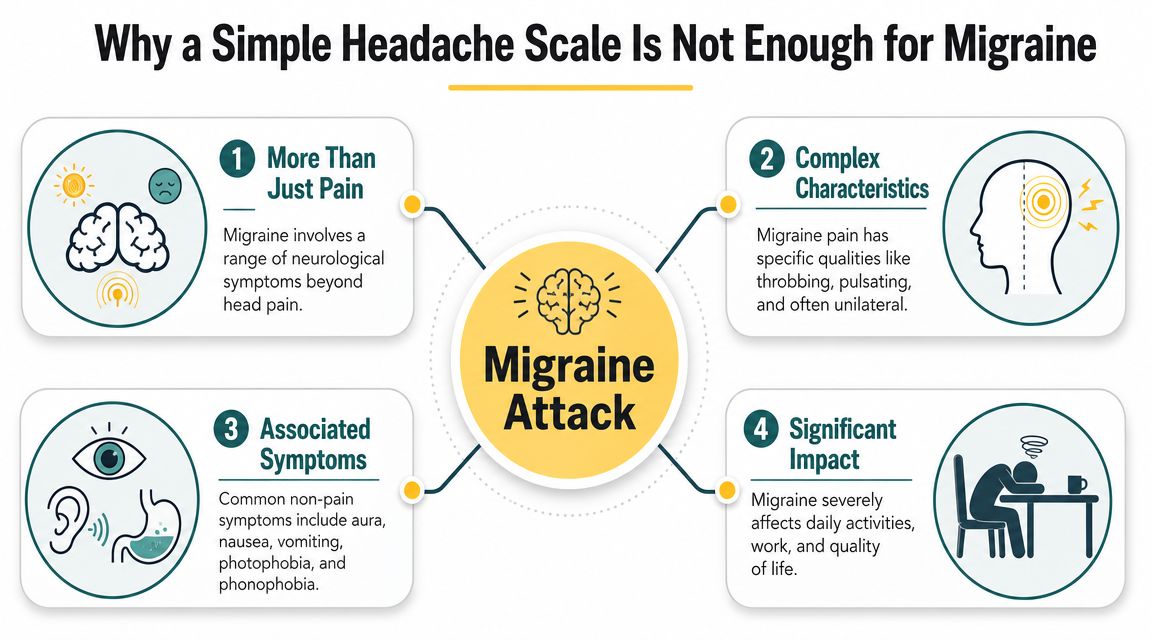
A headache scale focuses on pain. Migraine is broader than pain.
That distinction matters because many people are asked to rate migraine as if they're only reporting how much their head hurts. But a migraine attack can affect your vision, stomach, concentration, mood, speech, balance, and ability to tolerate light, sound, or movement.
Migraine is not just head pain
A simple headache scale misses the parts of migraine that often make it disabling.
You might have moderate pain but intense photophobia (light sensitivity), phonophobia (sound sensitivity), or nausea that keeps you from working. Or you might have severe head pain but still be able to function more than expected because you got to a dark room early and had access to your usual routine.
That's why people often feel that their number changes depending on the situation. The same attack can feel very different when you're safe at home versus driving, parenting, at work, or trying to get through a flight.
If your attacks leave you wiped out afterward, it can also help to understand the migraine recovery time and postdrome phase, because the “hangover” after the pain can be part of the burden too.
The phases change what the number means
Migraine often unfolds in phases, and each phase can change how you rate what's happening.
- Prodrome can come before the pain. Some people notice fatigue, mood changes, food cravings, neck discomfort, or trouble concentrating.
- Aura can include temporary visual or sensory symptoms. Not everyone gets aura.
- Pain phase is often the primary association. It may include throbbing or pulsating pain, nausea, vomiting, and sensitivity to light or sound.
- Postdrome is the after-effect. You may feel drained, foggy, sore, or emotionally flat after the worst pain passes.
A migraine pain score tells you about intensity. It doesn't automatically tell you where you are in the attack.
That's the key limitation of a simple pain scale. If you only log “7/10,” you may miss whether that 7 happened at onset, at peak, after medication, or during a long postdrome. Those details often make the number more useful than the number alone.
Decoding the Common Migraine Pain Scales
Individuals often encounter two systems: the 0 to 10 numeric rating scale and the four-point verbal scale. They're related, but they don't work exactly the same way.
A 2007 validation study of the 11-point migraine pain scale found that the 0 to 10 scale was 55% more sensitive than the older four-point scale at detecting clinically important changes in pain. That's a big reason numeric tracking is so useful when you're trying to see whether your attacks are shifting over time.
The 0 to 10 numeric rating scale
This is a widely recognized scale. Zero means no pain. Ten means pain as bad as it could be.
The challenge is that numbers feel abstract. They get easier when you tie them to function.
Here's a practical way to think about the middle and upper end:
- 0 means no pain
- 1 to 3 usually means pain is noticeable but still more background than dominant
- 4 to 6 usually means pain is harder to ignore and starts changing what you can do
- 7 to 8 often means you're struggling to function normally
- 9 to 10 usually means the attack is overwhelming and rest becomes the main task
The four point verbal scale
This scale uses words instead of numbers:
- None
- Mild
- Moderate
- Severe
Some people prefer this because it feels more natural. The drawback is that it compresses a lot of experience into only a few buckets. A “moderate” attack that lets you work slowly and a “moderate” attack that forces you to stop working may not feel like the same thing.
That's where the numeric scale often wins. It gives you room to say, “This is worse than my usual moderate attack, but not my worst.”
Migraine Pain and Impact Scale Conversion
0-10 Scale4-Point ScalePain DescriptionFunctional Impact (What you can do)0NoneNo migraine painYou can do normal activities without limitation1-3MildNoticeable pain, but not dominantYou can usually keep going, though you may be more careful with light, noise, or screens4-6ModeratePain is persistent and hard to tune outYou can do some tasks, but work, driving, reading, or conversation may feel harder7-8SeverePain is intense and disruptiveYou may need to stop normal activities, lie down, reduce stimulation, or avoid movement9-10SeverePain is overwhelming or unbearableFunction is extremely limited, and getting through the attack becomes the focus
A few examples can make this more concrete:
- A 2/10 might be, “I feel the migraine there, but I can still answer emails if the room is quiet.”
- A 5/10 might be, “I can work in short bursts, but I'm slow, irritable, and looking for a dark room.”
- A 7/10 might be, “I can't focus on a task, movement makes it worse, and I need to stop what I'm doing.”
- A 9/10 might be, “I'm in bed, I can barely tolerate sound, and basic conversation feels like too much.”
The most useful migraine pain scale is the one where your numbers match your real-life ability to function.
Measuring Impact Beyond Pain with the MIDAS Scale
A migraine pain scale tells you how intense an attack feels. MIDAS asks a different question: how much is migraine taking from your life?
That shift matters. Some people don't have the highest pain scores, but migraine still disrupts work, school, family time, or social plans in a major way. Others have intense attacks less often, but when they happen, they knock out entire days.
What MIDAS is trying to measure
MIDAS stands for Migraine Disability Assessment. You don't need to memorize the name to understand why it helps.
It focuses on lost function. Instead of asking only, “How bad was the pain?” it asks questions closer to these:
- How often did migraine make you miss work or school?
- How often did you do less than you meant to do?
- How often did migraine affect household tasks?
- How often did it interfere with family, social, or leisure time?
The value here is simple. A broader tool can reflect the burden that pain alone misses. The research background on migraine measurement notes that composite scores like MIDAS acknowledge that a simple 0 to 10 pain score doesn't capture the full burden of migraine, and that tracking lost function, medication use, and frequency provides a more clinically meaningful picture.
Why this helps at medical visits
Saying “my migraines are bad” is real, but it can be hard for another person to interpret.
Saying “my migraines keep me from finishing work” or “I'm losing important parts of my week” usually leads to a more specific conversation. It gives a clinician more context for discussing patterns, prevention, daily management, and when your current approach may not be doing enough.
A pain score tells part of the story. A disability measure tells what the story costs you.
Practical Tips for Accurate and Consistent Self-Reporting
If you've ever wondered whether today's 7 is the same as last month's 7, you're asking the right question. Migraine pain can be dynamic, and research discussed in this review of migraine pain responses supports the idea that a “7” can feel different depending on the situation or over time.
That doesn't mean tracking is pointless. It means consistency matters more than false precision.
Build your own anchor points
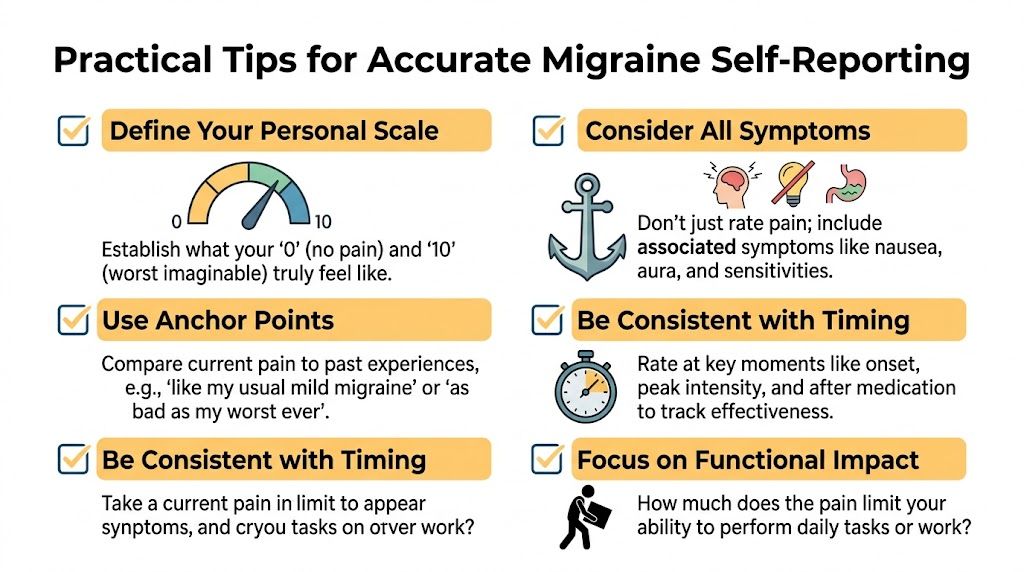
Start by defining a few numbers in your own words. Not every number. Just enough to keep you steady.
For example:
- Your 3 might mean “I can function, but I know a migraine is starting.”
- Your 6 might mean “I can still do simple tasks, but I'm slowing down and I need less stimulation.”
- Your 8 might mean “I cannot work or think clearly, and I need to lie down.”
- Your 10 might mean “This is as bad as I personally experience.”
These are your anchors. They turn the migraine pain scale from a vague public tool into a personal one.
Track the moment not just the memory
It helps to log a rating at a few consistent moments rather than trying to summarize the whole attack later.
Good moments to rate include:
- At onset when you first realize an attack is starting
- At peak when the pain or symptom burden is worst
- After intervention such as rest, food, hydration, or medication
- During recovery if postdrome symptoms are significant
Here's a useful walk-through on building a migraine tracking app routine that stays simple enough to keep using.
A short video can also make the habit easier to picture in real life.
Add context so the number stays useful
A single number becomes much more meaningful when you pair it with a few notes.
Try logging:
- Setting such as home, work, commute, travel, or overnight
- Function like “worked slowly,” “missed meeting,” “couldn't drive,” or “stayed in bed”
- Symptoms such as aura, nausea, vomiting, photophobia, phonophobia, dizziness, or neck pain
- Timing including when it started and when it peaked
A reliable migraine log doesn't chase objectivity. It creates a pattern you can trust.
You can use paper, a notes app, or a structured tracker. The tool matters less than the repeatability. If you use the same anchors and the same kinds of notes each time, your ratings become much easier to compare.
How to Use Your Pain Ratings to Improve Your Care
Once you've logged a few weeks or months, the numbers stop being isolated snapshots. They become a record.
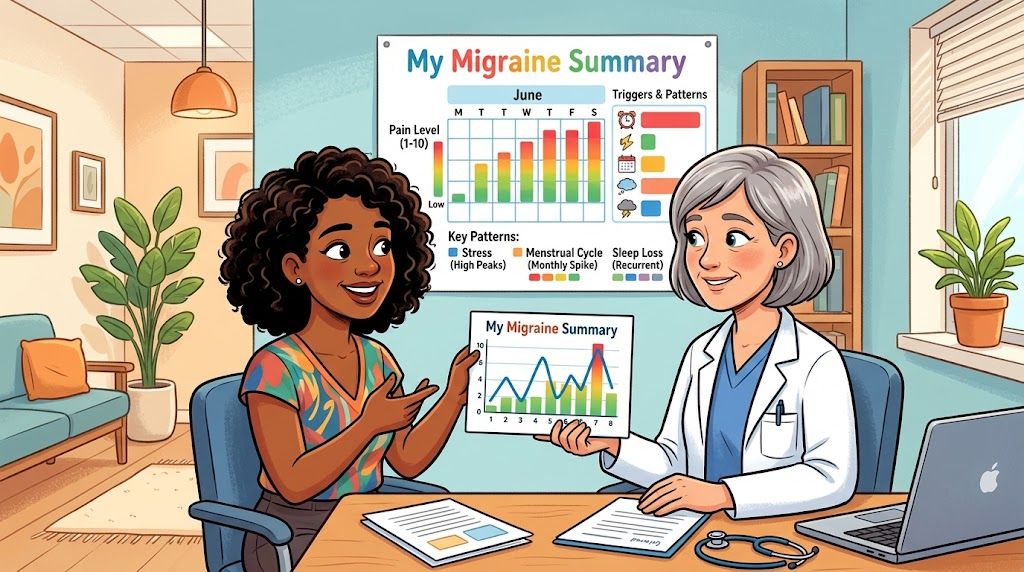
That record can help you talk with a clinician in a way that is shorter, clearer, and harder to dismiss. Instead of trying to remember everything during an appointment, you can bring a simple summary that shows what your migraine pain scale ratings mean in daily life.
Turn logs into a short doctor summary
You don't need a perfect spreadsheet. A few consistent points are enough.
Bring a summary like this:
- How often attacks happen
- Your usual peak pain range
- Whether symptoms like aura, nausea, or light sensitivity are common
- How often migraine disrupts work, school, driving, sleep, or family time
- Whether your current routine seems to reduce intensity or recovery time
You can even write two or three sentences before the visit. For example: “My attacks are becoming harder to function through. My peak pain is often in the severe range for me, and light sensitivity and nausea are major reasons I stop working.”
That kind of summary gives a clinician something concrete to respond to.
Know when a migraine needs urgent care
Most migraine attacks, even severe ones, aren't emergencies. Some symptoms are.
Seek immediate medical care for any of these red flags:
- Sudden severe headache that reaches maximum intensity quickly
- Headache with fever or stiff neck
- New neurological changes such as weakness, confusion, trouble speaking, fainting, or vision loss
- Headache after a head injury
This article is for informational purposes and is not medical advice. Consult a healthcare provider for personalized guidance.
Use tracking to spot patterns not just collect numbers
The best use of a migraine pain scale is not proving how tough an attack was. It's learning what the pattern looks like.
That might include noticing that your highest pain ratings cluster around poor sleep, travel, stress, changing weather, missed meals, or long screen-heavy workdays. It may also show that certain attacks are not the most painful, but are the most disruptive.
If you're also looking at routines that may affect attacks, it can help to review a broader migraine diet plan approach that focuses on patterns instead of universal food rules.
One practical option is Relief, an iOS app that lets you log severity, symptoms, triggers, and medications while also showing local weather, air quality, and pollen signals. Used consistently, that kind of tracking can help turn a migraine pain scale into something more useful than a number alone.
If you want one place to log your migraine pain scale, symptoms, and possible triggers, Relief can support that process and help you spot patterns over time.


