
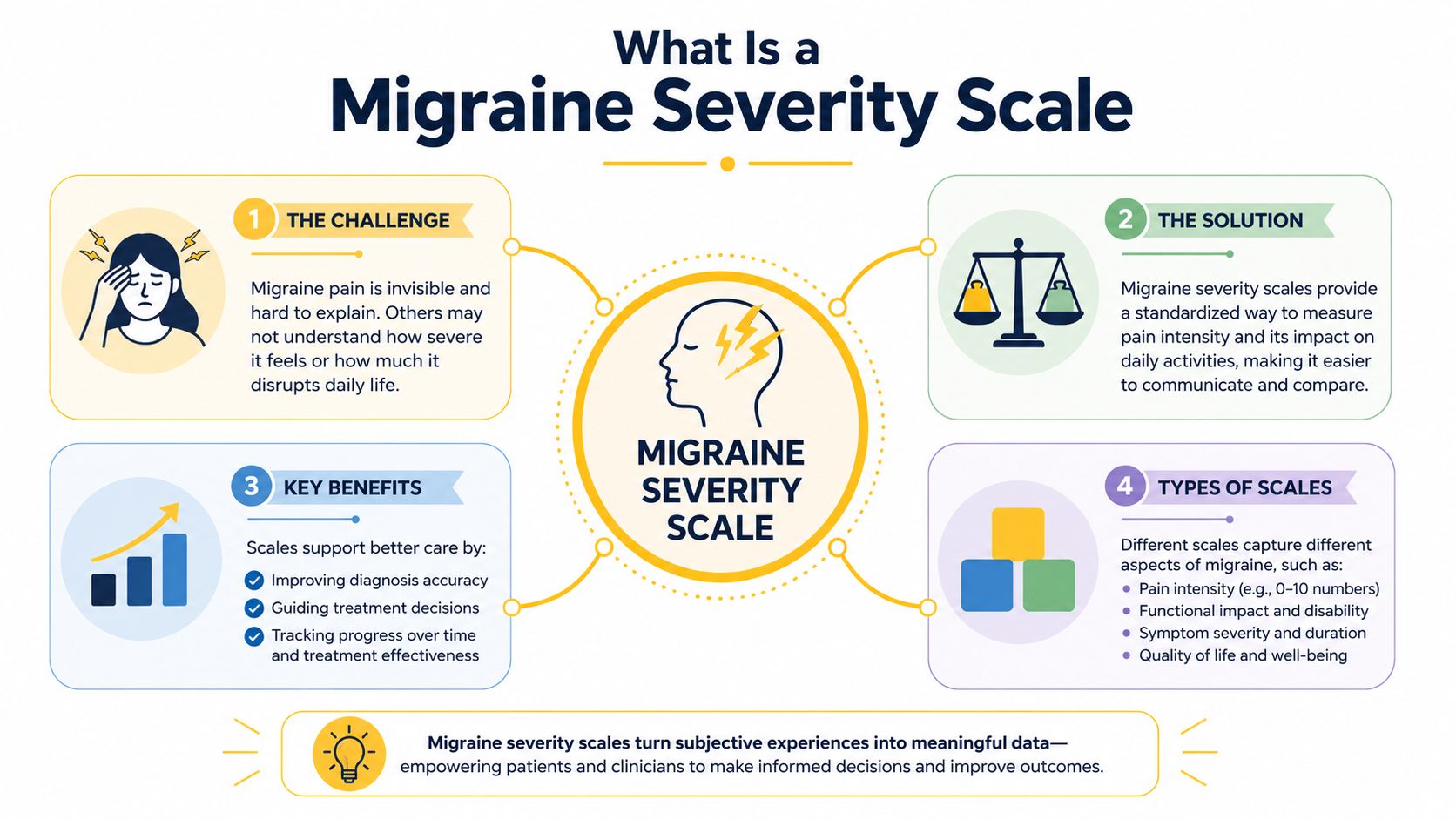
A migraine severity scale is a tool used to measure and communicate the intensity and impact of a migraine attack in a consistent way. It helps you and your doctor track patterns, assess treatment effectiveness, and understand the everyday disability caused by your condition.
If you've ever been asked, “How bad is it?” while you're nauseated, light-sensitive, and struggling to think clearly, you already know the problem. A single number can feel too small for something that affects your head, stomach, vision, energy, focus, work, and ability to function.
That's why a migraine severity scale matters. It gives you a repeatable way to describe what happened, not just how much it hurt. For many people, that shift changes medical visits from vague memory to usable information.
This article is for informational purposes and is not medical advice. Consult a healthcare provider for personalized guidance.
Table of Contents
- How to summarize your data clearly
- Red flags that need urgent care
- Questions you can bring to your visit
What Is a Migraine Severity Scale
When people hear “severity scale,” they often think it means rating pain from mild to severe. That's part of it, but it's not the whole story. A migraine severity scale is a structured way to record how intense an attack feels and how much it disrupts your life.
That distinction matters because migraine is not the same as a simple headache. A migraine attack can involve throbbing head pain, but it can also include aura (temporary neurological symptoms such as visual changes), photophobia (light sensitivity), nausea, sound sensitivity, dizziness, and brain fog. You can have an attack that isn't your highest pain level but still ruins your day.
Why a simple pain number often falls short
A lot of clinics start with, “Rate your pain from 0 to 10.” That can be useful in the moment, especially if you need a quick snapshot. But migraine severity isn't only about pain intensity.
You might rate pain as a 5, yet still be unable to read, drive, attend meetings, tolerate light, or care for your family normally. Another day, the pain may be an 8, but medication helps quickly and you're functional again by evening. Those two attacks are different, even if pain is the first thing people notice.
A useful scale turns “I felt awful” into something you can compare over time.
Two kinds of severity measures
Most migraine severity tools fall into two broad groups:
- Pain intensity scales measure how strong the pain feels right now. These are simple and quick.
- Impact or disability scales measure what migraine kept you from doing, such as work, chores, or social time.
Both matter. One helps you log the attack itself. The other helps show the burden of migraine across weeks or months.
That's why severity tracking can help you advocate for yourself. Instead of trying to remember scattered bad days, you build a clearer record of what your body is doing.
Why Consistent Severity Tracking Improves Your Care
A single severe attack tells your clinician something. A pattern tells them much more. Consistent tracking shows whether your attacks are changing in frequency, whether they're becoming more disruptive, and whether a treatment is helping in daily life, not just on paper.
That last part is important. Sometimes people think, “If I can't track perfectly, there's no point.” That's not true. A simple, repeatable method usually helps more than a detailed log you abandon after a week.
Your notes become clinical evidence
A patient-reported scale is not “just subjective.” In a 2019 study of the Global Assessment of Migraine Severity, self-rated severity was strongly correlated with MIDAS disability, attack frequency, migraine type, depression scores, and employment status. In that study, patients with chronic migraine reported a 0.758-unit higher severity score than patients with episodic migraine, and patients with aura reported a 0.405-unit higher score than those without aura.
That matters because your own severity rating can reflect the bigger picture of your migraine burden. It isn't only about pain. It can capture how often attacks happen, how disabling they feel, and how much they interfere with work and daily function.
If you're also looking at lifestyle patterns, a simple symptom log can pair well with practical changes like a migraine diet plan. The useful part isn't chasing perfection. It's seeing whether certain habits line up with better or worse days for you.
Consistency matters more than perfection
Tracking helps your care in a few concrete ways:
- It shows trends: You may not notice gradual change from memory alone.
- It helps evaluate treatment: A treatment may reduce intensity, shorten attacks, or improve function even if migraine doesn't disappear.
- It supports clearer appointments: Instead of “I think it's worse,” you can say what has changed.
- It validates your experience: A written record often helps when you've been minimizing symptoms or forgetting postdrome fatigue.
Practical rule: Pick one severity method and stick with it long enough to compare one month with the next.
This article is for informational purposes and is not medical advice. Consult a healthcare provider for personalized guidance.
Simple Scales for Logging Pain Intensity
For day-to-day logging, the easiest place to start is a basic pain scale. These tools don't capture everything about migraine, but they're fast, familiar, and useful when your brain is foggy.
The 0 to 10 scale
The Numeric Rating Scale is the classic “0 to 10” question.
A simple way to make it more useful is to define your own anchors ahead of time:
- 0 means no pain.
- Low numbers might mean you can still work, read, or do normal tasks.
- Middle numbers might mean you're slowing down and starting to limit activity.
- Higher numbers might mean you need a dark room, can't focus, or may vomit.
- 10 is your own worst imaginable migraine pain.
What matters is consistency. Your 7 doesn't need to match anyone else's 7. It needs to mean roughly the same thing each time you use it.
The visual slider approach
Some people do better with a Visual Analog Scale, which is more like moving a slider from “no pain” to “worst pain.” This can feel easier when numbers seem too rigid.
Use it if it helps you answer quickly. Don't use it if it makes you overthink.
Here's the catch with both methods. They mostly measure pain intensity, not the full attack.
What pain scales capture wellWhat they often missHead pain intensityNauseaChanges during an attackAuraResponse after acute treatmentPhotophobia and phonophobiaQuick check-insCognitive slowing and fatigueEasy comparison from one attack to anotherLost work, missed plans, reduced function
If you've ever had a “not the worst pain, but I'm completely wiped out” migraine, you've already seen this limitation. Pain scales are useful, but they work best when paired with impact tracking.
Beyond Pain Gauging Migraine's Impact on Your Life
Some of the most helpful migraine tools don't ask, “How much did it hurt?” They ask, “What did migraine stop you from doing?” That's often the answer your clinician needs.
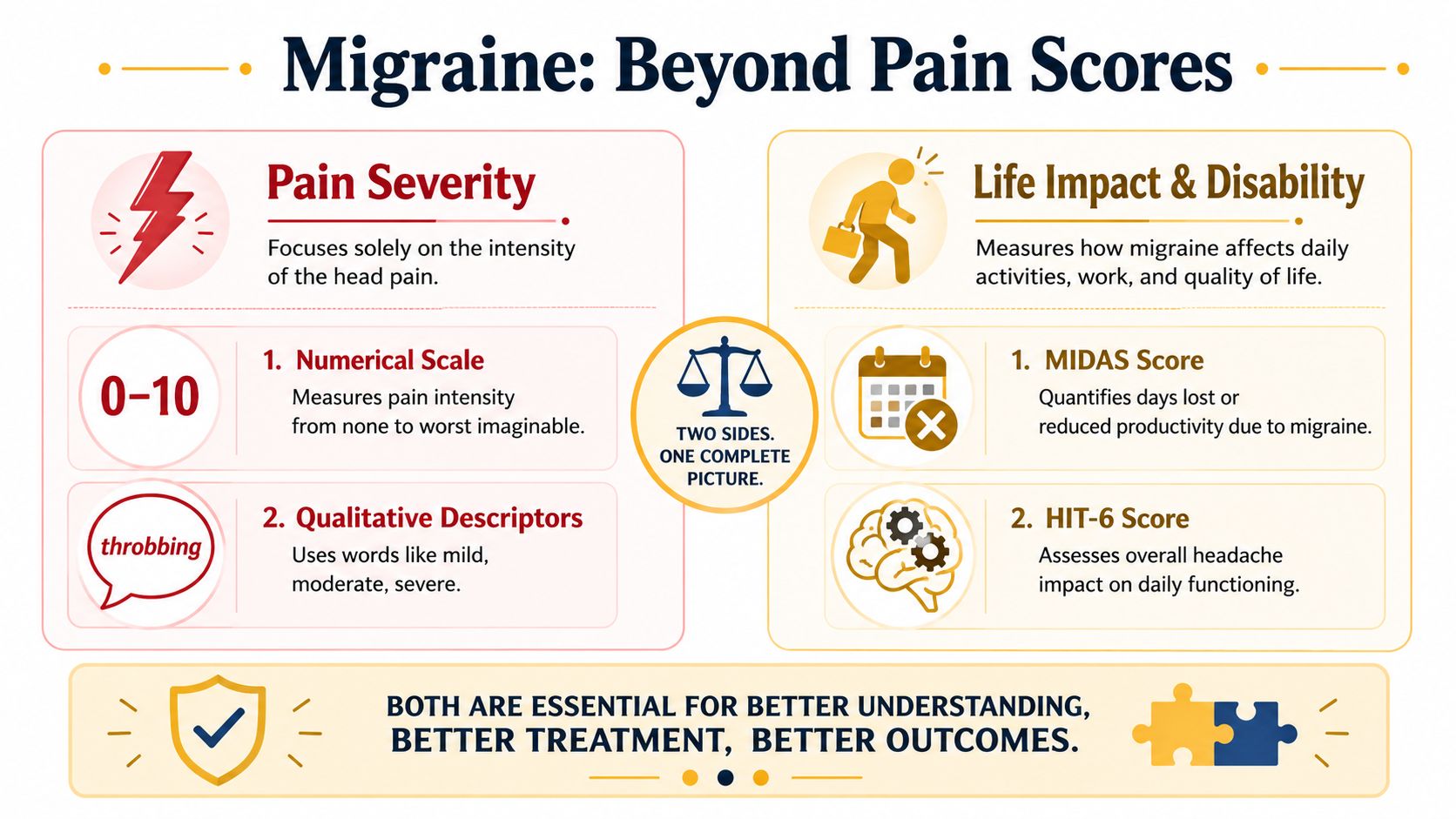
The best-known example is MIDAS, short for Migraine Disability Assessment. It has become one of the most widely used disability tools in migraine research and practice. According to the Scripps MIDAS overview, MIDAS uses 5 questions about the prior 3 months and produces a score from 0 to 270 based on missed work or school, reduced productivity, household activity loss, and missed social or leisure time. The same overview maps scores into four grades: 0 to 5 little or no disability, 6 to 10 mild, 11 to 20 moderate, and 21+ severe.
What MIDAS measures
MIDAS is less about your worst moment and more about the life effects that pile up around migraine. It asks how many days migraine caused you to miss things or function below your usual level.
That makes it especially helpful for people who tend to push through attacks. You may still go to work, answer messages, or care for your family while functioning at a fraction of your normal capacity. MIDAS gives that hidden burden a place on the record.
A large U.S. review summarized in 2018 found that migraine prevalence stayed fairly stable at 11.7% to 14.7%, while the share of people with migraine who had moderate-to-severe MIDAS disability rose from 22% in 2005 to 42.4% in 2018. The same review reported chronic migraine prevalence of 0.9% in adults, with higher prevalence in women (1.3%) than men (0.5%). That tells us something important. Even when the number of people with migraine looks stable, the level of disability can worsen.
When migraine tracking includes disability, it becomes easier to show why “I still went to work” doesn't always mean “I was okay.”
If recovery time is a big part of your burden, it can help to notice what happens after the pain phase ends. Many people find patterns by tracking their migraine recovery time alongside severity.
MIDAS compared with HIT-6
You may also hear about HIT-6, the Headache Impact Test. It's another tool clinicians often use to understand how headache affects daily life. Unlike MIDAS, which focuses heavily on days lost or reduced productivity, HIT-6 is commonly used to capture broader impact such as pain burden, fatigue, and emotional strain.
You don't need to memorize either tool. What helps is knowing they answer slightly different questions.
FeatureMIDAS (Migraine Disability Assessment)HIT-6 (Headache Impact Test)Main focusFunctional disability and lost productivityOverall headache impact on daily lifeBest forShowing missed days and reduced activity over timeCapturing broad day-to-day burdenTime styleLooks back over a longer periodOften used as a brief impact snapshotStrengthMakes invisible disruption more concreteGives a wider view of how headaches affect functioningLimitationLess focused on symptom experience beyond disabilityLess specific to lost work or household time
If you want a practical way to think about it, use pain scales during attacks and impact scales to understand the bigger pattern. Together, they tell a more honest story than either one alone.
How to Create a Consistent Tracking Habit
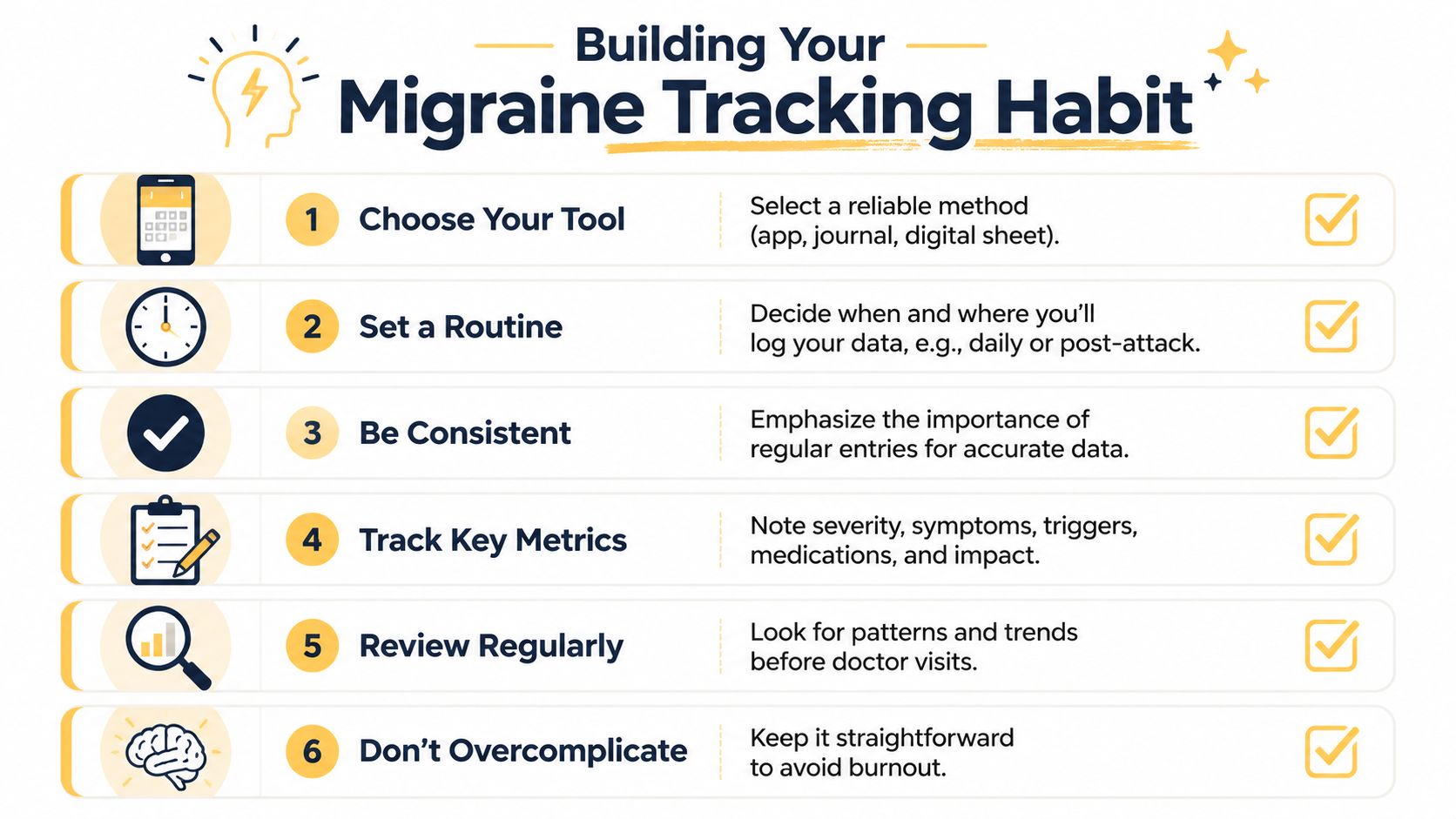
The best migraine severity scale is the one you'll use. A paper journal can work. Notes on your phone can work. An app can work. The method matters less than whether you can keep up with it on ordinary days and rough ones.
What to log during or after an attack
You do not need a complicated spreadsheet. Start with a short list that captures both intensity and impact.
- Severity score: Use one method every time. A 0 to 10 pain score is a reasonable starting point.
- Symptoms: Note features such as nausea, aura, photophobia, phonophobia, dizziness, neck pain, or brain fog.
- Timing: Write down when the attack started, when it eased, and whether the postdrome left you drained afterward.
- Function: Record what changed in real life. Did you miss work, cancel plans, lie down, or push through while working below your usual level?
- Possible triggers or context: Sleep changes, stress, weather shifts, skipped meals, hormonal changes, strong odors, travel, or screen exposure may be worth noting.
- What you used for relief: Include over-the-counter options, prescribed treatment categories, hydration, rest, ice, caffeine, or other strategies your clinician has discussed with you.
Keep your log short enough that you can finish it even when you're not feeling well.
How to keep the habit realistic
People usually stop tracking for one of two reasons. The system is too complicated, or they expect themselves to remember everything later.
Try this instead:
- Choose one main tool. Don't bounce between three notebooks and two apps.
- Log close to the event. During the attack is ideal. Afterward is still useful.
- Use defaults when brain fog is heavy. If needed, just record severity, start time, and one line about impact.
- Set a reminder. A gentle daily prompt often works better than relying on memory.
- Review once a week. You're looking for patterns, not writing a memoir.
A simple template can help:
What to noteExampleSeverity7 out of 10SymptomsNausea, light sensitivity, foggy thinkingTimingStarted morning, eased by eveningImpactLeft work early, skipped dinner plansContextPoor sleep, long screen dayRelief usedRest, hydration, acute treatment discussed with clinician
That's enough to make your data meaningful.
Talking to Your Doctor About Your Severity Scores
Many patients bring lots of migraine data to an appointment, then freeze when it's time to explain it. You don't need a perfect presentation. You need a short summary that shows what your severity scale has been telling you.

How to summarize your data clearly
Try leading with patterns instead of raw entries.
For example, you might say:
- “My attacks are not happening more often, but they're affecting my function more.”
- “The pain score is sometimes moderate, but the nausea and light sensitivity make me stop working.”
- “I'm recovering more slowly even when the pain improves.”
- “I tracked for several weeks, and the bad attacks seem to cluster after poor sleep.”
That kind of summary helps your clinician think clinically. It also keeps the visit from getting lost in details.
A simple one-page view is often enough. Include:
- Your chosen migraine severity scale
- A few common symptoms
- How migraine affected work, home tasks, or social plans
- Anything that seems to improve or worsen the pattern
- Questions you want answered before you leave
Bring the pattern, not every single sentence you wrote during every single attack.
Some people find it easier to watch how clinicians think about migraine patterns before their visit. This overview may help frame that conversation:
Red flags that need urgent care
Most migraine attacks, even miserable ones, are not emergencies. Some symptoms are different and need immediate medical attention.
Seek urgent medical care if you have:
- A sudden severe headache that reaches maximum intensity quickly
- Headache with fever or a stiff neck
- New neurological changes, such as weakness, confusion, trouble speaking, or vision loss that feels different from your usual aura
- Headache after a head injury
This article is for informational purposes and is not medical advice. Consult a healthcare provider for personalized guidance.
Questions you can bring to your visit
You don't need to know the “right” medical wording. Clear questions are enough.
- “Does my log suggest I need a better way to measure disability, not just pain?”
- “Which symptoms should I track more closely between visits?”
- “What would count as meaningful improvement for me?”
- “How should I separate migraine pain from postdrome symptoms in my log?”
- “Do my records suggest a pattern worth addressing with lifestyle changes, acute treatment review, or preventive treatment discussion?”
Those questions help turn your tracking into a shared plan.
Smarter Tracking with Migraine Management Apps
Manual tracking works, but it has limits. During a migraine, even a few taps can feel like a lot. Later, memory fills in gaps badly.
What an app can do better than memory alone
A migraine tracking app can make the process more doable by keeping the same fields ready every time. That matters because consistency is where severity scales become useful.
Some apps also organize your entries into trends you can review before an appointment. That can include symptom patterns, attack timing, changing severity, and possible environmental context.
If you want a digital option, migraine tracking apps can help you log severity, symptoms, triggers, and medications in one place. Relief is one example on iOS that combines personal check-ins with local weather, air quality, and pollen data to help users spot patterns and review migraine risk over time.
The goal isn't to hand off your care to an app. It's to reduce the friction of tracking so you can notice what your own body keeps showing you.
If you want a simpler way to log attacks and spot patterns over time, Relief can support your tracking without replacing medical care.


