You're not imagining it if your headaches changed after starting the pill. A headache birth control pill pattern can show up as new pain on placebo days, a different migraine rhythm, or a flare after switching formulations, and the reason isn't the same for everyone. For some people, steady hormones help. For others, the hormone drop during the pill-free window becomes the trigger.
This article is for informational purposes and is not medical advice. Consult a healthcare provider for personalized guidance.
Table of Contents
- Is the progestin-only mini pill safer for migraine?
- If I stop the pill, will my migraines go away?
- Does continuous or extended-cycle dosing reduce attacks?
- Are non-hormonal IUDs a good option if headaches worsened on combined pills?
Why Your Headaches Changed After Starting the Pill
You may have expected birth control to make things steadier, then noticed the opposite. Maybe your headaches started showing up on the last few inactive pills, or your migraine seemed worse after a switch from one combined pill to another. That confusion makes sense, because combined oral contraceptives can change migraine patterns in either direction, not just one.
The strongest reason is hormone movement. Combined pills supply estrogen for most of the cycle, then estrogen drops during the placebo week, and that drop can act like a mini-withdrawal in a sensitive brain. In people prone to migraine, that shift can set off attacks, especially if the headaches line up with the hormone-free days.
Why one person improves and another worsens
Migraine biology is individual. Some people feel better because steady hormones reduce the swings that used to happen around ovulation or menstruation. Others feel worse because the same hormonal change becomes a trigger, and the pill exposes a pattern they didn't notice before.
That's why online advice sounds contradictory. A pill that helps one person's menstrual migraine can aggravate another person's headache cycle. The key is not whether the pill is “good” or “bad” in general, it's whether your own symptoms consistently cluster around active pills, placebo days, or a new formulation.
Practical rule: If the pain shows up predictably during the hormone-free week, the placebo interval deserves as much attention as the pill itself.
A large review found headaches worsened in 18% to 50% of users with migraine, improved in 3% to 35%, and stayed unchanged in 39% to 65% (review on migraine and combined oral contraceptives). That spread is exactly why a one-size-fits-all answer doesn't work.
Migraine vs Headache and the Four Phases You May Notice
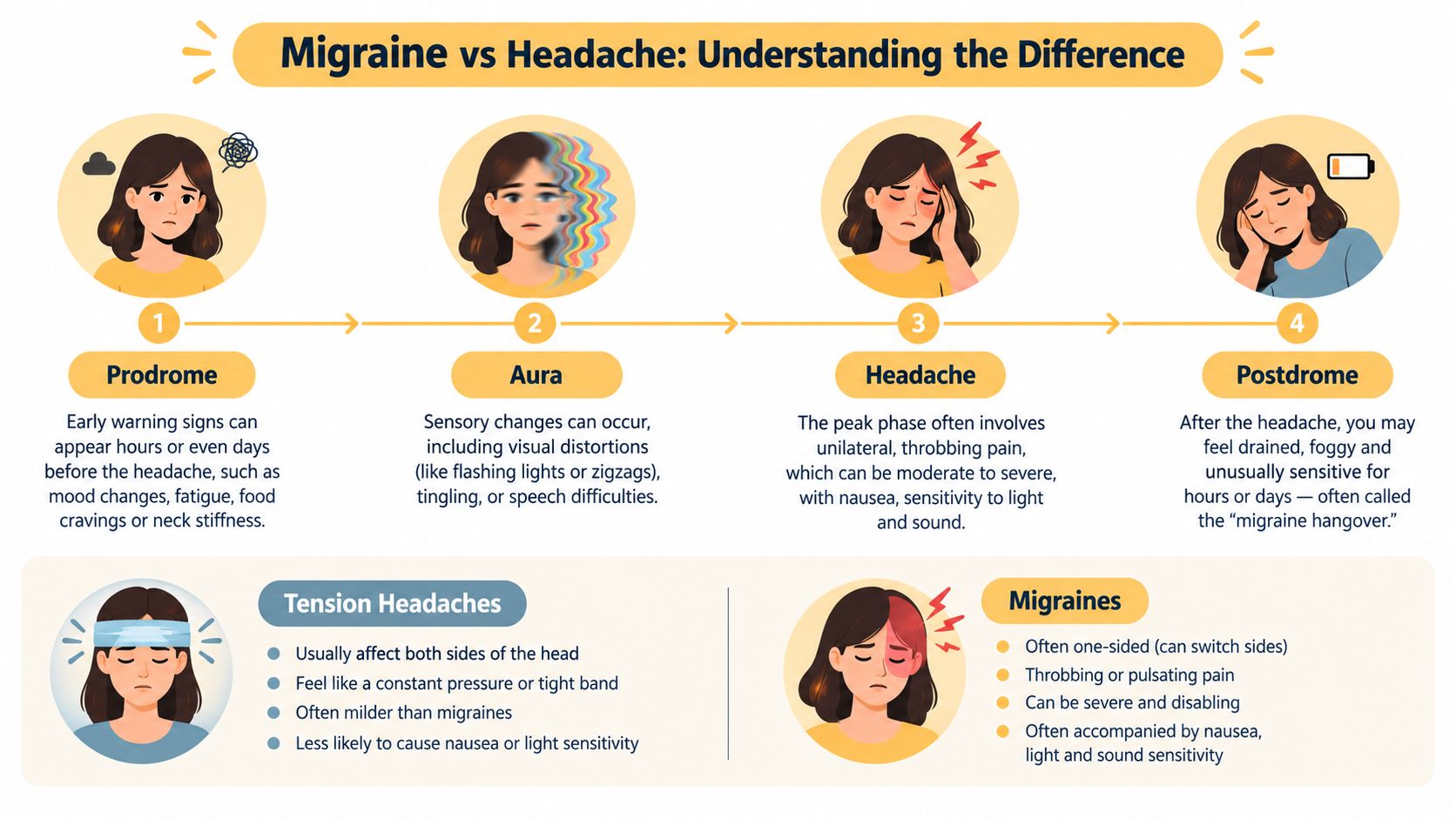
A headache is a symptom. Migraine is a neurological disorder that often includes headache, but also other symptoms that matter when you're deciding whether hormones may be involved. A dull, band-like ache on both sides is more typical of a tension-type headache, while migraine often brings throbbing pain, light sensitivity, and nausea.
The four phases in plain language
Prodrome comes first for many people, sometimes hours before pain. You might notice yawning, food cravings, mood shifts, stiffness, or a general “something's off” feeling.
Aura is a reversible neurological symptom, not just a bad headache. It can include zigzag vision, tingling, or speech trouble, and it usually passes within an hour. Aura matters because it changes the contraception conversation later.
Attack is the pain phase, often with photophobia, which means light sensitivity, phonophobia, which means sound sensitivity, nausea, or vomiting. The pain may pulse, and it can last long enough to disrupt work, sleep, or family plans.
Postdrome is the migraine hangover. The head pain eases, but fatigue, fogginess, and a low mood can linger.
Migraine can look different from person to person. If you've only ever called everything a headache, start separating “pain only” from “pain plus light sensitivity, nausea, aura, or fog.”
That vocabulary helps you notice whether the pill is changing headache type, not just headache frequency.
How Different Birth Control Options Affect Migraine Patterns
Not every contraceptive method affects migraine the same way. The main difference is whether the method contains estrogen, because estrogen can stabilize symptoms for some people and worsen them for others. The under-discussed variable is the placebo-week hormone withdrawal, which can trigger attacks even when the active pills were going fine.
For many people, the biggest clue is timing. If headaches cluster on the inactive pills, the problem may be the hormone drop rather than the whole method. Continuous or extended-cycle use sometimes helps because it shortens or removes that withdrawal window.
Comparing common options
| Contraceptive option | Estrogen exposure | Migraine pattern impact | Practical note |
|---|---|---|---|
| Combined oral pill | Yes | Can improve or worsen attacks | Placebo-week withdrawal can be a trigger |
| Progestin-only pill | No estrogen | May be neutral, better, or worse | Avoids estrogen exposure |
| Hormonal IUD | No systemic estrogen | Often unchanged for many users | Local hormone delivery, not an estrogen method |
| Copper IUD | None | No hormonal trigger from contraception | Good fit when you want to avoid hormones |
| Barrier methods | None | No hormonal trigger from contraception | Useful if you want to avoid hormone shifts entirely |
The biggest mistake is assuming every “birth control headache” means you need to stop all contraception. Sometimes the fix is to talk about the hormone-free interval, not to abandon the method altogether.
If you want a deeper look at cycle-linked patterns, see hormonal migraine prevention strategies.
Migraine With Aura and the Real Stroke Risk to Understand
Migraine with aura changes the risk discussion in a serious way. Aura itself is a vascular warning sign, and estrogen-containing contraception appears to add to that baseline risk. A review for women with headache notes that combined oral contraceptives independently contribute to ischemic stroke risk, with one meta-analysis reporting 2.75 times greater odds of stroke in women using any oral contraceptive pill (review of headache and oral contraceptives).
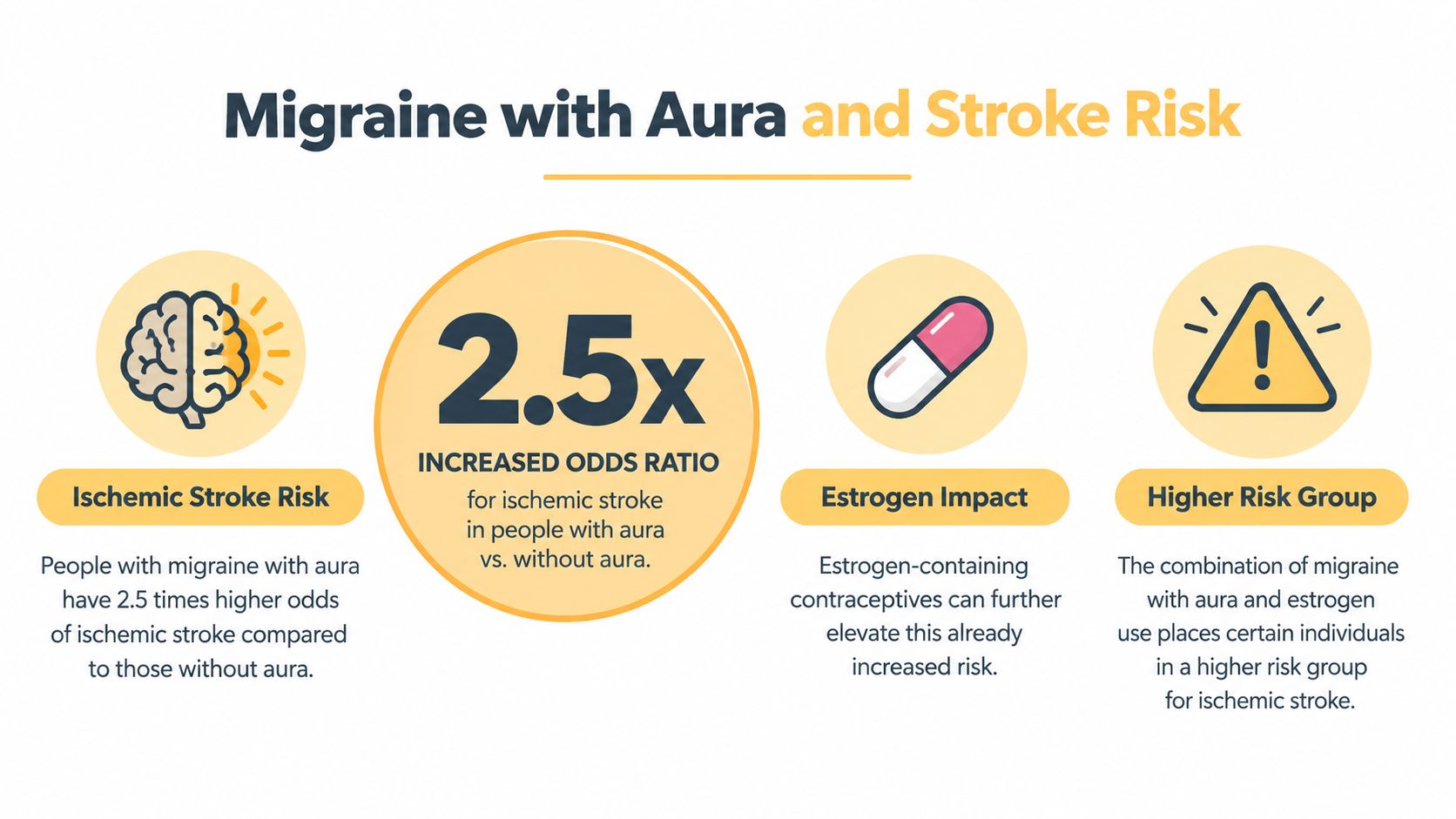
The practical point isn't panic. It's that migraine with aura plus estrogen is a combination most major guidance treats cautiously, especially when other vascular risks are present. Smoking, hypertension, age, diabetes, and a clotting history all make the conversation more urgent.
What makes the risk stack up
Aura matters because it doesn't just signal a headache type, it marks a different risk profile. In people with aura, expert reviews report odds ratios for ischemic stroke in the roughly 5 to 17 range when combined oral contraceptives are involved, while progestin-only contraception has not shown the same stroke signal (American Migraine Foundation).
If aura starts, worsens, or looks different after starting estrogen-containing contraception, that's not something to ignore.
If you need a visual guide to aura symptoms, the article about aura in vision and causes is a useful companion. The main takeaway here is simple. Migraine with aura and estrogen-containing birth control usually should not be treated as a casual match.
Warning Signs That Mean a Reassessment Is Overdue
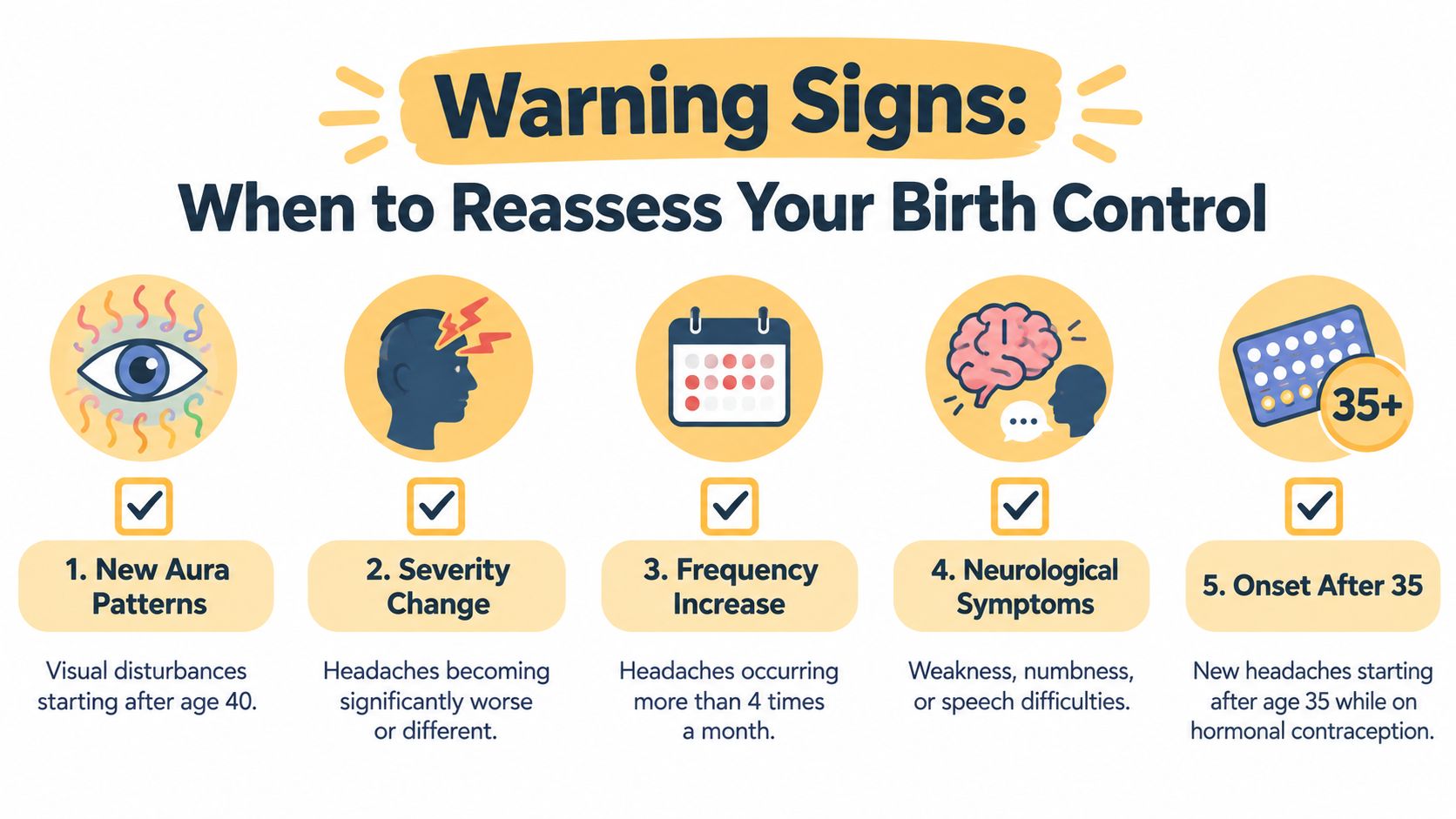
Some changes should prompt a timely check-in with the clinician who prescribed your contraception. New aura, a big jump in headache frequency after starting or switching pills, or headaches that become clearly different from your usual pattern all deserve a review. Persistent headaches that no longer respond the way they used to also deserve attention.
When to call sooner
- New visual, sensory, or speech symptoms, especially if they started after changing contraception.
- A sudden rise in frequency or intensity, not just an occasional bad week.
- Headaches that start later in life without a prior migraine pattern.
- Prolonged aura or focal neurological symptoms, meaning symptoms like numbness, weakness, or speech trouble that don't fit your usual pattern.
- The worst headache of your life, because that phrase is a red flag.
These are reassessment triggers, not self-diagnosis rules. If you ever have a sudden severe headache, headache with fever and stiff neck, neurological changes, headache after head injury, sudden weakness, confusion, or new vision loss, seek immediate medical care.
The useful framing is, “My headaches changed after contraception started or changed,” not “I think something is terribly wrong.” That wording helps a clinician triage faster.
Safer Contraceptive Alternatives Worth Discussing
There isn't one perfect option for everyone, so this works best as a decision menu. Your migraine history, whether you have aura, future pregnancy plans, and how you feel about bleeding changes all matter. The goal is to lower headache friction without creating a different problem.
Side-by-side comparison
| Method | Estrogen | Suitable with aura | Effect on menstrual migraines |
|---|---|---|---|
| Progestin-only pill | No | Often preferred | May help some, may be neutral for others |
| Etonogestrel implant | No | Often preferred | Pattern varies by person |
| Levonorgestrel hormonal IUD | No systemic estrogen | Often preferred | Many people see little change, some improve |
| Copper IUD | None | Yes | No hormonal effect on migraine |
| Barrier methods | None | Yes | No hormonal effect on migraine |
| Fertility awareness | None | Yes | No hormonal effect on migraine |
| Extended or continuous combined dosing | Yes | Usually not for aura | May reduce placebo-week attacks for selected patients |
Progestin-only and non-hormonal methods remove the combined estrogen stroke concern. That doesn't mean they'll fix migraine by themselves, but they do simplify the risk side of the equation. The copper IUD is especially useful if you want contraception with no hormonal input at all.
Extended or continuous combined dosing is a different conversation. For some people without aura, reducing or skipping the hormone-free interval can reduce withdrawal headaches. That trade-off has to be weighed against your overall risk profile and the reason you were considering contraception in the first place.
What to Track and What to Ask at Your Next Appointment
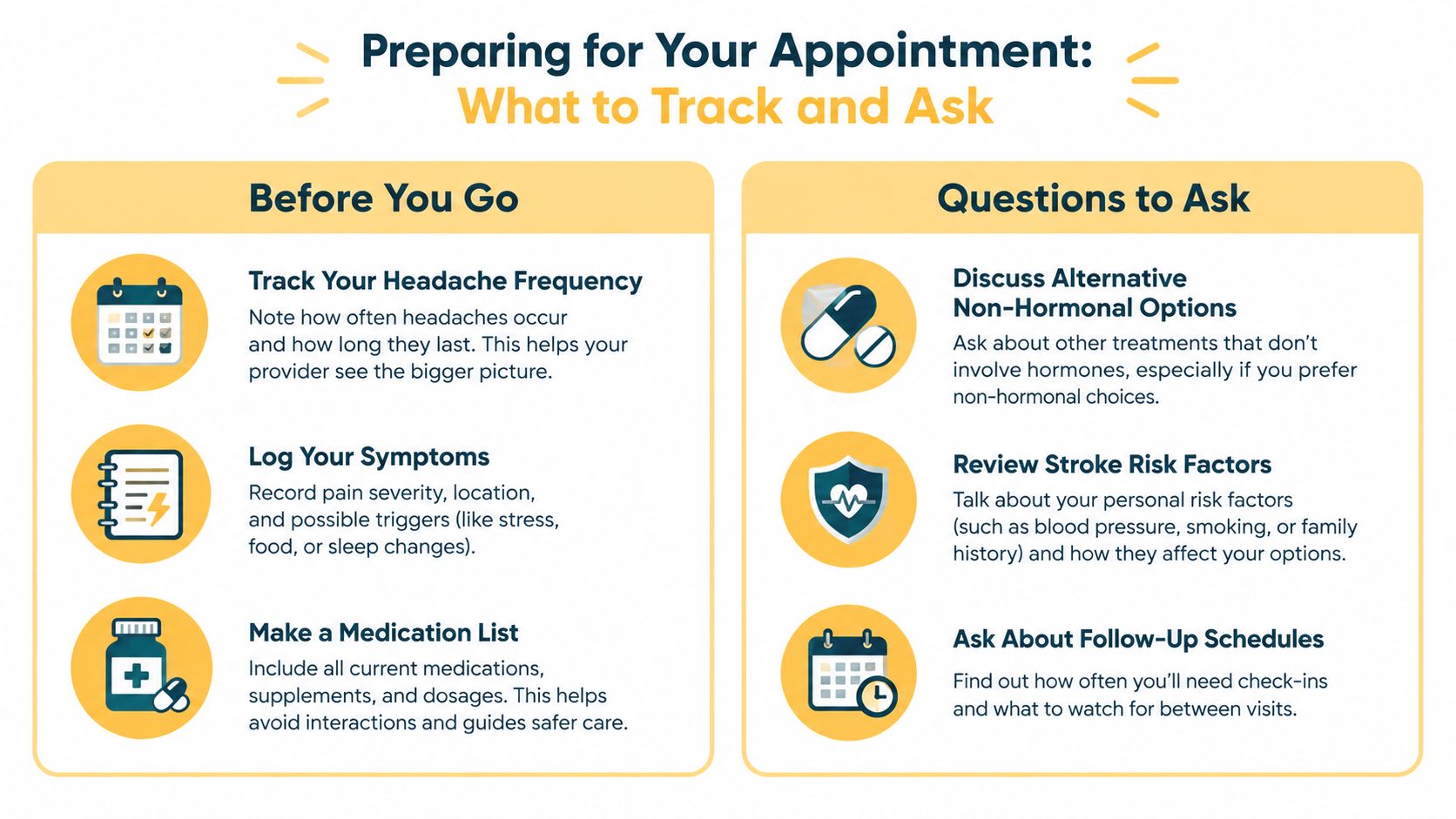
A good visit starts before you sit in the exam room. For two months, keep a simple headache diary with cycle day, pill pack position, headache intensity, aura presence, and any acute medication used. That gives your clinician a pattern instead of a vague memory.
What to say at the appointment
- “My headaches changed after I started or switched contraception.”
- “Do you think this is migraine, headache, or migraine with aura?”
- “Does my current formulation fit my risk profile?”
- “Would continuous dosing make sense for the pattern I'm seeing?”
- “Should I consider a progestin-only or non-hormonal option instead?”
- “When would a neurology referral be appropriate?”
That direct phrasing helps more than saying you “just feel off.” Providers can act faster when they hear a change tied to a medication timeline.
If you're tracking by hand now, keep it simple. If you prefer a structured log, the headache diary app guide shows how symptom tracking can make patterns easier to spot.
Quick Answers to the Questions Readers Ask Next
Is the progestin-only mini pill safer for migraine?
Usually, yes, because it avoids estrogen. That lowers the combined-hormone stroke concern, which matters most if you have aura or other vascular risk factors. Whether it improves attacks is less predictable, because some people do better and others notice no change. Bring your full migraine history to the discussion.
If I stop the pill, will my migraines go away?
Sometimes they improve, but it depends on what was causing the pattern. If the pill was creating a placebo-week withdrawal trigger, stopping or changing it may help. If you already had menstrual migraine, the underlying cycle-related pattern can still remain. A clinician can help separate those possibilities.
Does continuous or extended-cycle dosing reduce attacks?
It can, especially when the hormone-free interval is the main trigger. Fewer withdrawal days means fewer chances for that estrogen drop to spark a migraine. The trade-off is that some people get breakthrough bleeding, which can be frustrating even if the headaches improve. Ask whether your history makes this approach reasonable.
Are non-hormonal IUDs a good option if headaches worsened on combined pills?
They often are, because they remove hormonal exposure from the equation. The copper IUD has no estrogen and no progestin, so it won't create a hormone-withdrawal pattern. The main downside is that it can increase cramping or bleeding for some people. A clinician can help you balance that against migraine concerns.
If your headaches have been shifting with contraception, Relief can help you log the timing, spot patterns, and bring a clearer story to your next visit. Use Relief to track symptoms and triggers so you're not relying on memory when it matters most.


