
You're at your desk when the edge of your vision begins to shimmer. A crescent of zigzag lines grows slowly, perhaps leaving a dim or blank patch behind it. The most common explanation for aura in vision causes is migraine aura, a temporary neurological event produced by activity spreading through the brain's visual cortex, not a problem in the eye itself. But similar symptoms can also come from retinal, vascular, seizure-related, medication-related, or persistent visual conditions, so the pattern and timing matter.
Migraine aura affects roughly one quarter to one third of people with migraine, and visual symptoms account for more than 90% of aura cases, according to clinical reviews of migraine with aura (Practical Neurology's clinical review). This guide helps you recognize typical visual aura, understand why it happens, separate it from look-alike conditions, identify emergency warning signs, and track patterns you can discuss with a healthcare professional.
This article is for informational purposes and is not medical advice. Consult a healthcare provider for personalized guidance.
Table of Contents
What Visual Aura Feels Like and Why It Happens
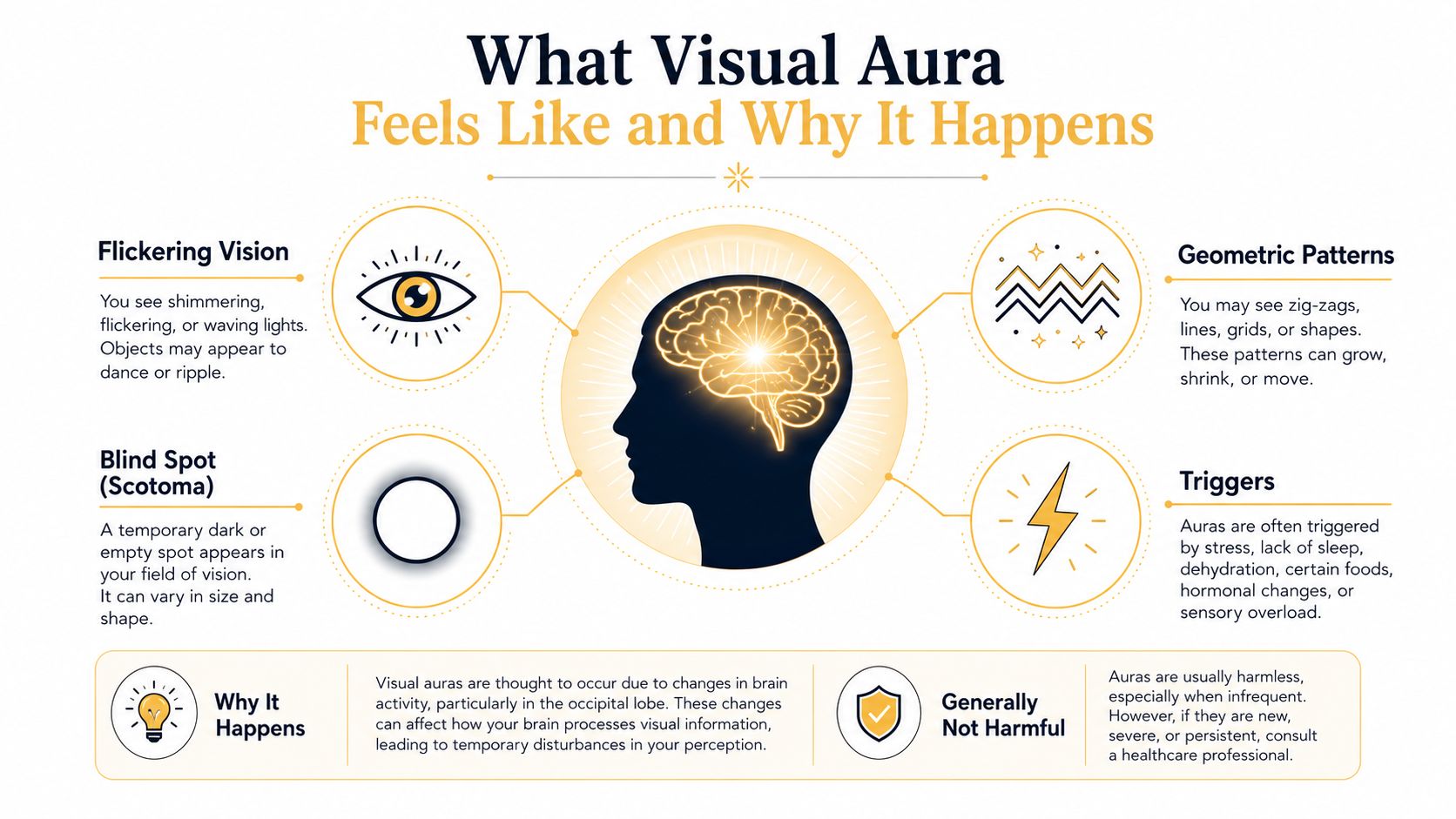
A shimmering edge may appear while you are reading, working, or looking across a room. Zigzag lines, flickering lights, colored dots, geometric shapes, or a growing blind spot can then spread or change across your field of vision. The episode often develops gradually, lasts 5 to 60 minutes, and fades, a pattern described in the clinical review of migraine with and without aura.
This experience is called visual aura, a temporary and reversible neurological symptom. Aura can affect vision, sensation, speech, or language. Head pain may follow, but it is not required. Some people have aura during a migraine attack, before the headache phase, or without head pain, a pattern often called a “silent migraine,” as explained in the Mayo Clinic's explanation of migraine aura.
Why the symptoms seem to move
The changing symptoms reflect a process in the brain, so an episode may expand, migrate, or transform. A small flicker might become a jagged arc, followed by a wider area of blurred or missing vision. This progression differs from a single fixed defect, although timing alone cannot confirm the cause.
Visual aura is a recognized migraine pattern rather than an unusual extra symptom. A review found visual aura among people with migraine and probable migraine, while a tertiary-care cohort reported aura in 38% of 952 migraine patients and visual disturbances in 92.1% of those auras (the review indexed by PubMed).
Practical rule: A new episode, a sharply changed pattern, or symptoms confined to one eye should prompt medical evaluation. Seek urgent help if red flags such as sudden persistent vision loss, weakness, confusion, or trouble speaking appear.
The Brain Mechanism Behind Migraine Aura
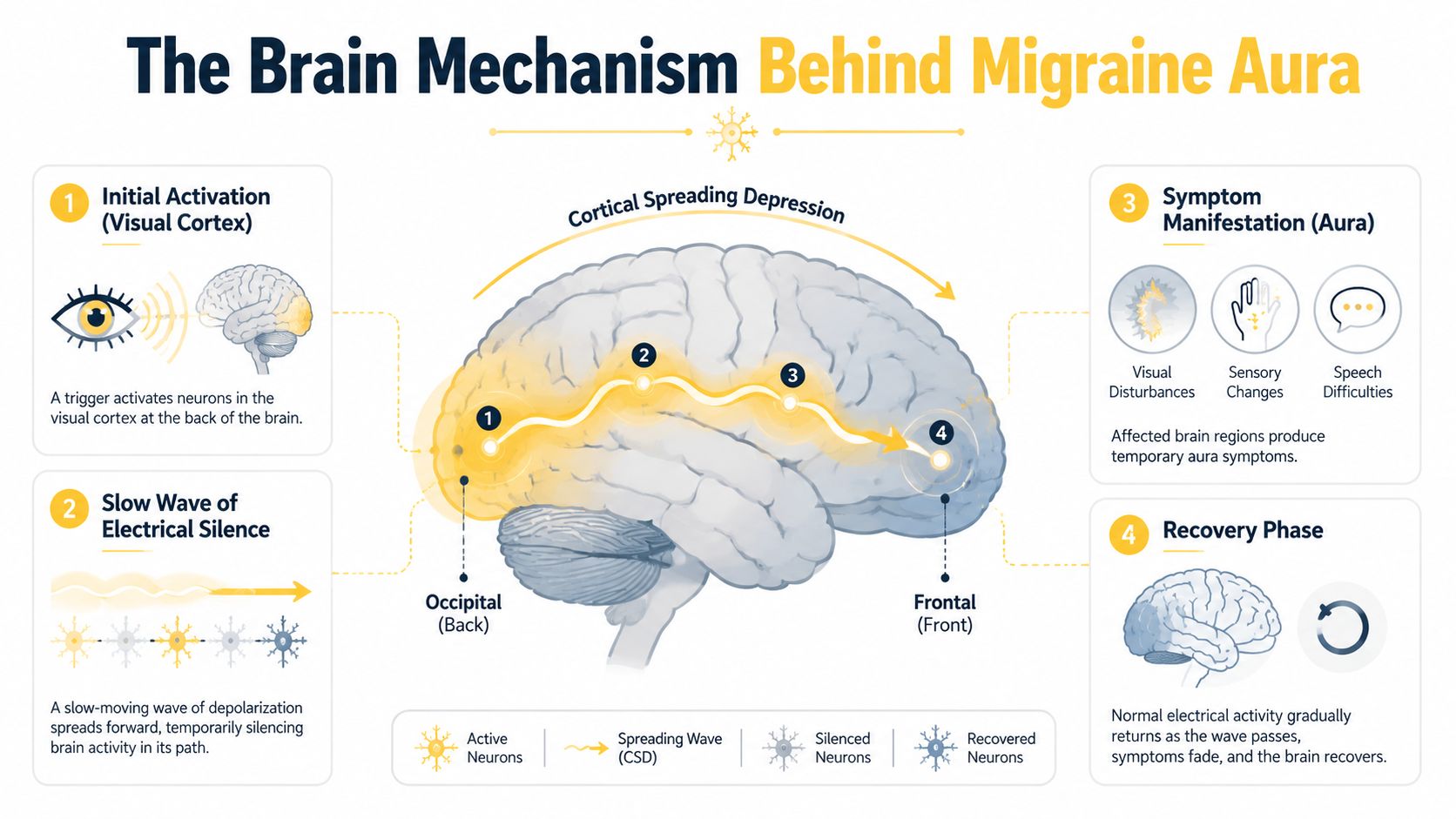
Visual migraine aura is most closely linked to cortical spreading depression, usually called CSD. It is a slowly traveling wave of changed electrical activity across the brain's cortex. Neurons first become highly active, then their activity is temporarily reduced as the wave passes.
CSD moves across the cortex much like a wave traveling through neural tissue, rather than appearing all at once in one spot. The effect begins in the brain, not in the eye itself. If the wave reaches the occipital cortex, the area near the back of the brain that processes vision, it can produce flashing lights, zigzag patterns, shimmering shapes, or an expanding blind spot.
How CSD creates visual symptoms
The visual cortex contains an organized map of the visual field. As CSD moves through that map, the symptoms can shift, widen, or change form instead of staying as one permanent defect. Neuroimaging reviews connect aura mainly with the occipital visual cortex and, in some cases, both primary and extrastriate visual areas. This helps explain scintillating scotoma, fortification spectra, zigzag lines, and expanding blind spots (the neuroimaging review on visual aura).
Blood-flow changes also fit a temporary neurovascular process. During acute aura, imaging may show reduced blood flow followed by increased flow, together with reversible cortical changes and venous engorgement. Reviews describe a pattern that differs from ischemia limited to one vascular territory, which makes a straightforward blockage less likely as the explanation for a typical spreading aura (the review of perfusion changes in migraine aura).
CSD explains a recognized migraine mechanism, but it does not account for every aura-like visual experience. Similar symptoms can arise from other conditions, including transient ischemic attack, seizure, retinal problems, medication effects, or visual snow. Clinical classification therefore also considers the likely cause, symptom timing, whether one or both eyes are involved, and how the episode develops (the clinical discussion of aura classification).
For a visual explanation of the process, this video illustrates the brain activity associated with migraine aura:
Common and Less Obvious Visual Aura Symptoms
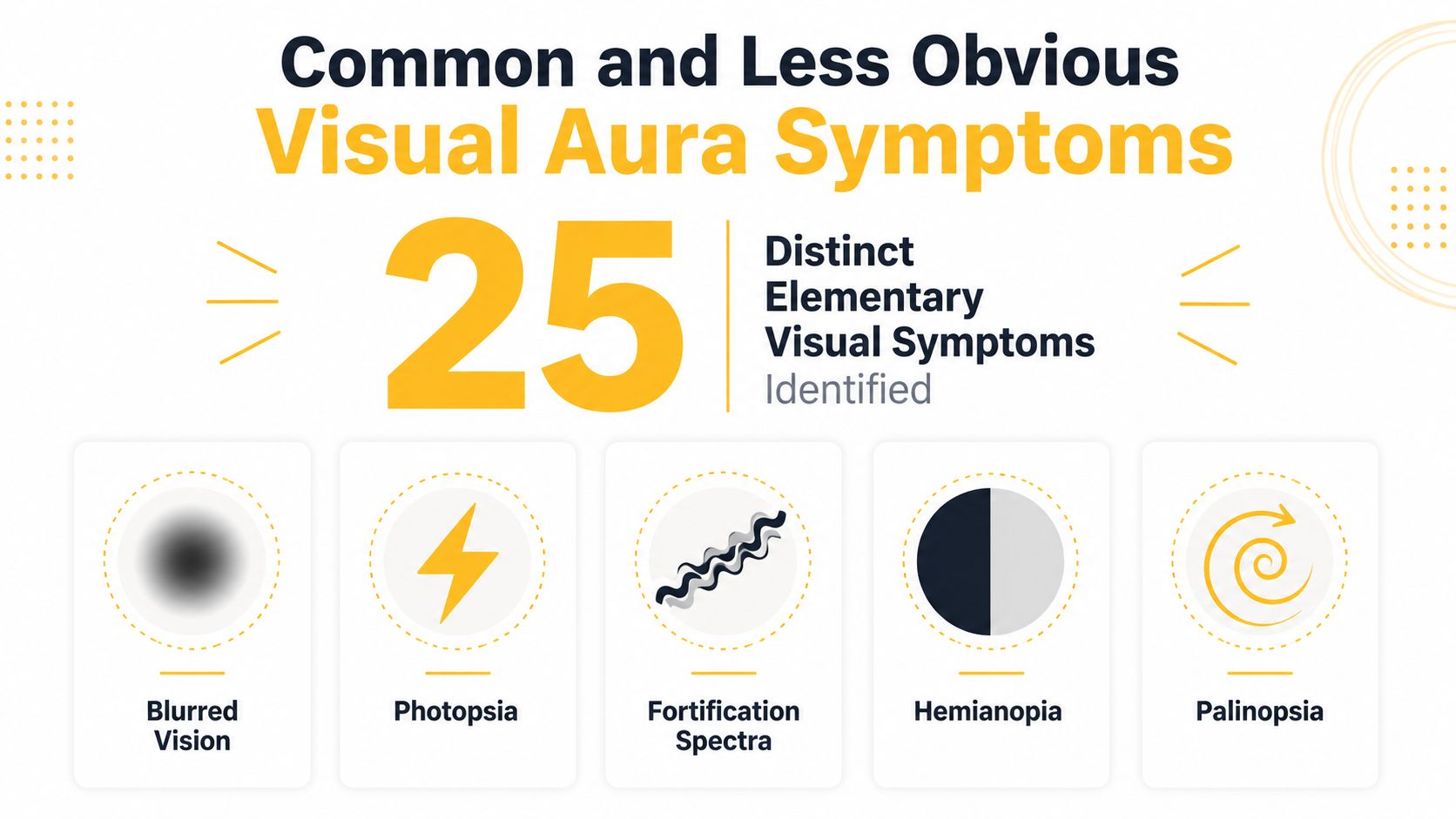
The classic description is a bright zigzag line. Real visual aura can be much more varied. A 2025 systematic review identified 25 elementary visual symptoms, including blurred vision, multiple scotomas, colored dots, geometric shapes, and other visual experiences (the 2025 systematic review of visual aura symptoms).
Symptoms may begin near the center of your vision and gradually expand outward. You might notice a bright border around a darker area, a field that seems divided, or a shimmering pattern that changes shape as the episode progresses. The gradual evolution fits the spreading-wave model described above.
Patterns people commonly describe
- Scintillating scotoma: A scotoma is a blind or dim area in the visual field. “Scintillating” means it may have shimmering, sparkling, or flickering edges.
- Fortification spectra: These are angular, castle-like or zigzag patterns that may widen as the aura develops.
- Photopsia: This term describes flashes or spots of light that aren't caused by an external light source.
- Blurred or fragmented vision: Objects may look hazy, broken up, or difficult to focus on.
- Geometric or colored forms: Dots, circles, spirals, and colored shapes can occur, even if you've never experienced the stereotypical zigzag.
- Hemianopic symptoms: You may lose or distort vision in one side of the visual field. Because each eye receives overlapping information, a brain-based field disturbance can feel as though it affects both eyes.
Palinopsia means seeing an image persist or recur after the original object is gone. It can occur for different reasons, so persistent afterimages shouldn't automatically be labeled migraine aura.
A useful distinction is temporary and evolving versus sudden and fixed. A first episode, a persistent distortion, or apparent loss limited to one eye deserves assessment rather than reassurance based only on resemblance to migraine.
Other Possible Causes of Aura-Like Visual Symptoms
Not every visual disturbance is migraine aura. The same broad complaint, such as flashes or missing vision, can arise from different parts of the visual system. Timing, progression, whether the symptom affects one eye or a visual field, and accompanying neurological signs help clinicians decide what needs investigation.
A transient ischemic attack, or TIA, and stroke can cause sudden visual changes or other neurological deficits. An occipital-lobe seizure may produce brief, rapidly developing flashes or formed visual phenomena. Retinal problems can cause flashes, floaters, shadows, or loss in one eye. Medication or toxin effects may alter visual perception, while visual snow syndrome produces persistent visual static rather than a short, fully reversible episode.
The table below is a triage aid, not a diagnostic tool.
Migraine aura vs other causes at a glance
| Cause | Onset Pattern | Typical Duration | Eye vs Field | Other Clues |
|---|---|---|---|---|
| Migraine aura | Usually gradual and evolving | Usually 5 to 60 minutes (clinical review) | Often affects a visual field processed by the brain, commonly perceived in both eyes | Shimmering, zigzags, scotoma, geometric patterns, possible headache or other aura symptoms |
| TIA or stroke | Often sudden | Variable | May affect a field or one eye, depending on the affected pathway | Weakness, speech difficulty, confusion, imbalance, or other new neurological changes require urgent assessment |
| Occipital-lobe seizure | Often sudden and rapid | Brief or variable | Usually a visual field processed by the occipital cortex | May include altered awareness, abnormal movements, or repeated stereotyped events |
| Retinal event | Sudden | Brief, recurring, or persistent | Usually one eye | Flashes, new floaters, a curtain-like shadow, or partial vision loss need urgent eye assessment |
| Medication or toxin effect | Variable | Variable | May affect overall vision or perception | New symptoms after starting, stopping, or changing an exposure should be reviewed with a clinician |
| Visual snow syndrome | Persistent or recurring background disturbance | Ongoing rather than a short episode | Often perceived across the whole visual field | Static-like dots, afterimages, or light sensitivity may occur; evaluation helps rule out other causes |
Retinal symptoms deserve particular care because an eye problem can threaten vision without causing pain. Sudden one-eye loss, a dark curtain or shadow, or a sudden increase in flashes or floaters should be treated as urgent.
A familiar migraine pattern can be reassuring, but it doesn't make an unfamiliar visual symptom safe to ignore.
Red Flags That Need Immediate Medical Attention
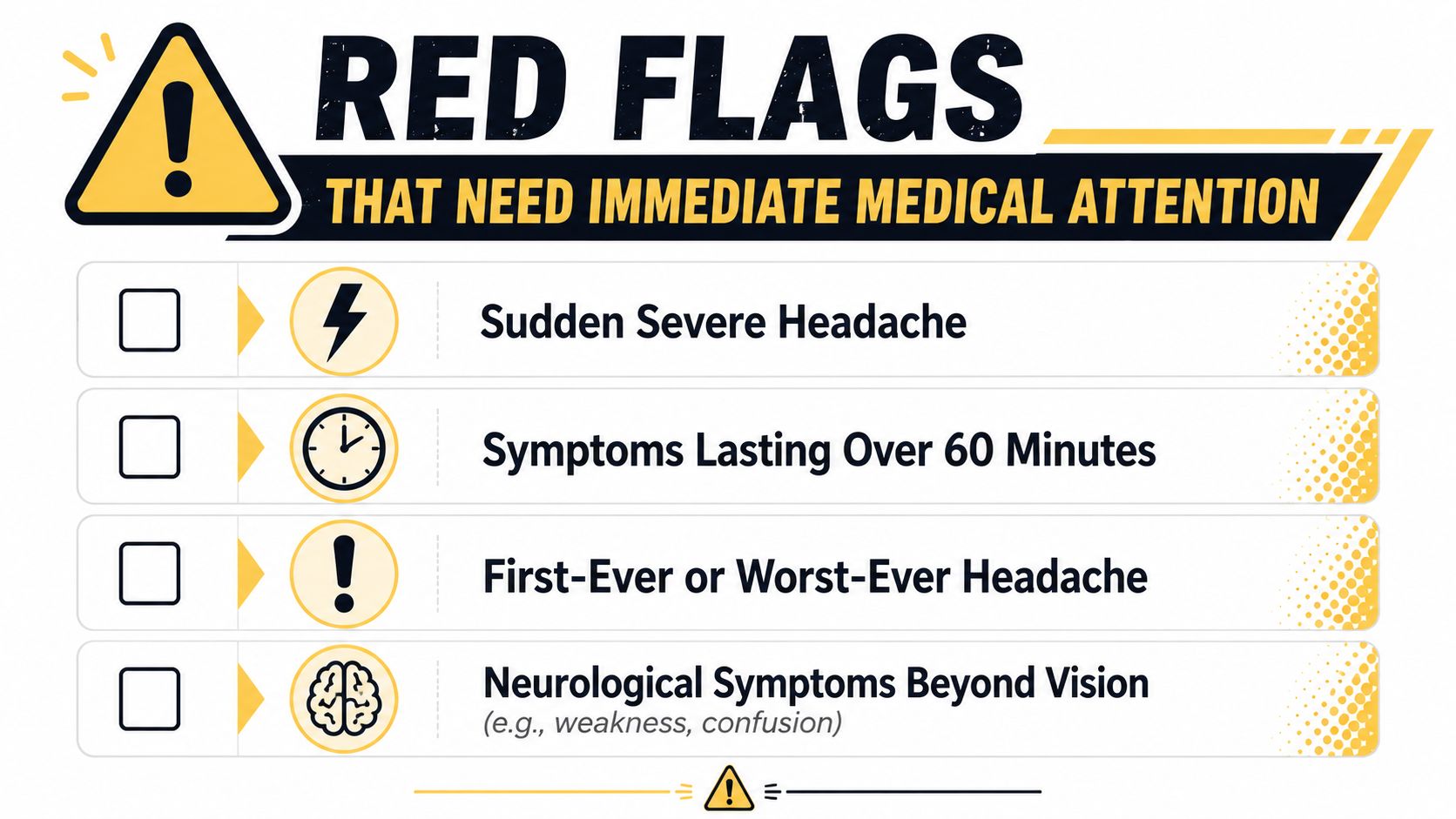
Seek immediate medical care rather than waiting for symptoms to pass if you notice any of the following:
- Sudden severe headache: A thunderclap-like headache, meaning a headache that reaches extreme intensity abruptly, needs emergency assessment.
- Fever or stiff neck: Headache with fever or neck stiffness can signal a serious infection or another urgent condition.
- New neurological changes: Weakness, numbness, confusion, trouble speaking, fainting, severe imbalance, or symptoms that don't follow your usual gradual aura pattern require urgent evaluation.
- Headache after head injury: A new headache or visual change after trauma should be assessed promptly.
- Sudden vision loss in one eye: This can indicate a retinal or vascular problem rather than typical brain-based aura.
- Symptoms lasting longer than 60 minutes: A first-ever prolonged episode, or a change from your established pattern, needs medical review. Typical aura is generally temporary and reversible, usually lasting up to 60 minutes (Mayo Clinic's migraine symptom overview).
Don't drive yourself if your vision or neurological function is impaired. If you're unsure whether the symptoms are an aura or an emergency, it's safer to seek urgent medical care.
This article is for informational purposes and is not medical advice. Consult a healthcare provider for personalized guidance.
How Doctors Diagnose Recurring Visual Aura
Doctors usually diagnose migraine aura clinically, which means they begin with your symptom history rather than relying on one definitive test. They'll want to know exactly what you saw, how quickly it appeared, whether it spread, how long it lasted, whether it affected one eye or a visual field, and what happened afterward.
A useful description includes the sequence, not just the label “blurred vision.” For example, you might record that a small shimmering area appeared, expanded into a jagged arc, affected the same side of your visual field each time, and resolved before or during a headache. That level of detail helps distinguish a stereotyped, gradual, reversible aura from a sudden fixed deficit.
What an appointment may include
- Symptom timeline: The clinician reviews onset, progression, duration, recurrence, headache association, and sensory or language symptoms.
- Neurological examination: This checks strength, sensation, coordination, speech, eye movements, and other neurological functions.
- Eye evaluation: An eye examination can help assess the retina and other structures when symptoms suggest an ocular cause.
- Imaging when indicated: MRI or CT may be used when the history or examination raises concern about stroke, a structural lesion, bleeding, or another vascular or neurological cause.
The term migraine with aura has a specific clinical meaning within international headache classification. Precise language helps your healthcare provider match your symptoms to the correct category instead of treating every visual complaint as an “ocular migraine,” a term people use inconsistently.
You can also learn about the organization behind this educational resource on the Relief migraine information page.
Practical Steps to Reduce and Track Aura Episodes
During an episode, stop tasks that depend on clear vision. Move to a dim, quiet room, reduce screen exposure, drink water if you can, and avoid driving until your vision has returned to normal. These steps won't necessarily stop aura, but they can reduce stimulation and help you stay safe while the episode runs its course.
Longer-term management usually combines regular routines with individualized tracking. There isn't one universal trigger list, and a factor that affects one person may be irrelevant to another. Some people identify associations with irregular sleep, skipped or delayed meals, stress changes, alcohol, bright light, weather shifts, humidity, air quality, or hormonal changes.
A simple tracking routine
- Log the beginning: Record when the first visual change appeared and when it fully resolved.
- Describe the pattern: Note flickering, zigzags, blind spots, colored forms, blurred vision, tunnel-like narrowing, or afterimages.
- Record the headache separately: Include whether head pain followed, appeared during the aura, or was absent.
- Add context: Note sleep timing, meals, stress, travel, screen exposure, alcohol, illness, and unusual environmental conditions.
- Record treatment response: If you use an over-the-counter or prescribed treatment, record what you took and whether it helped, without changing how you use medication unless a clinician advises you to.
- Review trends: Look for repeated associations rather than blaming one event after a single episode.
Tracking insight: A suspected trigger becomes more useful when you can compare it with repeated episodes and symptom-free periods.
A migraine diary, spreadsheet, or health app can work. Relief offers symptom and attack logging alongside environmental information such as weather and air quality, allowing you to review possible relationships between daily conditions and your episodes at Relief. Use any tracking tool as a way to prepare better questions for your healthcare provider, not as a diagnostic replacement.
Planning Your Day Around Migraine Risk
Aura can feel unpredictable, but your own history may reveal patterns that are invisible during a single episode. Combining symptom logs with sleep information, weather, air quality, and other relevant context can help you notice whether certain conditions repeatedly appear before attacks. The point isn't to eliminate every possible exposure. It's to identify practical signals you can respond to earlier.
A forecast can support decisions such as carrying your usual supplies, scheduling demanding visual work when you feel well, planning breaks, or protecting recovery time. It can't confirm that an episode will occur, and it can't explain a new or dangerous symptom.
Relief's iOS app combines lightweight migraine logging with an hour-by-hour risk forecast based on personal health information and local environmental data. It can help you review symptoms, suspected triggers, and medication responses while you work with a healthcare provider on appropriate care.
Understanding the brain mechanism behind aura gives you a clearer explanation. Tracking when symptoms start, how they evolve, and what surrounds them turns that explanation into information you can use.
Relief helps you log aura symptoms, attack timing, suspected triggers, and treatment responses so you can recognize patterns before they become overwhelming. Visit Relief to explore a practical way to plan around your migraine risk while keeping medical decisions with your healthcare provider.


