Science
How Relief forecasts migraine risk
Relief estimates your migraine risk for the day from the weather near you, your body and your own history. It’s an estimate, not a diagnosis, and it hasn’t been clinically validated.
What the number means
The score is an index of migraine risk from 0 to 100, not a percent chance: 74 doesn’t mean a 74% chance of an attack today. Each score falls in one of four bands, always written beside its color.
Low, 0–39
Moderate, 40–59
High, 60–79
Very high, 80–100
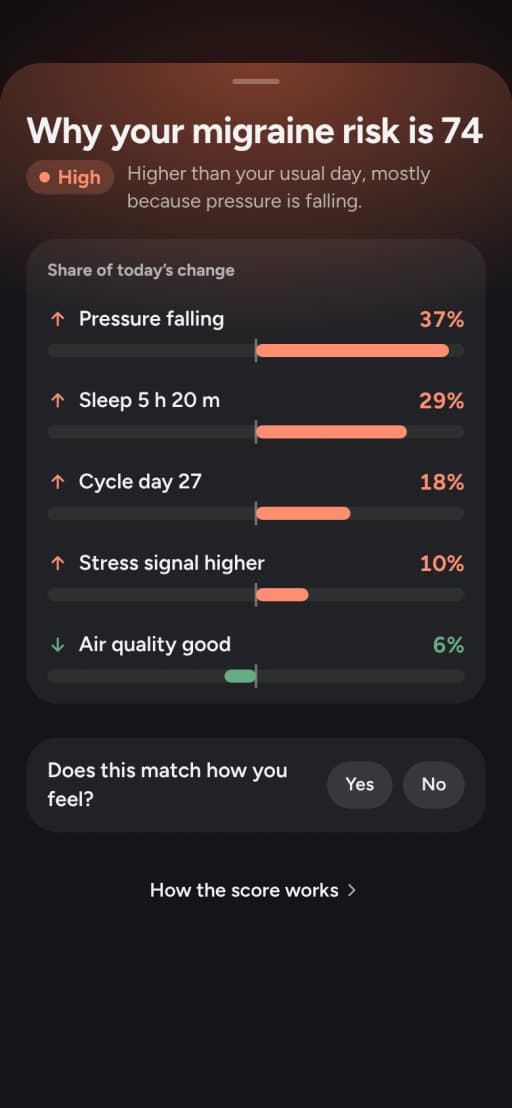
A score never stands alone: it comes with its band, one sentence on what drives it, and each factor’s share of today’s change.
On this page
What goes in
| Input | Where it comes from | How it’s used |
|---|---|---|
| Pressure and its changes, temperature swings, humidity, wind | Weather services, for where you are | Compared with your usual days and the days before your attacks |
| Air quality and pollen | Air-quality and pollen services, where local monitoring exists | The same; the forecast works without them |
| Sleep, cycle, heart rate, heart rate variability | Apple Health, with your permission, processed on your iPhone | Your sleep, your cycle day and a stress signal from your heart rate |
| Attacks, early signs, stress, diet and other factors | What you log in Relief | Lines up the days before your attacks with your other days |
Becoming yours
The forecast starts the same for everyone, then leans on your own patterns as your log grows.
- From day oneWeather and air quality
- After about 10 attacks or a monthPersonal adjustments start
- After about 30 attacksMostly your own patterns
What weighs most
Across people who use Relief, rapid pressure changes, large temperature swings, humidity extremes and poor air quality weigh most. Your own weights differ, and Why this score shows each factor’s share of today’s change.
How a factor gets linked to your attacks
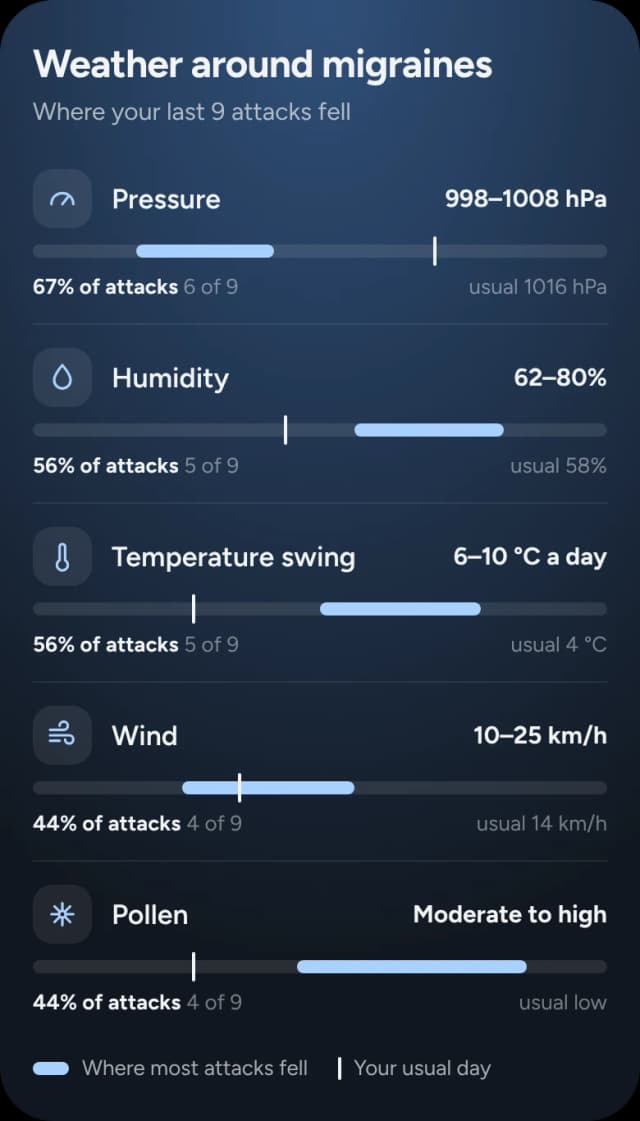
Relief compares how often a factor came before your attacks with how often it comes on your other days. It flags a factor only when the difference is large, repeats across attacks and passes a significance test, and it labels its confidence.
How often it updates
Every few hours with new weather, and at once when you log something or new Apple Health data arrives.
How accurate it is
It depends on the person and improves with history. False alarms and missed warnings both happen, and because the forecast leans toward warning, false alarms are likelier in the first weeks.
Relief can’t measure its accuracy across people: that would take your log, which stays on your devices. So there are no accuracy figures to publish.
Where it works
Weather data covers the world. Air quality depends on local monitoring and may be missing where you are; the forecast works without it. Weather, air-quality and pollen data come from Apple Weather, Google and OpenWeather.
What it can’t do
Relief doesn’t diagnose or treat anything, and its forecast is an estimate. Don’t change a medicine without your doctor.
In an emergency
For a sudden, severe or unusual headache, call your local emergency number.
Sources
The research behind the forecast, grouped by what it informs.
Early signs before an attack
- Giffin et al., Neurology, 2003
- Karsan and Goadsby, Nature Reviews Neurology, 2018
- Giffin et al., Neurology, 2016 On the stage after the headache