
You finally decide to wash your hair, then the water, brush, pillow, or even a light touch feels painful. Allodynia of the scalp can be a migraine symptom caused by an overreactive nervous system, not necessarily a problem with the scalp itself. The timing matters, though. Sensitivity that appears during a recognizable migraine and settles afterward can fit migraine-related allodynia, while new, persistent, localized, or visibly inflamed scalp pain needs medical evaluation.
This article explains what the symptom means, how it connects with migraine, why timing may matter for treatment discussions, and what to record so you can describe your pattern clearly to a healthcare provider.
Table of Contents
- Why Your Scalp Hurts During a Migraine
- What Scalp Allodynia Actually Means
- Recognizing the Signs and Knowing When to Seek Care
- How Allodynia Connects to Central Sensitization and Migraine Burden
- Early warning versus prolonged attack
Why Your Scalp Hurts During a Migraine
As a migraine builds, familiar routines can suddenly hurt. Brushing your hair may feel like scraping tender skin. A headphone band can become unbearable, a hat may seem too tight, and resting your head on one side of a pillow can add to the pain.
This pattern can be cutaneous allodynia, in which ordinary contact feels painful or intensely uncomfortable. During a migraine, pain-processing pathways can become more reactive, like a home alarm set to respond to harmless movement. Signals from the scalp that would usually feel neutral are then treated as pain. A clinical study summary found that allodynia was reported by many people with migraine.
The timing offers a practical clue. Sensitivity that appears with your familiar migraine symptoms and eases as the attack settles is more consistent with migraine-related allodynia. You might notice tenderness while washing or brushing your hair, discomfort from a pillow, or a small area that feels unusually sensitive. Record when the scalp pain begins, whether it follows the headache, and whether it fades during recovery. That timeline gives a clinician more useful information than “my scalp hurt.”
A migraine pattern does not explain every episode of scalp pain. Arrange medical evaluation for new or persistent sensitivity, pain confined to one small area, visible skin changes, or symptoms that occur without your usual migraine features. These details can point toward a scalp or nerve problem that needs separate assessment.
Use the pattern to decide what to do next: monitor familiar, temporary sensitivity and discuss recurring attacks with your healthcare provider; seek care sooner when the pattern changes.
This article is for informational purposes and is not medical advice. Consult a healthcare provider for personalized guidance.
What Scalp Allodynia Actually Means
Allodynia is pain caused by a stimulus that normally should not hurt. During a migraine, brushing, washing, wearing a hat, or resting your head on a pillow can feel painful even without a scalp injury. The nervous system is treating ordinary sensory input as a danger signal.
Cutaneous allodynia describes this altered response in the skin. Migraine-related sensitivity can involve the scalp, face, or neck because these areas connect with the trigeminal system, a major sensory network for the head and face.

During migraine, neurons along the trigemino-thalamo-cortical pathway can become hyperexcitable. A light touch that would usually register as neutral is then processed as pain (American Migraine Foundation explanation). The scalp may look completely normal because the change is occurring in pain processing, not necessarily in the skin itself.
This distinction can help with the next decision. Migraine-related allodynia tends to appear alongside a familiar attack and ease as the attack resolves. Tight hairstyles, sun exposure, rashes, and irritated skin can cause tenderness through a different process, often with redness, scaling, sores, bumps, or hair loss.
A single symptom cannot establish the cause. Track when the sensitivity starts, how it relates to headache intensity, whether it resolves afterward, and whether it returns between attacks. A new, persistent, or independent pattern deserves medical evaluation rather than automatic attribution to migraine.
For a visual explanation of how ordinary touch becomes painful, see the scalp allodynia video.
Recognizing the Signs and Knowing When to Seek Care
The timing of scalp pain often gives you the first useful clue. If it begins with a familiar migraine, changes as the headache changes, and fades afterward, migraine-related sensitivity becomes more plausible. Record the start and end times rather than judging the symptom from one painful moment.
A different pattern calls for closer attention. Arrange a medical evaluation when scalp pain:
- continues after the migraine has settled or returns between attacks
- stays in one small area instead of following your usual pattern
- becomes new, persistent, or strictly unilateral
- appears with a rash, sores, scaling, bumps, fever, hair loss, or another visible change
- follows a blow to the head or another injury
- keeps worsening, or feels unlike your previous migraine symptoms
Laterality toward the predominant headache side has been reported in clinical samples, but this pattern alone does not rule out other causes (migraine allodynia findings). A familiar location can still develop a separate scalp, infectious, traumatic, or neurological problem.
Use the symptom's relationship to your headache as a decision aid. Sensitivity that rises and falls with the attack supports a migraine connection. Pain that remains when the headache improves, or appears without a headache, deserves assessment rather than automatic attribution to migraine.
Seek immediate medical care for a sudden severe headache, a headache with fever or a stiff neck, new weakness, confusion, difficulty speaking, fainting, a significant change in vision, or a headache after head injury. These combinations can signal a problem that needs prompt evaluation.
At your appointment, share whether the skin looks normal, whether the pain is widespread or confined to one spot, when it started, and what happened to it as the migraine changed. A simple timeline can help distinguish temporary sensory sensitivity from a condition requiring separate treatment.
Familiar scalp pain can fit migraine, but a changed pattern should change your response.
This article is for informational purposes and is not medical advice. Consult a healthcare provider for personalized guidance.
How Allodynia Connects to Central Sensitization and Migraine Burden
During a migraine, signals from the scalp, face, meninges, and deeper head structures interact within shared pain pathways. Repeated or intense signaling can lower the activation threshold of these pathways, a process clinicians call central sensitization. Ordinary touch, warmth, or pressure may then produce pain because the nervous system is amplifying incoming information centrally, not because the scalp itself is necessarily injured. This mechanism is described in more detail in clinical context on scalp allodynia.
In central sensitization, second- and third-order trigeminovascular neurons become more excitable along the trigemino-thalamo-cortical pathway. Tactile, thermal, and mechanical input can therefore feel stronger than expected. A comb, pillow, shower, or pair of glasses may become a useful marker of how the attack is affecting sensory processing.
The same heightened processing can occur alongside photophobia, meaning increased sensitivity to light, and sound sensitivity. Migraine may also involve aura, temporary visual or sensory changes, and postdrome, the period of fatigue or other symptoms after the main headache eases. These symptoms often overlap, so tracking them together can reveal whether scalp sensitivity follows a familiar migraine pattern. For related context, see this guide to light and sound sensitivity.
Allodynia also provides burden context without determining your diagnosis. In one clinical study, it occurred in 81.3% of people with episodic migraine and 92.5% of those with chronic migraine, a statistically significant difference (clinical evidence). The finding does not establish that scalp pain caused more frequent attacks or predict your next migraine. Clinicians interpret it alongside attack frequency, duration, severity, aura, mood symptoms, and medication use.
Timing makes the information more useful. Sensitivity that rises during a headache and settles as the attack resolves supports a migraine-related explanation. Sensitivity that persists between attacks, gradually spreads, or follows a different pattern should prompt medical discussion, particularly if the scalp looks abnormal or the pain has a new quality.

Treatment Timing Implications and Prevention Considerations
A familiar attack may begin with a small clue: brushing your hair suddenly feels uncomfortable, or a pillow becomes painful against your scalp. That change can help you act earlier, but it is not a universal treatment rule. Research suggests that sensitization can develop after headache onset. Intracranial hypersensitivity may appear within about 20 minutes, while cutaneous allodynia has been reported roughly 60 minutes after pain begins (research on migraine sensitization).
The practical lesson is timing. An acute plan approved by your clinician may work better for some people when used before an attack becomes well established. Earlier clinical work found that people who developed allodynia during an attack were more likely to become pain-free when triptan therapy was given before allodynia became established. Once sensitization was present, response was poorer. The same treatment evidence connects allodynia with greater headache frequency, more intense pain, more severe symptoms, and medication overuse. Reviews also indicate that effective prevention may improve allodynia, while studies of erenumab did not show reduced preventive efficacy in people with allodynia (treatment timing review).
These findings do not mean scalp sensitivity proves you waited too long. Acute medicines may still help after allodynia appears, and responses differ. Do not change medication timing, choose a prescription, or increase use without discussing the plan with a qualified provider.
Early warning versus prolonged attack
| Pattern you notice | What it may suggest | Useful next step |
|---|---|---|
| Scalp sensitivity appears before your usual headache | It may be an early warning feature for you | Record it and ask whether your existing plan should begin at that stage |
| Sensitivity emerges as headache intensity peaks | It may reflect established sensitization | Note the timing and treatment response instead of assuming treatment failed |
| Sensitivity continues after the headache eases | It may reflect postdrome or lingering sensitization | Record its duration and whether it follows particularly difficult attacks |
| Sensitivity occurs independently with visible scalp changes | A separate scalp problem becomes more important to assess | Contact a healthcare provider |
Scalp sensitivity that repeatedly appears early can support a prevention discussion, especially when attacks are frequent. For procedure-related questions, your clinician can explain options such as a greater occipital nerve block for migraine. Sensitivity that persists between attacks, spreads, or occurs with visible skin changes deserves separate medical evaluation rather than being automatically attributed to migraine.
This article is for informational purposes and is not medical advice. Consult a healthcare provider for personalized guidance.
Tracking Scalp Sensitivity to Identify Your Personal Patterns
After your next attack, try a brief timeline: headache began at 8:10, scalp tenderness appeared at 9:05 while brushing, and eased at 11:30. That sequence shows where sensitivity fits in the attack and gives your clinician more useful information than a yes-or-no answer.
Start with the headache clock. Record when the headache begins, when scalp sensitivity appears, whether it arrives during the prodrome, at peak pain, or during recovery, and when it settles. Timing can help distinguish a temporary migraine-related symptom from sensitivity that needs separate evaluation.
| What to record | Examples |
|---|---|
| Headache features | Side, severity, duration, aura, photophobia, nausea, and other familiar symptoms |
| Scalp contact | Brushing, washing, styling, a hat, headphones, glasses, or a pillow |
| Treatment timing | When you use your acute plan and whether the headache or scalp discomfort changes afterward |
| Context | Sleep, stress, weather, temperature, air quality, pollen, and other relevant exposures |
| Recovery | Whether the scalp returns to normal or remains sensitive between attacks |
A consistent severity scale can make entries easier to compare. You might use a daily scalp-sensitivity score from 1 to 10 if that format feels practical. The goal is a usable record, not a perfect dataset.
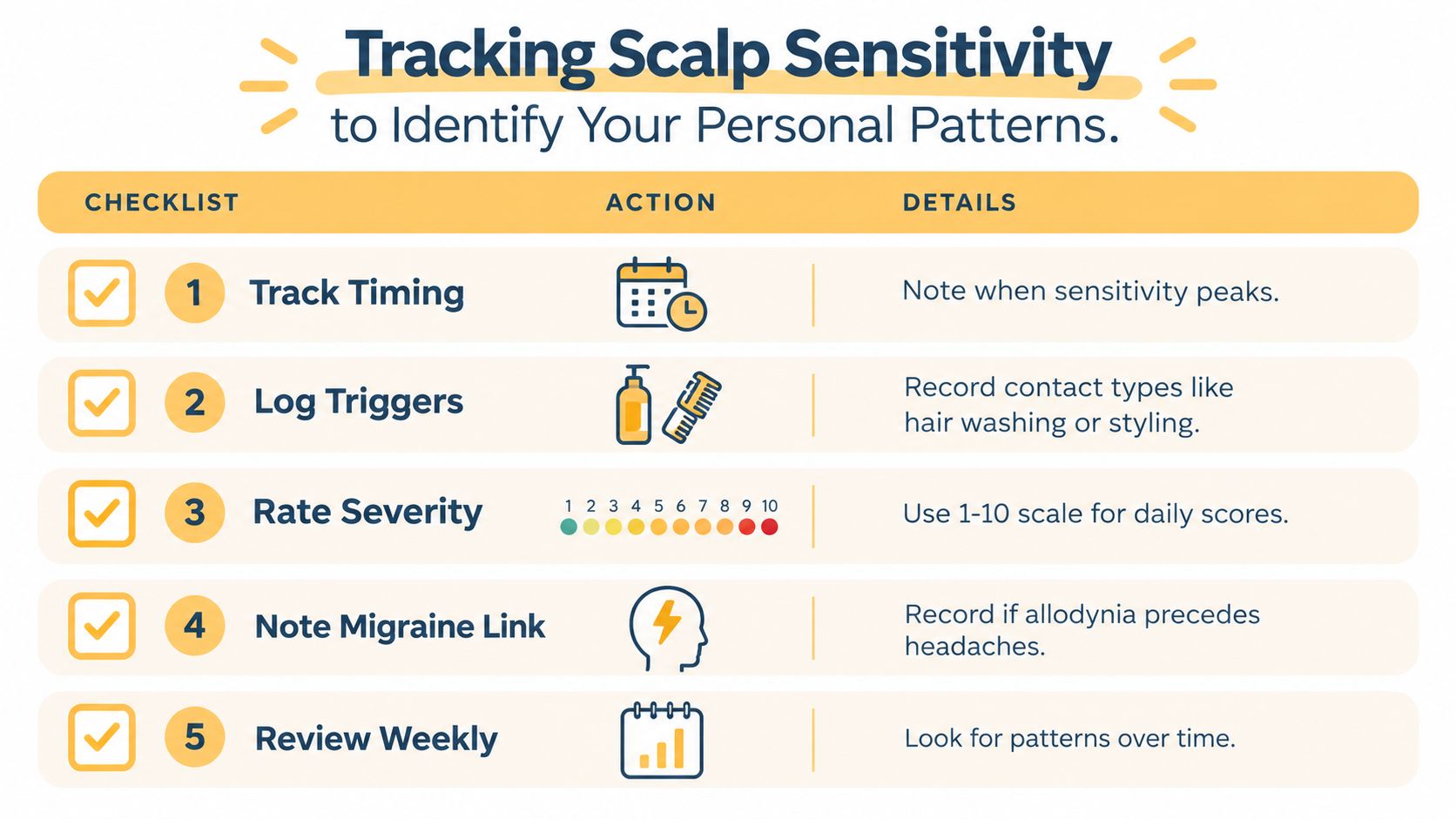
Review the timeline for repeated patterns. Sensitivity that consistently appears near the start of an attack may be useful to discuss as an early warning sign. Sensitivity that persists after recovery, occurs independently, or accompanies visible scalp changes should prompt a conversation with a healthcare provider rather than being assigned automatically to migraine.
A headache diary app can help capture symptoms during an attack, when exact timing is harder to remember. Share the entries with your healthcare provider, especially when the pattern changes.
Common Assumptions About Scalp Pain and Migraine
Assumption one: every painful scalp during migraine is harmless. Migraine can make light contact painful, especially when the symptom follows your familiar attack pattern and the skin looks normal. But persistent pain between attacks, a strictly localized area, a rash, fever, hair loss, recent trauma, or neurological changes can indicate that something else needs attention.
The scalp has its own skin, follicles, and nerves. Irritation, infection, inflammation, medication effects, or another neurological problem can produce pain there. A migraine history helps provide context, but it doesn't eliminate the need to evaluate a new or unusual symptom.
Assumption two: allodynia always means acute treatment has failed. Sensitization can make response to some acute therapies less reliable after it becomes established, and early treatment may be more effective for some people. Still, scalp sensitivity doesn't automatically predict a poor outcome, and it doesn't mean an acute plan cannot help once the symptom appears.
Assumption three: one timing pattern applies to everyone. Some people notice scalp sensitivity early. Others experience it only at peak headache intensity or during recovery. Migraine also varies across individuals and subtypes, including migraine with or without aura, chronic or episodic migraine, vestibular migraine, and hemiplegic migraine. Your pattern deserves attention without being forced into someone else's rule.
Questions to bring to a clinician
- Does scalp sensitivity consistently precede my headache, or does it follow rising pain?
- Does it occur on the same side as the headache?
- Does it disappear after the attack, or persist between attacks?
- Could a medication, scalp product, rash, injury, or another condition explain it?
- Does my current acute or preventive plan need review?
- Am I using acute medication often enough to discuss medication-overuse risk?
Careful tracking won't diagnose the cause by itself, but it can improve the conversation. ReliefMigraine can help you organize symptoms, timing, triggers, and environmental context so you can recognize patterns and plan earlier without treating the app as a substitute for medical care.
Use Relief to log scalp sensitivity alongside headache onset, symptoms, medications, sleep, and environmental exposures, then review the patterns that emerge. Visit Relief to build a clearer record of your attacks and bring more useful timing information to your next healthcare conversation.


