
You've had three migraines this month, and now you're trying to work out whether poor sleep, stress, weather, or something else set them off. A headache diary app can help by giving you a quick place to record attacks, symptoms, medication, possible triggers, and environmental conditions, then turning those entries into patterns you can review. It's a tracking and planning tool, not a diagnosis or a treatment.
You also don't need to document every detail of your life. The most useful diary is usually the one you can keep using after the first few weeks, including on days when your head hurts and concentration is difficult.
Table of Contents
What a Headache Diary App Actually Does
A headache diary app creates a structured record of what happens before, during, and after your attacks. Instead of relying on memory at an appointment, you can capture when pain began, how long it lasted, how severe it felt, which symptoms appeared, what you took, and what your day looked like around the attack.
That structure matters because a generic symptom tracker may treat “headache” as one broad category. A migraine-focused diary is designed around features such as aura, nausea, light sensitivity, sound sensitivity, dizziness, medication use, and attack duration. You can learn more about ReliefMigraine's approach to symptom awareness and migraine management on its information page.
A migraine isn't a stronger version of every other headache. The International Classification of Headache Disorders describes migraine without aura as attacks lasting 4–72 hours, typically involving unilateral, pulsating pain of moderate or severe intensity that worsens with routine physical activity. Nausea or vomiting, or both photophobia and phonophobia, commonly accompany it. See the International Classification of Headache Disorders criteria for the formal definition.
A tension-type headache can feel more like pressure or tightening and may not include the same combination of nausea and sensory sensitivity. Still, your symptoms can vary. Migraine may occur with or without aura, and some people experience vestibular or hemiplegic features, episodic attacks, or a more persistent pattern. An app won't tell you which condition you have, but it can help you describe your experience clearly.
Practical rule: Choose a diary that helps you record an attack in seconds, not one that expects a detailed journal entry while you're in pain.
Why Logging Helps You Understand Your Migraines
Clinical descriptions become more useful when they match what you can observe. Recording whether pain was one-sided, pulsating, activity-sensitive, or accompanied by nausea and photophobia gives you a clearer account than writing “bad headache” several days later.
A diary also captures time. You may notice that attacks last through part of the day, continue overnight, or leave a postdrome, the drained or foggy period after the main pain has eased. You might also record prodrome, the warning phase that can occur before an attack, or aura, temporary neurological symptoms such as visual changes or sensory disturbances.
The fields that carry the most meaning
A validated electronic diary that measured headache frequency, peak intensity, average intensity, duration, and medication use showed strong test-retest reliability, with reported coefficients ranging from r = 0.68 to 0.79 in the published research (validated e-diary study). The same research area also notes that people often add useful free-text details beyond fixed icons, which can enrich later pattern analysis.
That doesn't mean you need to write an essay. It means a few carefully chosen fields can preserve information you'd otherwise forget:
- Timing: When the attack began and ended.
- Intensity: A simple mild, moderate, or severe scale, or a numerical scale.
- Associated symptoms: Nausea, vomiting, photophobia, phonophobia, dizziness, vertigo, or aura.
- Function: Whether you had to stop working, cancel plans, or rest.
- Treatment response: What you used and whether you needed to take it again.
The diary can also give you a record to share with a healthcare provider. That's especially valuable if you've felt dismissed or struggled to explain an unpredictable condition. Your entries aren't a self-diagnosis, but they can show frequency, duration, functional impact, and changes over time in a way that memory often can't.
A multinational analysis using a migraine diary app collected self-reported data from 60,474 users between August 2016 and August 2018. More than 60% of users were aged 24–45, about 90% were female, and more than one-third reported 2 to 5 headache or migraine episodes per month. The analysis also recorded impaired concentration, slower performance, and missed work or social activities, demonstrating how diary data can describe real-world burden at population scale (digital migraine diary analysis).
Features That Separate a Useful App from a Data Graveyard
A long feature list doesn't make a diary useful. The deciding question is whether each feature helps you log consistently or understand the result.
Interest in digital diaries has been high, but completion has been much harder. In a primary-care cohort, 69% of respondents said they were interested in using a headache diary app, yet only 23% of participants who activated accounts generated a personalized trigger-and-protector report (primary-care digital diary cohort). That gap explains why speed and simplicity deserve more attention than decorative dashboards.
Start with friction
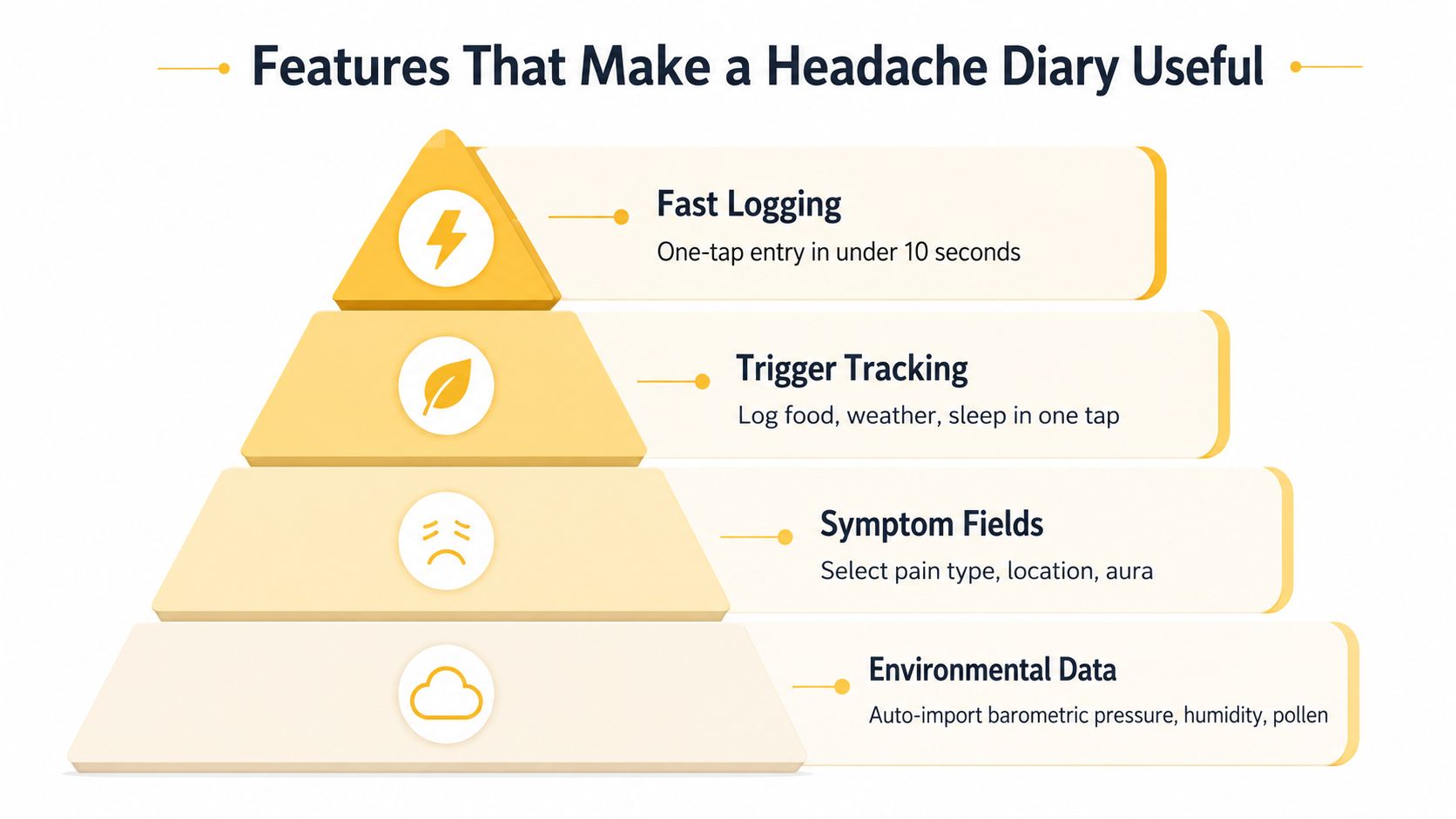
Fast logging comes first. You should be able to record an attack without navigating through multiple screens or entering details you can't reliably remember. A reminder can help, but the workflow itself should remain short.
Symptom fields should reflect migraine rather than reduce everything to a pain score. Look for options for pain location and quality, aura, nausea, photophobia, phonophobia, dizziness, and vertigo. These fields help preserve clinically relevant differences between attacks.
Trigger tracking should let you record possible exposures without treating them as proven causes. Sleep disruption, skipped meals, stress, hormonal changes, medication use, and environmental conditions may be worth testing, but your own record matters more than a universal trigger list.
Environmental integration can add context that's difficult to enter manually. A 2025 meta-analysis of 31 studies found associations between migraine attacks and weather changes overall. Temperature showed a significant association with an OR of 1.15, and ambient pressure showed one with an OR of 1.07, while humidity wasn't significant, with an OR of 1.04 (weather and migraine meta-analysis). These findings support tracking weather carefully, not assuming every pressure or humidity change causes pain.
Raw entries aren't insight, so trend analytics matter too. Useful outputs include attack frequency, duration, symptom patterns, medication records, and exposure comparisons. Privacy also belongs on your checklist. Before using any health app, review what it stores, what permissions it requests, and how you can manage your data. Relief, for example, combines quick logging with environmental signals and an hour-by-hour risk forecast on its iOS app.
What to Log Each Day Without Burning Out
The best starting point is a minimal core set, not an attempt to document every meal, emotion, conversation, and weather detail. The Migraine Trust recommends keeping a diary simple while recording dates, day of the week, attack duration, severity, associated symptoms, medication, and possible triggers. Its guidance also includes noting photophobia, phonophobia, dizziness, vertigo, and medication re-dosing (headache diary guidance).
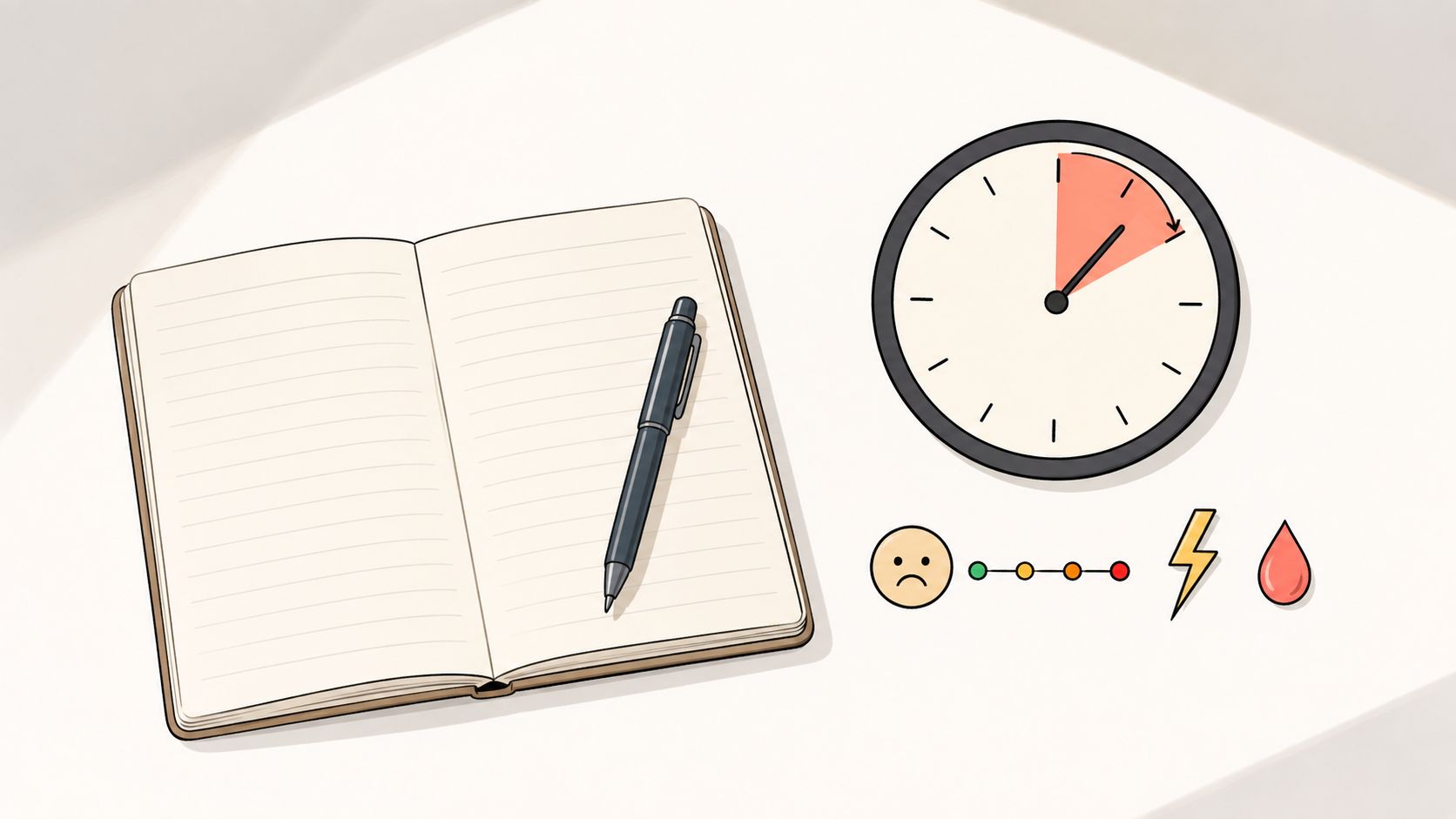
Use this compact checklist:
- Attack time: Record when symptoms began and, later, when they ended.
- Severity: Choose a consistent scale, such as mild, moderate, or severe, or use 1–10.
- Key symptoms: Select only what applies, including nausea, light sensitivity, sound sensitivity, dizziness, vertigo, or aura.
- Medication and response: Note what you took and whether you needed to re-dose. Don't use the diary as a dosing guide.
- Possible context: Add one or two factors, such as poor sleep, a skipped meal, stress, or a noticeable weather change.
- Function: Mark whether you worked, rested, cancelled plans, or couldn't perform normal activities.
A useful entry might read: “Tuesday, 2 p.m. Moderate pain, nausea and light sensitivity. Took an over-the-counter pain reliever. Slept poorly the night before. Barometric pressure dropped.” That short record preserves timing, intensity, symptoms, medication, sleep, and environmental context without demanding a paragraph.
Try to log on the same day whenever possible. A short delay can blur the details, especially the start time, early symptoms, and medication response. If you miss a day, continue rather than trying to reconstruct an entire week from memory.
Low-friction habit: Log the minimum during an attack, then add one detail later only if it helps you understand that episode.
Reading Your Own Trends and Forecasts
A diary becomes useful when you stop treating each entry as an isolated event. Look for changes in attack frequency, average duration, severity, migraine-free stretches, and the number of attacks recorded alongside a suspected exposure.
Suppose your entries show several attacks occurring after a night of broken sleep and a noticeable barometric pressure change. That isn't proof that pressure caused the migraine. It is a testable pattern. You could keep tracking both factors and discuss the pattern with your healthcare provider rather than making a sudden, restrictive change based on one observation.
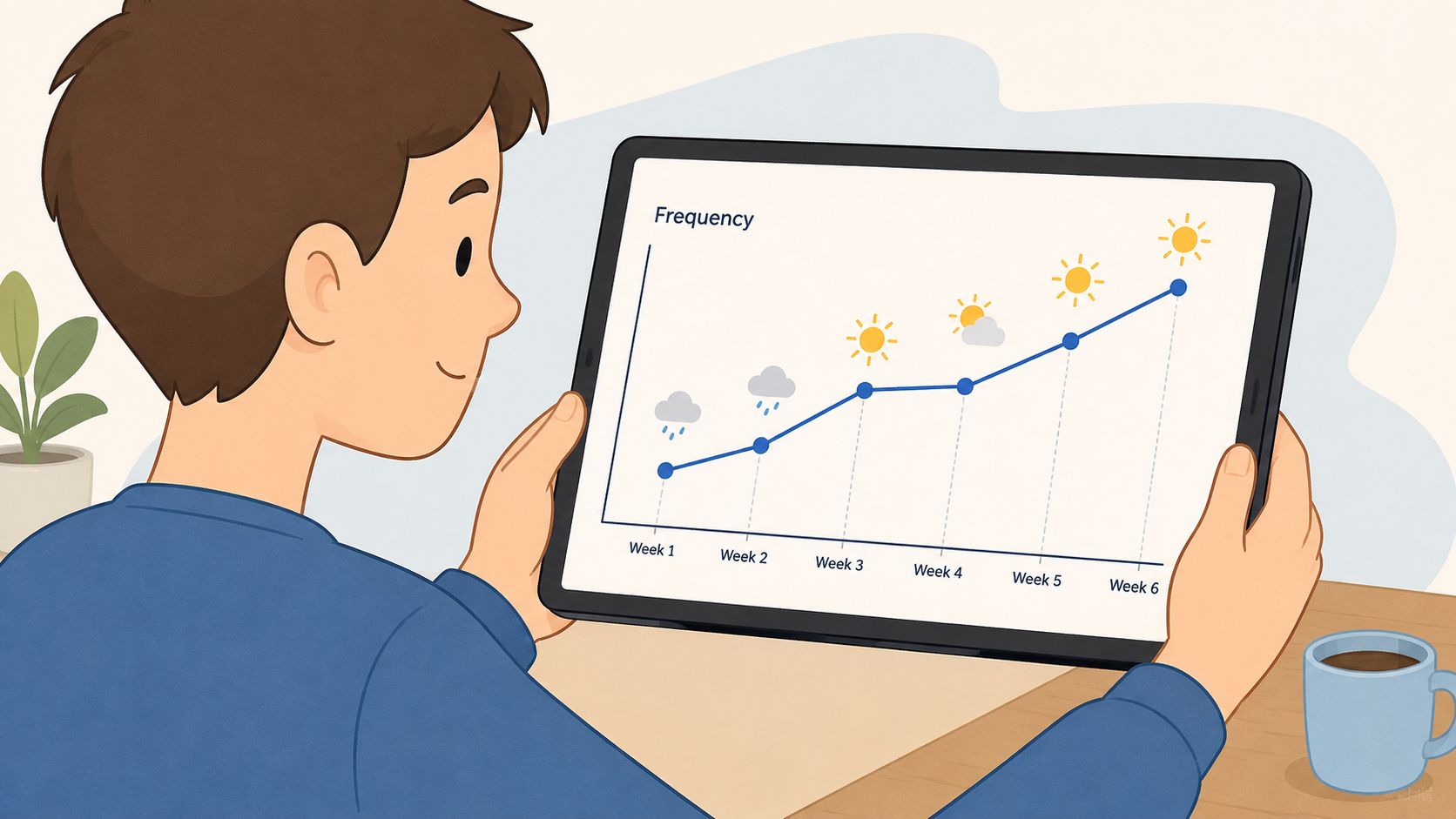
A useful trend view should answer practical questions:
- Are attacks becoming more or less frequent?
- Are they lasting longer?
- Are mild symptoms appearing before severe attacks?
- Which exposures occur often without an attack?
- Which exposures appear repeatedly near attacks?
- Is medication use changing over time?
Forecasts are planning tools
Some apps combine your personal history with local weather, air quality, and pollen data to estimate risk by hour. An hour-by-hour forecast can help you decide when to protect rest, prepare essentials, reduce avoidable strain, or leave space in your schedule.
A high-risk period doesn't guarantee an attack, and a low-risk period can't eliminate uncertainty. The forecast becomes more personally relevant as the app receives consistent, specific entries from you.
The environmental evidence also calls for restraint. The weather meta-analysis cited above found different relationships for temperature, ambient pressure, and humidity, so a single vague “weather trigger” label can hide important differences. Tracking the actual exposure gives you a better basis for asking what may be happening.
Watch the short explainer below for a visual overview of how migraine risk forecasting can fit into daily planning.
Common Mistakes That Quietly Kill the Habit
Abandoned diaries usually don't fail because the person lacks interest. They fail because the process asks too much, offers no clear feedback, or encourages conclusions that the data can't support.
A naturalistic study found a median 90-day adherence rate of 0.34, meaning half of users logged on 34 or fewer of 90 diary days (naturalistic adherence study). That result makes a missed day ordinary, not a personal failure.
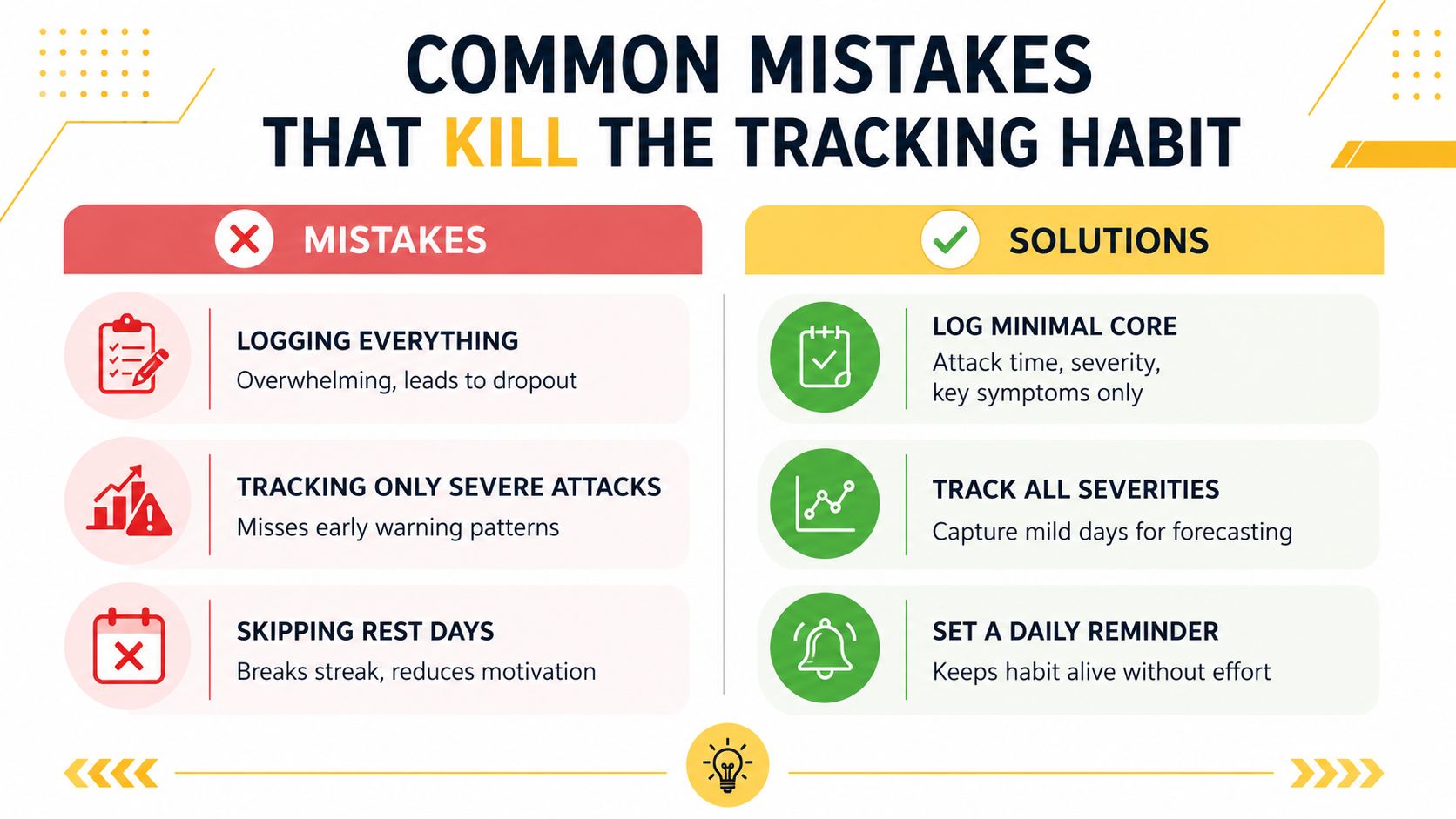
Four habits to replace
- Logging everything: Recording every food, drink, mood shift, and environmental detail can make the diary feel like a second job. Start with attack time, severity, key symptoms, medication, and a small number of possible exposures.
- Tracking only severe attacks: Mild symptoms can provide early context and may help reveal how an attack develops. Record them when you can, even if the entry stays brief.
- Quitting after a quiet week: A week without pain doesn't prove that triggers disappeared. It's still useful information, so keep the habit alive with the smallest possible daily check-in.
- Treating the app as a diagnosis: A chart can show coincidence, timing, and repeated exposure. It can't confirm a condition or establish that one factor caused an attack.
A newer evidence review also points toward a practical distinction: the diary itself may hold attention better than additional behavior-change modules, which can lose engagement quickly (migraine app engagement research). Choose the core logging workflow first. Add complexity only when it answers a question you have.
Red Flags, Safety, and Working With Your Clinician
A headache diary can support care, but it must never delay urgent evaluation. Seek immediate medical care for a sudden severe headache, a headache with fever or stiff neck, new neurological changes, or a headache after a head injury.
Neurological changes can include new weakness, numbness, confusion, speech difficulty, or major visual changes. Don't wait for an app to classify the episode, generate a forecast, or complete a trend. Those features are safety signals, not diary fields to monitor at home.
For a routine appointment, bring a summary rather than scrolling through every entry. Highlight changes in frequency, duration, function, symptoms, medication use, and patterns you'd like to test. Phrase your observations as questions, such as “These attacks often followed poor sleep and a pressure change,” rather than “This proves pressure causes my migraine.”
Triggers vary widely, so a list found online should be treated as a starting hypothesis. Your clinician can help interpret the record alongside your medical history and decide whether further evaluation or treatment changes are appropriate. Review an app's data practices before connecting personal health information, including the details in ReliefMigraine's privacy information.
This article is for informational purposes and is not medical advice. Consult a healthcare provider for personalized guidance.
Putting It All Together and Sticking With It
Start with an app that makes logging quick. For the first 14 days, record attack time, severity, key symptoms, medication, function, and one or two relevant environmental or lifestyle factors. Then review the record for one pattern, not a complete explanation of your migraines.
Check trends monthly rather than judging yourself after every entry. Consistent, low-friction records can make attacks more predictable, while environmental context can help you plan around periods of higher personal risk. Migraine isn't something you're expected to overcome through willpower, but greater predictability can make daily decisions less uncertain.
Relief combines quick migraine logging with local environmental signals and hour-by-hour risk forecasting, positioning the app as a planning and awareness tool rather than a treatment.
If you want a lower-effort way to test this approach, visit Relief to explore quick logging, personal pattern tracking, and environmental migraine-risk forecasts. Start with the smallest useful record, then let your own history show you which details deserve closer attention.


