Can Low Blood Pressure Cause Migraines? What to Know
Can low blood pressure cause migraines? Explore the real connection, autonomic dysfunction, orthostatic changes, and when to seek care.
In this guide
- The Short Answer to a Complicated Question
- How Migraine and Blood Pressure Are Actually Connected
- What the Research Actually Shows About Pressure Readings
- Why Standing Up Can Trigger Migraine-Like Symptoms
- When Low-Pressure Headaches Aren't Migraines at All
- Red Flags That Mean You Need Medical Care Now
- Tracking the Pattern So You Can Show It to Your Doctor
- Questions People Ask After the First Read
A low blood-pressure reading during a migraine doesn't prove that hypotension caused the attack. Low blood pressure isn't established as a direct, universal cause of migraine; the stronger connection involves how the autonomic nervous system regulates blood pressure and responds to standing.
If you've checked your monitor mid-attack and found a low number, it's understandable to wonder whether you've found the explanation. Migraine symptoms can be exhausting, and it can feel dismissive when a routine test doesn't capture what's happening. The useful question isn't only whether your pressure is low, but whether changes in posture or other signs of impaired blood-pressure regulation line up with your symptoms.
The Short Answer to a Complicated Question
You're in the middle of a migraine, feeling dizzy or nauseated, and your blood-pressure monitor gives you a low reading. That number alone doesn't show that low blood pressure caused your migraine.
Researchers haven't established ordinary low blood pressure as a direct, universal migraine cause. Instead, migraine and blood-pressure changes may overlap through the autonomic nervous system, which helps regulate heart rate, blood-vessel tone, and the body's response to standing or stress.
That distinction matters because a reading is a snapshot, not a diagnosis. Your pressure may be low at rest, may drop when you stand, or may be one finding that happens to coincide with an attack. Those possibilities don't mean the same thing, and none can be confirmed from one home measurement.
People whose symptoms don't show up clearly on basic tests deserve to be taken seriously. A normal reading at one moment doesn't disprove what you feel, just as a low reading doesn't settle what caused it.
The practical bottom line: track the circumstances around the reading, especially posture, symptoms, hydration, and medication changes, and discuss recurring patterns with a healthcare professional. The evidence is clearer about the possible role of autonomic and posture-related regulation than it is about a single low number causing migraine.
How Migraine and Blood Pressure Are Actually Connected
Migraine is a neurological disorder, not another name for a bad headache. An attack can involve head pain as well as nausea and sensitivity to light (photophobia) or sound (phonophobia). Some people experience aura, temporary neurological symptoms such as visual changes; prodrome refers to early warning symptoms before the head pain, and postdrome to symptoms that may follow it.
Low blood pressure, or hypotension, describes blood pressure that's lower than usual. It can be associated with dizziness or light-headedness, blurred or fading vision, fainting, fatigue, difficulty concentrating, and an upset stomach. These symptoms can overlap with how you feel during migraine, but they don't establish that the head pain is a migraine or that low pressure caused it. The Mayo Clinic's overview of low-blood-pressure symptoms describes symptoms that may occur with hypotension.
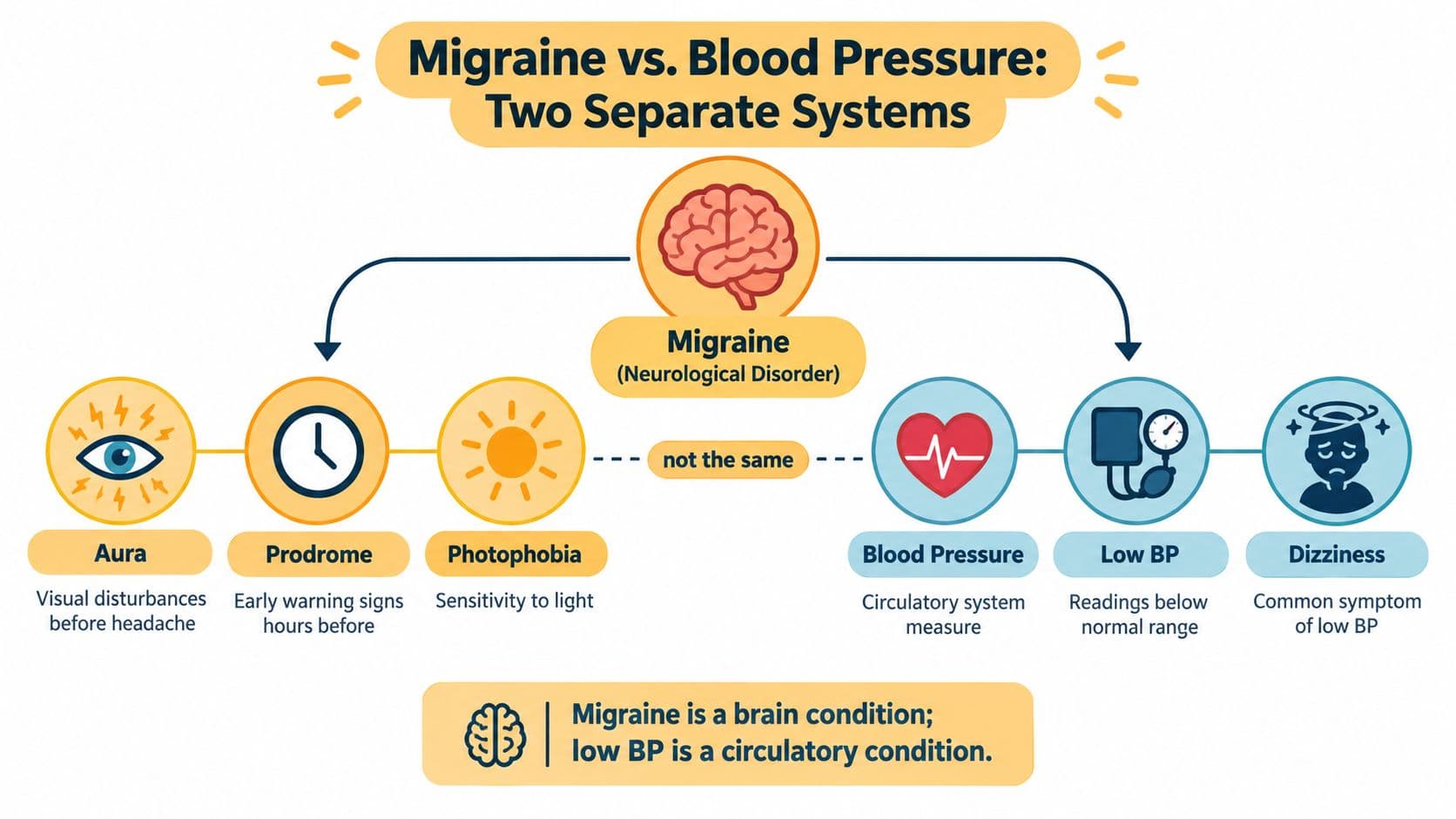
The systems can still interact. Your autonomic nervous system acts a little like a thermostat, adjusting heart rate and blood-vessel tone as your body's needs change. If that regulation is impaired, blood-pressure responses and migraine susceptibility might shift together. That's a possible shared biological link, not proof that one condition directly causes the other.
For a related look at another environmental factor that can coincide with attacks, see how low-pressure weather and migraines may relate.
What the Research Actually Shows About Pressure Readings
Resting blood pressure doesn't appear consistently lower in people with migraine. In one study of 22 migraine patients and 33 controls, mean arterial pressure was 89±9 mmHg in the migraine group and 88±9 mmHg in controls. The figures were nearly identical, which argues against a simple explanation based on migraine always occurring alongside low resting pressure. The study is indexed in PubMed.
A separate population-based case-control study compared 80 people with migraine with 85 matched controls. Resting diastolic pressure averaged 73.2 mmHg in participants with disabling migraine, 71.6 mmHg in those with nondisabling migraine, and 69.8 mmHg in controls; the reported differences weren't statistically significant. The study instead found lower heart-rate variability in the disabling-migraine group, a sign that cardiovascular regulation may differ.
Low readings have appeared in some selected clinical samples, too. In a small 2005 autonomic-profile study, 22 of 32 participants, or 69%, had systolic pressure below 94 mmHg, while 25, or 78%, had diastolic pressure below 60 mmHg. The sample findings don't prove that low pressure came before or triggered migraine.
How to interpret a reading: Treat it as a clue to record, not a verdict about the cause of an attack.
Across these findings, autonomic responses offer a more consistent area of interest than resting blood pressure alone. A low number may be relevant to your history, but it can't diagnose migraine or explain an attack by itself.
Why Standing Up Can Trigger Migraine-Like Symptoms
When you stand, gravity draws blood toward your lower body. Your autonomic nervous system normally helps compensate by adjusting blood vessels and heart rate. If that response doesn't meet your body's needs, you may feel light-headed, nauseated, or visually unsettled, and headache can occur alongside those symptoms.
In a population-based study of 323 people with migraine and 153 controls, orthostatic intolerance was reported in 32% of migraineurs versus 12% of controls. Orthostatic intolerance means symptoms occur with upright posture; it doesn't automatically mean a measurement meets formal criteria for orthostatic hypotension. A commonly used clinical benchmark is a fall of at least 20 mmHg systolic or 10 mmHg diastolic within three minutes of standing.
If it's safe for you to take readings, you can record blood pressure while lying down and again after standing for one to three minutes. Note symptoms at each point, and stop if you feel faint or unsafe. A home check can help describe a pattern, but a clinician should interpret it.
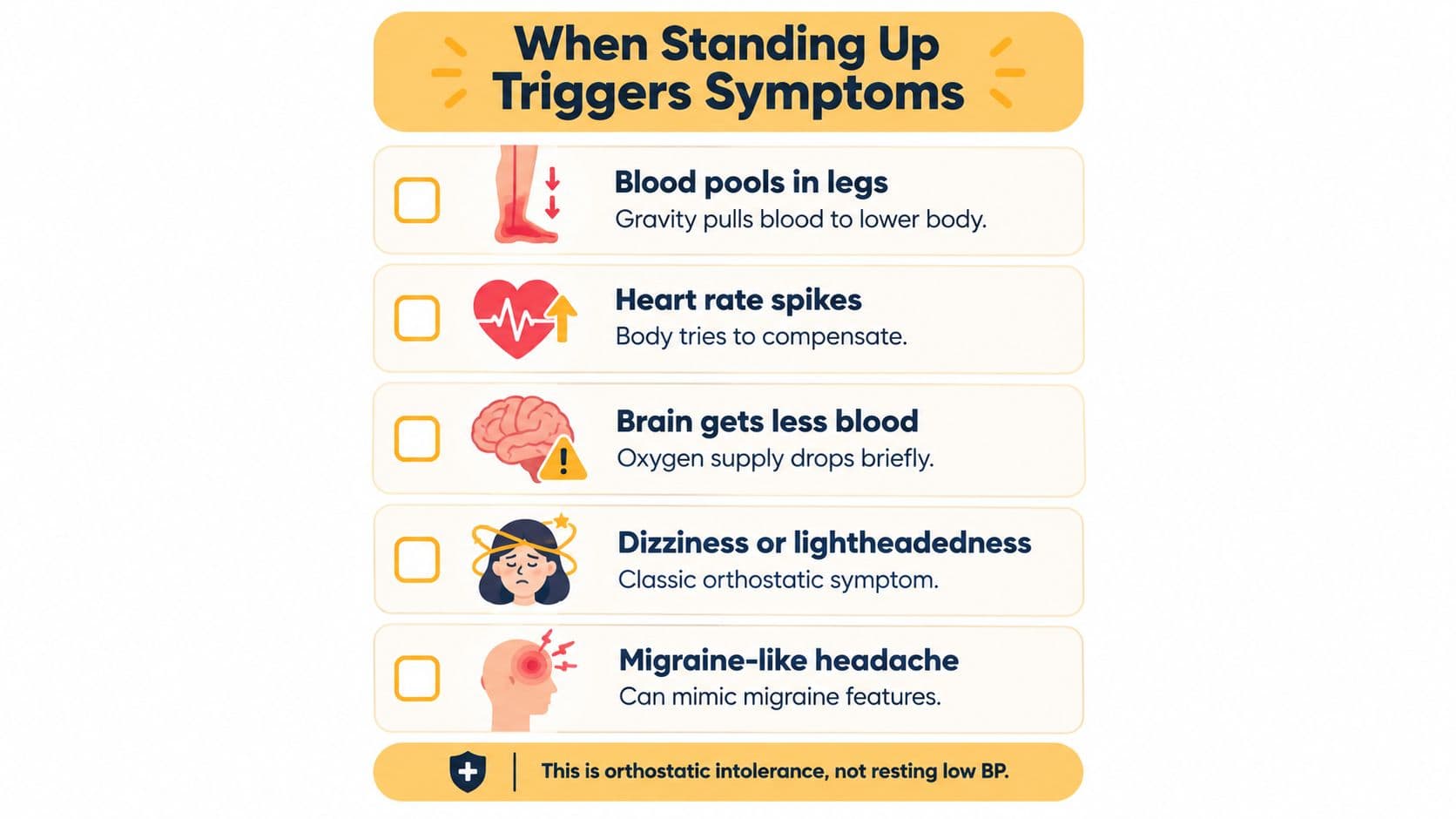
Keep a short record of the context:
- Position and timing: Note whether you were lying down, sitting, or standing when you measured.
- Symptoms: Record light-headedness, visual dimming, nausea, head pain, or faintness.
- Possible circumstances: Note hydration, heat, illness, prolonged bed rest, or medication changes.
- Attack features: Track whether your usual migraine symptoms, such as aura or light sensitivity, were present.
For more on the overlap between these experiences, see what light-headedness with migraine can feel like. Take readings only when you can do so safely, and don't delay medical care to collect measurements if you have severe symptoms.
When Low-Pressure Headaches Aren't Migraines at All
The phrase “low pressure” can refer to two different things. Blood pressure is the force of blood moving through your blood vessels. Spontaneous intracranial hypotension (SIH) involves reduced pressure of the cerebrospinal fluid surrounding your brain and spinal cord. A low blood-pressure reading doesn't tell you whether you have SIH.
SIH can cause a strongly orthostatic headache: pain that gets worse while sitting or standing and improves or disappears within about 20–30 minutes of lying down. It may also bring light and sound sensitivity, nausea, or vomiting, so it can resemble migraine. The American Migraine Foundation's guide to low-pressure headache explains why this posture-linked pattern deserves attention.
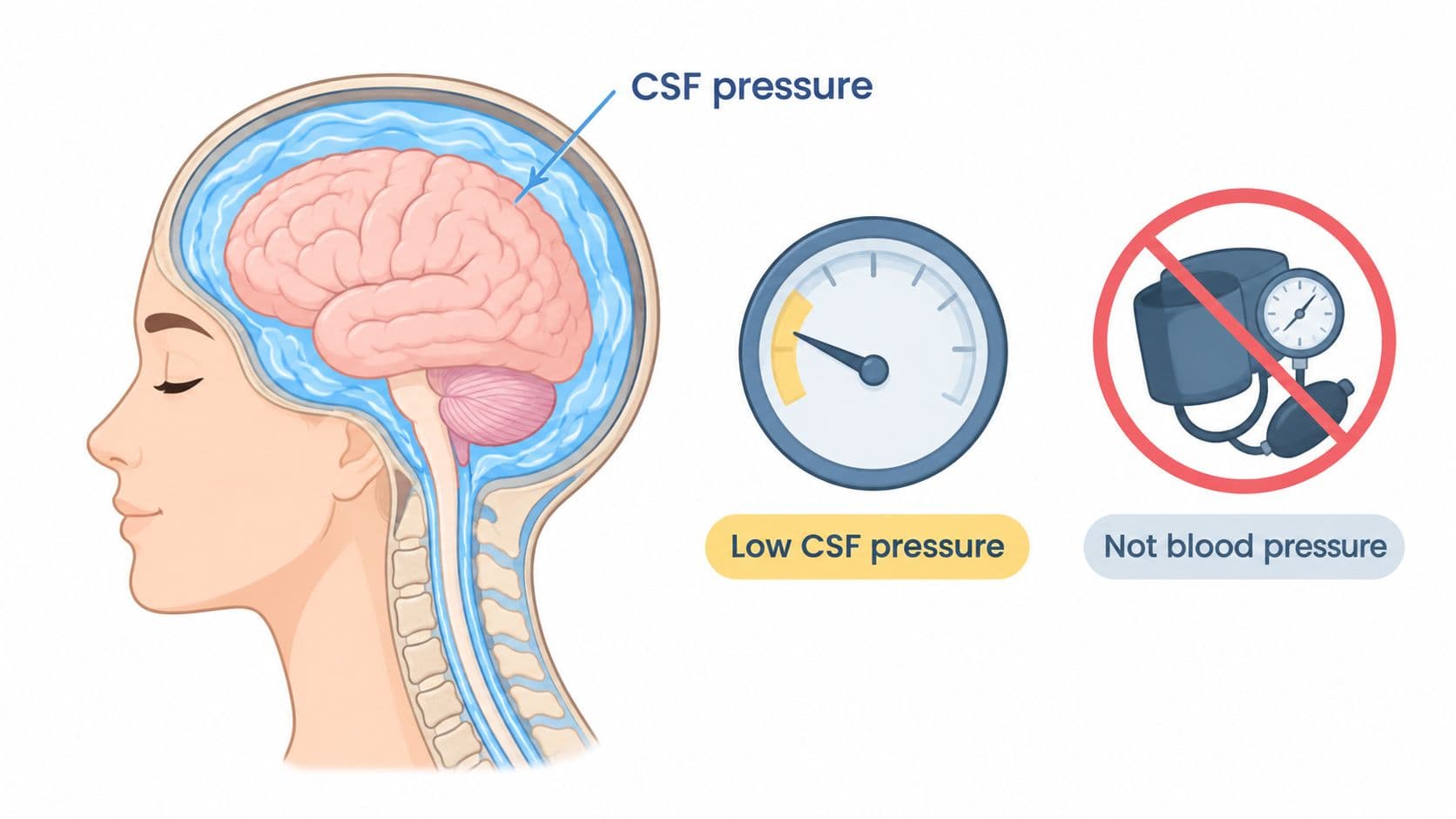
The pattern itself is useful information. If a new or persistent headache reliably worsens upright and eases after you lie down, don't assume it's your usual migraine or attribute it to a low blood-pressure reading. Seek medical evaluation, especially if the headache is clearly different from previous attacks.
Red Flags That Mean You Need Medical Care Now
A single low reading without significant symptoms doesn't automatically mean you need treatment. But low pressure alongside signs of poor circulation, a new severe headache, or neurological changes calls for prompt attention.
Seek immediate medical care for a sudden, severe headache; a headache with fever or a stiff neck; a headache after a head injury; or new neurological symptoms such as weakness, vision loss, slurred speech, or facial droop. Recurrent fainting or chest pain also warrants urgent medical assessment.
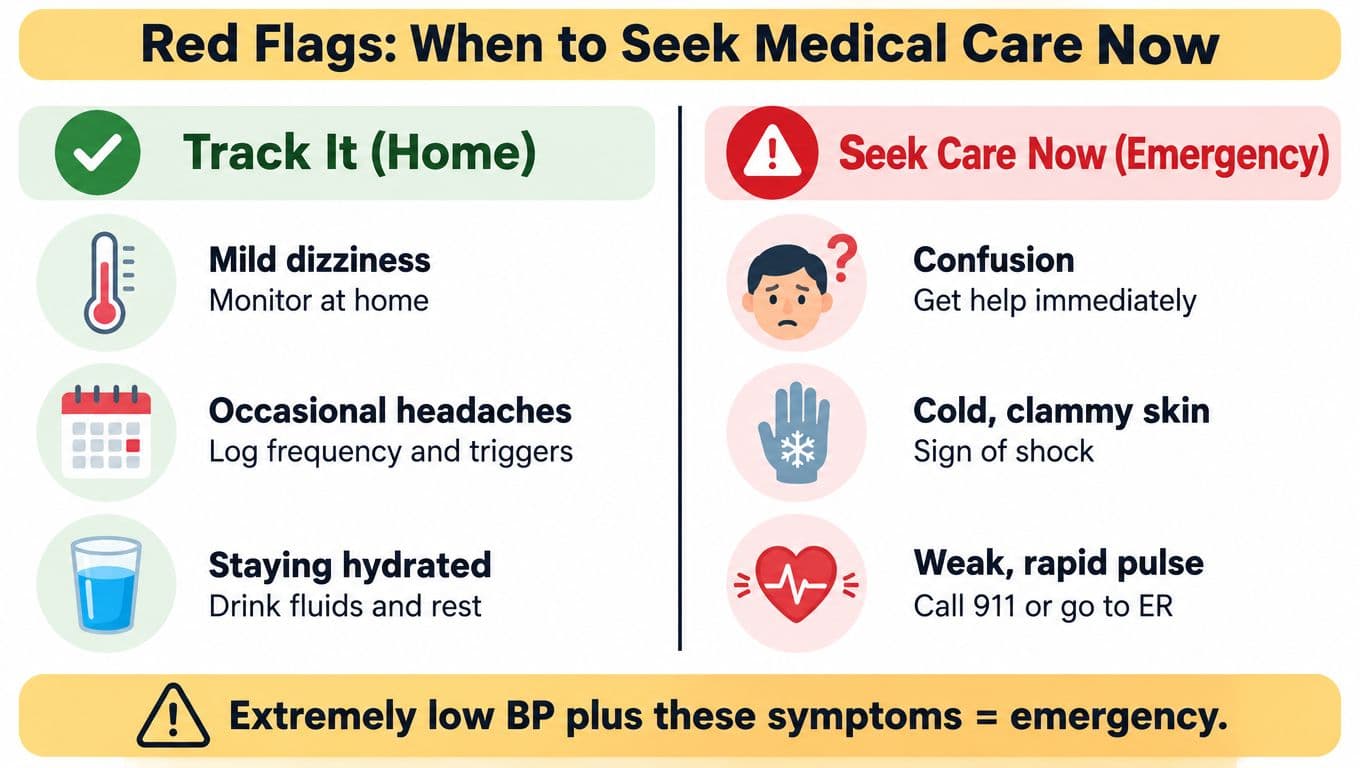
Extremely low blood pressure with confusion, cold skin, or a weak and rapid pulse may signal inadequate circulation and requires immediate help. If you're experiencing those symptoms, don't try to manage the episode as a routine migraine or wait to see whether another reading changes.
Get help now for emergency symptoms. Don't rely on a home monitor to rule out a serious problem.
If you're unsure how urgently to act, contact a healthcare professional or local emergency services for guidance. This article is for informational purposes and is not medical advice. Consult a healthcare provider for personalized guidance.
Tracking the Pattern So You Can Show It to Your Doctor
One reading gives you a number; a record gives you context. Note whether you were lying down, sitting, or standing, when the headache began, and whether symptoms appeared or changed with posture. Add information about hydration, meals, heat, sleep, illness, and medication changes, since these circumstances can help a clinician interpret what happened.
Include the measurements you take safely, such as resting blood pressure and heart rate and, if appropriate, readings after standing. Describe the attack in your own terms: head pain, nausea, light or sound sensitivity, visual changes, dizziness, faintness, and whether lying down changed how you felt.
A useful entry might read: “Felt dizzy after standing; headache started later; low reading while seated; had been unwell and drinking less than usual.” That kind of note doesn't establish a cause, but it helps distinguish a one-off reading from a pattern that recurs around posture, symptoms, or other circumstances.
You can also use a migraine and headache tracking guide to make your notes easier to discuss at an appointment. Bring the record to your clinician rather than trying to diagnose yourself from the numbers.
Questions People Ask After the First Read
Can blood-pressure-lowering medicines help migraine?
They can reduce migraine frequency for some people when prescribed for that purpose, so lowering blood pressure medically isn't automatically migraine-provoking. The effect depends on the person and the treatment context; don't stop or change medication without discussing it with your prescriber.
Does dehydration-related low pressure count as chronic hypotension?
They're not the same situation. Dehydration can coincide with lower pressure and symptoms such as light-headedness, while chronic hypotension describes a recurring pattern that needs interpretation in context. If symptoms keep happening or you're unsure what's contributing, discuss them with a clinician rather than assuming a single cause.
What should I do if my reading is low during an attack?
If you feel well enough to do so safely, record the number, your body position, the time, and your symptoms. A single reading doesn't prove that hypotension triggered the migraine, and severe or alarming symptoms call for medical help rather than repeated checks.
Could this be POTS?
Posture-related dizziness can have different explanations, and symptoms alone can't establish postural orthostatic tachycardia syndrome (POTS). If standing repeatedly brings on symptoms, ask a healthcare professional whether an assessment for orthostatic intolerance or another cause is appropriate. Don't use a home reading to diagnose yourself.
This guide is general information, not medical advice, and it isn’t a diagnosis. Talk to your doctor about your own headaches.