Low pressure weather and migraines are linked for about 20% of migraine attacks, but the speed and scale of the pressure drop, not just the low number itself, may be the more useful trigger for many people. One small study found migraine frequency increased when pressure changed by more than 5 hPa, although no universal threshold applies to everyone.
You wake with a familiar throbbing pain just as the sky turns gray. The storm hasn't arrived, but your stomach feels unsettled, light seems too bright, and concentrating takes effort. If you've ever sensed a migraine before the first rain, you're not imagining the pattern, and you haven't failed to “manage stress” well enough.
Barometric pressure means the weight of the air around you. Weather systems change that pressure, sometimes gradually and sometimes quickly. For some people with migraine, those shifts add strain to an already sensitive nervous system.
This article is for informational purposes and is not medical advice. Consult a healthcare provider for personalized guidance.
Table of Contents
- Why Your Head Pounds Before the Rain Starts
- What the Research Says About Barometric Drops
- Why a fast change may matter more
Why Your Head Pounds Before the Rain Starts
Low pressure weather and migraines can be connected for a subset of people, but the important signal may be a rapid fall in pressure rather than a low reading on its own. A stable pressure pattern may feel different from a fast-moving front that brings changing wind, temperature, humidity, and cloud cover.
Migraine is more than a standard headache. It can involve throbbing or pulsating pain, nausea, photophobia, which means sensitivity to light, and phonophobia, which means sensitivity to sound. Some people also experience aura, temporary neurological symptoms such as visual changes or tingling, before or during the headache phase.
The timing can feel especially unfair. You might notice pressure behind one eye, repeated yawning, food cravings, fatigue, or difficulty finding words before the pain becomes obvious. These early symptoms may be part of prodrome, an early phase of migraine that can begin before the headache itself. They don't prove that weather caused the attack, but they can become useful signals when they repeat alongside a pressure change.
Practical rule: Don't judge your experience by the forecast alone. Track what changed in the hours before your migraine and compare it with your own symptoms.
Research supports a real but uneven relationship between weather and migraine. The evidence doesn't say every storm causes an attack, and it doesn't give doctors one pressure number that applies to every patient. Your nervous system may tolerate a pressure fall on one day and react to a smaller change when sleep, stress, skipped meals, hormones, or dehydration have already lowered your migraine threshold.
That distinction matters because it shifts the question from “Does bad weather cause my migraine?” to “What pressure change tends to matter for me, and what else is happening when it does?”
What the Research Says About Barometric Drops
A forecast can show falling pressure, yet your migraine may not follow. Research supports a relationship between weather and migraine for some people, but the findings do not establish one universal pressure threshold. A 2024 NIH-indexed review reported that weather influences about 20% of migraine attacks and found that several studies associated low barometric pressure with more headaches. One Japanese study observed more frequent migraines when pressure changed by more than 5 hPa. In that study, 64% of 28 patients connected weather changes with their headaches, while 14 patients identified low pressure as a cause. (NIH-indexed review of weather and migraine)
Other findings point to a narrower, more individualized pattern. A review described attacks clustering in some groups when pressure fell below 1005 hPa, while emphasizing that results differed between studies. A 2011 study of 28 patients concluded that low pressure alone did not independently trigger migraine. A diary-based analysis of 100 migraineurs also found no significant association across the full group, although effects appeared in subgroups. The same weather change may therefore be meaningful for one person and irrelevant to another. (Review of atmospheric pressure and migraine evidence)
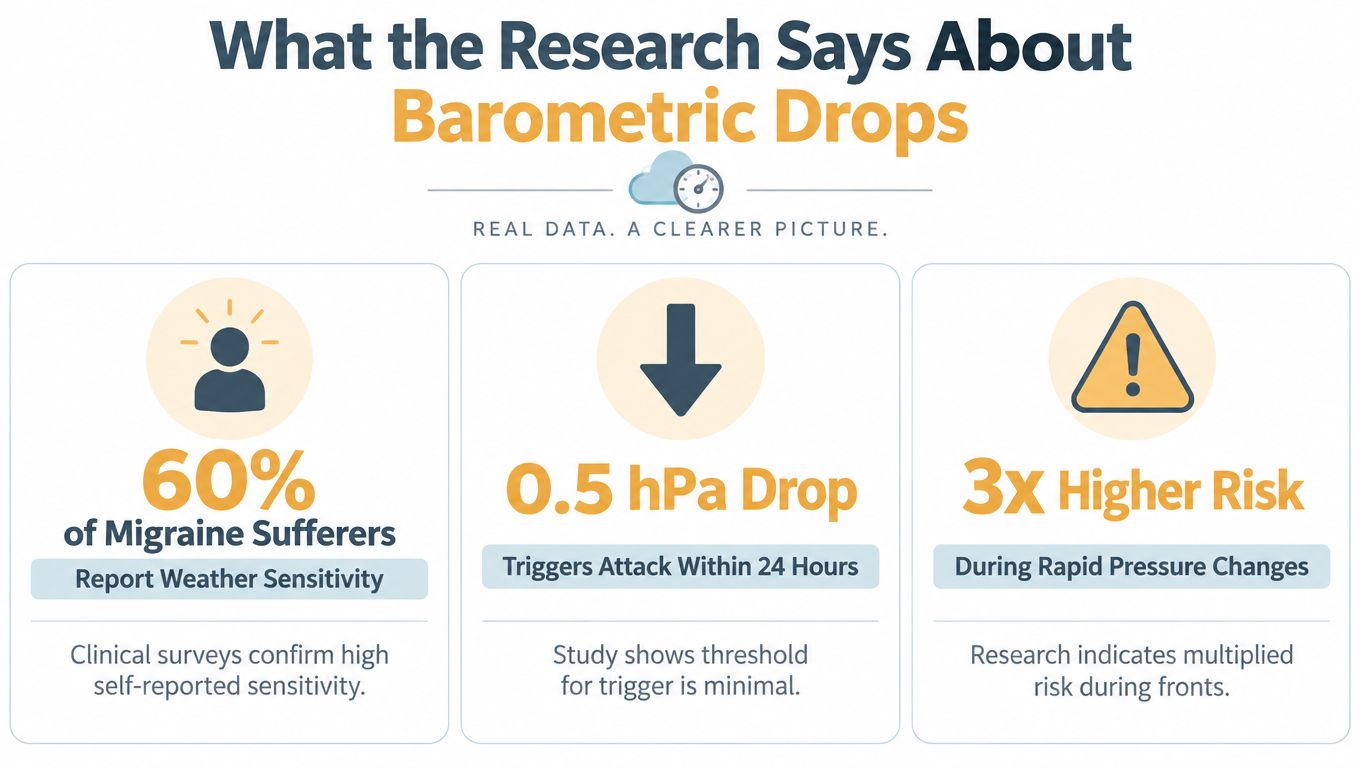
A 2025 systematic review and meta-analysis found a significant association between ambient pressure and migraine attacks, with an odds ratio of 1.07 and a 95% confidence interval of 1.01 to 1.15. It did not find humidity significant. Pressure may be one piece of the trigger pattern, rather than a complete explanation for every weather-related attack. (2025 systematic review and meta-analysis of ambient pressure and migraine)
For a practical explanation of reading pressure trends, see this guide to barometric pressure changes and migraine.
The useful question is not whether storms cause migraines in everyone. Ask how quickly and how far pressure must fall before your symptoms tend to appear, then consider whether poor sleep, heat, stress, or a missed meal lowered your threshold that day.
How Falling Pressure Affects Your Nervous System
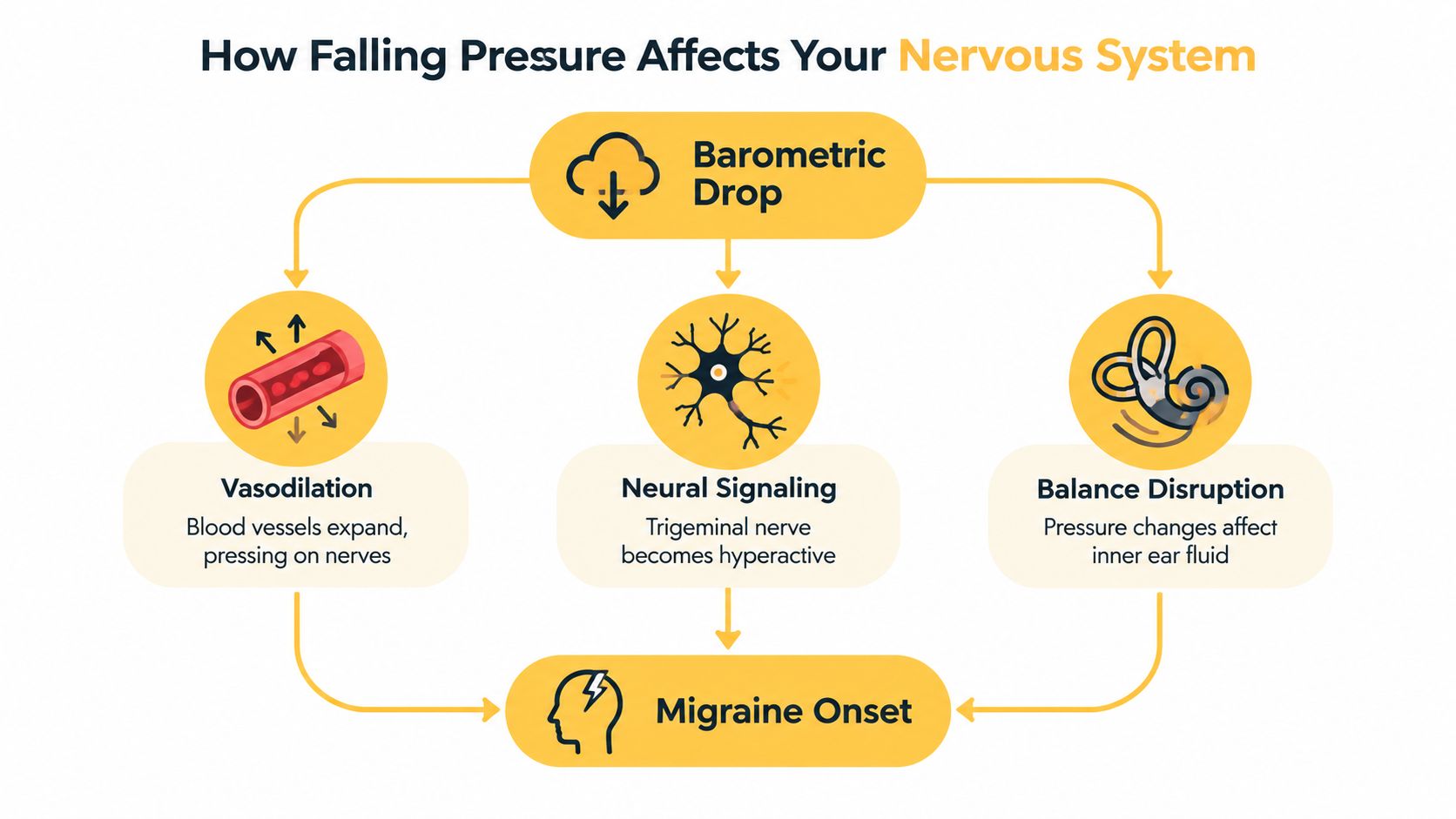
Your trigeminal system acts like a sensitive alarm network for the head and face. It carries information from areas around the eyes, sinuses, jaw, and meninges, the protective layers surrounding the brain. In people prone to migraine, this network can become easier to activate.
A pressure change doesn't mean your brain is being crushed by the atmosphere. The proposed mechanism is subtler. A change outside the body may influence vascular tone, the way blood vessels narrow or widen, and may alter pressure relationships in air-filled spaces and inside the skull. Those changes can provide additional input to a nervous system already close to its migraine threshold.
Expert reviews have proposed that barometric shifts may excite the spinal trigeminal nucleus, a region involved in processing head and facial pain. They also discuss possible changes in vascular tone and intracranial pressure. One observational study cited in the literature found that lower barometric pressure during the preceding 48 to 72 hours was associated with more acute headache presentations, with an odds ratio of 0.939 per 5 mmHg decrease. That suggests a gradient of risk rather than a simple on-or-off trigger. (Review of headache and barometric pressure mechanisms)
Why a fast change may matter more
A stable atmospheric environment gives the body time to adjust. A fast-moving storm front can create several simultaneous changes, including pressure, wind, temperature, and humidity. Your brain may respond to the combined load rather than to pressure alone.
This explains why two people in the same town can experience the same storm differently. One may notice nothing. Another may experience aura, nausea, dizziness, or throbbing pain, especially if their nervous system is already sensitized by a recent attack or disrupted sleep.
The result isn't imaginary or a matter of willpower. Migraine involves neurological and vascular pathways that can amplify sensory input. A pressure alert that detects a fast fall ahead of a storm may therefore be more useful than a weather app that just labels the day “low pressure.”
Barometric Migraine vs Standard Tension Headache
Weather changes can accompany different types of head pain, so timing alone doesn't identify migraine. A migraine may be one-sided and throbbing, while a tension-type headache is more often a steady pressure or tightness on both sides of the head.
The word “barometric migraine” describes a migraine pattern that appears related to pressure changes. It isn't a separate diagnosis that can be confirmed from a weather app. Your healthcare provider considers the full symptom pattern, history, neurological examination, and other possible causes.
| Feature | Barometric Migraine | Standard Tension Headache |
|---|---|---|
| Pain quality | Often throbbing or pulsating | Usually dull, pressing, or tightening |
| Location | May be one-sided, although it can affect both sides | Commonly affects both sides |
| Sensory symptoms | Photophobia and phonophobia are common | Light or sound sensitivity may occur, usually less prominently |
| Nausea | Can occur and may include vomiting | Less typical |
| Aura | May occur before or during the attack | Not a typical feature |
| Early symptoms | Prodrome may include yawning, fatigue, mood changes, or concentration problems | Usually lacks a distinct migraine prodrome |
| Weather relationship | May recur around a pressure fall or rapid atmospheric shift | May coincide with weather but often tracks muscle tension, stress, or posture more closely |
| Effect on activity | Activity may worsen the pain | Activity doesn't always aggravate it |
Research has examined weather exposure across the 48 to 72 hours before acute headache presentations, but that doesn't mean every migraine begins on a fixed schedule. Your own timing matters more than a general forecast window.
Facial pressure can also confuse the picture. Migraine can include facial discomfort and nasal symptoms, so assuming that pain near the cheeks or eyes is sinus-related may lead you away from the right conversation with your clinician. Log the pain location, quality, associated symptoms, and pressure trend instead of assigning a label based on location alone.
Proactive Strategies for High Risk Weather Days
You can't control a storm, but you can reduce the other factors that make your migraine threshold easier to cross. The most useful plan is layered: watch the pressure trend, protect your routine, and follow an acute treatment plan you've already discussed with a healthcare professional.
Start with the habits that are safe and repeatable:
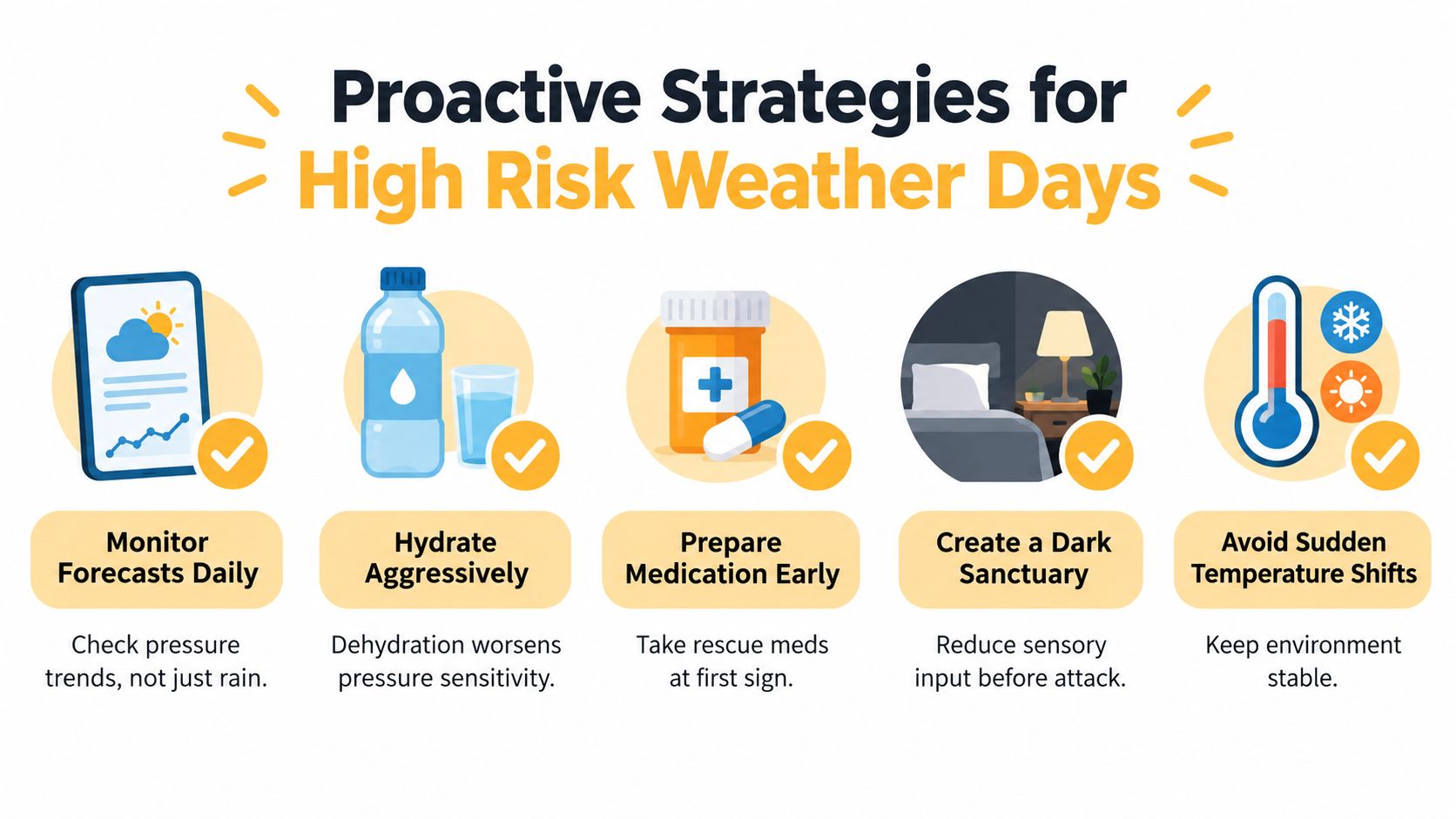
- Watch pressure trends: Look for a falling pattern rather than focusing only on whether the day is rainy.
- Keep fluids consistent: Dehydration can add stress to the body, particularly during heat or travel.
- Protect regular sleep: Avoid a major change to your usual bedtime or wake time before a forecast pressure shift.
- Eat on schedule: Skipped meals can combine with weather changes and make an attack more likely for some people.
- Reduce sensory load: Keep sunglasses, ear protection, or a quiet room available if light and sound usually worsen your symptoms.
- Limit abrupt temperature changes: Dress in layers and avoid moving rapidly between very different environments when possible.
Use treatment plans early and safely
If your clinician has recommended an over-the-counter treatment or a prescribed acute treatment, ask when they want you to use it. Some people are advised to treat at the first familiar signs of an attack, such as prodrome or the beginning of pain, rather than waiting until symptoms peak. Don't change medication timing, frequency, or combinations without professional guidance.
Over-the-counter options and prescription treatments aren't interchangeable, and the safest choice depends on your health history, other medicines, pregnancy status, and migraine features. A clinician can also help you recognize whether frequent acute treatment is contributing to medication-overuse headache.
You might prepare a low-stimulation space before the pressure falls. Dim the lights, reduce screen exposure, keep water and food nearby, and make your prescribed or clinician-approved treatment accessible. This won't guarantee that an attack stops, but it can remove avoidable obstacles when concentration and movement become difficult.
Safety check: Seek immediate medical care for a sudden severe headache, a headache with fever or stiff neck, new neurological changes, or a headache after head injury.
Urgent symptoms include new weakness or numbness, confusion, fainting, seizure, trouble speaking, double vision, or vision loss that doesn't match your usual aura. A healthcare provider should also assess a rapidly changing headache pattern.
For additional prevention ideas, see this practical guide to preventing weather-related migraines.
This article is for informational purposes and is not medical advice. Consult a healthcare provider for personalized guidance.
Tracking Your Personal Pressure Thresholds
A pressure pattern becomes useful only when it matches your own attacks. Your diary should capture how quickly pressure falls, how far it drops, and what else is happening, rather than search for a universal threshold.
Record:
- Log the event: Note when symptoms began, including any prodrome.
- Compare the trend: Check pressure before the attack and compare it with migraine-free days.
- Record other influences: Add sleep, meals, hydration, stress, illness, travel, temperature, humidity, and hormonal changes when relevant.
- Review repeated combinations: A possible personal threshold is more convincing when similar pressure changes and circumstances recur.
- Share the record: Bring it to a healthcare provider, since memory can miss timing and competing triggers.
The 2025 systematic review and meta-analysis linking ambient pressure with migraine attacks reported an odds ratio of 1.07. It also emphasized that pressure is one environmental factor, so your useful forecast may depend on your own rate and size of change. (2025 ambient-pressure meta-analysis)
A headache diary app can keep symptoms and weather observations together. Relief combines personal logs with local pressure trends and presents an hourly migraine-risk forecast. It supports pattern tracking, but it is not a diagnosis or replacement for medical care.
Relief also lets you compare attack severity, symptoms, triggers, medications, humidity, temperature, wind, and air quality with local weather signals. Visit Relief to review your pressure patterns and plan around higher-risk weather days.


