
You're lying in a dark room, trying to remember whether it was the skipped lunch, the storm front, or the bad sleep that set off the attack. Migraine headache tracking turns that fog into usable information, because a structured diary helps you spot patterns, compare attacks over time, and separate real triggers from guesswork. It also helps you see whether treatment is changing your migraine days, instead of relying on memory that can blur when you're in pain.
This article is for informational purposes and is not medical advice. Consult a healthcare provider for personalized guidance.
Table of Contents
Why Tracking Your Migraines Changes How You Manage Them
The attack is already underway, and your brain wants a fast answer. Structured migraine headache tracking gives you one, because it turns scattered symptoms into a record you can act on instead of a memory you have to trust. That matters when you're trying to figure out whether the weather, the missed meal, the extra screen time, or something else lined up with the pain.
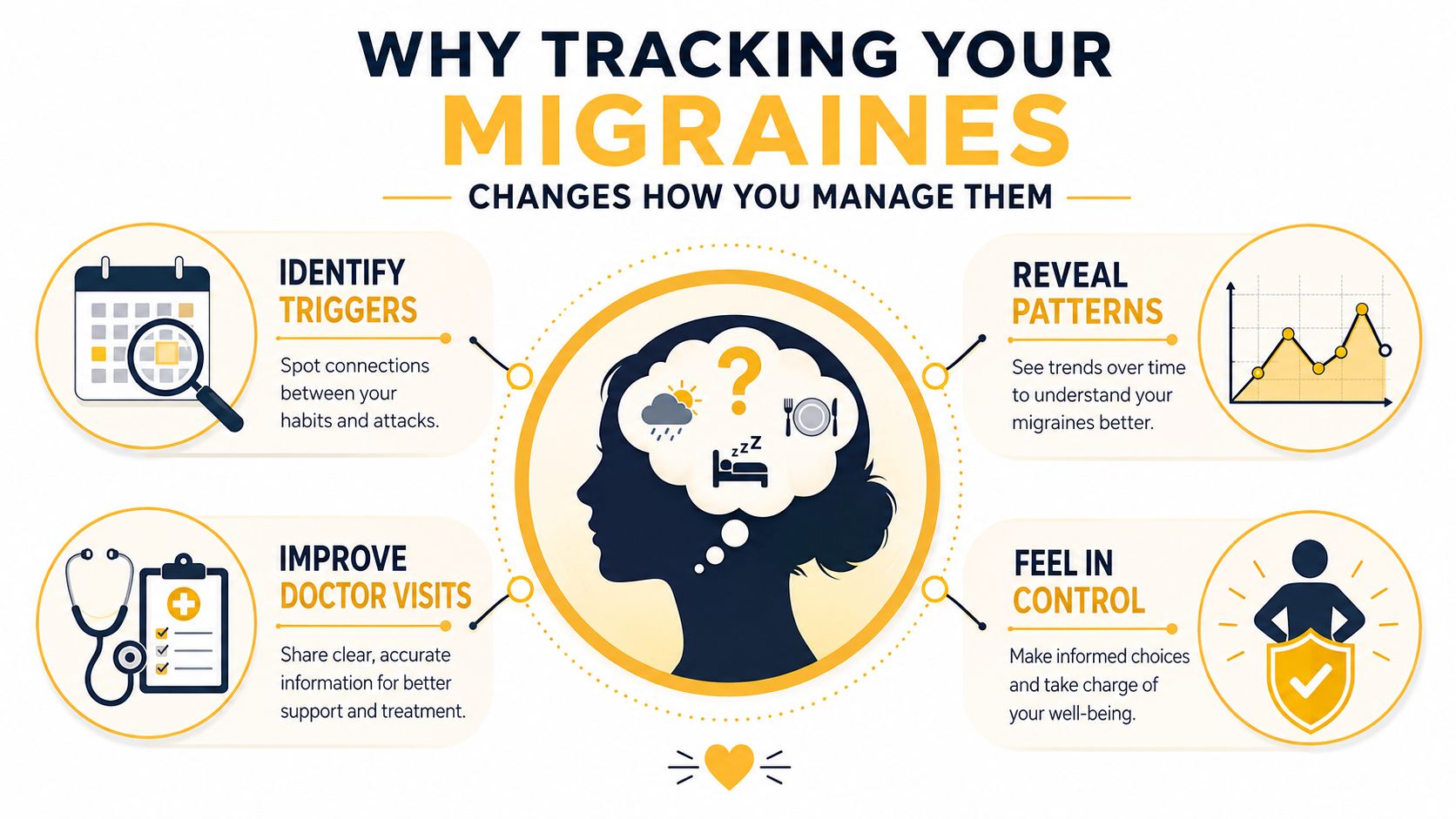
Migraine isn't a small, occasional nuisance. The best current global estimates put prevalence at 14–15% of the population, and migraine contributes 4.9% of global years lived with disability (Nature review). Those numbers are why a diary isn't just self-help. It's a way to manage a large, persistent condition that keeps coming back.
Why recall alone falls short
A diary beats memory because attacks don't stay neatly organized in your head. In a randomized trial secondary analysis, monthly recall questionnaires underestimated headache frequency by an average of 1.7 to 3.4 days over four 28-day periods, and self-estimated monthly migraine days differed from diary-based counts by an absolute mean of 4.7 ± 5.0 days (trial analysis). That's a big enough gap to distort whether a treatment looks helpful or whether attacks are increasing.
The point isn't to collect every possible detail. It's to capture the handful of facts that change decisions, frequency, duration, severity, medication timing, and the symptoms that distinguish migraine from another headache type. Long-term logging can also show whether a pattern is stable or shifting, which matters because migraine is not static.
Practical rule: if a field won't change what you do next week, it probably belongs in review time, not daily logging.
That mindset keeps the log useful instead of exhausting. It also makes it easier to notice trends like worsening frequency, longer attacks, or a treatment that's no longer pulling its weight. This article is for informational purposes and is not medical advice. Consult a healthcare provider for personalized guidance.
What to Log Every Day and What Only Matters at Review Time
Daily tracking should be small enough that you'll still do it on a bad day. That means separating must-have fields from the things you can add later when your head is clearer. The Migraine Trust recommends recording the date, day of week, attack duration, severity, associated symptoms, medication taken, a second dose if you used one, side effects, potential triggers, and menstrual timing if relevant (Migraine Trust diary guide).
Daily essentials versus review fields
Use severity in a 1 to 10 scale or mild, moderate, severe, because you need a consistent trend, not a perfect number. Record duration because it helps distinguish a migraine attack from another headache episode, and note medication timing because how early you treated the attack often matters more than what you remember later. Associated symptoms also help, especially photophobia (light sensitivity), phonophobia (sound sensitivity), osmophobia (smell sensitivity), dizziness, and vertigo, which means a spinning or motion sensation.
Periodic fields belong in review time, not in the middle of a painful attack. That's where menstrual timing, sleep quality, stress load, weather context, and trigger hypotheses fit. You don't need to wrestle with all of that at 2 a.m. while your forehead is throbbing.
If you can only fill out five things on a bad day, make them date, duration, severity, symptoms, and medication.
| Field | When to log | Why it matters |
|---|---|---|
| Date | Daily | Anchors the attack in time and helps reveal patterns |
| Day of week | Daily or weekly review | Shows schedule-linked clusters |
| Duration | Daily | Helps classify the event and compare attacks |
| Severity | Daily | Lets you track whether attacks are trending worse or better |
| Symptoms | Daily | Distinguishes migraine features from other headache types |
| Medication taken | Daily | Shows whether acute treatment is being used and whether it's early enough |
| Second dose | Daily | Helps you see if one treatment round is usually enough |
| Side effects | Daily or next morning | Flags tolerance problems |
| Menstrual timing | Review time | Useful for people whose attacks track with cycle changes |
| Sleep quality | Review time | Adds context without slowing the daily log |
| Stress load | Review time | Helps explain clusters without guessing in the moment |
During a flare, keep it minimal and catch up the next morning if needed. A short note is better than a perfect template you never finish.
Paper, Digital, or Hybrid Choosing a Format That Actually Sticks
The right format is the one you'll use when your head hurts and your patience is thin. Paper works because it's immediate, screen-free, and easy to keep beside the bed. Digital works because it's searchable, easier to review, and better at surfacing patterns over time.
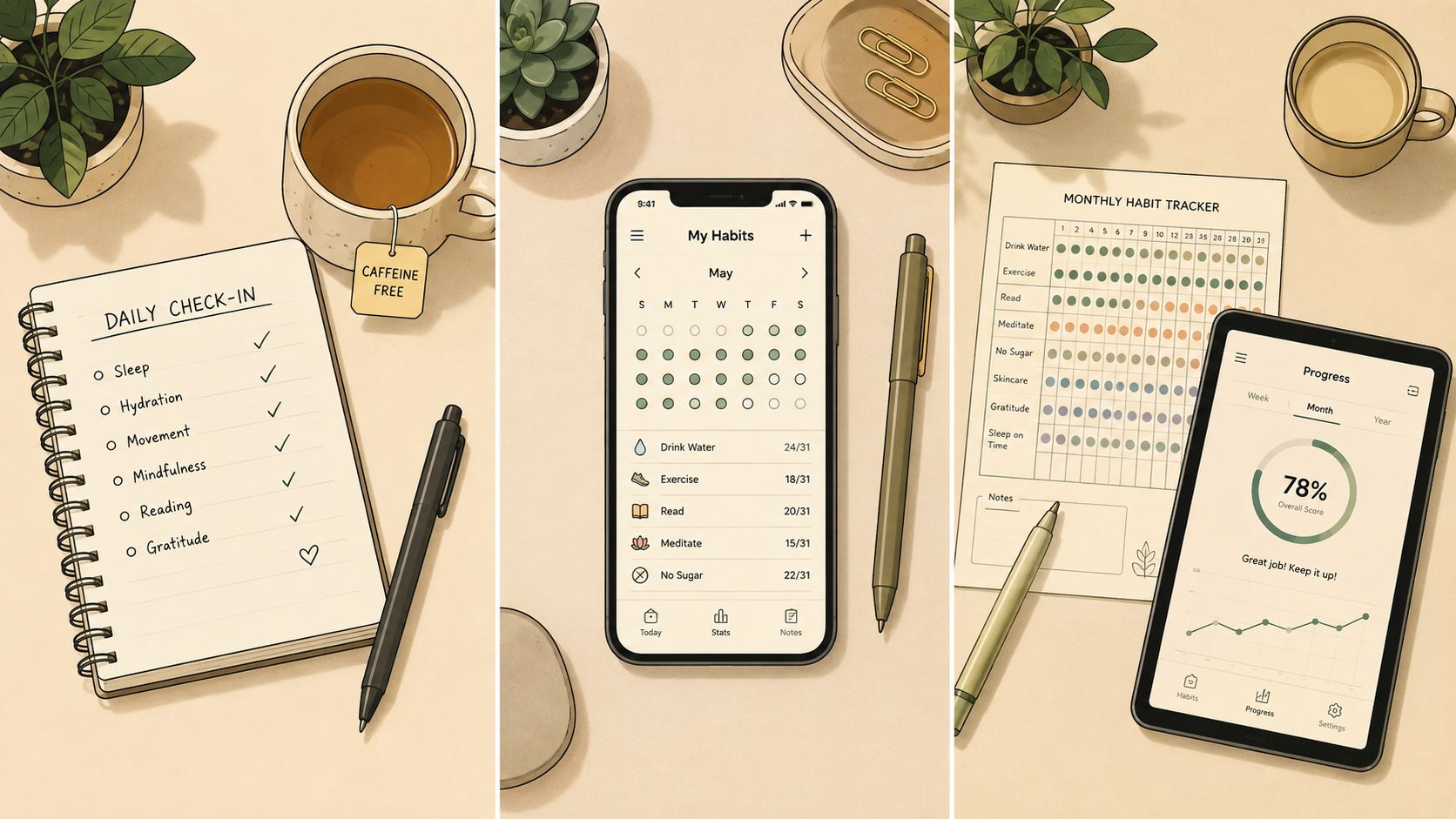
Paper diaries have one real advantage, they're low friction when screens feel unbearable. The downside is that trend analysis becomes manual, and you have to scan rows yourself to see whether attacks cluster around sleep loss, hormonal shifts, or pressure changes. That's fine for some people, especially during severe brain fog, but it's not ideal if you want the log to do the analysis for you.
Digital forms and spreadsheets add structure, but they still depend on manual entry. Structured electronic tools can do more when they're built well, because an electronic headache questionnaire paired with an e-diary showed very high sensitivity for migraine, while adding a broader migraine questionnaire improved specificity (clinical headache-practice study). Free-text alone is weaker because the labels get fuzzy fast.
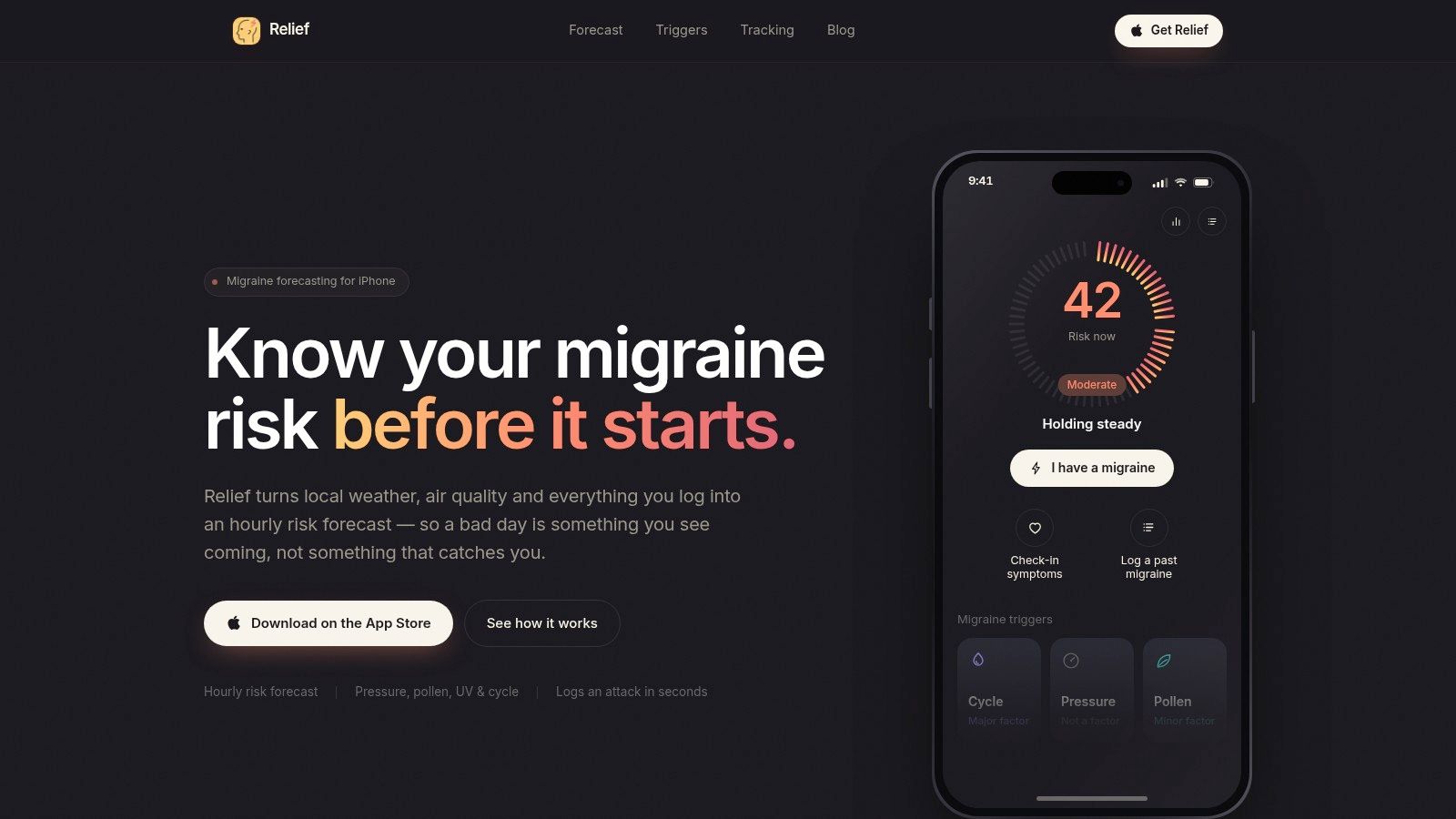
A hybrid system often works best in real life. Keep a paper backup during flare weeks, then move the details into a digital log when you have more energy. If you want one place to combine logging and forecasting on iOS, Relief brings in health data and environmental context alongside attack check-ins, but the bigger point is choosing a format that lowers friction instead of adding it.
Layering Environmental and Passive Data Into Your Log
A good diary doesn't just record pain, it adds context you'd never remember to write down later. Weather shifts, sleep, activity, and air quality can sit around an attack without being the whole cause, but they often help explain why one day hit harder than another. You don't need to log every environmental variable manually if your tool can pull them in for you.
What passive data adds
Passive data gives you objective context. In a prospective real-world study, days with headache were linked with reduced step count, less time spent active, more daytime napping, and lower maximum heart rate, and migraine days also showed more sleep and less physical activity (prospective real-world study). That doesn't prove cause on its own, but it does show how your body behaves around attacks in a way memory usually misses.
A useful diary can blend what you felt with what your phone or wearable already knows. iOS tools can pull in Apple Health data like sleep, steps, and heart rate, then pair that with local weather and air-quality feeds so the log shows the context around each attack. That helps when you're trying to spot a pattern like attacks clustering after a pressure drop plus short sleep.
A reader might notice the same thing only after looking back over several weeks. One cluster could line up with days when pressure dropped sharply and sleep dipped under a normal night, while another stretch might show no weather pattern at all and a stronger link to stress or missed meals. That's why layered data matters, it keeps you from overcrediting the trigger that happened to stand out in your memory.
Practical rule: if a signal shows up often but also happens on ordinary days, treat it as context first and a trigger hypothesis second.
The key is not to drown the diary in noise. Add what helps you explain attacks, then ignore what never changes your decisions. If you ever get a sudden severe headache, headache with fever and stiff neck, neurological changes, or a headache after head injury, seek immediate medical care.
Reading Exposure Hit Rates and Trend Analytics Without Fooling Yourself
A diary only becomes useful when it separates signal from coincidence. Exposure hit rates show how often a suspected exposure appears before an attack. Rolling trends show whether migraine days, attack duration, or severity are moving up, down, or sideways over time.
What a hit rate really means
If you logged 14 attacks over 60 days, and 10 followed a barometric-pressure drop you were watching, that gives you a 71% exposure hit rate for that variable. The number matters only if the exposure is not present all the time and you are not retrofitting every attack into the same bucket after the fact.
Rare exposures usually tell you more than near-constant ones. If short sleep happens on most workdays, a “hit” there does not narrow much. If a food, schedule, or environment shows up only sometimes and lines up with attacks again and again, that is worth a closer look.
How to read trends without fooling yourself
Trend lines need context, too. A bad week does not automatically mean your migraine pattern is getting worse, especially if you just changed treatment, sleep, or routine, or if the diary is still settling into a stable baseline. Recheck after any major change so you do not mistake a temporary shift for your new normal.
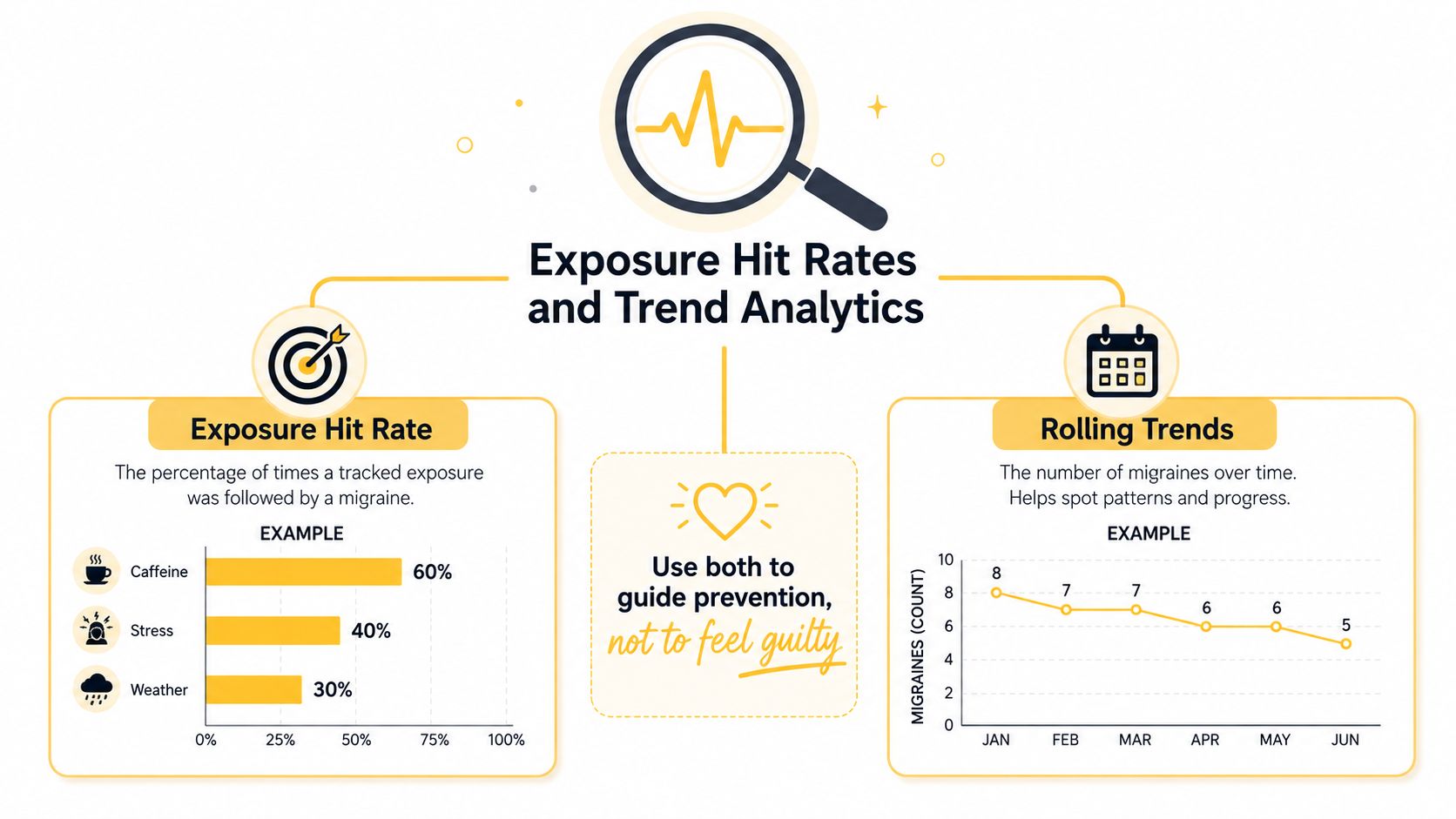
Before you act on a trend, ask three questions, did it repeat, did it matter clinically, and did anything else change at the same time?
That check keeps confirmation bias from running the diary. Once a trigger seems plausible, it becomes easier to notice and harder to question. Good analytics make that bias visible, so the diary stays a decision tool instead of turning into a story that only confirms what you already suspected.
Preparing a Clinician-Ready Summary From Your Diary
A diary only helps if it becomes usable in the appointment. Clinicians tend to get more value from a small set of decision-relevant fields, headache frequency, intensity, medication use, and functional impairment, than from a giant record that's hard to scan (clinical usefulness review). So trim hard before the visit.
What to bring
Bring the monthly migraine days for the past 1 to 3 months, your average attack duration, the severity trend, the number of medication doses you've taken over the month, and your top three suspected triggers with their exposure hit rates. If your diary shows a clear change in function, note that too, because disability matters as much as pain.
A one-paragraph narrative helps more than a pile of screenshots. Write down what changed, when it changed, what feels different now, and what you've already tried. That gives the clinician a quick timeline instead of forcing you to rebuild the story from memory while you're sitting in a narrow 15-minute slot.
A clean one-page summary often beats a 60-entry spreadsheet. It keeps the visit focused on treatment decisions, preventive options, rescue strategy, and whether your current plan is lowering your migraine burden. You're not handing over the whole diary, you're handing over the signal.
This article is for informational purposes and is not medical advice. Consult a healthcare provider for personalized guidance.
Building a Tracking Habit That Survives Bad Weeks
Tracking has to hold up during the weeks when migraine is loudest, not only when things are quiet. The habit works best as a feedback loop, a short check-in at the same time each day, one fallback rule for flare periods, and a monthly review that turns entries into decisions. Migraine also carries a large disability burden, so the fact that logging feels hard is not a character flaw, it is part of the job.
A cadence that's realistic
A simple rhythm usually lasts longer than an ambitious one you abandon after two bad attacks. A quick daily entry works during stable weeks, a weekly catch-up helps when symptoms flare, a monthly review shows frequency and severity, and a deeper quarterly look can reveal patterns that are easy to miss day by day. If your schedule is irregular, your specialist access is limited, or medication costs make follow-up inconsistent, the system should get smaller, not more complicated.
A diary still has to work when your work shifts change, your pharmacy pickup is delayed, or you cannot get in to see a specialist right away. The people who benefit most from tracking are often the same people whose routines get disrupted most often, so the log has to fit real life. That means fewer fields on bad days, not a complete stop.
Practical rule: do not aim for perfect completeness. Aim for enough consistency that next month's pattern is clearer than this month's confusion.
Relief fits that approach because it pulls in environmental signals and shows exposure hit rates without forcing you to build everything by hand. Use it to keep the daily record small, keep the fields tied to decisions, and let the pattern emerge over time. This article is for informational purposes and is not medical advice. Consult a healthcare provider for personalized guidance.
If you want migraine headache tracking to feel less like paperwork and more like a tool, keep one clean log for the next two weeks and review only the fields that change treatment decisions. Relief helps you log attacks quickly, layer in weather and health data, and spot trigger patterns so you can bring a clearer summary to your next appointment. Visit Relief to see how that can fit into your routine.


