
If you're looking at migraine clinical trials because your usual plan isn't working well enough, you're not alone. A clinical trial is a structured research study that tests a possible new way to prevent or treat migraine, and it can also give you a clearer path for understanding your own condition and options.
For many people, the hardest part isn't deciding whether research matters. It's figuring out what a trial involves, whether you'd qualify, and how to show researchers what's really happening between attacks. Your own records can help more than you might think.
This article is for informational purposes and is not medical advice. Consult a healthcare provider for personalized guidance. If you have a sudden severe headache, headache with fever or stiff neck, new neurological changes, or headache after a head injury, seek immediate medical care.
Table of Contents
What Are Migraine Clinical Trials
When you've tried lifestyle changes, over-the-counter options, prescription treatments, and still feel stuck, a trial can sound intimidating. In reality, migraine clinical trials are carefully planned studies that ask a focused question, such as whether a treatment helps prevent attacks, eases symptoms during an attack, or is tolerable enough for real-world use.
They're not the same as ordinary medical care. Your regular clinician's job is to choose what seems best for you now. A trial team's job is to follow a research plan so they can evaluate a treatment in a way that's fair, consistent, and useful for future patients.

They study migraine, not just headache
Migraine is a neurological disease, not just a bad headache. A trial may track pain, but it may also look at nausea, photophobia (light sensitivity), phonophobia (sound sensitivity), aura, postdrome symptoms, function at work, or whether you can stick with the treatment.
That difference is why trial paperwork often sounds very specific. Researchers may ask about "migraine days," "moderate-to-severe headache days," or attack features instead of using headache as a catch-all term.
Practical rule: If you're considering a study, ask what exact symptom pattern they're measuring. A trial for acute treatment can be very different from one for prevention.
This is an active area of research
Migraine research isn't a fringe effort or a last stop after everything else fails. It's a large and active field. A 2024 review of migraine clinical trial publications identified 1,129 complete publications from 2004 through 2024, with publication counts staying above 80 articles per year over the last 5 years. The same review describes growing attention to CGRP-targeted therapies and a broader shift toward mechanism-based treatment.
That helps explain why trial options can feel so varied. Some studies test prevention. Some focus on treatment during an attack. Others compare existing options head-to-head or examine how to measure outcomes in ways that match daily life.
Here's a simple way to understand the process:
Trial typeMain questionWhat you may be asked to trackPrevention trialDoes this reduce future migraine burden?Migraine days, severity, medication use, daily functionAcute treatment trialDoes this help during an attack?Pain relief, associated symptoms, whether you'd use it againComparative trialWhich option works better in practice?Benefit plus side effects, persistence, satisfaction
For patients, the big point is this. Joining a trial means participating in a real scientific effort while also learning to describe your migraine more clearly. That skill helps even if you never enroll.
The Four Phases of a Clinical Trial Explained
A clinical trial moves in stages, much like building and opening a bridge. You don't start by sending full traffic across it. You test the materials, inspect the structure, then allow wider use, and keep monitoring it after opening.
That same logic shapes the four phases.
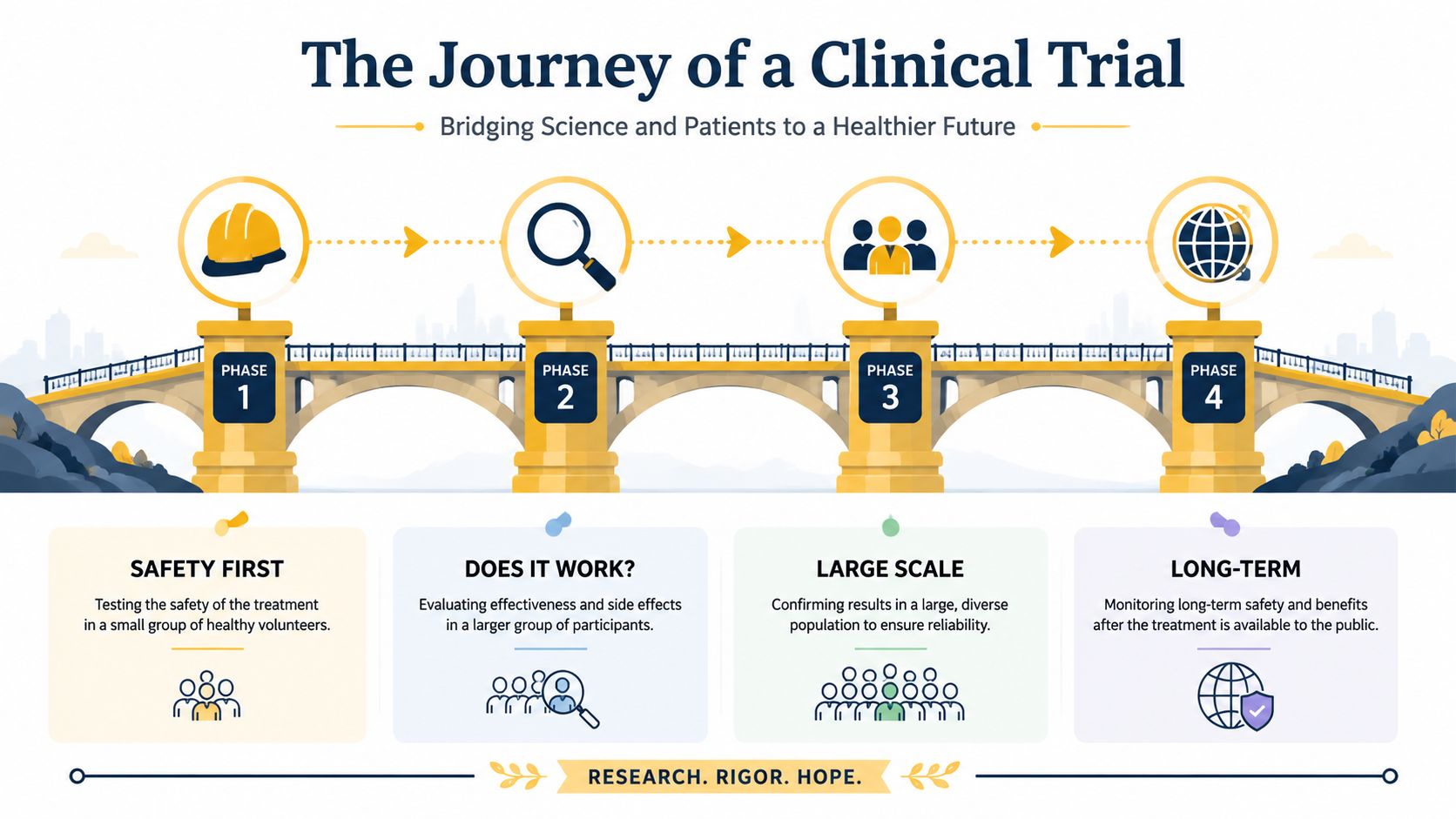
Phase 1 through Phase 4 in plain language
Phase 1 is the early safety stage. Researchers want to understand how the treatment behaves and what problems show up first. If you ever see Phase 1 on a listing, expect the study to be more exploratory.
Phase 2 asks whether the treatment shows signs of helping people with migraine. Researchers are still learning, but the question shifts from "Is this safe enough to continue studying?" to "Does this appear to work, and for whom?"
Phase 3 is where a treatment usually gets its biggest test. These studies often compare a new option with placebo or another treatment. If you're looking for a trial with a more established protocol and more patient-facing information, Phase 3 studies often provide that.
Phase 4 happens after approval. The treatment is already on the market, but researchers still monitor long-term use, safety, and how it performs outside tightly controlled settings.
Some people assume later phase always means "better for me." Not necessarily. It often means the research question is different.
Why endpoints matter to patients
One of the most confusing parts of migraine clinical trials is the word endpoint. It means the main result the researchers are measuring.
Older descriptions can make endpoints sound abstract. Modern migraine studies often use endpoints that reflect whether a treatment is usable in real life, not just whether a score changes on paper. A current comparative-effectiveness migraine prevention trial defines a responder as someone who stays on the assigned medication for 12 weeks and achieves at least a 50% reduction in moderate-to-severe headache days during the target period.
That kind of design matters because it combines benefit with tolerability. If a treatment only works when people can't stay on it, that doesn't help much in everyday care.
Here's how patients can read common endpoint language:
- Frequency endpoint means the study is counting migraine or headache days over time.
- Responder endpoint means the study is asking whether you crossed a meaningful threshold, not just whether there was a small average change.
- Persistence or adherence endpoint means researchers care whether people can continue the treatment.
- Patient-centered endpoint may include practical questions like whether symptoms improved enough that you'd choose the treatment again.
If a listing feels hard to interpret, ask the coordinator one direct question: "What would count as success for a participant in this study?" That usually gets you a much clearer answer than trial jargon.
Could a Migraine Trial Be Right for You
Not every trial fits every person with migraine. That isn't a judgment about your symptoms. It's how researchers try to answer one question clearly without too many competing variables.
Most studies have inclusion criteria and exclusion criteria. Inclusion criteria describe who the study is trying to enroll. Exclusion criteria describe situations that could make the results harder to interpret or make participation less safe.
What researchers usually look for
A trial may look for adults within a certain age range, a documented migraine diagnosis, a specific pattern of attacks, or a history of trying certain types of treatment. Some studies focus on episodic migraine. Others focus on chronic migraine. Some include aura, while others don't focus on it.
Exclusion criteria can include certain medical conditions, recent changes in treatment, medication patterns that complicate measurement, or practical issues such as being unable to attend study visits. None of that means your migraine isn't real. It means the study has narrow rules.
A useful self-check is to gather your recent history around:
- Attack pattern such as how often migraine happens and how long attacks tend to last
- Symptoms including aura, nausea, vomiting, photophobia, phonophobia, dizziness, or postdrome symptoms
- Treatment history with what you've tried and what happened
- Daily life impact such as missed work, disrupted sleep, or inability to function normally
If you're still trying to understand your overall pattern, a guide to migraine risk factors can help you organize the bigger picture before you contact a study team.
Your tracking data can make screening easier
Many readers gain an advantage here. Researchers often need a clean record of what your migraine has been doing. Memory alone usually isn't enough, especially if attacks blur together.
A strong tracking record can help you answer questions like:
- When did your attacks happen?
- Were they migraine attacks or another kind of headache?
- How severe were they?
- What associated symptoms showed up?
- Did the treatment help, and if so, how quickly?
- Were there stretches where attacks clustered around sleep disruption, weather changes, menstrual cycle timing, stress, or missed meals?
Bring data that helps someone else understand your month at a glance. A simple, consistent log is more useful than a complicated story told from memory.
You don't need a perfect diary. You need a usable one. If you've been logging symptoms consistently, you may be better prepared for screening than you realize.
Weighing the Potential Benefits and Risks
People join migraine clinical trials for different reasons. Some want access to a treatment that's not widely available yet. Some want more structured follow-up. Some feel strongly about contributing to better care for the next group of patients.
All of those reasons are valid. So are your hesitations.
Why people choose to join
A good trial can offer careful monitoring, a clear protocol, and more regular contact with a research team that focuses on migraine. Some people also appreciate having a defined plan instead of another open-ended cycle of trial and error.
There is also a bigger-picture benefit. Participating helps researchers refine what counts as meaningful improvement, which matters in a condition where function can change before pain fully improves.
Possible benefitWhat it can mean for youEarly accessYou may be able to try an investigational approach before it becomes widely availableStructured follow-upVisits and symptom review can feel more systematic than routine careContribution to scienceYour experience may help improve future migraine treatment and trial design
What can make participation hard
The risks are real too. You may have side effects. The study schedule may be demanding. You might need to stop or avoid certain treatments during the trial. And in some studies, you may receive placebo.
The placebo issue deserves plain language. A migraine research update summarizing rimegepant studies notes that in one prevention study, the placebo group saw monthly migraine days decrease by 0.5 days, and in an acute trial 32.7% of patients on placebo had pain relief at 2 hours. That doesn't mean symptoms are imagined. It means migraine trials need careful controls because improvement can happen even without the active treatment.
A few practical tradeoffs to think through:
- Time commitment includes screening, follow-up visits, forms, and sometimes travel.
- Uncertainty includes not knowing whether you'll benefit or whether you'll be assigned placebo in some studies.
- Routine disruption can include changes to your usual migraine plan. If recovery time after attacks already disrupts your life, it may help to think through that burden realistically. This article on migraine recovery time can help you frame that discussion.
If a coordinator can't explain the burdens and uncertainties in plain language, that's useful information. Good studies don't hide the inconvenient parts.
How to Find and Evaluate Migraine Trials
Finding migraine clinical trials is easier when you start with official registries and then narrow carefully. Search broadly first. Evaluate closely second.
Where to look first
Your best starting point is ClinicalTrials.gov because it lets you search by condition, location, recruitment status, and study type. Large headache centers and recognized headache organizations may also list studies or point you toward active sites.
When you open a trial listing, focus on the parts that affect real life:
- Recruitment status tells you whether enrollment is active
- Condition details show whether the study is targeting migraine broadly or a specific subtype
- Intervention model helps you understand whether there is comparison, randomization, or placebo
- Outcome measures reveal what the study values
- Contacts and locations tell you whether participation is realistic for you
Don't stop at "this sounds promising." Read the eligibility section slowly. A trial may sound relevant but still be a poor fit because of scheduling, treatment restrictions, or migraine subtype.
Questions worth asking before you enroll
A short call with a study coordinator can save a lot of frustration. Write questions down before you contact them.
Try asking:
- What is the study testing and is it for prevention or acute treatment?
- What does participation look like week to week including visits, diaries, procedures, and symptom reporting?
- What treatments or medications are restricted during the study?
- What costs are covered and what practical expenses should I ask about?
- What happens if my migraine gets worse or I need to leave the study?
- How will you decide whether the results apply to someone like me?
That last question matters more than many patients realize. A Practical Neurology review on underrepresented populations in headache medicine notes an analysis in which participants in studies for seven recently approved migraine treatments were, on average, 82% non-Hispanic white. If a study population doesn't reflect the people who will eventually use the treatment, it can limit what we know about generalizability.
You can also ask whether the study has removed common barriers. Transportation, work schedules, childcare, language access, internet access, and outreach all affect who gets in the door. That's not a side issue. It affects whether findings feel trustworthy to the people reading them later.
How to Prepare for Your First Study Visit
Your first study visit usually isn't a test. It's a screening conversation with paperwork, questions, and a careful review of whether the study is a match. Going in organized can lower your stress a lot.

What to bring
Think in terms of evidence, not just memory. Bring materials that help the research team understand your migraine pattern without guessing.
A useful checklist includes:
- Medication list with current treatments, past treatments, and any side effects or reasons you stopped
- Diagnosis history including notes from clinicians if you have them
- Migraine log covering dates, symptoms, severity, duration, and any acute treatment used
- Questions for the team so you don't forget them when you're tired or symptomatic
- Schedule notes about work, caregiving, transportation, and anything that could affect attendance
If you use a digital diary, it may help to review how a migraine tracking app can organize your records before the visit.
How to present your migraine history clearly
You don't need to tell your whole migraine story in one long stream. You'll help the team more if you summarize patterns.
For example, it helps to be able to say:
- when attacks usually start
- what your early symptoms are, such as prodrome changes or aura
- what makes an attack clearly "migraine" for you
- how long attacks tend to last
- what usually helps, what doesn't, and what side effects you've had
A short, organized record often works better than a detailed narrative. If your migraines vary a lot, say that directly and show examples from your log.
This video can help you get into the right mindset before a study conversation:
Bring the version of your history that is easiest to verify. Dates, symptom patterns, and treatment responses matter more than trying to sound polished.
If you're worried you'll forget details during the visit, print or export your recent entries in advance. That turns the meeting into a collaboration instead of a memory test.
Your Rights and Safety as a Participant
Clinical research has rules for a reason. You are not expected to hand over control just because a study sounds promising.
Informed consent is an ongoing process
Informed consent means the study team should explain what the trial is for, what will happen, what the risks are, what alternatives exist, and what your options are if you change your mind. It isn't just a signature page. It's a conversation you should be able to revisit.
You can ask for plain-language explanations. You can ask for time to think. You can leave a study if you no longer want to participate.
Most human research is also reviewed by an Institutional Review Board, often called an IRB. This is an independent group that reviews whether the study is ethical and whether participant protections are adequate. You don't need to know every regulatory detail to benefit from that safeguard. You do need to know that questions about safety, privacy, and burden are appropriate to ask.
Ask how results will be shared
One overlooked question is what happens after the trial ends. A historical review of registered migraine trials through 2013 found that results were publicly available for 55% of studies. Transparency has improved, but that benchmark is still a good reminder to ask how and when participants and the public will learn what the study found.
Ask these directly:
- Will participants receive a summary of the results
- Will the study be published or posted publicly
- Who should I contact after the trial if I have questions
- What happens to my care if I withdraw early
Good research should make you feel informed, not cornered. If you decide to explore migraine clinical trials, your own tracking records can help you ask sharper questions, communicate more clearly, and advocate for yourself at every step.
If you want a simple way to build that kind of record over time, Relief can help you log symptoms, triggers, and patterns so you're better prepared for clinical visits, research screening, and everyday migraine self-management.


