
A migraine cocktail in the ER usually isn't one fixed recipe. It's a combination of IV treatments given together for a severe migraine attack, and one widely cited emergency department review describes a sample regimen of 1 L IV normal saline, 10 mg IV prochlorperazine, 25 mg IV diphenhydramine, 30 mg IV ketorolac, and 10 mg IV dexamethasone.
If you're reading this while trying to decide whether the ER is the right move, you're probably already worn down. Severe migraine can make basic decisions feel impossible, especially when pain, nausea, light sensitivity, and fear are all hitting at once. Knowing what a migraine cocktail is, what to expect, and how to advocate for yourself can make an ER visit feel less chaotic and more manageable.
This article is for informational purposes and is not medical advice. Consult a healthcare provider for personalized guidance.
Table of Contents
When a Migraine Attack Warrants an ER Visit
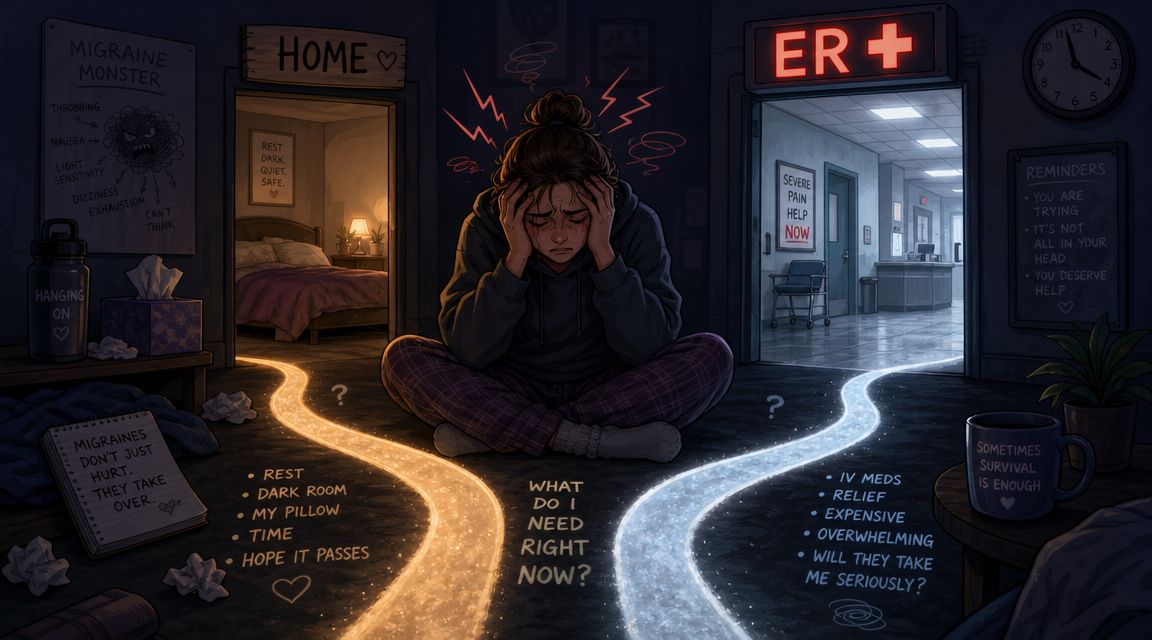
It's hard to know when to keep trying at home and when to stop pushing through. A severe migraine attack can feel dramatic even when it isn't dangerous, and that's exactly why clear red flags matter.
Red flags that need immediate care
Seek urgent medical care right away if you have any of these:
- A sudden, explosive headache that reaches maximum intensity fast, especially if it feels unlike your usual migraine.
- Headache with fever or stiff neck.
- New neurological symptoms such as weakness, trouble speaking, confusion, vision loss, or symptoms that are different from your usual aura.
- Headache after a head injury.
- A major change from your typical migraine pattern, especially if you're thinking, “This is not my normal attack.”
Safety rule: A severe migraine can be miserable without being an emergency, but a severe headache with new or unusual features should be evaluated immediately.
This is not optional. If you have a sudden severe headache, headache with fever or stiff neck, neurological changes, or headache after head injury, seek immediate medical care.
When it may still be migraine, but home care isn't enough
Sometimes the issue isn't a new dangerous symptom. It's that your usual plan just isn't working.
If your migraine has lasted a long time, you can't keep fluids down, or your normal rescue medications haven't helped, the ER may be the safest place to get hydration, symptom control, and an exam. This is also when it helps to know your own pattern. Tracking changes in frequency, severity, and triggers can make that decision less guesswork. ReliefMigraine's guide to migraine risk factors can help you think through what tends to make your attacks spiral.
A useful question is: Is this attack severe but familiar, or severe and different? Familiar but unrelenting may point toward urgent treatment for migraine. Different, sudden, or neurologic needs emergency evaluation first.
What Exactly Is a Migraine Cocktail
During a bad migraine, the phrase migraine cocktail can sound confusing or even a little dismissive. In the ER, it usually means a group of treatments given together to calm several parts of the attack at the same time.
That matters because a severe migraine is rarely just head pain. It can also bring nausea, vomiting, dehydration, sensitivity to light and sound, and a nervous system that feels stuck in high alert. A single medicine may help one piece of that puzzle. ER treatment is often built to address several pieces at once.
A helpful way to picture it is a fire response. If smoke, heat, and alarm systems are all going off, one tool will not solve the whole problem. The ER team may use fluids, anti-nausea medicine, pain treatment, and sometimes a medication to lower the chance the migraine rebounds soon after you leave.
There is also no single universal recipe. The exact mix depends on what your symptoms look like, what you have already taken at home, your medical history, and how you have responded to past migraine treatments. Two patients can both receive a “migraine cocktail” and get slightly different plans.
For patients, the most useful takeaway is simple. A migraine cocktail is a treatment strategy. It is the ER's way of trying to interrupt a severe attack quickly enough that you can rest, keep fluids down, and get your body out of crisis mode.
Knowing that can help you ask better questions in the moment. If staff mention a migraine cocktail, you can ask, “What is each medication meant to help with?” and “Are you treating the pain, the nausea, and the chance it comes back?” In a stressful ER visit, that kind of clarity can make the experience feel more manageable and less mysterious.
Common Medications in an ER Migraine Cocktail
When a nurse lists several medications in quick succession, it can sound like a lot. A simpler way to make sense of it is to sort each one by what problem it is trying to solve. That gives you a clearer picture of the plan and makes it easier to ask good questions in the moment.
Common migraine cocktail components and their purpose
Medication ClassExample(s)What It DoesIV fluidsNormal salineHelps if you have been vomiting, have poor fluid intake, or seem dehydratedAntiemeticProchlorperazine, metoclopramideTreats nausea and can also help calm the migraine attack itselfAntihistamineDiphenhydramineMay be added to reduce side effects from some anti-nausea medicinesNSAIDKetorolacTreats pain and inflammationCorticosteroidDexamethasoneMay lower the chance of the migraine returning soon after treatment
What each type of medication is doing
IV fluids are often used when migraine has made drinking hard or vomiting frequent. They do not erase every migraine on their own, but they can support recovery if your body is running low on fluids.
Antiemetics are anti-nausea medicines, but migraine care uses them for more than stomach symptoms. Drugs such as metoclopramide or prochlorperazine can help with nausea and may also interrupt part of the migraine process. If staff mention one of these, a useful question is, “Is this mainly for nausea, or is it also meant to help the migraine itself?”
NSAIDs are anti-inflammatory pain medicines. In the ER, ketorolac is a common example. It is one way clinicians treat severe migraine pain without jumping straight to opioids, which are usually avoided unless there is a specific reason to use them.
Diphenhydramine confuses many patients because they know it as an allergy medicine or sleep aid. In an ER migraine cocktail, it is often there to help prevent or ease side effects from certain antiemetics, especially that keyed-up, restless feeling some people get.
Dexamethasone is a steroid. Its job is usually not immediate pain relief. Instead, it may be added to reduce the chance that the migraine returns soon after you go home.
One helpful way to view the cocktail is as a team effort. One medicine helps the nausea. Another targets pain. Another helps with side effects. Another may help you stay better after discharge.
That is also why two people with “the same” migraine may not get identical treatment. Your mix may change based on vomiting, dehydration, prior reactions, what you already took at home, pregnancy status, allergies, or other health conditions.
If you feel too foggy to track the medication names, ask for the plain-language version. “Can you tell me what each medicine is for?” is a smart question, not a difficult one. In a stressful ER visit, that kind of clarity can make the experience feel less confusing and more manageable.
Why Combination Therapy Is Effective for Severe Migraine
Severe migraine usually needs more than a one-note treatment plan. In the ER, the goal is often to calm several parts of the attack at once so the whole cycle can start to break.
Migraine acts more like a system-wide flare than a simple pain problem. Pain is part of it, but so are nausea, vomiting, light sensitivity, sound sensitivity, dehydration, and the slowed, foggy feeling that makes it hard to answer questions or even sit upright. If a clinician treats only one piece, the others can keep feeding the attack.
Combination therapy works like tackling a house fire from more than one angle. One medication may reduce pain. Another may settle nausea so you can stop vomiting. Fluids may help if you have not been able to drink. A steroid may be added to lower the chance that the migraine roars back soon after discharge. Instead of waiting for one medicine to fail before trying the next, ER teams often stack treatments to give your brain and body a better shot at resetting.
Application for status migrainosus
This approach becomes even more important when an attack will not let go. A prolonged migraine can wear you down physically and mentally, especially if you have had little sleep, poor oral intake, or repeated vomiting. By the time someone reaches the ER, the problem is often bigger than pain control alone.
In that setting, the team is trying to interrupt an entrenched migraine state, not just take the edge off. That is one reason opioids are usually not the center of ER migraine treatment. They may dull pain briefly, but they do not address the broader migraine process in the same targeted way as the medicines commonly used in a cocktail.
For patients, this is useful context. If the ER clinician offers several treatments at once, it usually reflects a practical strategy, not over-treatment. You can ask, “Which symptom is each medication meant to help?” That question can make the plan feel less mysterious, especially when your brain is overloaded.
If you already track what has and has not worked for past attacks, bring that information with you. A migraine tracking app that shows timing, symptoms, and prior treatments can make those conversations faster and clearer when you are in too much pain to explain everything from memory.
How to Prepare for a Migraine ER Visit
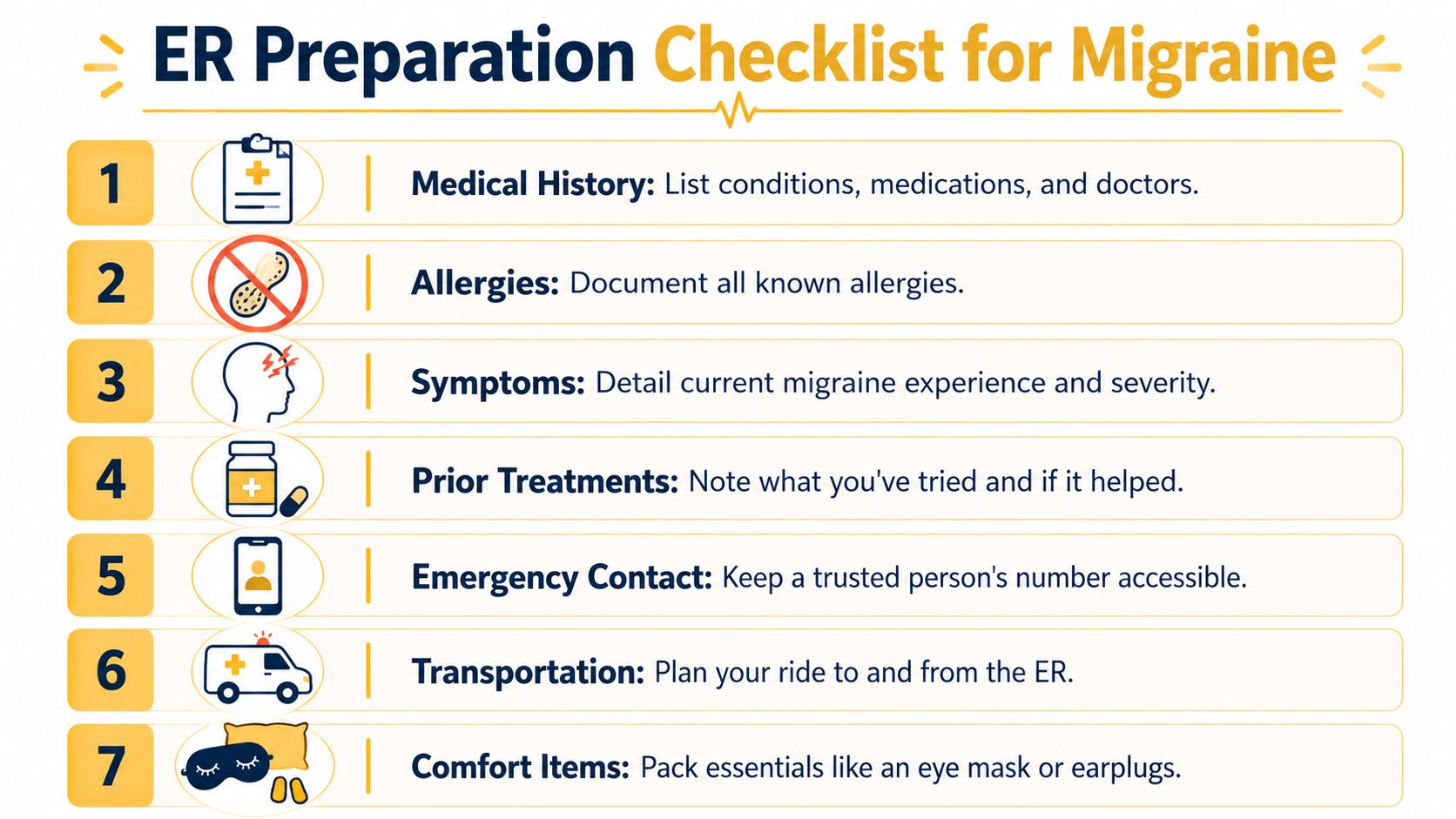
Preparation won't make an ER visit pleasant, but it can make it smoother. When your brain is overloaded, a short checklist helps more than trying to remember everything in the moment.
Here's a simple visual to save or screenshot before you need it.
What to bring
If you can, grab these basics:
- ID and insurance card if you use one
- Medication list including regular prescriptions, recent migraine treatments, and supplements
- Allergy list with medication reactions
- Your migraine history in a few lines such as whether you get aura, vomiting, or prolonged attacks
- Emergency contact information
- A charged phone and charger
If you track your attacks in an app, bring that too. A tool like Relief's migraine tracking app can help you show timing, symptoms, possible triggers, and what you already tried before arriving.
What to say when your brain feels foggy
You do not need a perfect speech. Short, concrete facts help most.
Try a script like this:
- When it started: “This attack started yesterday morning.”
- How it compares: “This feels like my usual migraine” or “This is different from my usual migraine.”
- Symptoms: “I have nausea, vomiting, photophobia, and I can't keep fluids down.”
- What you already used: “I took my usual migraine medicine at home, but it didn't help.”
- What worries you: “The pain is severe,” or “I'm having symptoms I don't usually get.”
Photophobia means light sensitivity. If sound is unbearable too, say that plainly. You don't need perfect terminology for the staff to understand you.
A short explainer can also help if someone is with you:
“I get migraine, not just headache. During an attack I may have nausea, light sensitivity, trouble thinking clearly, and difficulty answering lots of questions fast.”
Later in the section, if you want a walkthrough of what ER migraine care can involve, this video may help:
Small comfort items that help
The ER isn't designed for sensory-sensitive brains, so a few small items can matter:
- Sunglasses or a hat for bright lights
- Earplugs or noise-canceling headphones if sound ramps up symptoms
- A vomit bag or tissues for the ride
- A small eye mask if it helps you rest
- A support person who can help answer questions if you're foggy
If you're too sick to organize all of this, don't let that stop you from going. The checklist is there to reduce stress, not create another task you can fail.
Understanding Potential Risks and Side Effects
The migraine cocktail in ER care can be very helpful, but it isn't side-effect free. Knowing what might happen can make treatment less alarming.
Common side effects you might notice
Different components can cause different effects, and some overlap:
- Drowsiness or grogginess can happen with several medications used in ER migraine care.
- Dizziness may show up during treatment or afterward.
- Restlessness can happen with certain anti-nausea medications. Some people describe this as feeling unable to sit still in their own body.
- Upset stomach or stomach irritation may be associated with anti-inflammatory medication.
- Temporary wired or off-feeling mood changes can happen after steroids in some people.
Diphenhydramine is often included partly because it may help with certain medication side effects, not just because it causes sleepiness.
What to tell staff right away
Don't tough out side effects in silence. Tell the nurse or doctor promptly if you notice:
- A sudden feeling of intense inner restlessness
- Trouble breathing
- A rash or swelling
- Worsening dizziness
- Anything that feels very different from what staff told you to expect
You're in a monitored medical setting. Staff can often adjust treatment or give another medication to manage side effects.
This balance matters. Severe migraine itself can be destabilizing, and ER teams use these treatments because the benefits may outweigh the downsides when an attack is prolonged, disabling, or not responding to home care.
After the ER Visit Your Next Steps
Relief after IV treatment can feel almost surreal. Then the next question hits: what now?

What the next day may feel like
Even if the worst pain is gone, you may still feel drained. Many people notice lingering fatigue, brain fog, sensitivity, or a “migraine hangover,” often called postdrome, which is the phase after the main attack ends.
A few practical steps usually help:
- Rest if you can
- Rehydrate gently
- Eat something simple if nausea has eased
- Avoid jumping straight back into a full, overstimulating schedule
- Review your discharge instructions while your memory is fresh
If your symptoms return, worsen, or new red flags appear, seek medical care promptly.
How to make the follow-up visit more useful
An ER visit for migraine usually means your current plan needs another look. That doesn't mean you failed. It means the attack outpaced the tools you had at home.
Before your follow-up with your primary care clinician or neurologist, write down:
- When the attack started
- What symptoms you had
- What you tried before the ER
- What happened at the ER
- How you felt in the next day or two
- Anything unusual about this attack compared with your normal pattern
This kind of record helps your clinician think about whether your acute treatment plan, prevention plan, or trigger-management strategy needs adjusting. It also helps separate a typical severe migraine from a meaningful change in pattern.
If you often struggle to remember details after a bad attack, reviewing migraine recovery time can help you make sense of what's normal in the postdrome phase and what deserves more attention.
A useful follow-up question is: “What should my home rescue plan be so I know when to treat earlier, when to call, and when the ER is appropriate?”
A severe migraine can make you feel powerless. Clear records, a follow-up plan, and better timing for future treatment can give some of that control back.
If you want one place to log the attack, note what happened in the ER, and track symptoms afterward, Relief can support that process without replacing medical care.


