A migraine hangover, also called postdrome, is the final phase of a migraine attack, and more than 80% of people who have migraine attacks experience it at some point. It often brings fatigue, brain fog, body aches, dizziness, nausea, and light or sound sensitivity, and it can last from a few hours up to 48 hours.
If you're reading this after the head pain has eased but you still feel wrung out, slow, shaky, or strangely fragile, you're not imagining it. This is one of the most frustrating parts of migraine because other people may think the attack is over, while your brain and body clearly know it isn't.
A lot of people call this a “migraine hangover” because it can feel similar to an alcohol hangover. You're tired, unfocused, sensitive, and not fully yourself. The medical name matters, though. Calling it postdrome reminds you that this isn't random leftover discomfort. It's a recognized recovery phase of migraine.
That distinction can be a relief. It also changes how you manage the day after an attack. Instead of pushing yourself to “get back to normal,” it often helps to treat this period like real neurological recovery.
Table of Contents
- The Migraine is Over But You Still Feel Awful
- Migraine is more than head pain
- Why postdrome feels so disruptive
The Migraine is Over But You Still Feel Awful
You finally get through the worst of the migraine. The pounding eases. Maybe the nausea backs off a little. Then you expect relief, but instead you're left with cotton-brain, heavy limbs, a stiff neck, and the sense that your body has been through something major.
That's a common migraine pattern. The headache phase may be ending, but the attack itself hasn't fully resolved yet.
The “migraine hangover” is the postdrome phase of migraine. It often shows up as fatigue, brain fog, and body aches, though many people also notice dizziness, irritability, nausea, or lingering sensitivity to light and sound. Those symptoms can make simple things feel harder than they should, like answering email, driving, cooking, or following a conversation.
You don't have to wait for pain to be severe to count yourself as impaired. If your thinking, balance, energy, or sensory tolerance is off, you're still recovering.
One reason readers get confused is that migraine is often talked about like it's just a bad headache. It isn't. Migraine is a neurological event, and the pain phase is only one part of it. That's why you can still feel significantly unwell after the sharpest pain stops.
Another point that trips people up is guilt. You may think, “The migraine is over, so why can't I function?” The answer is that postdrome isn't laziness, low motivation, or overreacting. It's part of the same attack.
What Is the Migraine Postdrome Phase
Migraine is more than head pain
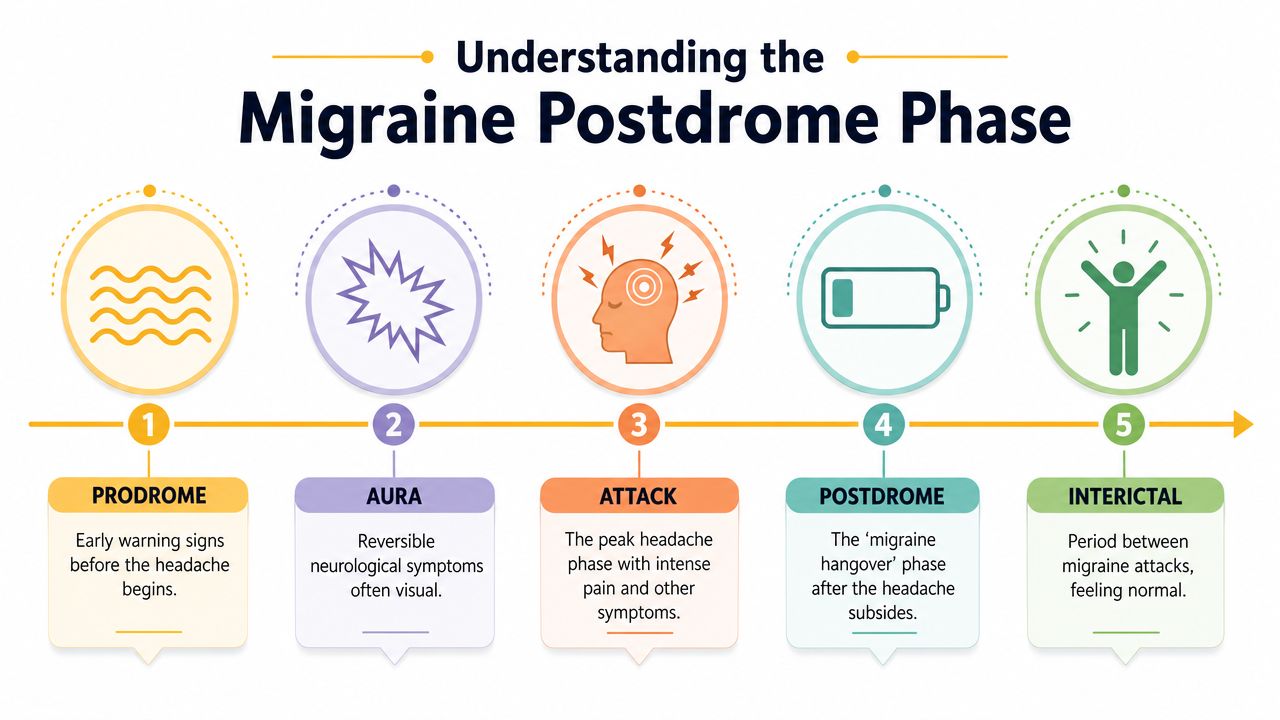
Modern migraine care treats an attack as a multi-phase process, not just a block of head pain. A typical migraine may include:
- Prodrome. Early warning changes before the headache phase, such as feeling off, tired, or unusually sensitive.
- Aura. Temporary neurological symptoms that some people get, often visual changes or other sensory changes.
- Headache. The attack phase commonly recognized, often with pain, nausea, and sensory sensitivity.
- Postdrome. The recovery phase after the worst pain eases, when you still don't feel back to normal.
A helpful way to think about it is a storm. The loudest part is the worst weather. Postdrome is the messy aftermath. The storm has moved on, but there are still branches down, power flickers, and cleanup to do.
According to Cleveland Clinic's overview of migraine hangover and postdrome, more than 80% of people who experience migraine attacks also experience postdrome, and it commonly lasts from a few hours to as long as 48 hours. That matters because it confirms this phase is common, recognized, and medically relevant.
Why postdrome feels so disruptive
Postdrome can be confusing because the outside signs of migraine may be fading while the functional effects are still obvious to you. You may not be curled up in a dark room anymore, but you also may not be ready for spreadsheets, school pickup, a workout, or a noisy restaurant.
The idea that “the migraine is over” can be misleading. Pain relief doesn't always mean full recovery. If you've ever wondered why your brain feels slow the day after a migraine, that's exactly the kind of experience postdrome helps explain.
If you're trying to understand your full recovery window, it can help to look beyond the pain phase and learn more about how long migraine recovery can actually take.
Postdrome is easier to handle when you stop treating it like a mystery and start treating it like recovery.
Common and Uncommon Migraine Hangover Symptoms
Some migraine hangover symptoms are easy to recognize. Others are subtle and easy to dismiss. The tricky part is that they don't always look dramatic from the outside, even when they clearly affect your ability to function.
In a study summary discussed by Migraine.com, 68% of participants reported postdrome symptoms lasting from a few hours to a couple of days, with an average duration of 25.2 hours. The reported symptoms included cognitive slowing, weakness, dizziness, and mood shifts.
Cognitive symptoms
For many people, the most disruptive part of postdrome isn't pain. It's the sense that their brain is running below normal capacity.
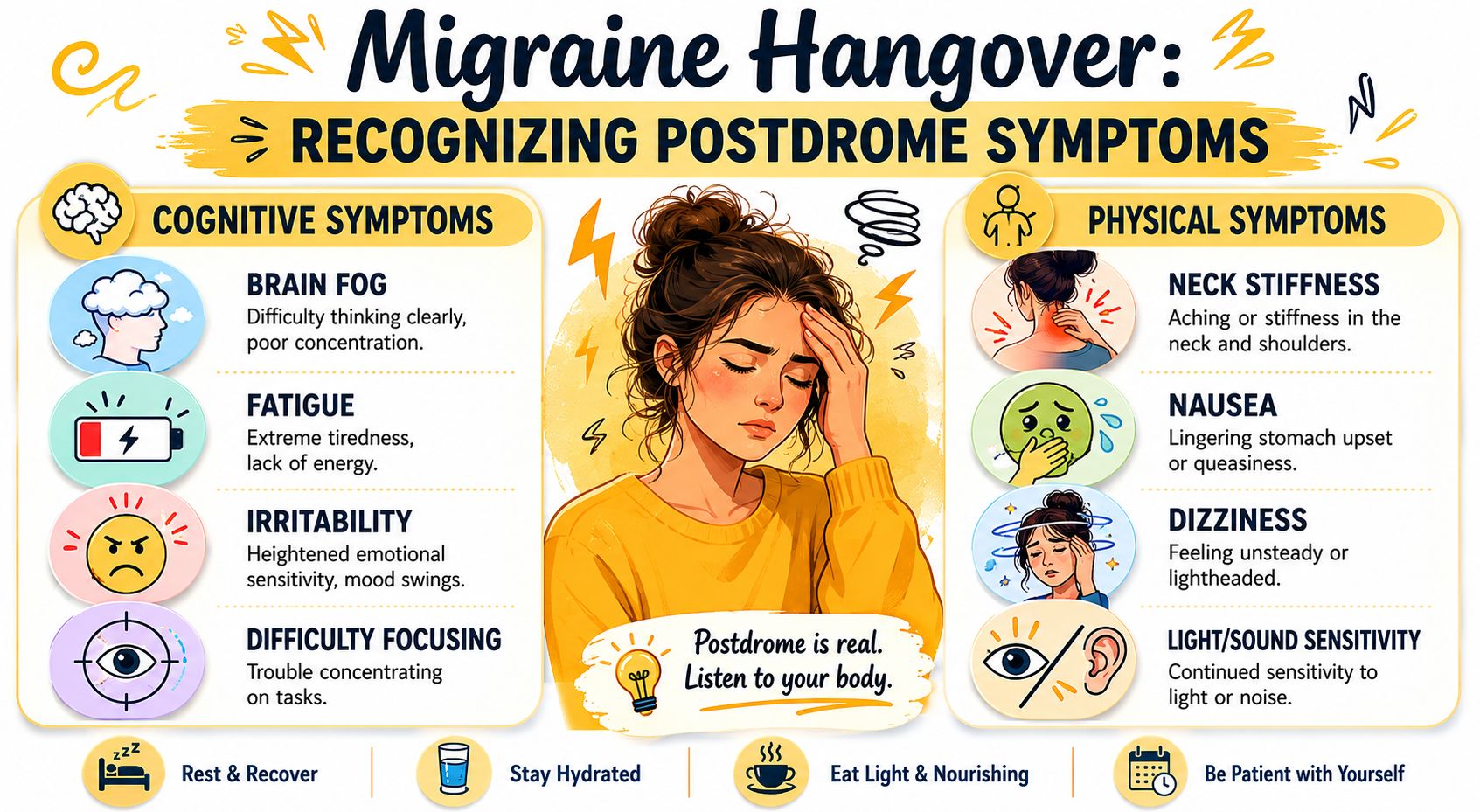
Common cognitive migraine hangover symptoms include:
- Brain fog. You know what you want to do, but your thinking feels muddy or slow.
- Difficulty concentrating. Reading, planning, or staying on task may feel unusually hard.
- Forgetfulness. You may lose track of words, steps, or simple details.
- Reduced mental stamina. Tasks that usually feel routine can become draining fast.
This is why postdrome can interfere with work even when you're technically “better.” You may be able to sit at your desk, but not think clearly enough to do high-focus tasks well. That's real impairment, not poor effort.
Physical symptoms
Postdrome also has a strong physical side. Some symptoms feel like the body version of brain fog. Others feel like your nervous system is still on edge.
You might notice:
- Fatigue or exhaustion. Not just sleepiness, but a heavy, used-up feeling.
- Body aches. A general sore, flu-like sensation can linger.
- Neck stiffness or shoulder tension. This is especially common after the attack phase.
- Dizziness or lightheadedness. You may feel unsteady or slightly off-balance.
- Nausea. Your stomach may still be unsettled even after head pain improves.
- Sensitivity to light and sound. Bright rooms, screens, music, traffic, or conversation can still feel like too much.
- Residual head pain. Sometimes the intense migraine pain fades into a milder ache, pressure, or tenderness.
- Scalp or skin sensitivity. Your head or face may still feel tender.
A useful question is not just “Do I have symptoms?” but “What can I not do comfortably right now?” If screens are impossible, standing makes you woozy, or conversation feels like work, that gives you a better picture of how much recovery you still need.
Mood and emotional symptoms
Postdrome can affect mood in ways people don't always expect. This can be frustrating because emotional symptoms are easy for others to misread.
Some people notice:
- Irritability. Small demands feel bigger than usual.
- Sadness or low mood. You may feel emotionally flat or fragile.
- Anxiety about another attack. Recovery can make you hyperaware of every sensation.
- A strange “off” feeling. Not exactly sad or anxious, just not fully like yourself.
If postdrome changes your mood, that doesn't mean the symptoms are “just stress.” Migraine can affect thinking, energy, and emotional regulation at the same time.
Not every symptom fits neatly into a category. Some people mainly feel drained. Others feel mentally foggy but physically restless. Some have almost no pain afterward but still can't tolerate noise or multitasking. Variability is normal.
How to Manage Migraine Hangover Symptoms
You don't need to wait and hope for the best. The most helpful way to approach postdrome is as active recovery. That means reducing strain on your brain and body while giving yourself the best shot at settling back to baseline.
The American Migraine Foundation's guidance on migraine hangover recommends continued hydration, light activity only, such as gentle stretching, and avoiding overstimulation during this phase. The same guidance notes that bright light, loud noise, and strenuous exercise can amplify lingering symptoms and may increase the risk of another attack.
Treat postdrome like active recovery
A few practical strategies tend to make the biggest difference.
- Keep drinking fluids. If you got dehydrated during the attack, recovery may feel rougher. Sip steadily instead of trying to catch up all at once.
- Lower sensory load. Dim lights, reduce screen brightness, use a quieter room, and ease back into normal stimulation.
- Eat something steady and simple. If your appetite is off, try a small meal or snack rather than skipping food entirely. Some people also find it useful to review a broader migraine diet plan for patterns around meals and recovery.
- Move gently, not intensely. Stretching, a short easy walk, or other light movement may feel better than jumping back into hard exercise.
- Protect your schedule. If possible, avoid stacking demanding tasks right after an attack.
- Rest without pressure. Sleep can help, but quiet rest also counts if you can't fall asleep.
A common mistake is treating the end of head pain like a green light to do everything you missed. Catching up all at once can backfire. If your nervous system is still sensitive, too much cognitive work, noise, motion, or exercise can leave you feeling worse again.
Practical rule: If an activity raises your symptoms while you're doing it, scale it down. Recovery usually goes better with less forcing, not more.
If it helps, think in layers. First reduce what aggravates symptoms. Then add back basics like hydration, food, and gentle movement. Only after that should you test higher-focus or higher-exertion tasks.
A short visual walkthrough can also help if you're too foggy to read much more:
Over-the-counter care and medical conversations
Some people use over-the-counter options for lingering discomfort such as body aches or mild residual pain. Because migraine patterns and medication risks vary, it's best to check with a healthcare provider or pharmacist about what's appropriate for you, especially if you use pain relievers often.
This article is for informational purposes and is not medical advice. Consult a healthcare provider for personalized guidance.
It also helps to tell your clinician about the part after the pain. Instead of saying only “my migraine lasted six hours,” try noting what happened after. For example: “The severe pain ended by afternoon, but I had brain fog, dizziness, and light sensitivity until the next day.” That gives a fuller picture of how disabling the attack really was.
If you use a tracking tool, include postdrome as its own entry rather than rolling it into headache severity. Relief, for example, lets users log symptoms and patterns over time, which can help separate what triggers an attack from what seems to prolong recovery.
Is It a Migraine Hangover or Something Else
One reason migraine hangover symptoms cause so much confusion is that they overlap with other problems. You may wonder whether you're still in the same migraine, dealing with medication overuse, having lingering aura symptoms, or looking at something unrelated.
The biggest clues are usually timing, symptom pattern, and how the symptoms relate to medication use.
A quick comparison
| Feature | Migraine Postdrome (Hangover) | Medication Overuse Headache (MOH) | Lingering Aura |
|---|---|---|---|
| When it starts | After the main migraine pain begins to ease or ends | Often develops in the setting of frequent use of acute pain or migraine medicines | Usually follows or extends aura-type symptoms |
| Main feel | Drained, foggy, achy, sensitive, “not back to normal” | Ongoing or recurrent headache pattern that may feel hard to break | Ongoing neurological symptoms more than a classic hangover feeling |
| Common symptoms | Fatigue, brain fog, dizziness, nausea, neck stiffness, light or sound sensitivity, mood changes | Frequent headache, concern about repeated need for medication, symptoms tied to a broader cycle of recurring head pain | Visual changes, sensory changes, or speech-related symptoms that fit aura more than fatigue alone |
| Relationship to medications | Can happen whether or not you took acute treatment | Closely linked to a pattern of using acute medicines too often | Not defined by medication pattern |
| What often helps clarify it | Tracking symptom start after pain relief and noting recovery window | Reviewing how often you use acute medicines with a clinician | Noting whether symptoms are aura-like rather than general exhaustion |
This table can't diagnose the difference, but it can help you ask better questions.
If what you mainly feel is exhaustion, mental fog, and sensory sensitivity after the attack, postdrome is often the more likely explanation. If you're stuck in a repeating cycle of frequent headaches and frequent rescue medication use, that points to a different conversation with your clinician. If your symptoms are mostly visual or other reversible neurological changes, lingering aura may be the issue.
Post-concussion symptoms can also overlap with migraine symptoms, especially if there was a recent head injury. In that situation, timing matters a lot. If your symptoms follow trauma, don't assume it's “just postdrome.”
When to get medical help now
Some symptoms should never be written off as a routine migraine hangover.
Seek immediate medical care for a sudden severe headache, headache with fever or stiff neck, new neurological changes, or headache after a head injury.
This article is for informational purposes and is not medical advice. Consult a healthcare provider for personalized guidance.
It's also worth checking in with a clinician if your “hangover” keeps lasting much longer than usual for you, changes in character, or starts happening in a way that feels different from your typical migraine pattern.
Tracking Your Postdrome for Better Forecasting
A lot of migraine tracking focuses on when the pain started and what stopped it. That's useful, but it misses part of the story. If your pain lasts half a day and your postdrome lasts into the next day, the impact of the attack is much bigger than the pain window alone.
Many people describe postdrome as feeling like a traditional alcohol hangover, and a survey-style clinical summary cited by GammaCore's overview of what a migraine hangover is and how to cope estimated that most participants recovered within about 24 hours. The same body of reporting highlights why tracking this phase matters. It helps patients and clinicians assess the full recovery window, not just the point when pain eases.
A simple tracking framework can help:
- Log when pain ended. That marks the start of your recovery phase.
- Record the main postdrome symptoms. Brain fog, fatigue, dizziness, nausea, sensory sensitivity, mood changes, or body aches.
- Note what made things worse. Screens, skipped meals, bright light, noise, travel, intense exercise, or work stress.
- Note what helped. Rest, hydration, gentle stretching, a dark room, or a slower schedule.
- Mark when you felt fully normal again. That gives you a more realistic duration for the entire attack.
Over time, this kind of record can show whether a treatment helps only with pain or seems to shorten the whole episode. It can also reveal patterns in your recovery days that aren't obvious in the moment.
If you want one place to capture those patterns, a migraine tracking app can make it easier to log postdrome symptoms alongside triggers, medications, and timing.
Relief can help you track the full arc of a migraine, including the postdrome phase, so you can spot what seems to trigger attacks, what prolongs recovery, and what helps you get back to baseline.


