
You've planned the mountain trip, the ski weekend, or the flight into a high-altitude city, and then the familiar pain starts before you've even unpacked. Altitude can contribute to migraine attacks and altitude-related headaches, but not every headache above sea level is a migraine. The difference matters because a true migraine may need your usual migraine plan, while high-altitude headache or acute mountain sickness may call for rest, medical assessment, or descent.
The evidence points to altitude as a measurable environmental variable, not merely an impression. A population-based study in Nepal found that migraine prevalence and symptom burden increased across residential elevations, while research in high-altitude hikers found that a prior migraine history strongly predicted headache outcomes. This guide separates the main mechanisms, compares migraine with high-altitude headache, identifies meaningful risk factors, and gives you a practical acclimatization and tracking plan.
This article is for informational purposes and is not medical advice. Consult a healthcare provider for personalized guidance.
Table of Contents
- Does flying count as altitude exposure?
- Can altitude affect a CPAP machine?
- Do children or pregnant travelers need different precautions?
- How do hormones interact with altitude?
When the Mountain Becomes the Trigger
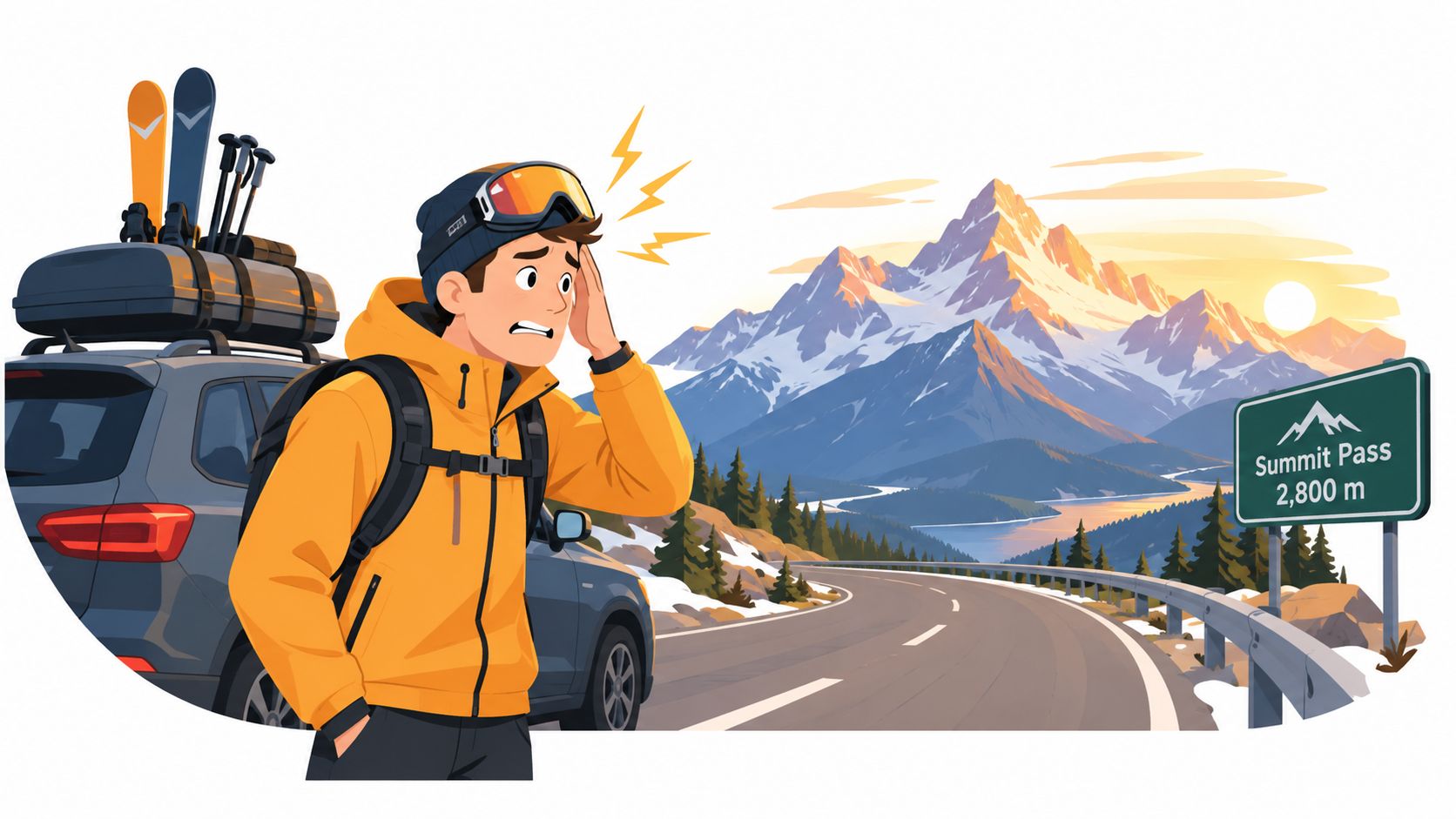
You arrive at a mountain pass after hours of winding roads. The air feels colder and thinner, sunlight reflects off the snow, and you realize you've barely eaten since breakfast. Then the pain begins behind one eye, or perhaps across your temples, followed by nausea and a growing need to escape the glare.
You may wonder whether the elevation is really responsible or whether the journey disrupted your routine. Both can be true. Altitude often arrives with less available oxygen, lower air pressure, dry air, exertion, missed meals, altered sleep, and stress, so several migraine-relevant conditions can overlap during one trip.
Why your experience deserves attention
Migraine isn't just a bad headache. It's a neurological disorder that can include throbbing pain, nausea, photophobia, meaning sensitivity to light, phonophobia, meaning sensitivity to sound, and sometimes aura, temporary visual, sensory, or speech changes that can precede or accompany the attack. Some people live with episodic migraine, others with chronic migraine, vestibular migraine, migraine with aura, or less common forms such as hemiplegic migraine.
Altitude may lower your personal threshold without being the only cause. A late night, dehydration, glare, weather changes, and a rapid ascent can combine in a way that makes an attack more likely than any single factor would have done alone.
A useful way to approach migraines and altitude is to ask three questions:
- What changed in the environment? Note elevation, ascent speed, air pressure, temperature, wind, and glare.
- What changed in your body? Track sleep, food, fluids, exertion, stress, and medications.
- What did the pain look like? Record location, quality, duration, nausea, aura, and whether descent helped.
That record can help you distinguish a repeatable altitude pattern from a one-off travel disruption. It also gives a clinician something more useful than the vague memory that “the mountains caused it.”
Practical rule: Treat altitude as one important variable in a larger pattern, not as proof that every mountain headache is a migraine.
The Three Altitude Mechanisms That Drive Migraines
Altitude doesn't act through one single switch. Three processes commonly overlap, and understanding them makes prevention more practical.
Hypobaric hypoxia
At higher elevation, atmospheric pressure is lower. The percentage of oxygen in the air doesn't disappear, but each breath delivers less oxygen pressure to your lungs and bloodstream. Think of oxygen as fuel for an engine. The engine may still run, but it has less fuel available while you're walking uphill, carrying luggage, or sleeping in a new environment.
This state is called hypobaric hypoxia. Reviews describe possible migraine-related pathways involving changes in cerebral blood flow, nitric oxide, calcitonin gene-related peptide, cortical spreading depolarization, and blood-brain-barrier leakage. These mechanisms can activate or sensitize the trigeminovascular system, a network involved in migraine pain signaling. The review of hypoxia and migraine mechanisms explains why reduced oxygen can produce both migraine-like symptoms and altitude-related headache.
Falling pressure and changing weather
As you ascend, pressure falls. Weather systems can also produce pressure changes, especially when a front moves through. For some people, that changing pressure seems to irritate pain-sensitive nerve pathways or interact with already sensitive migraine biology.
Pressure isn't a guaranteed trigger. One person may react to a rapid ascent, another to a storm front, and another may notice no pattern at all. If weather changes also affect you, tracking barometric pressure changes can help you compare pressure shifts with your own symptoms rather than relying on assumptions.
Dehydration and exertion
Mountain air is often cold and dry. You may lose fluid through breathing, sweating, exertion, or increased urination, while travel makes it easy to miss meals and forget to drink. Dehydration can narrow the margin between feeling well and crossing into an attack, particularly when it combines with poor sleep or intense physical activity.
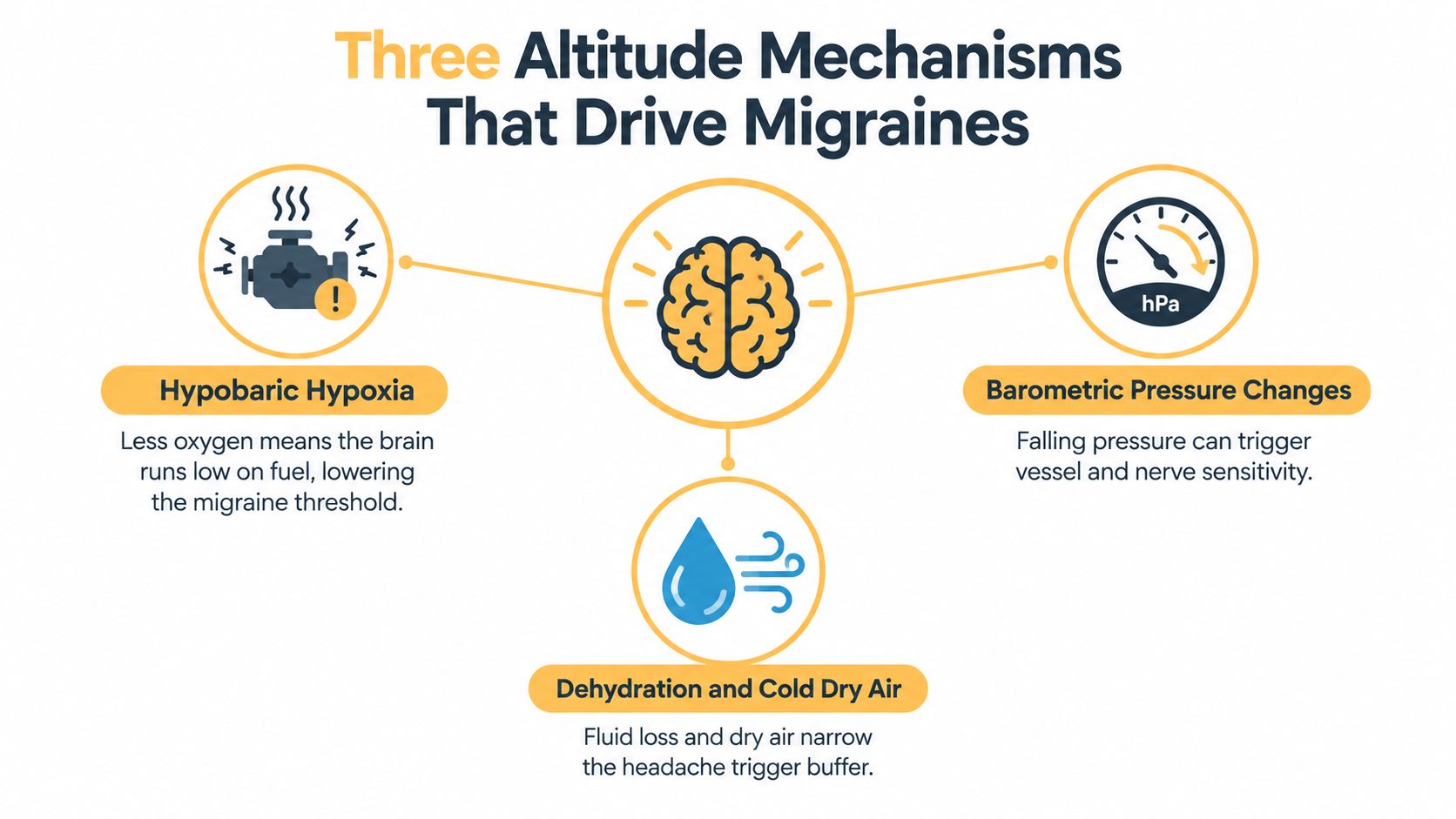
During a typical travel day, these factors can stack up. You might fly or drive upward, sleep poorly, hike in dry air, drink less than usual, and encounter a pressure change before dinner. The resulting headache may reflect one mechanism, several, or a separate altitude illness syndrome.
A practical response is to reduce the factors you can control. Pace exertion, eat regularly, protect sleep, drink consistently, and record the elevation and timing of symptoms. These actions won't guarantee prevention, but they'll make the trigger pattern clearer and may help you respond earlier.
Altitude Migraine or High-Altitude Headache
A headache at elevation isn't automatically a migraine. High-altitude headache is a recognized secondary headache disorder in the International Classification of Headache Disorders, third edition. It occurs after ascent above 2,500 metres, is often bilateral, may worsen with exertion, and typically resolves within 24 hours after descent below that elevation, according to ICHD-3.
Acute mountain sickness can include headache along with nausea, fatigue, dizziness, and feeling unwell after ascent. Those symptoms deserve caution, especially if they're worsening or accompanied by confusion, balance problems, breathing difficulty, or other neurological changes.
Migraine has a different pattern, although the symptoms can overlap. Migraine pain may be one-sided and throbbing, and attacks may include nausea, light sensitivity, sound sensitivity, aura, and a postdrome, the drained or foggy period after the main pain eases. Migraine attacks commonly last from 4 to 72 hours, but your usual pattern and clinical history matter.
| Feature | High-Altitude Headache | Migraine at Altitude |
|---|---|---|
| Typical setting | After ascent above 2,500 metres | Can occur at altitude in someone susceptible to migraine |
| Pain pattern | Often bilateral and pressing | May be one-sided and throbbing |
| Associated symptoms | May occur with altitude illness, nausea, fatigue, or dizziness | Nausea, photophobia, phonophobia, aura, or postdrome may occur |
| Response to descent | Often improves after descent below 2,500 metres | May continue according to the person's usual migraine pattern |
| Main concern | Hypoxia-related secondary headache or acute mountain sickness | A migraine attack triggered or facilitated by altitude |
Researchers still can't clearly answer whether altitude increases genuine migraine attacks in susceptible people, produces a separate secondary headache with overlapping features, or does both. The review discussing altitude-related headache and migraine highlights this uncertainty.
The distinction matters because the response may differ. A migraine plan discussed with your clinician may include acute or preventive treatment, while altitude illness may require stopping ascent, rest, assessment, oxygen, or descent. Don't assume that taking your usual migraine treatment makes progressive altitude illness safe to ignore.
Who Is Most at Risk at Elevation
The clearest risk signal is a history of migraine. In a study of hikers at high altitude, 39% developed headache and 26% developed acute mountain sickness. A prior migraine history was associated with 2.49-fold higher odds of any headache at altitude and 14.05-fold higher odds of migrainous headache specifically, as reported in the PubMed-indexed study.
Residential elevation shows a broader dose-response pattern. In a Nepal study of 2,100 participants, migraine prevalence rose from 27.9% below 500 metres to 45.5% at 2,000 to 2,499 metres. The adjusted odds ratio increased from 1.5 at 1,000 to 1,499 metres to 2.2 at 2,000 to 2,499 metres, compared with the below-500-metre reference group. The Nepal population study also found that attacks became longer and more severe as elevation increased.
| Elevation band | Migraine prevalence | Median attack frequency | Median attack duration | Highest pain intensity |
|---|---|---|---|---|
| Below 500 metres | 27.9% | 1.3 days per month | 9 hours | 35.5% |
| 2,000 to 2,499 metres | 45.5% | 3.0 days per month | 24 hours | 56.9% |
These findings don't mean elevation alone determines your risk. The participants' living environment, genetics, health, and daily routines also matter, and a population result can't predict what will happen to one traveler.
Personal factors that deserve planning
You may need extra preparation if you have a known migraine history, have previously developed headache at altitude, or plan a rapid ascent. Hormonal shifts can also affect migraine patterns, including around menstruation or perimenopause, so a trip that overlaps with a familiar hormonal window may be harder to interpret.
People with obstructive sleep apnea should discuss high-altitude travel with a clinician, including how their CPAP equipment and settings will be handled. Children and pregnant travelers may need individualized precautions because symptoms can be harder to interpret and medical decisions depend on age, pregnancy stage, health history, and destination access.
A previous altitude headache is a particularly useful warning from your own history. Record where it happened, how quickly you ascended, what symptoms appeared, and whether descent helped. That information can guide a safer conversation with a healthcare provider before your next trip.
Travel and Acclimatization Strategies You Can Use
A safer mountain trip starts before departure. Use this checklist as a discussion tool, not as a substitute for individualized medical advice.
Before you leave
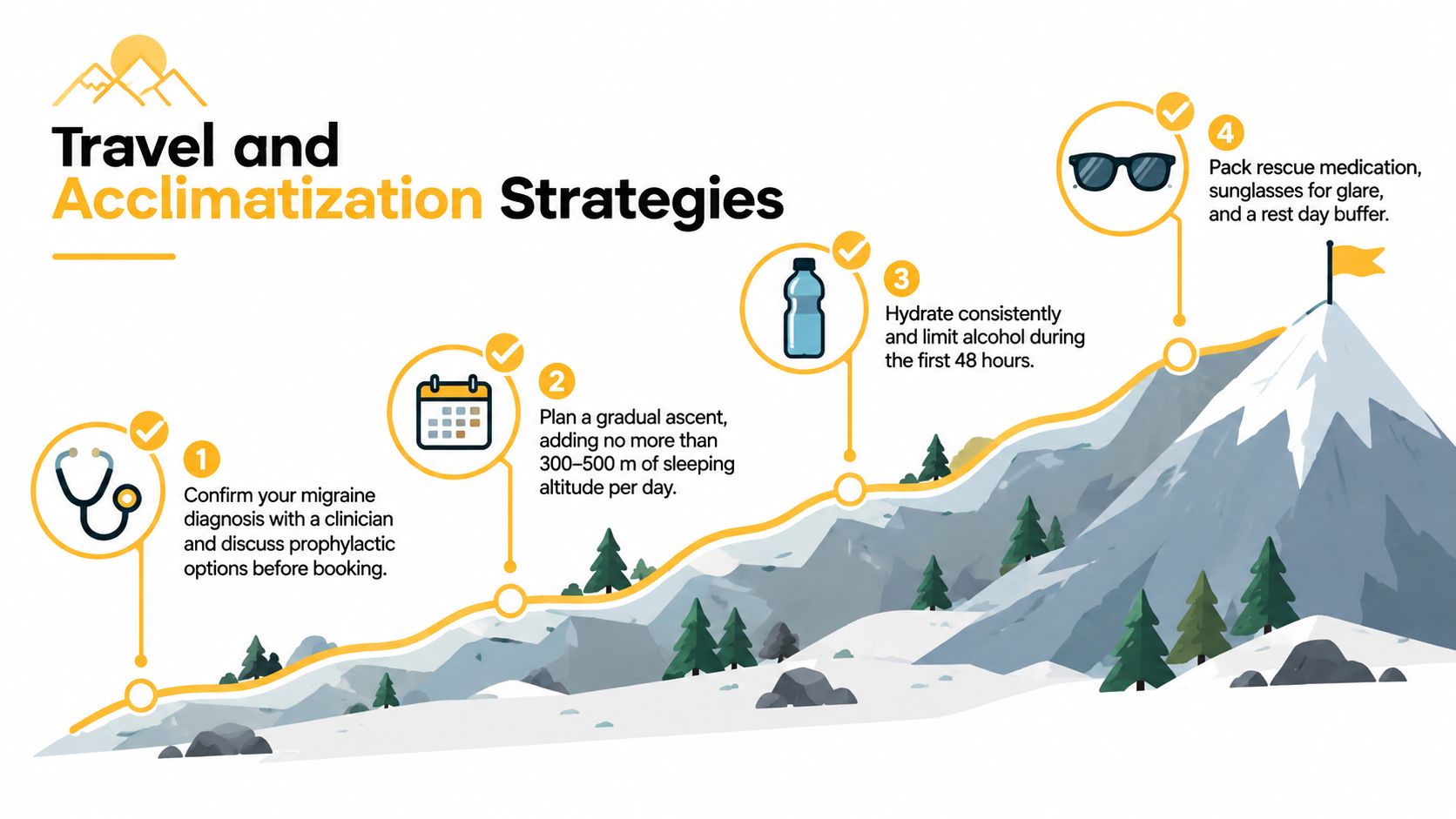
- Review your diagnosis: Confirm your migraine history and travel plans with a clinician, particularly if you've never traveled at elevation or had symptoms resembling acute mountain sickness.
- Discuss prevention: Ask whether a preventive option is appropriate for your itinerary. Some people may be advised to discuss medicines such as acetazolamide or ibuprofen, but the choice depends on your health history, other medicines, allergies, pregnancy status, and the type of headache involved.
- Pack an organized kit: Keep your clinician-approved acute treatment, regular medicines, water, food, sunglasses, ear protection, and a written health summary accessible rather than packed in checked luggage.
- Plan flexibility: Build in time to rest instead of scheduling strenuous activity immediately after arrival.
Ascend gradually
Above 3,000 metres, common mountaineering guidance recommends adding no more than 500 metres of sleeping elevation per day and planning a full rest day for every 1,000 metres gained. These figures come from the travel guidance specified for this article, but your clinician or an experienced expedition service may recommend a different plan for your route and health.
Sleeping elevation matters because your body has to adapt while you rest. A brief daytime visit followed by a return to a lower sleeping elevation isn't identical to moving your base higher, although any symptoms still deserve attention.
- First night: Keep activity light and choose a lower sleeping location when your itinerary allows.
- During ascent: Stop gaining elevation if symptoms begin or worsen. Don't treat a deteriorating headache as something you must push through.
- If symptoms improve: Rest and reassess rather than assuming the problem has disappeared permanently.
Reduce avoidable amplifiers
Drink consistently, especially in dry air and during exertion. The supplied travel plan suggests 3 to 4 litres daily, but fluid needs vary with body size, health conditions, activity, climate, and medical restrictions, so ask a clinician what's appropriate for you.
Avoid alcohol during the first two nights, limit abrupt changes in caffeine, protect an eight-hour sleep window, and eat carbohydrate-rich meals if they fit your usual nutrition plan. These choices target dehydration, sleep disruption, missed meals, and exertion, which can compound the altitude burden.
For broader travel planning, strategies for preventing weather-related migraines can help you account for pressure and weather alongside elevation.
At the first sign of trouble
Pause strenuous activity, move to a comfortable place, drink according to your clinician's guidance, and note your elevation and symptoms. Use only the acute treatment plan you've already discussed with a healthcare professional, and don't improvise doses.
Descent becomes more important if symptoms are progressive, don't improve with rest, or occur with signs of acute mountain sickness. Flying directly to a destination above 2,500 metres can expose you to a rapid environmental change, so plan a slower first day where possible. If you use CPAP, ask your sleep clinician or equipment provider in advance whether altitude affects your device or requires a travel-specific plan.
Tracking Your Personal Altitude Patterns
Memory compresses complicated trips into one conclusion: “The mountain caused a migraine.” That may be directionally correct, but it doesn't tell you whether the key factor was elevation, rapid ascent, poor sleep, low fluid intake, glare, exertion, weather, or a combination.
A simple log can separate those variables. Record the same details each day, even on symptom-free days, so you have a baseline for comparison.
Four environmental and body variables
- Elevation: Record your starting elevation, highest daytime elevation, sleeping elevation, and how much your sleeping elevation changed.
- Pressure: Note barometric pressure from a reliable weather service or phone sensor when available, along with major weather changes.
- Sleep: Log when you slept, how long you slept, and whether the night felt restorative.
- Fluids and food: Record approximate fluid intake, alcohol, caffeine changes, meals, and unusually strenuous activity.
Add a symptom entry with a 0-to-10 pain score, whether the pain felt like your usual migraine, nausea, photophobia, phonophobia, aura, dizziness, fatigue, and the time symptoms began and ended. Include treatment and response without changing medication use based solely on the log.
A meaningful pattern looks repeated, not dramatic. For example, you might notice attacks clustering after sleeping above 2,500 metres, especially on nights with poor sleep, or you might find that pressure changes matter more than elevation. Don't assume a correlation proves causation. Share the pattern with a neurologist or primary-care clinician, who can interpret it alongside your medical history.
A 14-day sample template
| Day | Sleeping elevation | Pressure or weather change | Sleep | Fluids and meals | Pain or migraine score |
|---|---|---|---|---|---|
| 1 | Record elevation | Stable or changing | Hours and quality | Intake and missed meals | 0 to 10, symptoms |
| 2 | Record elevation | Stable or changing | Hours and quality | Intake and missed meals | 0 to 10, symptoms |
| 3 | Record elevation | Stable or changing | Hours and quality | Intake and missed meals | 0 to 10, symptoms |
| 4 to 14 | Repeat daily | Repeat daily | Repeat daily | Repeat daily | Repeat daily |
You can use paper, a spreadsheet, a weather app, or a dedicated headache diary. A tool such as the headache log app from ReliefMigraine can support rapid symptom and trigger entries, but the important part is consistency.
Look for clusters after the full 14 days. Mark days when elevation rose, sleep fell, fluids dropped, or pressure changed, then compare those entries with your symptom scores. This creates a personal risk picture that's more reliable than trying to remember one difficult trip months later.
Red Flags, FAQs, and Your Next Step
Seek immediate medical care: Get urgent evaluation for a sudden, severe, or worst-ever headache; a headache with weakness, vision loss, slurred speech, confusion, fever, or a stiff neck; a headache after head injury; or symptoms that don't improve with descent. At altitude, worsening symptoms can signal a serious illness rather than a routine migraine.
Does flying count as altitude exposure?
Yes, a flight changes your environment even though the cabin is pressurized. The experience differs from sleeping at a mountain elevation, but pressure changes, disrupted sleep, dehydration, missed meals, glare, and travel stress can still affect someone with migraine. Record the flight timing and symptoms rather than assuming every post-flight headache has the same cause.
Can altitude affect a CPAP machine?
It can affect how some equipment operates, and sleep-disordered breathing may be more difficult to manage at elevation. Contact your sleep clinician or equipment provider before travel to check your specific device, destination, and settings. Don't change pressure settings on your own.
Do children or pregnant travelers need different precautions?
They may. Children can have difficulty describing headache quality or neurological symptoms, while pregnancy changes which medicines and travel plans are appropriate. Pregnant travelers and caregivers should seek individualized guidance before high-altitude travel, particularly if there's a migraine history or prior altitude illness.
How do hormones interact with altitude?
Menstruation, perimenopause, and other hormonal shifts can coincide with changes in migraine susceptibility. If a mountain trip overlaps with a familiar hormonal pattern, log the timing alongside elevation, sleep, food, fluids, and pressure. A clinician can help you decide whether the pattern needs a broader migraine-management review.
Your next step is simple. Start a daily altitude and symptom log before your next trip, then bring it to a healthcare provider for a pre-travel conversation. Altitude is one variable, and identifying how it interacts with your own sleep, hydration, weather, and migraine symptoms can make future decisions less uncertain.
Relief helps you log migraine severity, symptoms, triggers, and medications while bringing weather and environmental signals into one view for pattern tracking. Visit Relief to explore a practical way to monitor altitude-related patterns alongside your broader migraine risk.


