
Red wine can trigger migraines for some people, but it isn't a universal rule. In one meta-analytic review, 28% of studies identified red wine as a migraine trigger, and a separate review found alcohol triggered migraine in 27% of cases overall, which means the connection is real but far less absolute than many people fear.
You may know this feeling already. You're out to dinner, you finally relax, you order a glass of red, and then part of your brain starts negotiating with the rest of you: Will I enjoy this, or will I pay for it later? That tension is exhausting, especially when migraine already makes everyday choices feel loaded.
The frustrating part is that both things can be true. Red wine can set off a migraine attack in some people because of compounds such as quercetin, histamines, and tyramine. At the same time, not every person with migraine reacts to red wine, and not every red wine acts the same way.
That's why a simple yes-or-no answer usually doesn't help. What helps is understanding the science in plain language, then figuring out whether red wine is one of your triggers, under your conditions.
This article is for informational purposes and is not medical advice. Consult a healthcare provider for personalized guidance.
Table of Contents
- That Perfect Glass of Red and the Fear of a Migraine
- Quercetin may be the main chemical suspect
- Histamines and tyramine can add pressure
- Headache and migraine are not the same thing
- Belief and biology are not always the same
- A safer way to test a possible trigger
- Get urgent help for red flag symptoms
That Perfect Glass of Red and the Fear of a Migraine
There's a specific kind of dread that comes with red wine and migraines. It's not just about the drink. It's about whether a small pleasure will turn into hours of throbbing pain, nausea, light sensitivity, or the wiped-out feeling that can linger into the next day.
A lot of people use the phrase “red wine headache” to describe any pain after drinking. But if you live with migraine, you already know there's a difference. A headache is one symptom. A migraine attack is a neurological event that may include head pain, photophobia (light sensitivity), phonophobia (sound sensitivity), nausea, dizziness, aura (temporary visual or sensory symptoms), and a postdrome, which is that drained, foggy feeling after the worst part passes.
Research supports the idea that red wine stands out among alcoholic drinks. In a meta-analytic review on primary headache and alcohol use disorders, 28% of studies identified red wine as a specific migraine trigger, compared with 14% for spirits and 10% for beer.
What that means in real life: if alcohol is going to be a trigger, red wine is one of the more commonly reported suspects. It still doesn't mean it's your trigger every time.
That distinction matters because migraine isn't fair or predictable. One night you're fine. Another night, the same pour seems to spark symptoms. You may start to wonder if you're imagining it, if the wine changed, or if your body did.
Here's the more useful perspective:
| Situation | What it may mean |
|---|---|
| Red wine seems to trigger symptoms often | It may be a genuine trigger for you |
| Red wine only causes problems sometimes | Other triggers may be stacking with it |
| Some reds bother you, others don't | The wine's chemical profile may matter |
| You get pain but no migraine features | It may be a non-migraine headache rather than a migraine attack |
You're not overthinking this. You're trying to make sense of a pattern that often gets oversimplified.
If you've been told to just “avoid wine” and move on, that advice can feel both blunt and disappointing. Sometimes full avoidance is the right choice. Sometimes it isn't. The more practical question is whether there's a pattern you can use.
The Science Behind a Red Wine Headache
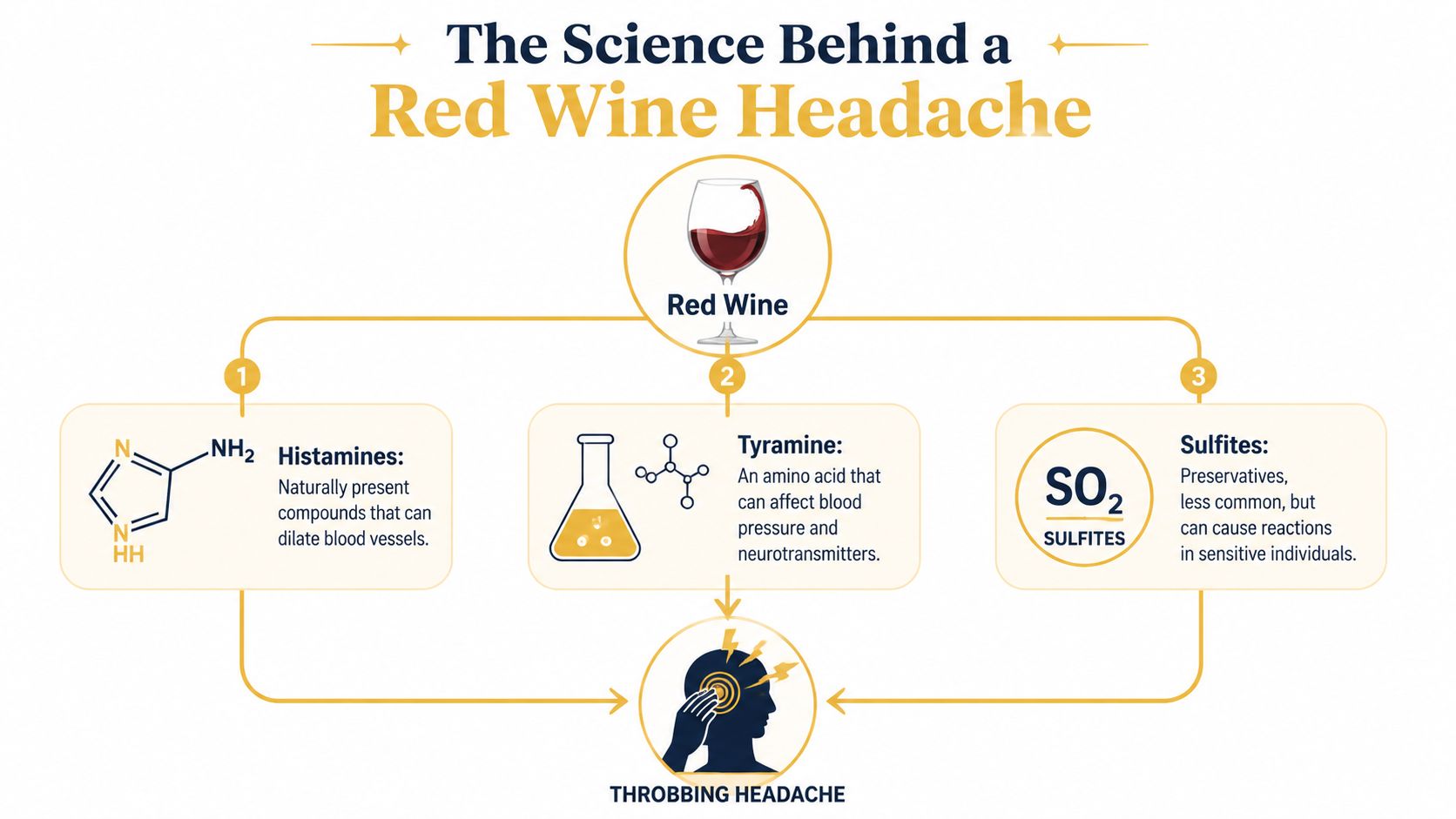
One theory stands out because it explains why red wine can bother some people so quickly, even after a small amount. This visual gives the basic idea before we break it down:
Quercetin may be the main chemical suspect
According to UC Davis Health on why some people get headaches from red wine, quercetin is a key suspect. It's a flavanol found at levels ten times higher in red wine than white, and when your body metabolizes it, it can interfere with ALDH2, an enzyme that helps clear acetaldehyde, a toxic alcohol byproduct. That buildup is thought to trigger a headache within 30 minutes to 3 hours.
A plain-language analogy helps here. Think of ALDH2 as a cleanup crew. Alcohol creates mess as your body processes it. If quercetin's metabolite blocks the cleanup crew, acetaldehyde piles up like trash bags in a hallway. For some people, that backup appears to contribute to flushing, nausea, and head pain.
That may also explain why some people react after only one glass rather than after heavy drinking. The problem isn't always “too much alcohol.” For some bodies, it may be “this particular chemical mix.”
If histamine is one of your usual migraine concerns, this background on histamine and migraine headaches can help connect the dots.
A short explainer can make the pathway easier to picture:
Histamines and tyramine can add pressure
Quercetin isn't the only possible issue. Red wine also contains histamines and tyramine, both of which may matter for susceptible people.
Histamines are compounds produced during fermentation. They can dilate blood vessels and contribute to flushing and inflammation. Tyramine can affect blood vessels and blood pressure regulation. In plain terms, these compounds may make an already sensitive nervous system more likely to tip into an attack.
Some people don't react to alcohol itself as much as they react to the package of compounds that comes with a specific drink.
A common source of confusion for readers involves this distinction. These compounds aren't the same thing as a classic allergy. You don't need to be “allergic to wine” for wine to be a migraine trigger. Migraine involves brain and nervous system sensitivity, and a trigger can be something that nudges that system past its threshold.
Headache and migraine are not the same thing
A red wine headache and a migraine attack can overlap, but they're not identical. If you get simple head pain after wine, that's different from getting throbbing pain plus nausea, aura, light sensitivity, dizziness, or a lingering postdrome.
That difference matters when you're tracking. If your symptom log only says “headache after wine,” you may miss the pattern. If it says “throbbing one-sided pain, nausea, photophobia, started two hours after Cabernet,” that's much more useful.
Is Red Wine Actually One of Your Migraine Triggers
A lot of people feel sure they already know the answer. Sometimes they're right. Sometimes they've absorbed a cultural belief that sounds certain but turns out to be messier on closer look.
Belief and biology are not always the same
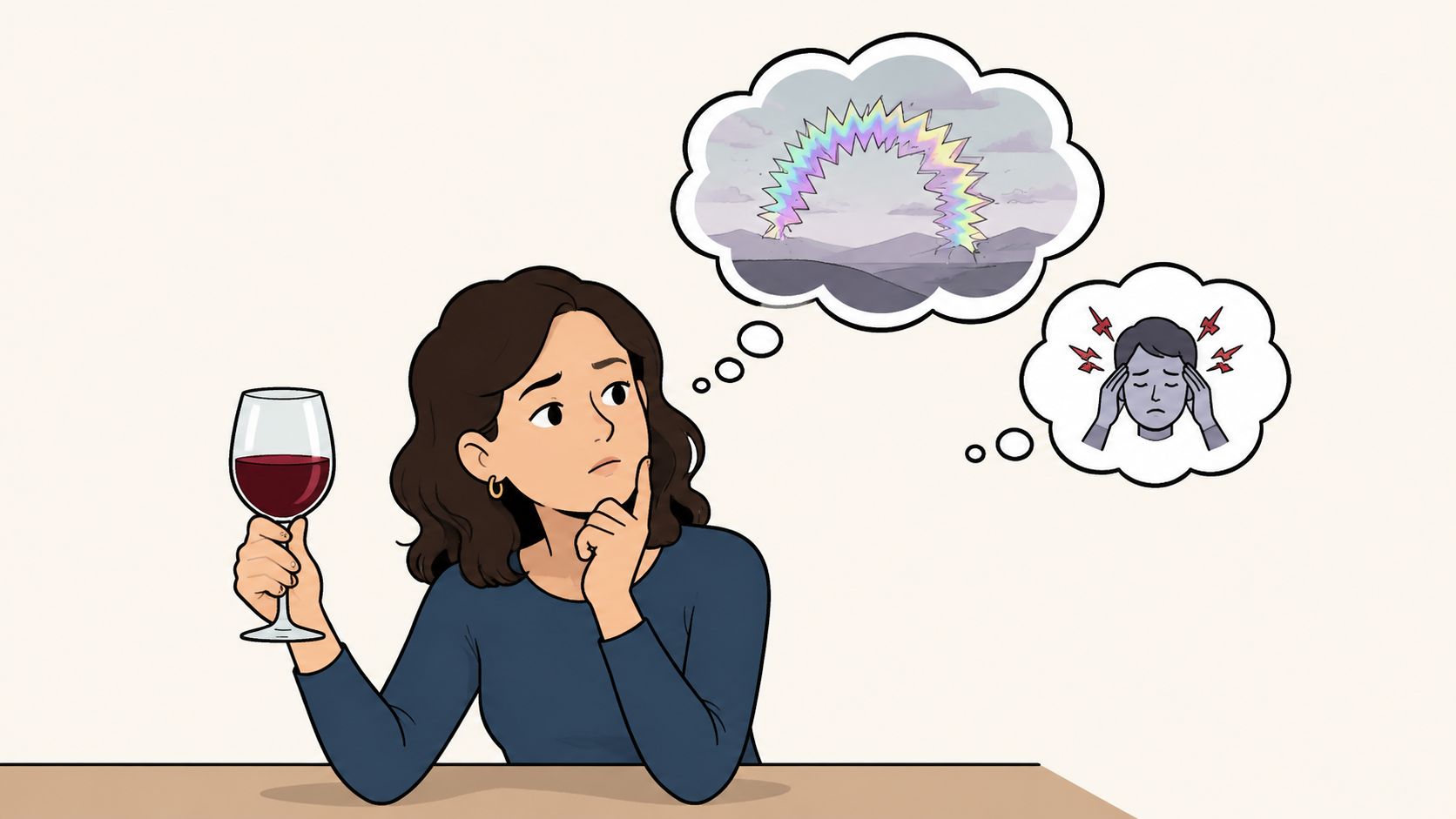
In a systematic review and meta-analysis on alcohol and migraine, a global survey of 2,197 participants found that 77.8% believed red wine specifically caused migraines. But controlled studies showed a more nuanced picture, with the review noting that belief in red wine as a trigger was more common than confirmed cases in clinical settings.
That doesn't mean your reaction isn't real. It means migraine triggers are easy to over-assign when the pattern feels emotionally obvious. Wine is memorable. Stress, poor sleep, skipped meals, and weather shifts are easier to overlook.
If alcohol in general is something you're trying to sort out, this guide to alcohol as a migraine trigger is a useful companion.
A safer way to test a possible trigger
If you want to test whether red wine is one of your triggers, keep the process gentle and structured. Don't do it during a high-risk week, after several bad nights of sleep, or when you're already in prodrome, which is the early phase before a migraine attack when you might feel tired, irritable, stiff, or crave certain foods.
Try this checklist:
- Pick a stable day: Choose a day when your sleep, meals, and stress are as steady as possible.
- Avoid obvious confounders: Don't combine the wine with fasting, intense exertion, or a loud late night.
- Log timing carefully: Note when you drink, when symptoms begin, and whether those symptoms fit migraine or a simpler headache.
- Track the wine itself: Record the grape variety, producer if you know it, and whether it was something like Pinot Noir or Cabernet.
- Watch for migraine features: Note aura, nausea, photophobia, phonophobia, dizziness, and postdrome symptoms.
Practical rule: you're not trying to prove that wine is “bad.” You're trying to see whether a repeatable pattern shows up under similar conditions.
Get urgent help for red flag symptoms
Some symptoms should never be treated as a routine food or drink trigger issue.
Seek immediate medical care if you have:
- Sudden severe head pain: A thunderclap headache or abrupt, extreme pain.
- Fever or stiff neck: Especially when paired with headache.
- Neurological changes: Weakness, confusion, fainting, trouble speaking, vision loss, or new numbness.
- Headache after head injury: Even if it seems mild at first.
This article is for informational purposes and is not medical advice. Consult a healthcare provider for personalized guidance.
Practical Ways to Reduce Your Risk
If red wine seems to be a possible trigger for you, the answer isn't always permanent abstinence. Sometimes risk drops when you change the conditions around the drink, or the type of wine itself.
Change the setting before you change the wine
Start with the basics. They sound simple because they are simple, but they can matter.
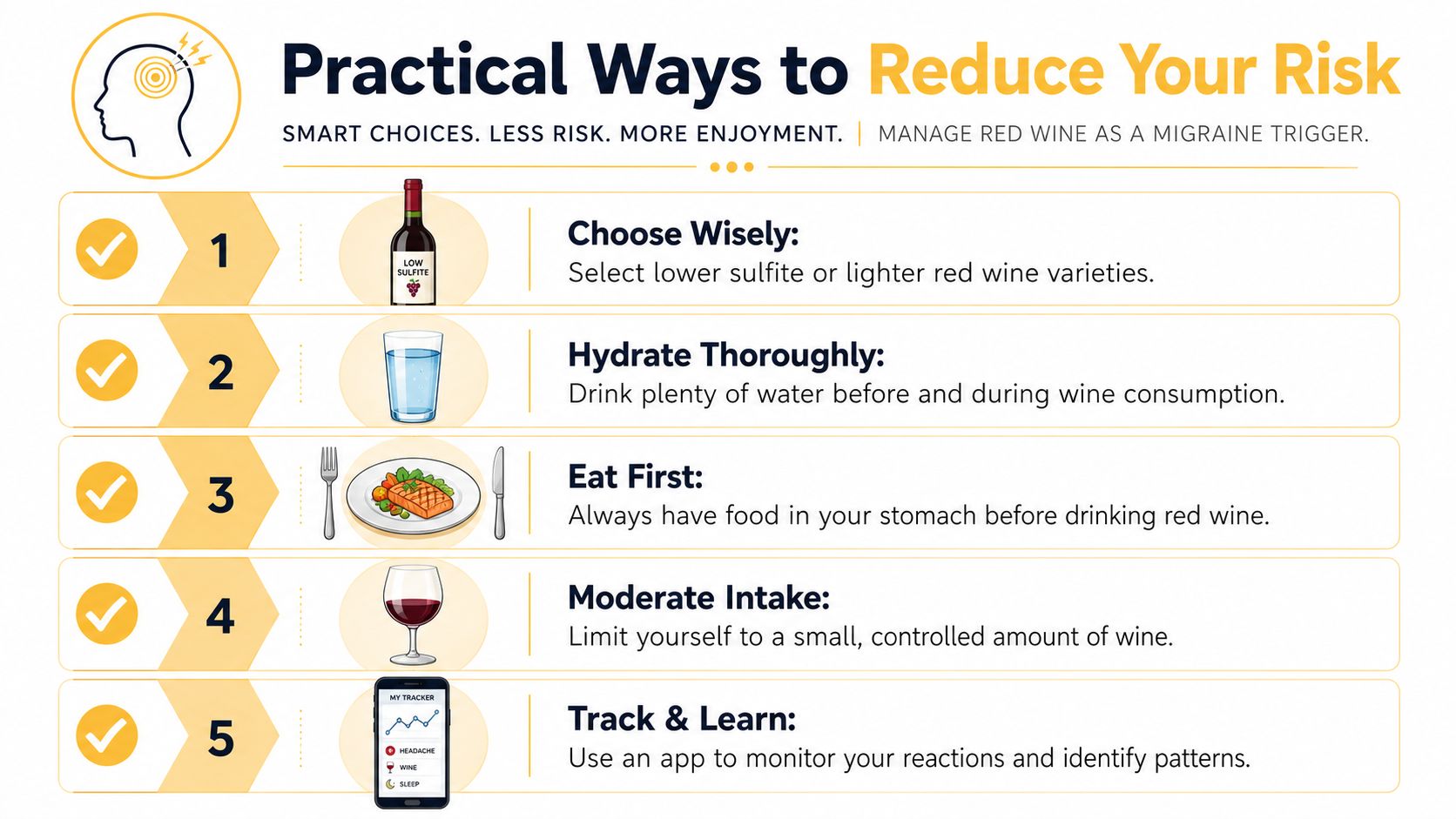
- Eat first: Drinking on an empty stomach may leave you more vulnerable. A full meal slows things down.
- Hydrate before and during: Water won't erase a trigger, but it may reduce the extra strain that dehydration adds.
- Keep the evening boring: A quiet dinner is a cleaner test than wine plus skipped lunch plus bright lights plus a late bedtime.
Migraine management becomes more realistic. You're not trying to create perfect conditions forever. You're trying to stop blaming one glass of wine for a night that also included low food intake, stress, and poor sleep.
A simple comparison can help:
| Higher-risk setup | Lower-risk setup |
|---|---|
| Wine after skipping dinner | Wine with a full meal |
| Wine after a stressful, dehydrated day | Wine after fluids and regular meals |
| Unknown restaurant pour | A wine you've tolerated before |
| Late night with strong lights and noise | Calm evening at home |
Treat wines as different exposures
One of the most useful ideas in this whole topic is that not all red wines are chemically the same. According to this discussion of red wine headaches and quercetin variability, quercetin levels vary significantly based on grape variety, winemaking techniques, and sun exposure. That means a Pinot Noir and a Cabernet may not hit your system the same way.
That's a relief. It shifts the question from “Can I never drink red wine again?” to “Are there specific reds that seem easier for me?”
You might notice patterns like these:
- Lighter reds seem easier: Some people do better with wines that feel less intense for them personally.
- Certain regions stand out: Sun exposure affects grape chemistry, so wines from different climates may not behave the same.
- One repeat offender keeps showing up: If the same style keeps appearing before attacks, that's useful evidence.
You don't need a perfect explanation before you respect a pattern.
If you do decide to experiment, keep it narrow. Change one variable at a time. Trying three new wines across one chaotic weekend won't teach you much.
Understanding the Full Picture of Migraine Triggers
Sometimes red wine is the trigger. Sometimes it's only part of the story.
That's because migraine often behaves less like a simple on-off switch and more like a threshold problem. Your brain may tolerate one stressor on its own, then react when several arrive together. A glass of red after a well-rested weekend might be fine. The same glass after poor sleep, stress, bright lights, and a weather shift might not be.
Why wine is fine one day and a problem the next
This pattern confuses people all the time. It can look inconsistent, but it often isn't. The trigger may be the stack, not the single item.
Common factors that can stack with wine include:
- Sleep disruption: Too little sleep, irregular timing, or poor-quality sleep.
- Stress changes: Not only stress itself, but the letdown after stress.
- Skipped meals: Fasting is a known trigger in migraine research and can make any other exposure hit harder.
- Environmental shifts: Weather, barometric pressure, pollen, and air quality can matter for some people.
- Hormonal changes: For many people, hormone fluctuations change the threshold for an attack.
A migraine trigger isn't always a direct cause. Sometimes it's the last push on a nervous system that was already close to the edge.
A simple trigger stacking checklist
The next time wine seems involved, ask yourself:
- How was my sleep the night before?
- Did I eat regularly that day?
- Was I already in prodrome without noticing it?
- Was the environment louder, brighter, or more intense than usual?
- Did anything else change, like stress, weather, or hormones?
That kind of review often softens the all-or-nothing thinking around red wine and migraines. It doesn't erase the possibility that wine matters. It helps you see whether wine acts alone, or mostly when the rest of the conditions line up badly.
Use Tracking to Stay One Step Ahead
The difference between guessing and learning usually comes down to tracking. Memory tends to overvalue dramatic exposures and undervalue recurring background factors. A written log is better. A structured app is usually better still, because it helps you compare events over time instead of relying on your last bad night.
Your genes may shape your response
There's another reason blanket rules fail here. SelfDecode's overview of red wine and migraine genetics notes that genetic susceptibility plays a key role, including variants in genes like MTHFR, AOC1, and MAOA, which affect how the body processes compounds such as histamine and tyramine. In plain language, two people can drink the same red wine and have very different outcomes because their bodies handle those compounds differently.
That's also why standard advice can feel so frustrating. If your biology is more sensitive to a wine's chemical profile, generic rules like “just drink less” may miss the actual issue.
What to log if you want useful answers
The best tracking is specific enough to reveal patterns but simple enough that you'll keep doing it.
Try logging:
- The exact drink: “Red wine” is less helpful than “Pinot Noir at dinner.”
- Timing: Note when you drank and when symptoms started.
- Migraine features: Aura, nausea, photophobia, phonophobia, dizziness, neck pain, and postdrome.
- Context: Sleep, meals, stress, menstrual cycle if relevant, weather, and other exposures that day.
- What happened next: Did symptoms fade, become a full migraine attack, or stay as a simple headache?
If you want a dedicated tool for this, a migraine tracking app that helps connect triggers and symptoms over time can make the pattern clearer than mental notes or a scattered phone diary.
You're looking for repeatability, not certainty after one event. If the same type of wine keeps showing up before similar symptoms under similar conditions, that's useful. If the pattern disappears once you account for sleep, meals, and stress, that's useful too.
The ultimate win is not proving a theory. It's getting closer to a life where fewer choices feel like gambles.
If you want help spotting whether a specific red wine, a stacked-trigger day, or a weather shift is more likely driving your attacks, Relief can help you track symptoms, exposures, and patterns without relying on memory alone.


