A silent migraine is a real, recognized type of migraine where you get aura symptoms like flashing lights, zigzags, numbness, or trouble speaking, but without the usual head pain. It's relatively uncommon, accounting for about 3% of migraine attacks in women and 1% in men, but it's still medically significant and worth taking seriously.
If you're reading this because you had a strange spell of shimmering vision, pins and needles, or a few minutes where words wouldn't come out right, the lack of headache can make the whole thing feel even more confusing. Many people assume, “If it didn't hurt, it can't be migraine.” That's not how migraine works.
Migraine is a neurological disorder, not just a bad headache. For some people, the brain changes involved in migraine show up mainly as aura, which means temporary neurological symptoms. That's why a silent migraine can feel dramatic and unsettling even when your head doesn't pound.
This article is for informational purposes and is not medical advice. Consult a healthcare provider for personalized guidance.
Table of Contents
- Answering the Question What Is a Silent Migraine
- Visual symptoms
- Sensory and speech symptoms
- What can happen before and after
Answering the Question What Is a Silent Migraine
A silent migraine is also called migraine aura without headache or acephalgic migraine. It means you experience the aura part of migraine, but the head pain either never shows up or is so mild that it doesn't feel like a typical migraine attack.
That distinction matters because aura is not “just eye weirdness.” Aura can involve fully reversible visual, sensory, or speech and language symptoms, and it's recognized in the formal migraine criteria used by headache specialists. The Migraine Disorders description of ICHD-3 migraine aura without headache explains that it meets the same aura criteria as migraine with aura, just without a following headache.
For a lot of people, the most frightening part is that the symptoms can seem neurological rather than painful. You may see jagged lights, lose part of your visual field, feel tingling move across your face or hand, or struggle to find words. That can feel much more alarming than a familiar headache.
Practical rule: If you've had new neurological symptoms and no one has evaluated them, don't assume “silent migraine” on your own. Get checked.
It also helps to zoom out. Migraine affects about 15% of the global population, or roughly 1 to 1.5 billion people, and silent migraine is a smaller but well-documented subset of that broader condition, as summarized in this migraine statistics overview.
When people ask what is a silent migraine, the simplest answer is this: it's still migraine, even if it doesn't look like the widely understood version.
The Wide Range of Silent Migraine Symptoms
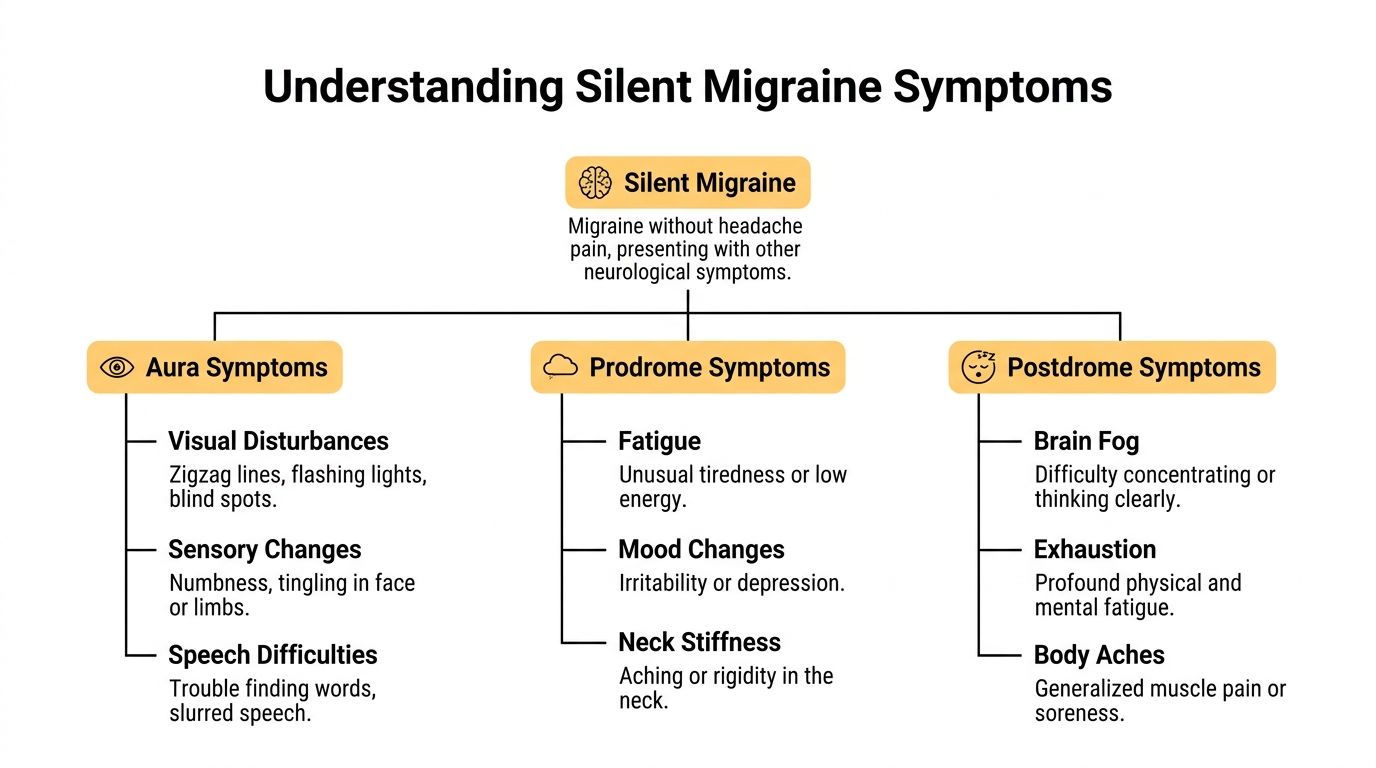
Silent migraine doesn't always look the way people expect. Some attacks are mostly visual. Others affect sensation, language, balance, or mental clarity. The common thread is that the symptoms are temporary and fit the pattern of migraine aura.
This symptom overview may help you place what happened.
Visual symptoms
Visual aura is the version people mention most often. You might notice:
- Flashing lights that seem to sparkle or pulse
- Zigzag lines or shimmering edges
- Blind spots where part of your vision goes missing
- Tunnel vision or a sense that your field of view has narrowed
These symptoms often develop gradually rather than hitting all at once. That gradual build can be one clue that migraine is involved.
A lot of readers also confuse aura with the earlier warning phase of migraine, called prodrome. If you want a simple breakdown of that earlier phase, ReliefMigraine's guide on what prodrome means in migraine is a useful companion.
Sensory and speech symptoms
Silent migraine can also affect how your body feels and how your brain handles language. The Migraine Trust's overview of aura symptoms notes that silent migraine can include tingling, numbness, speech difficulties, nausea, dizziness, fatigue, and confusion, and that aura symptoms typically last between 5 and 60 minutes.
That can look like:
- Pins and needles in one hand that spread up the arm
- Numbness in the face, lips, or tongue
- Word-finding trouble, where you know what you want to say but can't get it out
- Confusion or mental fuzziness that makes normal tasks feel oddly difficult
Here's a short explainer if you want to hear the pattern described another way:
What can happen before and after
For some people, the aura isn't the whole event. You may also notice warning signs before it starts, or a drained feeling after it passes.
Common examples include:
- Before the attack you feel off, tired, irritable, or extra sensitive to light
- During the attack you have the aura symptoms but no meaningful head pain
- Afterward you're wiped out, foggy, or just not quite yourself
Silent migraine can still interrupt work, driving, reading, meetings, and screen time, even if no headache arrives.
That's one reason these episodes deserve attention. Painless doesn't mean minor.
How Silent Migraine Differs from Other Conditions
The hardest part of silent migraine is that it can overlap with several other experiences. You might wonder whether you had a regular migraine, a visual problem, a panic episode, a TIA, or something else entirely.
Silent migraine is also less common than other migraine patterns. As noted earlier, it accounts for about 3% of migraine attacks in women and 1% in men, which is one reason many people have never heard it explained clearly.
Migraine type comparison
The table below can help sort out the main migraine categories.
Migraine type comparison
| Feature | Silent Migraine (Aura without Headache) | Migraine with Aura | Migraine without Aura |
|---|---|---|---|
| Head pain | Absent or very mild | Usually follows or accompanies aura | Present, without aura |
| Aura symptoms | Yes | Yes | No |
| Visual changes | Common | Common | Not part of aura |
| Sensory changes | Can happen | Can happen | Less central to diagnosis |
| Speech or language changes | Can happen | Can happen | Not typical aura |
| Typical pattern | Neurological symptoms without the expected headache | Aura plus migraine headache | Migraine symptoms without aura |
| Need for medical evaluation if new | Yes | Yes | Yes, if symptoms are new or unusual |
If you've also had facial tingling with head pain or pressure at other times, ReliefMigraine's article on headache with facial tingling may help you think through how symptoms can overlap.
Why stroke and TIA can enter the picture
This is the safety piece. Silent migraine can mimic stroke or transient ischemic attack (TIA), especially when symptoms are visual, sensory, or language-based. That's why diagnosis matters.
A simple pattern many clinicians look for is this:
- Migraine aura often starts gradually and may include “positive” symptoms, such as flashing lights or tingling
- TIA or stroke may be more sudden and more likely to involve loss of function, such as abrupt weakness or sudden vision loss
That pattern is helpful, but it is not a home diagnosis tool.
Any new, sudden, or unusual neurological symptom deserves prompt medical evaluation, especially if it's your first episode.
Seek immediate medical care for sudden severe headache, one-sided weakness, facial drooping, fainting, confusion, symptoms after a head injury, or headache with fever or a stiff neck.
Potential Causes and Triggers of Silent Migraine
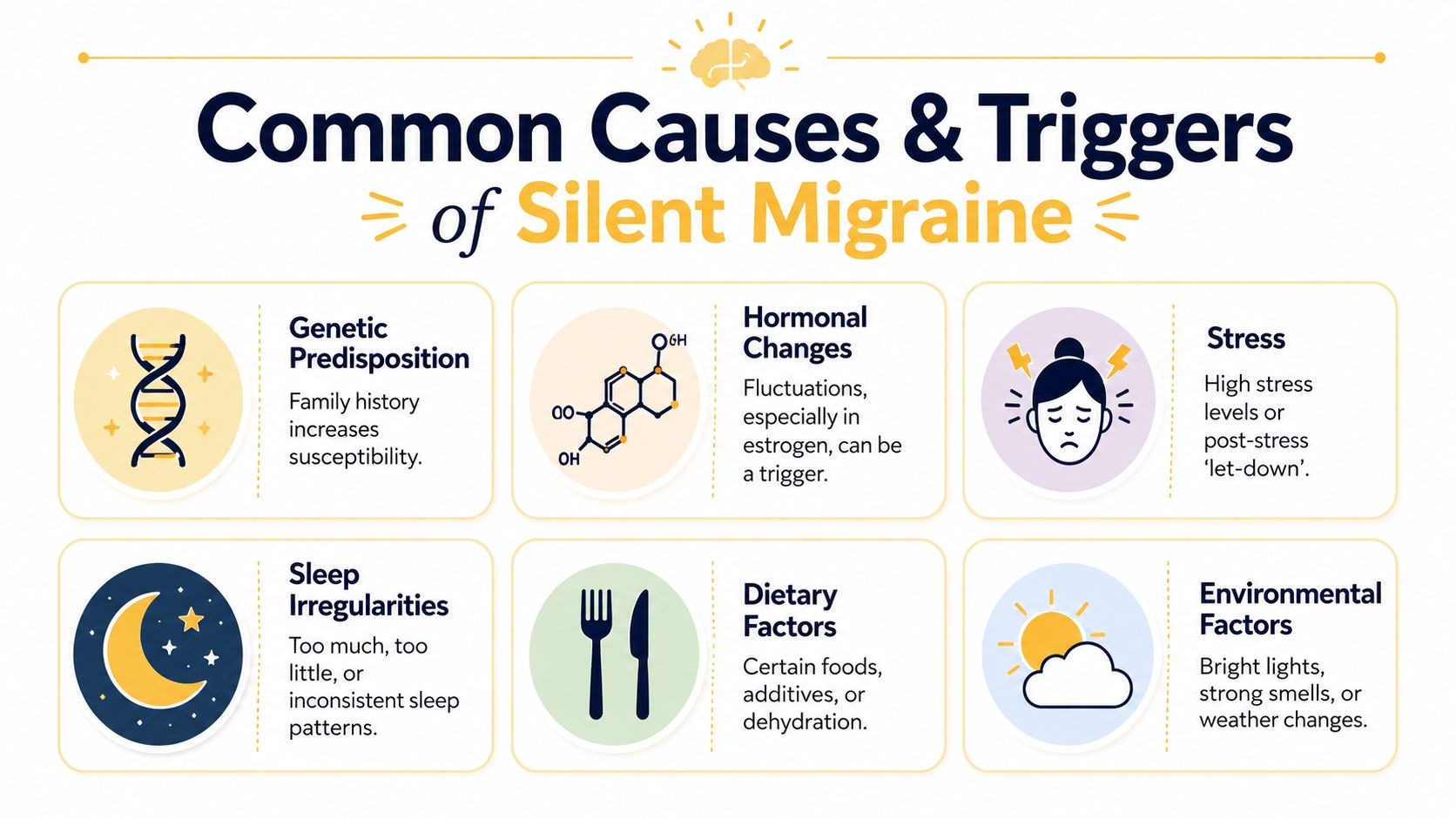
Silent migraine comes from the same broad migraine biology as other migraine types. The difference is how your nervous system expresses the attack. Instead of a more familiar pain-heavy pattern, the event may stay centered on aura and related neurological symptoms.
For some people, silent migraine isn't a brand-new disorder. It seems to be part of an existing migraine pattern that changes over time.
Why it can show up later in life
Silent migraine is diagnosed more often in older adults. The Migraine World Summit discussion of silent migraine notes that it's more commonly diagnosed in people over age 50, and that up to 38% of patients who have migraine with aura may have at least one episode of silent migraine during the course of their condition.
That can be surprising if you used to get classic migraine attacks with pain and now mostly get visual or sensory symptoms. In other words, your migraine pattern can evolve.
This is also why healthcare providers are careful with new aura symptoms in later life. They usually want to rule out other neurological or vascular causes before settling on silent migraine as the explanation.
How modern life can lower your threshold
Many articles stop at a generic trigger list. Real life is messier than that.
A more useful way to think about triggers is threshold management. If your brain is already migraine-prone, several smaller stressors can stack up:
- Long screen exposure with bright light, scrolling, and constant visual focus
- Notification overload that keeps your nervous system on alert
- Indoor environments that feel stale, stuffy, or visually harsh
- Chronic low-grade stress that never turns fully off
- Sleep disruption from late work, travel, or inconsistent routines
You don't need to avoid work, school, or every screen. The practical goal is to notice which combinations seem to precede aura-only attacks.
Consider testing a few simple adjustments:
- Short screen breaks before your eyes feel strained
- Lower visual intensity by reducing glare or harsh brightness
- More regular meals and hydration during busy workdays
- Consistent sleep timing even when your schedule gets hectic
- A calmer ramp-up after stress, since the letdown period can matter too
If your attacks tend to happen during visually intense days, the problem may not be “screens” in general. It may be the accumulated load of light, focus, stress, and skipped breaks.
Getting a Diagnosis and Exploring Management Strategies
If you think you may be having silent migraine, the first step isn't self-treatment. It's getting a proper evaluation, especially if symptoms are new, changing, or frightening.
This article is for informational purposes and is not medical advice. Consult a healthcare provider for personalized guidance.
What diagnosis usually involves
A clinician will usually start with the story of the attack:
- What did you see or feel first?
- How long did it last?
- Did symptoms spread gradually or start suddenly?
- Did you have numbness, language trouble, dizziness, nausea, or light sensitivity?
- Have you had other migraine patterns in the past?
They may also ask about family history, medications, cardiovascular risk factors, and whether symptoms affected one eye or your overall visual field. Depending on your history, they may evaluate for conditions that can resemble silent migraine, including TIA, stroke, seizures, or eye problems.
That part can feel unnerving, but it's appropriate. The aim is to make sure a reversible aura pattern isn't being confused with something more urgent.
Lifestyle approaches
Management often starts with reducing the conditions that make attacks more likely.
A few approaches that may help reduce frequency for some people:
- Regular sleep helps stabilize the nervous system
- Meal consistency and hydration reduce common migraine stressors
- Stress regulation matters, especially if attacks cluster around busy stretches or post-stress letdown
- Light and screen management can be useful if visual overload seems relevant
- Trigger tracking can reveal patterns you won't spot from memory alone
Some people also benefit from planning around high-risk days. If visual aura tends to show up after back-to-back video calls, that's a clue worth respecting.
Over-the-counter and prescription options
Treatment is more individualized than many people expect. Because silent migraine may involve little or no pain, the goal is not always pain relief. It may be reducing attack frequency, reducing disruption, or treating associated symptoms like nausea.
Broad categories a clinician may discuss include:
- Over-the-counter options for any mild residual pain or associated discomfort
- Prescription acute treatments that may be used for migraine attacks in some cases
- Preventive prescription treatments when attacks are frequent, disabling, or hard to predict
No single medication is the “best” choice for everyone. Your clinician will weigh your symptom pattern, other health conditions, and how often attacks happen.
A practical appointment checklist can help:
- Bring a symptom timeline with start, spread, and resolution
- Note whether symptoms were positive or negative such as flashing lights versus vision loss
- Record associated features like nausea, dizziness, fatigue, or confusion
- List recent context including sleep changes, stress, heavy screen use, skipped meals, or weather shifts
- Write down your questions so you don't forget them in the visit
How to Track Your Attacks and When to Seek Medical Care
One reason silent migraine gets missed is simple. People often dismiss it as a strange but isolated event, especially if there was no pain. That's a problem, because aura-only episodes can still reveal your overall migraine pattern.
As noted earlier in the article, many people brush off these attacks as a one-off weird episode rather than logging them consistently. If you don't track them, you lose useful pattern data.
What to log after a silent migraine
Use a notes app, paper journal, or a purpose-built tool. If you want a structured format, this migraine log template gives you a practical starting point.
Try to record:
- Symptom type such as flashing lights, blind spot, tingling, or word-finding trouble
- Timing including when it started, how it spread, and when it stopped
- Context like screen time, stress, skipped meals, poor sleep, weather, or bright environments
- Associated symptoms such as nausea, dizziness, confusion, or fatigue
- After-effects including brain fog, exhaustion, or sensitivity
When to seek immediate medical care
Get urgent help right away if you have:
- A first-ever aura or new neurological symptom
- Aura symptoms that last longer than an hour
- One-sided weakness or facial drooping
- A sudden severe headache
- Headache with fever or a stiff neck
- Symptoms after a head injury
- Confusion, fainting, or anything that feels dramatically different from your usual pattern
If you live with migraine, tracking painless episodes can still change your care. It helps you see your full migraine burden, not just the attacks that hurt.
If you want a simple way to log symptoms, triggers, and changing patterns over time, Relief can support that tracking and help you spot what tends to come before an attack.


