Ever had a diet soda, sugar-free gum, or “light” dessert and wondered, is this why my migraine started? The short answer is that aspartame doesn't seem to trigger migraines for the average person, but a small susceptible subgroup may react, especially when the exposure is repeated and other migraine factors are already in play. If you're dealing with migraine, which can include aura, prodrome (the warning phase), and postdrome (the hangover-like after phase), the confusing part is that one person's clear trigger can be another person's complete non-issue.
This article is for informational purposes and is not medical advice. Consult a healthcare provider for personalized guidance.
Table of Contents
Does Aspartame Actually Cause Migraines
For most people, the evidence does not support aspartame as a universal migraine cause. For a smaller subgroup, though, it may be a real trigger, which is why this topic keeps coming up in headache clinics and patient diaries.
Aspartame is an artificial sweetener found in diet sodas, sugar-free gum, flavored drinks, and many “light” packaged foods. That matters because people often meet it in more than one place in a day, so the total exposure can add up without feeling dramatic in the moment.
A useful way to think about migraine is that it's a threshold disorder, not a simple on-off switch. You can have one attack with photophobia, another with nausea, and another with aura, and the same food may matter in one setting but not another.
Practical rule: if a food seems suspicious, treat it like a hypothesis, not a verdict.
The strongest reading of the evidence is straightforward. Aspartame and migraines are linked in some people, but not in everyone, and the people most likely to notice a pattern usually already have migraine or believe they're sensitive to it. That's not the same as saying the trigger is imaginary. It does mean the next step is personal testing, not blanket fear.
What the Clinical Evidence Shows
The first clue came from a headache-unit survey published in Neurology. Among 171 patients with headache, 8.2% said aspartame was a precipitating factor, compared with 2.3% for carbohydrates and 49.7% for alcohol, and patients with migraine identified aspartame about three times more often than patients with other headache types. That pattern points to a smaller group of people who may be sensitive, rather than a trigger that affects everyone in the same way. PubMed record for the 1988 headache-unit survey
Survey data are good at spotting patterns, but they cannot prove cause and effect. Controlled trials are better for that, and they are where the picture becomes mixed.
One landmark placebo-controlled study reported migraines per subject rising from 1.72 at baseline to 1.55 during placebo and 3.55 during the aspartame phase, which looks like a signal during exposure. A later crossover trial in 40 adults who believed aspartame triggered their headaches found 35% had headache after aspartame versus 45% after placebo, with no significant overall difference, and the authors concluded aspartame was no more likely than placebo to produce headache in that group. NIH evidence appendix and controlled crossover trial in adults who suspected sensitivity
Notable Aspartame and Migraine Trials at a Glance
| Study | Design | Key Numbers | Conclusion |
|---|---|---|---|
| 1988 headache-unit survey | Observational survey | 8.2% reported aspartame as a trigger, 49.7% reported alcohol | Suggests a susceptible subgroup |
| Landmark placebo-controlled trial | Controlled exposure trial | 1.72 baseline, 1.55 placebo, 3.55 aspartame | Migraine frequency rose during aspartame exposure |
| Crossover trial in self-suspected users | Double-blind crossover | 35% after aspartame, 45% after placebo | No overall difference versus placebo |
The lesson is not that one paper was right and another was wrong. Migraine groups are mixed, expectation effects are strong, and the people who volunteer for trigger studies often bring different histories and different levels of certainty.
A later Neurology crossover trial found a bigger difference in people who were “very sure” aspartame triggered headaches than in those who were only “somewhat sure,” with 0.37 versus 0.18 headache-days, p < 0.001. That pattern fits a susceptible subgroup, and it also shows how belief and biology can overlap in headache research. Later Neurology crossover study on suspected aspartame sensitivity
How Aspartame Could Plausibly Affect the Brain
Aspartame is broken down into small components, and that is where most biological theories begin. The main ideas center on phenylalanine, tyrosine, and downstream effects on brain signaling, but none of these theories prove that aspartame causes migraine in a general sense.
The main ideas people talk about
One hypothesis is that phenylalanine and tyrosine may compete with other amino acids involved in neurotransmitter production. A busy highway works as a clear comparison here, where one extra type of truck can slow the rest of the traffic enough to change how smoothly the road functions. That makes the mechanism easy to picture, but it remains only a model.
Another theory focuses on metabolites from aspartame breakdown, including older formaldehyde-related explanations. Those ideas have shown up in isolated case reports and narrow discussions, but they are not established as a general explanation for migraine.
A third line of thought looks at altered signaling through pathways involving glutamate, nitric oxide, or related excitatory systems. Changing one ingredient in a recipe can shift the final flavor even if the dish is still recognizable, but that does not mean every person will notice the difference.
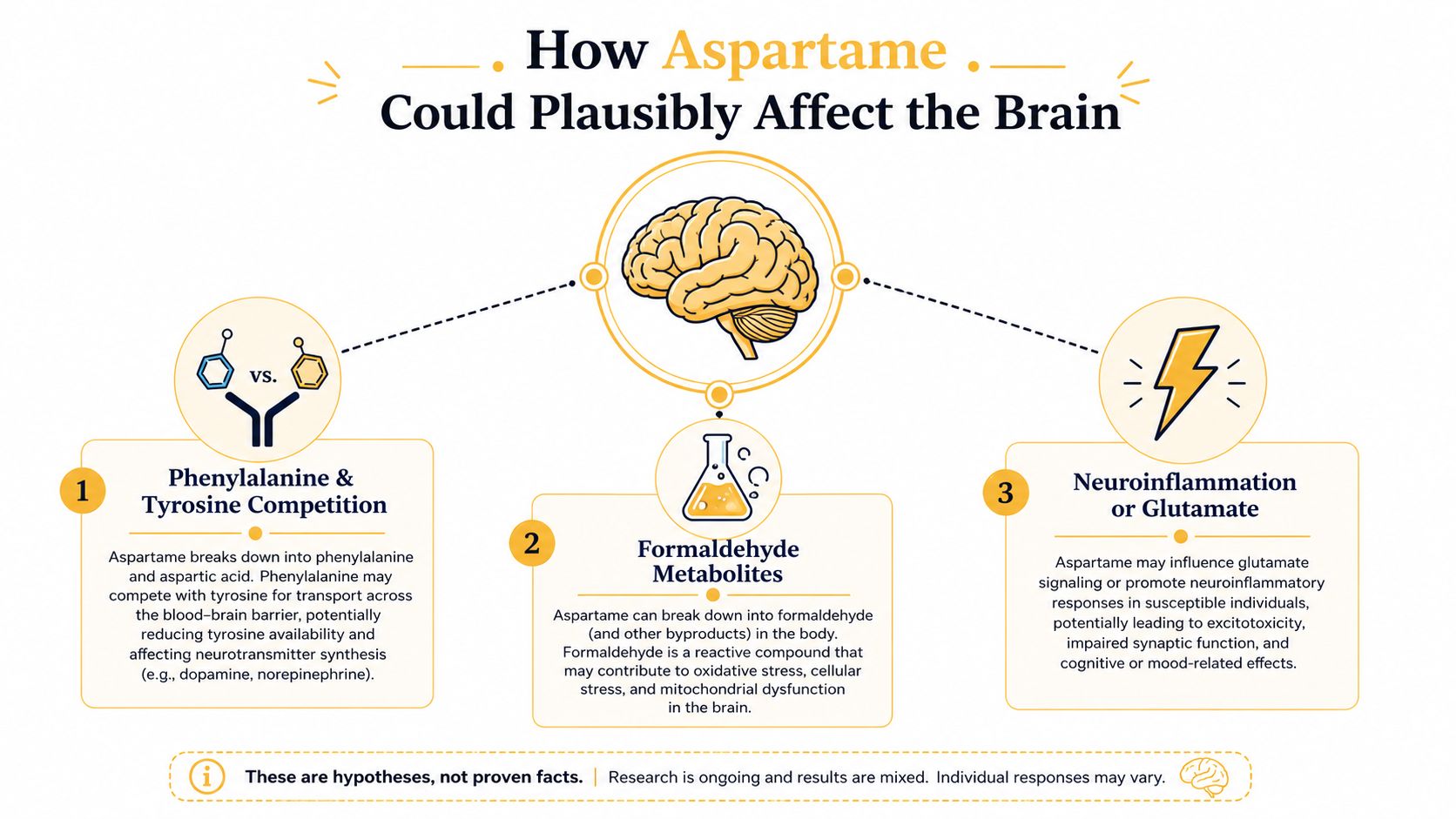
The key point is restraint. These are plausible mechanisms, not proven migraine causes, and the older formaldehyde-based theories remain narrow and not generally accepted as a universal explanation. That is why the science stays cautious even when individual stories sound convincing.
The mechanism matters less than the pattern you can observe in your own life.
Who Is Most Likely to React
Who is most likely to react? Usually, it is not the casual diet-soda drinker. The pattern shows up more often in people with a migraine history who are exposed again and again, or in people who already suspect aspartame is part of their personal trigger mix.
Dose matters, and that is where many people get confused. The stronger trials and reviews describe large, prolonged exposures in the range of 900 to 3,000 mg/kg/day, which one clinical source translates into roughly 2 to 3 liters of diet soda per day for sustained intake. NIH literature review on dose and headache susceptibility Clinical review noting high exposure levels and migraine susceptibility
That is a very different picture from a single serving. A randomized crossover study using 30 mg/kg/day found no significant differences in headache length or intensity versus placebo, which helps explain why everyday intake has not produced a clean signal for everyone. NIH literature review on dose and headache susceptibility
What that means in real life
- Repeated exposure matters more: one soda can be too little to judge, while several days of steady intake may reveal a pattern.
- Migraine history matters: people with migraine seem more likely to notice sensitivity than people with other headache types.
- Expectation matters too: in controlled studies, the people who are very sure about aspartame often show a bigger difference than the somewhat sure group, which can reflect both real susceptibility and a strong nocebo effect.
One expert review notes that susceptibility may apply to only about 2% of migraine patients, a useful reminder not to treat a small subgroup like a universal rule. Clinical review on sweeteners, headaches, and the unpredictability of triggers
A symptom diary can help sort out whether you belong to that subgroup, especially if you pair it with a structured elimination and rechallenge approach like the one described in this migraine tracking guide.
How to Test Whether Aspartame Triggers Your Migraines
The cleanest way to answer this for yourself is a structured elimination-and-rechallenge test, not a vague “I stopped it for a day and felt weird” experiment. That matters because migraine timing can be delayed, overlapping, and influenced by sleep, stress, missed meals, and hormones.
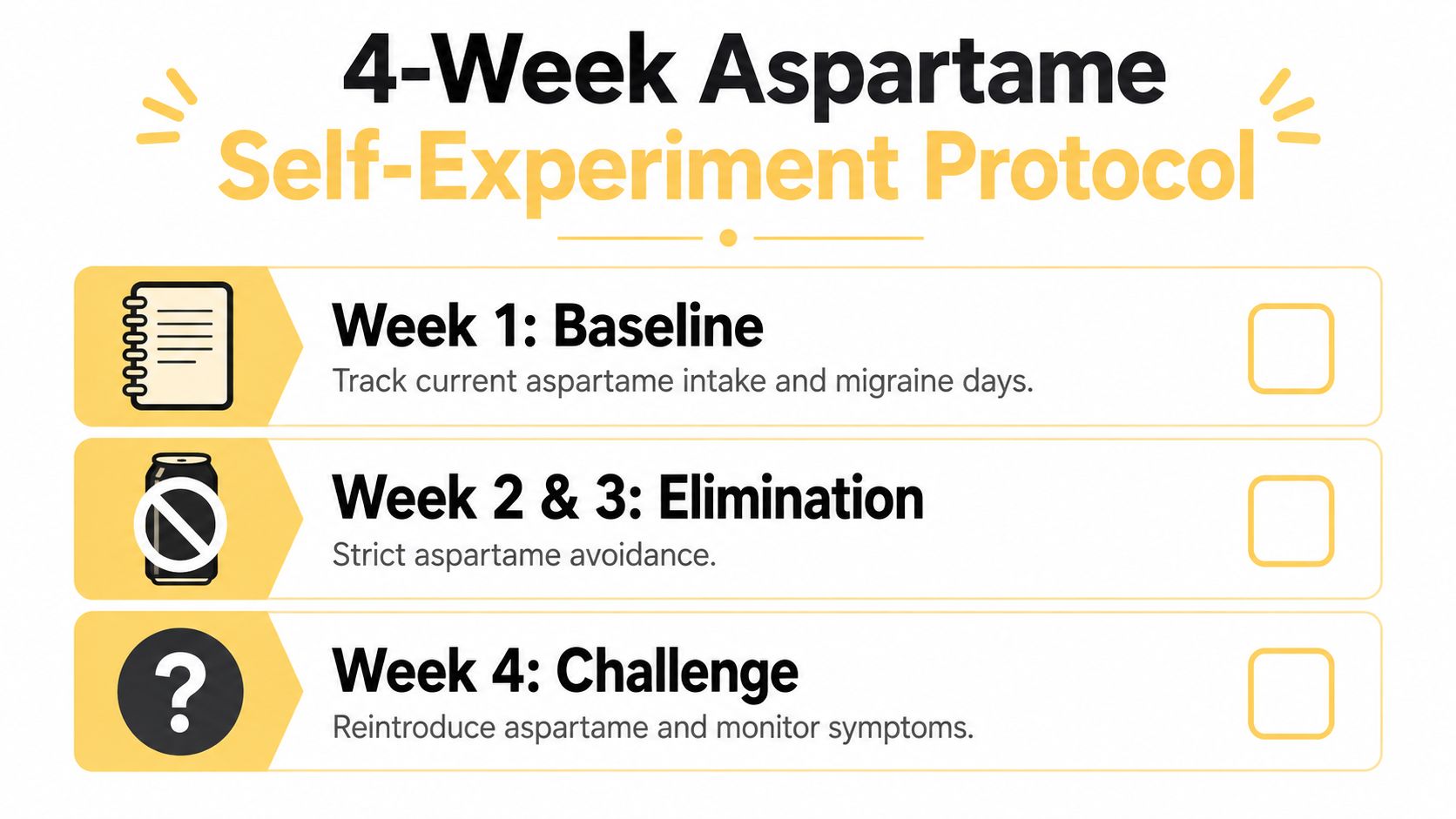
A simple 4-week self-experiment
Week 1, baseline. Keep your usual diet and log everything you currently consume that might contain aspartame, including diet sodas, sugar-free gum, yogurts, protein bars, and even medications or supplements that may use sweeteners.
Weeks 2 and 3, elimination. Avoid aspartame strictly and keep the rest of your routine as steady as you reasonably can. The point is to remove the sweetener, not to overhaul your life all at once.
Week 4, challenge. Reintroduce aspartame at your typical dietary pattern while keeping other variables as stable as possible. Then compare what happened.
What to log each day:
- Severity
- Duration
- Symptoms, including aura, nausea, light sensitivity, and sound sensitivity
- Time of day
- Context, such as sleep, stress, skipped meals, dehydration, or caffeine changes
A symptom diary is most useful when you treat it like pattern recognition, not proof by single episode. One migraine after a diet drink doesn't establish causation, and one migraine-free week doesn't rule it out.
If you prefer digital tracking, an app like Relief can help you compare exposure and attack timing without doing the math by hand.
Alternatives to Aspartame and What to Watch For Instead
If you want to test the sweetener angle without aspartame, people often swap in stevia, monk fruit, erythritol, allulose, or plain sugar in moderation. The evidence for those as migraine triggers is thinner than for aspartame, but that doesn't make them automatically harmless for every person.
The bigger issue is often what travels with the sweetener
Diet drinks and sugar-free products often bundle in other possible triggers. Caffeine swings can matter if you're drinking cola-style products, and dehydration can show up when soda replaces water during a busy day or a long work shift.
Some products also contain artificial colors, and many people reach for diet drinks when they've skipped meals, are under stress, or are already running on low sleep. That makes the drink look guilty when the trigger cluster may be broader.
Practical rule: when you test one suspected trigger, keep an eye on the whole package it usually arrives in.
A short checklist can help you isolate the variable:
- Check caffeine: note whether the drink has caffeine, and whether your usual intake changed.
- Check hydration: compare soda days with water intake and activity level.
- Check meal timing: log skipped meals, long gaps, or appetite suppression.
- Check add-ins: look for colors, other sweeteners, and flavoring agents.
That broader lens keeps you from swapping one confusing trigger for another. It also helps you see whether the pattern is really about aspartame, or about the context in which you usually encounter it.
When Aspartame May Not Be the Real Trigger
Many people find this confusing. A headache after a diet drink feels specific, but the drink may just be the most visible part of a larger chain.
If you had caffeine earlier, skipped lunch, slept badly, or were already stressed, the diet beverage can look like the culprit even when it's part of a trigger cluster. That's the classic correlation-versus-causation problem, and it's why self-reported food triggers need careful testing.
The “very sure” subgroup data also matters here. Strong belief can reflect a real sensitivity, but it can also magnify attention to symptoms, timing, and expectation, which is why placebo-controlled trials remain so useful.
The most useful question isn't “Does aspartame cause migraine?” It's in whom, under what context, and alongside which other exposures does it appear to correlate with attacks? That framing keeps the conversation honest and makes your own tracking much more precise. Review discussing aspartame as a possible small-subgroup trigger and the uncertainty around artificial sweeteners overall
When to See a Doctor and How Tracking Helps
Get immediate medical care for a sudden severe headache, a headache with fever or stiff neck, new neurological changes such as weakness, confusion, or trouble speaking, or a headache after a head injury. Those are red flags, and they need urgent evaluation rather than food detective work.
This article is for informational purposes and is not medical advice. Consult a healthcare provider for personalized guidance.
If your migraine pattern is changing, bring your log to your next appointment. Relief's about page explains how tracking can pair attack history with environmental signals, which gives you a clearer picture than memory alone.
If you're trying to figure out whether aspartame belongs on your personal trigger list, Relief can help you track exposures, symptoms, and timing without turning your day into a spreadsheet. Visit Relief to start spotting patterns that a single bad day can't explain.


