A barometric pressure headache map is a weather chart that shows atmospheric pressure changes, and many people with migraine use it to spot potential weather triggers before symptoms ramp up. Research suggests that for many migraineurs, a drop of 6 to 10 hPa in 24 hours is a meaningful trigger zone, and attacks occur most often when pressure sits around 1003 to 1007 hPa.
If you're reading this because you woke up feeling that familiar heaviness behind your eyes, checked the forecast, and wondered if the weather is messing with you again, you're not overreacting. A lot of people with migraine notice that storms, sticky air, or sudden weather swings seem to show up right before pain, aura, dizziness, photophobia, or that washed-out prodrome feeling starts.
Weather won't explain every attack. But for some people, tracking pressure changes can turn a vague suspicion into something more useful. Instead of thinking, "I guess the weather hates me," you can start asking a better question: "What kind of pressure change tends to show up before my migraine attacks?"
Table of Contents
- Start with the big symbols
- Watch the numbers and the speed of change
- A simple way to use the map today
That Familiar Pressure Is It the Weather Again
You know the pattern. The sky turns gray, your head feels tight, maybe your neck starts to ache, and you find yourself checking the weather app before you check your messages. That repeating cycle can be frustrating, especially when other people treat it like coincidence.
A barometric pressure headache map is a weather map that highlights air pressure patterns and changes over time. People with migraine use it to watch for shifting pressure, especially around storms or fronts, because those changes may lower their migraine threshold.
That doesn't mean every weather-related symptom is a migraine. A generic headache can happen for lots of reasons. A migraine attack is a neurological event that may include head pain, but can also involve aura, nausea, phonophobia (sound sensitivity), photophobia (light sensitivity), dizziness, or a postdrome "hangover" after the worst part passes.
The experience is common enough that it deserves to be taken seriously. The American Migraine Foundation reports that more than 33% of people with migraine identify certain weather patterns, including barometric pressure shifts, as triggers at least some of the time, as summarized by Medical News Today's review of weather-related migraine triggers.
You're not imagining the pattern just because it isn't perfectly predictable.
What a map can do for you
A pressure map won't tell you with certainty that you'll have an attack. It can still help in practical ways:
- Spot risk windows: You may notice that symptoms often start before a storm, not during it.
- Reduce surprise: If a front is moving in, you can simplify your schedule, hydrate, protect sleep, or limit extra triggers.
- Improve conversations with your clinician: A clear record of weather-linked patterns is more useful than a vague memory of "bad weeks."
This article is for informational purposes and is not medical advice. Consult a healthcare provider for personalized guidance.
Why Pressure Changes Can Trigger a Migraine Attack
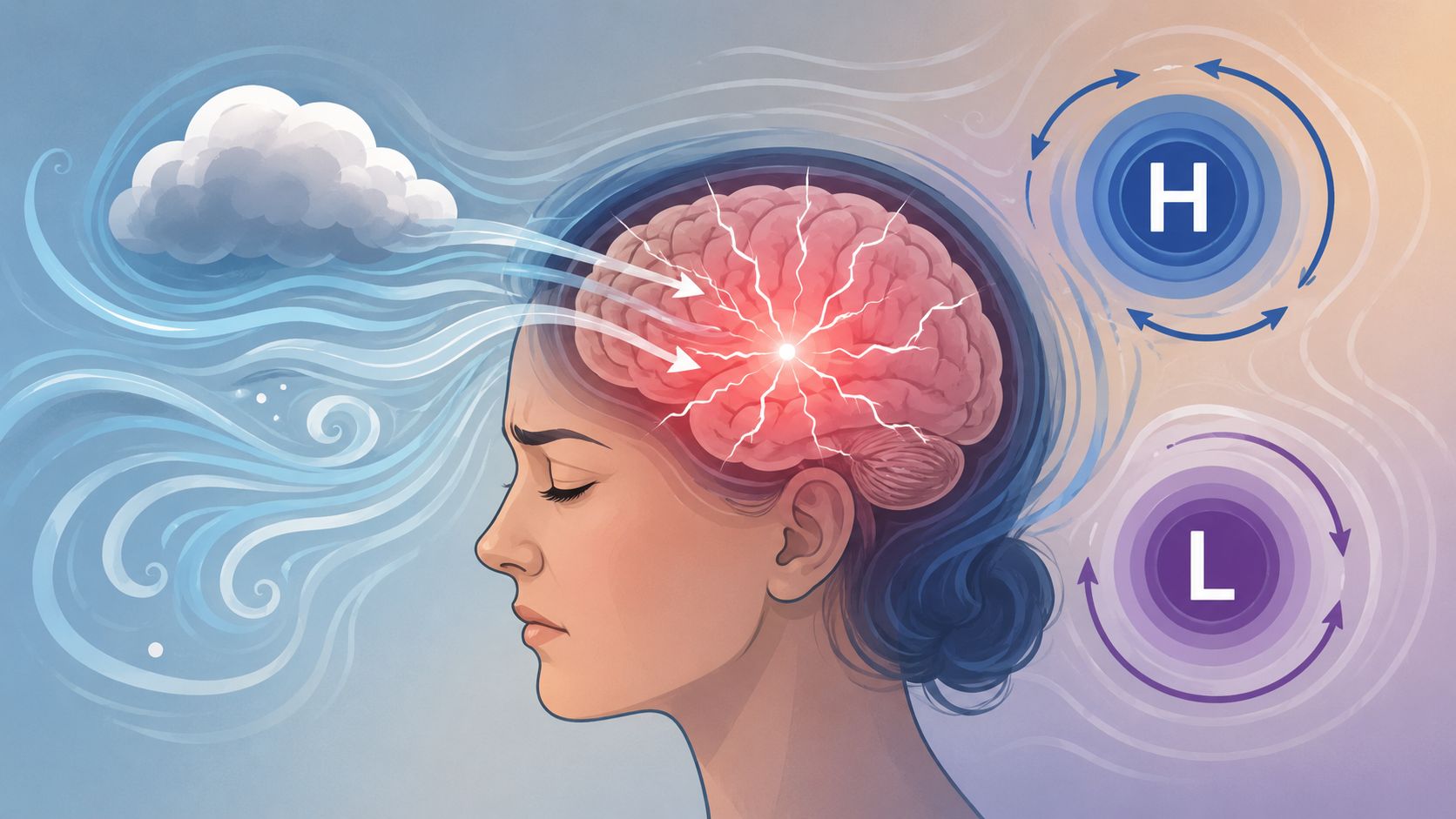
The short version is that your body doesn't experience "weather" as an abstract forecast. It experiences changes in pressure, moisture, temperature, and sensory load. If you have a sensitized migraine nervous system, those shifts may be enough to push you toward an attack.
Your nervous system may feel the shift before you do
One leading explanation involves a small pressure mismatch between your body and the air around you. Researchers also think the inner ear system plays an important role. In a systematic review in Headache, researchers noted that the brain appears to sense pressure changes through the inner ear, where nerves cross-talk with pain pathways. Animal studies also showed changes in brain chemicals and sympathetic nerve activity, which gives this weather trigger a plausible biological pathway.
Another way to think about it is this: your nervous system may be acting like a very sensitive pressure sensor. When the outside environment shifts, your body may respond before the weather change feels dramatic to anyone else.
Migraine is not the same as a generic headache
This distinction matters because a lot of people say "weather headache" when they're really describing a migraine attack. Migraine can involve:
- Aura: temporary neurological symptoms such as visual changes or tingling that can happen before or during an attack
- Prodrome: early warning symptoms such as fatigue, mood change, food cravings, or neck stiffness
- Photophobia and phonophobia: sensitivity to light and sound
- Postdrome: that drained, foggy feeling after the main attack eases
A pressure change doesn't have to cause instant pain to matter. It may lower your threshold, making you more vulnerable when another trigger shows up the same day, like poor sleep, stress, dehydration, or a skipped meal.
Practical rule: If your symptoms often begin hours before rain starts, pay attention to pressure trend changes, not just the rain icon in your weather app.
Some researchers also describe pressure-related effects through blood vessel and nerve responses, or pressure changes in sinus and inner ear structures that can stimulate pain-sensitive tissue. That helps explain why weather-triggered migraine can feel very physical, not vague or imagined.
A useful visual explainer can make this easier to picture:
How to Read a Barometric Pressure Headache Map
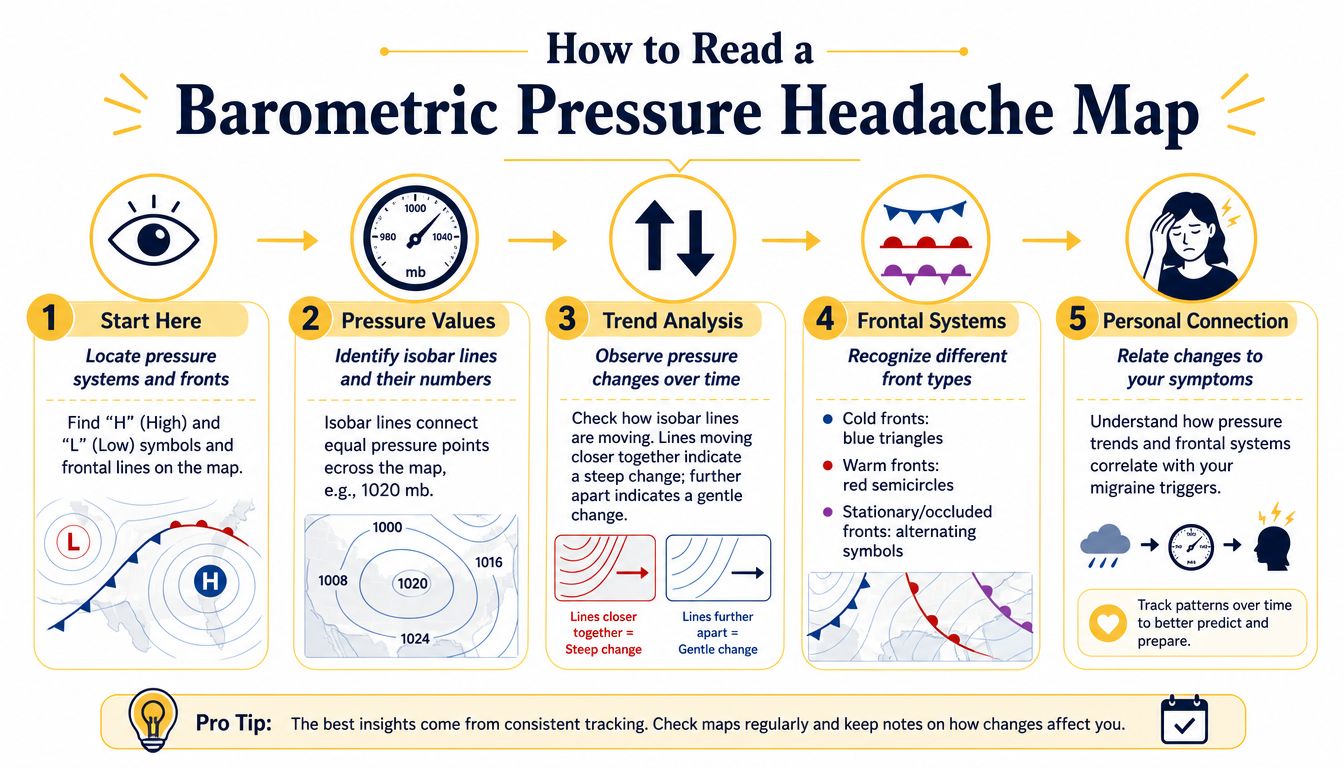
A barometric pressure headache map looks intimidating at first, but you don't need to become a meteorologist. You only need to know what to scan for, what numbers deserve your attention, and how to connect those changes to your own symptoms.
Start with the big symbols
Most weather maps show H for high pressure and L for low pressure. In very general terms, high pressure often brings calmer, more stable weather, while low pressure is more often linked with unsettled weather and storms.
Then look for isobars. These are the curved lines connecting places with the same pressure. When those lines are tightly packed, pressure is changing more sharply across an area. For some people with migraine, that kind of shift matters more than whether the map looks sunny or rainy.
You'll also see fronts:
| Map feature | What it usually means | Why it may matter |
|---|---|---|
| Cold front | A boundary where cooler air moves in | Often comes with rapid weather change |
| Warm front | Warmer air moves into cooler air | Can bring a slower build of cloud and humidity |
| Low-pressure area | More unsettled conditions | Often worth watching if weather is a trigger |
| Tightly packed isobars | Faster pressure transition | May signal a more abrupt change |
Watch the numbers and the speed of change
The map's actionability is enhanced by research suggesting that for many migraineurs, a drop of 6 to 10 hPa in 24 hours can be a critical trigger, and attacks occur most frequently when pressure is in the 1003 to 1007 hPa range, according to a PubMed Central article on weather sensitivity and migraine pressure thresholds.
That gives you two things to track:
Absolute pressure level
If your local pressure is sitting in a lower range, you may want to be more alert.Rate of change
If pressure is dropping fast across the day, that may be more meaningful than the starting number alone.
Some people get confused because weather apps often show one pressure number but not the trend. If that's your app, compare the current reading with earlier readings from the same day. You're looking for movement, not just a snapshot.
If you want to use a pressure map well, ask two questions: "Where is the pressure now?" and "How fast is it changing?"
A simple way to use the map today
Try this the next time your head feels "off" before the weather turns:
- Check the pressure trend first: Look at whether local pressure has moved over the last day.
- Notice nearby fronts: A front passing through often means change is underway, even before rain starts.
- Write down timing: Did symptoms begin before, during, or after the pressure shift?
- Track the symptom type: Migraine pain, aura, dizziness, neck pain, fatigue, and nausea don't always appear together.
This process won't make weather predictable in a perfect way. It will make your own pattern easier to recognize.
Understanding Pressure Trends Rising Versus Falling
A lot of weather-migraine advice stops at "watch for falling pressure." That's useful, but it's incomplete. Some people clearly react to the drop before a storm. Others feel rough during the rebound afterward.
Why falling pressure gets most of the attention
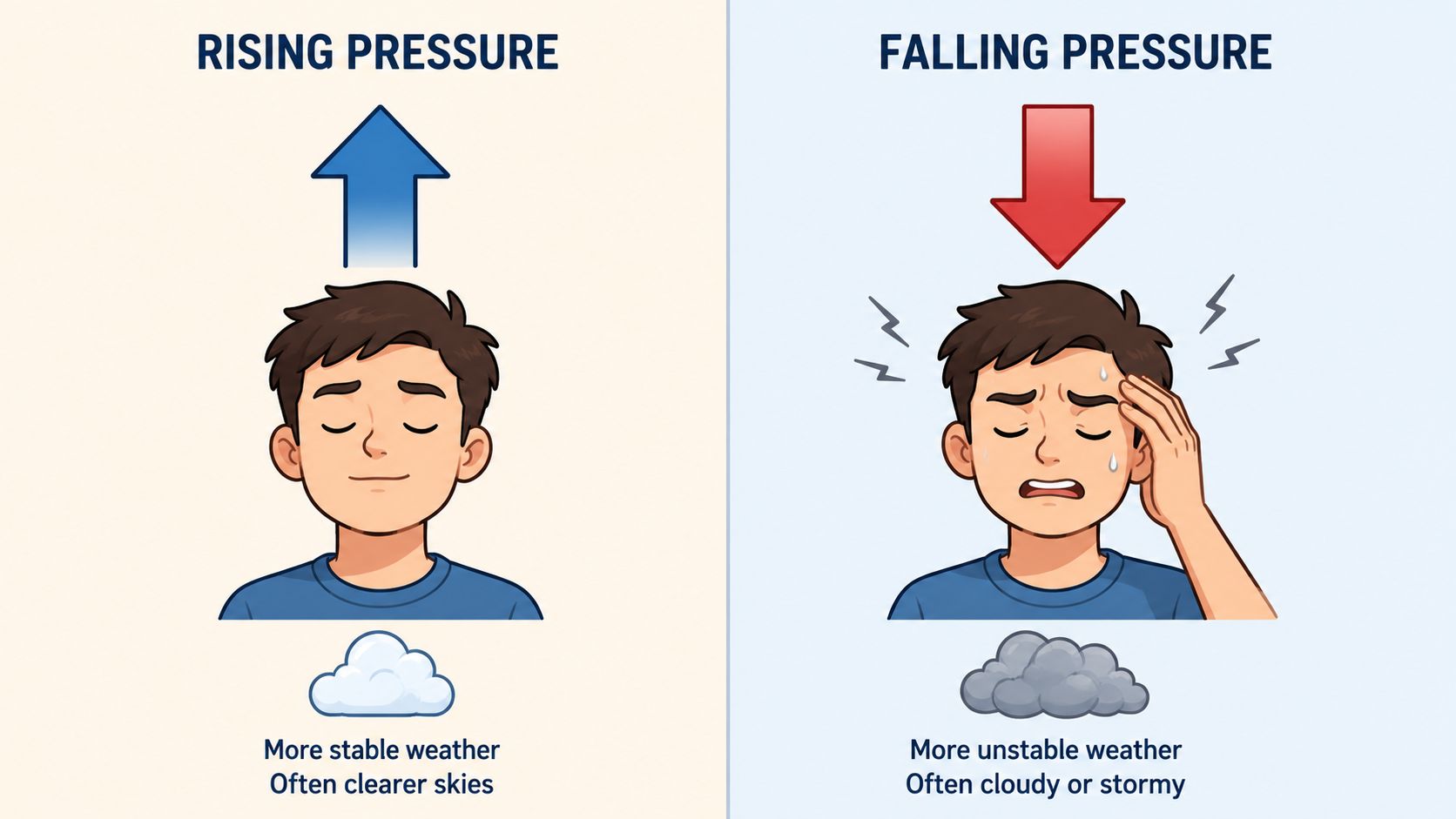
Falling pressure is the classic weather trigger because it's often tied to incoming storms, humidity changes, and broader atmospheric instability. Many people notice prodrome symptoms or pain ramping up as a storm system approaches, not after it fully arrives.
That pattern makes sense. A drop in pressure can happen alongside darker skies, poor sleep, stress about changing plans, and temperature shifts. Your migraine brain may not be reacting to one signal in isolation.
Why rising pressure can still matter
Some data suggests the primary issue isn't only falling pressure. It's change itself. According to Meteorologist David Paul's discussion of pressure-swing sensitivity, falling pressure is the more common trigger, but rising pressure can also stir up symptoms in sensitive people. The key idea is that rapid transitions in either direction may be the main risk.
That matters because it changes how you read the map. If you only brace for storm drops, you may miss the post-storm rebound that still leaves you feeling awful.
A useful way to conceptualize it is:
- Falling pressure: often linked with incoming weather systems and storm buildup
- Rising pressure: may bother you during the atmospheric reset after a front passes
- Low but steady pressure: can still be a problem for some people, even without a dramatic swing
Some migraine triggers aren't about "bad weather." They're about your nervous system reacting to a changing environment.
Your own notes become more valuable than generic advice. You may be a "drop person," a "rebound person," or someone who reacts only when pressure change combines with another trigger.
Turning Weather Data into a Personal Forecast
A weather map can tell you what the atmosphere is doing. It can't tell you how your body reacts to it. That's why two people in the same city can live through the same storm front and have completely different days.
Weather maps are useful but incomplete
One person may get aura and nausea before a pressure drop. Another may only notice a mild headache. Someone else may feel nothing unless the weather shift lands on a bad sleep night.
Weather variables also travel together. For example, for every 10-degree Fahrenheit increase in daily temperature, there was a corresponding 6% increase in headache occurrence, a pattern discussed in Migraine Again's review of weather and headache data. Temperature can move with storm systems and pressure changes, which means "barometric pressure" may be only part of your trigger picture.
What to track with your symptoms
Instead of trying to prove that weather causes every attack, try to notice repeatable combinations. A simple log can include:
- Timing: Did symptoms start the night before, the morning of, or after the weather change?
- Symptom pattern: Was it migraine pain, aura, vertigo, fatigue, neck pain, or a mix?
- Other context: Sleep disruption, stress, dehydration, missed meals, or hormonal changes
- Weather details: Pressure trend, temperature shift, humidity, rain, and wind if you have access to them
You don't need a perfect spreadsheet. You need consistency.
A helpful approach is to review a few attacks together instead of analyzing each one in isolation. You might notice that a moderate pressure drop alone doesn't affect you, but a pressure drop plus poor sleep does. Or maybe your main clue isn't pain at all. It's a day of yawning, sensory sensitivity, and brain fog before pain hits.
Treat the weather like one ingredient, not the whole recipe.
If you're discussing treatment or prevention with a clinician, keep categories separate in your own notes. List lifestyle approaches like sleep regularity and hydration, over-the-counter options you used, prescription treatments your clinician has discussed, and any emerging approaches you've read about. That makes your record clearer and safer to review.
How Relief Creates Your Personalized Migraine Forecast
Manually checking pressure charts, comparing hourly readings, and matching them to symptoms works. It's also a lot to keep up with when you're already dealing with migraine.
Less manual detective work
Relief combines your check-ins with local environmental conditions so you don't have to do the comparison by hand. That includes weather signals like barometric pressure, temperature, humidity, and other exposures that may overlap with your migraine pattern.
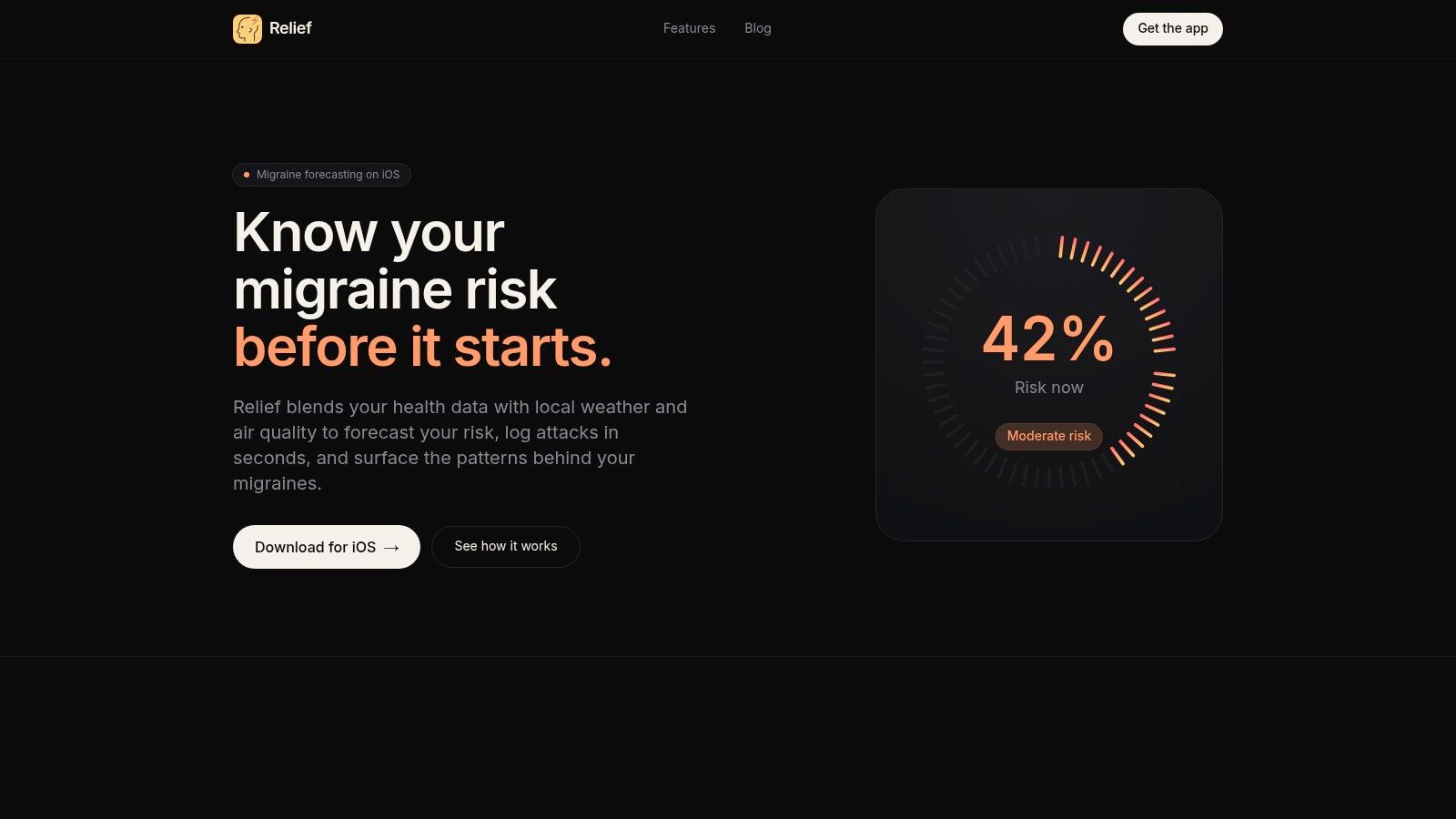
Instead of asking you to become your own weather analyst, the app organizes the information into something more usable: your recent symptoms, likely trigger patterns, and an hour-by-hour forecast built around your history. You can see how Relief works on the Relief migraine tracking app.
Why personalization matters
Generic weather advice can only go so far. It may tell you that pressure is changing in your area, but it won't know whether your attacks tend to show up before a pressure drop, during a rebound, or only when weather shifts stack with stress and poor sleep.
That's where tracking gets more practical. Over time, a personalized forecast can help you notice patterns earlier, protect important plans, and have better context for conversations with your healthcare provider. Relief doesn't replace medical care. It supports awareness, tracking, and day-to-day planning.
When a Headache Is a Sign of Something More Serious
Weather can be a real trigger. Still, not every severe headache should be written off as "just my usual migraine."
Red flags that need urgent care
Seek immediate medical care if you have any of the following:
- A sudden, severe headache: especially one that peaks fast or feels unlike anything you've had before
- Headache with fever or a stiff neck: this needs urgent evaluation
- Neurological changes: confusion, weakness, trouble speaking, fainting, or new vision changes that are unusual for you
- Headache after a head injury: don't wait this out at home
If you have recurring headaches or migraine attacks that are changing in pattern, becoming harder to manage, or causing major disability, schedule a medical evaluation. This article is for informational purposes and is not medical advice. Consult a healthcare provider for personalized guidance.
If you'd like a simpler way to track weather signals, symptoms, and patterns in one place, Relief can help you turn a barometric pressure headache map into a personal migraine forecast.


