Yes, today's barometric pressure can trigger a headache or migraine, especially if it has dropped by more than 5 to 10 hPa in the last 24 to 48 hours. If you're wondering whether the weather is really part of what you're feeling right now, you can check that with a simple pressure comparison instead of guessing.
You wake up feeling off. Maybe there's pressure behind your eyes, your neck feels tight, light already seems too bright, and the sky doesn't even look dramatic enough to justify it. That kind of day can make you feel dismissed before you've even explained it.
If this sounds familiar, you're not imagining it. Weather shifts can play a real role in migraine attacks, and that's different from an ordinary headache. A headache is a symptom. A migraine is a neurological condition that can involve head pain, but also nausea, photophobia (light sensitivity), phonophobia (sound sensitivity), aura, dizziness, and a washed-out postdrome phase after the pain eases.
This article is for informational purposes and is not medical advice. Consult a healthcare provider for personalized guidance.
Table of Contents
- A simple way to verify todays pressure change
- Quick reference table
- A few places readers get tripped up
- Lifestyle moves that can lower your risk
- OTC and prescription planning
- What pressure drops usually mean
That Feeling in the Air Is Real
You wake up with that familiar off feeling. The sky does not look dramatic. There is no downpour, no crack of thunder, nothing that would make anyone else expect a migraine. Still, your head feels different, your energy is off, and you start wondering whether the weather changed before the forecast made it obvious.
That experience is common among people with migraine. Your nervous system can pick up on subtle shifts before the day looks stormy.
For some people, the first sign is not pain at all. It is prodrome, the early warning phase of a migraine attack. You might yawn more, feel unusually tired, get brain fog, become irritable, or notice food cravings hours before the head pain begins. That matters because a "barometric pressure headache today" may really be a migraine process that started earlier, before you connected it to the weather.
A weather-related migraine also tends to look different from a typical tension headache. Tension headaches often feel like a steady, band-like tightness. Migraine is more likely to bring nausea, sensitivity to light or sound, motion sensitivity, one-sided throbbing pain, or aura with temporary visual or sensory changes.
You do not need a major storm for weather to affect you. Pressure can shift before the obvious weather change shows up outside your window.
Research supports the pattern many patients describe. In one study of 28 people with migraine, weather-related attacks were common, and many of the weather-sensitive participants pointed to low barometric pressure as a trigger, according to a peer-reviewed study in Internal Medicine.
The tricky part is that weather is rarely the only factor. Migraine works more like a bucket that slowly fills. Pressure changes can add to the load, but so can poor sleep, stress, skipped meals, bright light, hormonal shifts, strong smells, or changes in exercise. On one day, a small pressure drop may do nothing. On another, the same drop may be enough to tip you into an attack.
Why this gets confusing so fast
Weather apps often show a single pressure number, which is like seeing one frame of a movie. What helps more is the change over time.
This leads to a more useful question. Instead of asking, "Is the pressure low today?" ask, "Has pressure fallen by about 5 to 10 hPa over the last day or two?" That is the range worth watching because studies have linked drops in that ballpark with migraine attacks. A concrete number gives you something practical to track, instead of vague advice to "watch the weather."
How a Change in Pressure Triggers Pain
Why your body notices pressure shifts
You wake up with that odd, storm-is-coming feeling. Your head is not pounding yet, but something feels off. That can happen before the weather looks dramatic outside.
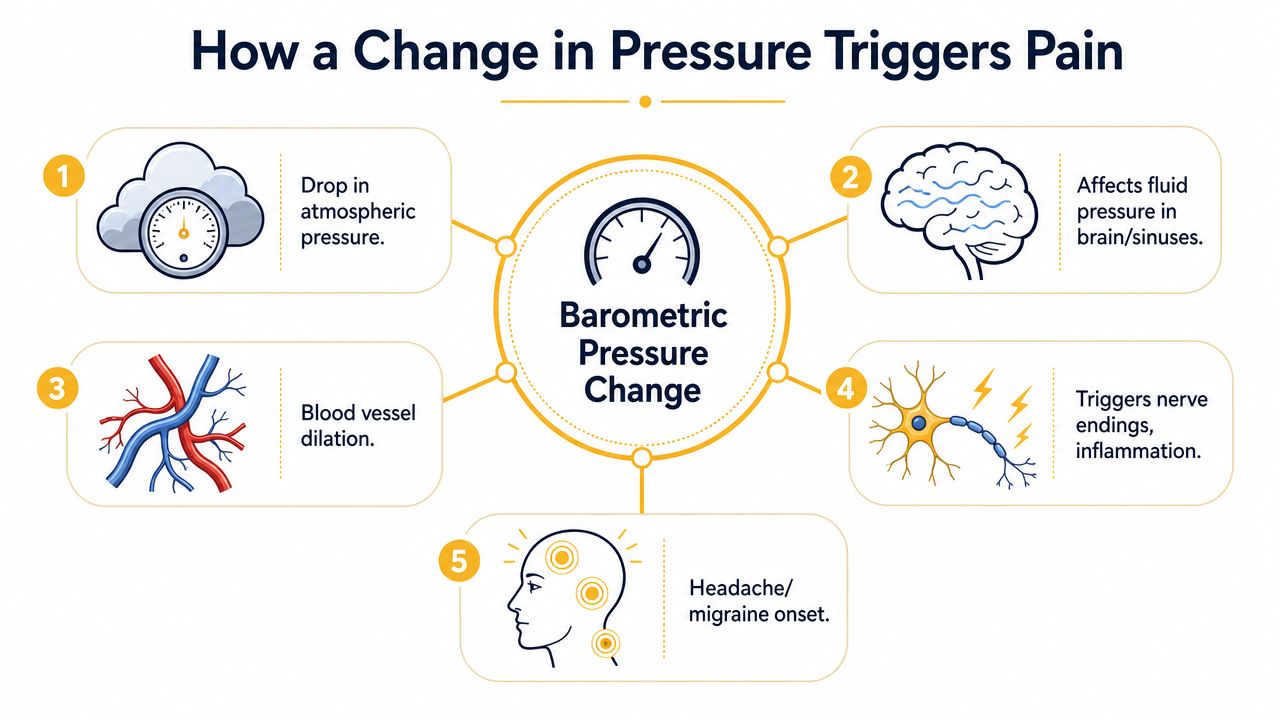
Barometric pressure is the weight of the air around you. When that weight changes, your body has to adapt to a new balance. A balloon works as a simple comparison. Change the pressure around it, and the tension changes even if the balloon stays in the same place.
Your body has air-filled spaces in the sinuses, along with pressure-sensitive tissues and nerves in the head and face. For people with migraine, a pressure shift may irritate pain pathways, especially the trigeminal nerve, which plays a major role in migraine pain.
Migraine is best understood as a sensitive alarm system. Weather is one input. If your brain is already on high alert because of stress, poor sleep, hormones, or skipped meals, a falling pressure pattern can be the extra nudge that starts symptoms.
The number worth watching
Here is the part that makes weather tracking more useful. A lot of articles say to watch for "pressure changes," but that advice is too vague to help on a real day when you are deciding whether to rest, hydrate, or take medication early.
As noted earlier, studies have linked migraine attacks with pressure drops in roughly the 5 to 10 hPa range. That gives you a concrete threshold to watch, not just a general sense that the weather is changing.
One study found a pattern where headaches became more common when pressure was lower by more than 5 hPa across the headache day and the following day. The practical takeaway is simple. A meaningful drop may affect you before the storm peaks, while the pressure is still falling, or even as your body is catching up to that change.
Practical rule: If the pressure trend is falling and the total drop moves past 5 hPa, treat that as a useful warning sign.
What this can feel like in real life
A pressure-related migraine does not always begin with obvious pain. It can start with a quieter set of signals that are easy to brush off if you are not looking for the pattern.
Common early clues include:
- Morning fogginess that does not feel like ordinary tiredness
- Behind-the-eye pressure or a sinus-like full feeling
- Light sensitivity before the headache becomes clear
- Nausea or dizziness without another explanation
- Neck stiffness that shows up before or during the attack
Some people notice these signs several hours before the main headache. Others notice the pattern only in hindsight. The pressure dropped, symptoms started, and what seemed random begins to look predictable.
That is why the change matters more than the single reading. Your body is reacting to the shift, not just the number on the screen.
Your Step-by-Step Guide to Checking the Pressure
You wake up with that familiar behind-the-eye heaviness, check the sky, and wonder whether the weather is part of the story today. The useful clue is usually not the pressure number by itself. It is how far that number has moved.
Weather apps can make this feel more complicated than it is. You may see Pressure, Barometer, hPa, mb, or sometimes inHg. For migraine tracking, hPa and mb are the easiest units to use because they line up with how research often describes pressure changes.
A simple way to verify todays pressure change
Use this quick check:
Open a weather app you already trust
Apple Weather, The Weather Channel, AccuWeather, and many local weather apps show barometric pressure or a pressure trend.Switch the unit to hPa or mb if you can
That makes the numbers easier to compare over time. It also helps you judge whether a drop has crossed the range linked with attacks in research.Look at more than one time point
Check the current pressure, then compare it with a reading from about 24 hours ago. If your app shows hourly or next-day data, look ahead too.Measure the size of the drop
Ask a very specific question. Has pressure fallen by more than 5 hPa? Has it moved into the 6 to 10 hPa range?Match the timing to your symptoms
Write down whether fogginess, light sensitivity, nausea, aura, sinus-like pressure, or head pain showed up before the drop, during it, or later.
That last step matters because pressure works less like an on-off switch and more like a slope your nervous system is reacting to. A single reading is one snapshot. The change across several hours gives you the pattern.
A systematic analysis found that small decreases of 6 to 10 hPa relative to standard atmospheric pressure were the most frequent pressure changes linked with migraine attacks, according to this systematic analysis of atmospheric pressure and migraine. For everyday tracking, that gives you a concrete number to watch instead of a vague sense that the weather is "off."
Quick reference table
| What you see in the weather data | What it may mean |
|---|---|
| Pressure is stable | Weather may be less likely to explain today's attack |
| Pressure is falling slightly | Worth watching if symptoms are already starting |
| Pressure has dropped more than 5 hPa | Fits a research-linked warning range for higher migraine risk |
| Pressure drop falls in the 6 to 10 hPa range | Matches the range most often linked to attacks in systematic analysis |
| Pressure is changing but your symptoms do not match | Weather may be only a small part of the picture today |
A few places readers get tripped up
One common mistake is focusing on "low pressure" as if that alone explains everything. For many people, the more useful signal is the drop itself, especially once it passes about 5 hPa.
Another point that causes confusion is timing. Symptoms do not always start the minute pressure falls. Some people feel off while the number is still dropping. Others notice the attack later, after their body has already been stressed by the change.
If you want patterns you can use, log the pressure trend, the size of the drop, and when symptoms started.
It's also a good time to compare weather with the rest of your day. Poor sleep, missed meals, stress, and a falling barometer can stack together, much like several small weights added to the same shelf. Any one weight might be manageable. Add enough at once, and the shelf starts to strain.
If you want more context on trigger tracking, it can help to pair this with articles on migraine prodrome symptoms and how to track migraine triggers consistently. Keep your notes specific so the pattern is easier to spot later.
What to Do When You See a Pressure Drop Coming
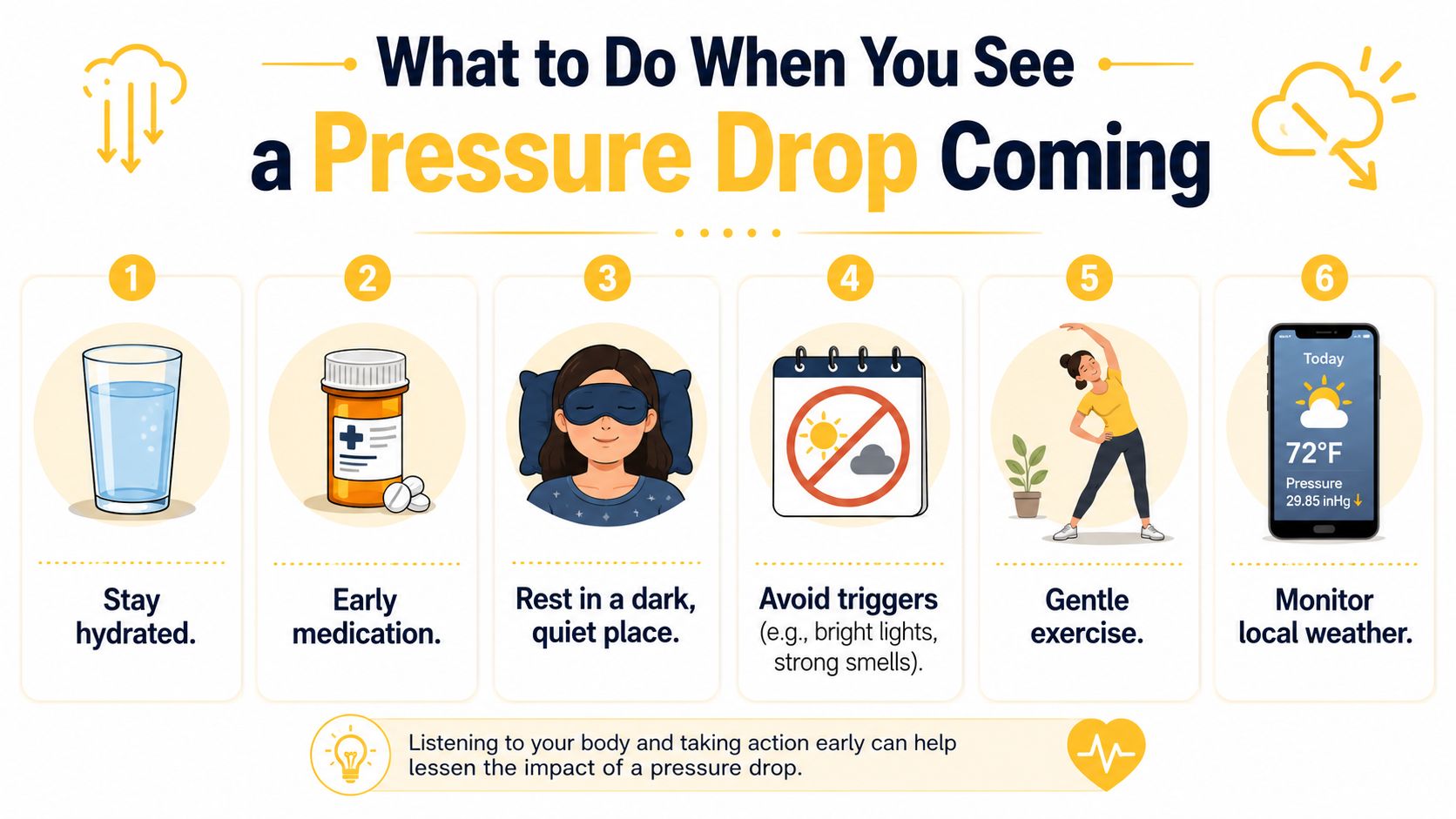
You check the forecast, see the barometer sliding, and feel that small wave of dread. A better response is to treat it like a yellow traffic light. Slow down, get ready, and make the next few hours easier on your nervous system.
A pressure drop in the research-linked range, especially about 5 to 10 hPa, is not a guarantee that migraine will hit. It is a useful warning sign. If your body tends to react to weather, that number gives you something concrete to watch instead of the vague idea that the weather is “bad.”
Lifestyle moves that can lower your risk
The goal is simple. Lower the other strain on your system so the pressure change has less to pile onto.
Migraine often works like a bucket that fills from several small sources at once. Weather may be one source. Poor sleep, dehydration, missed meals, bright light, and stress can each add a little more. On a day with a noticeable pressure drop, the practical move is to keep the rest of the bucket from filling too fast.
- Hydrate early so you are not trying to catch up once symptoms begin.
- Keep your sleep timing steady if you can. Even one later night can make a weather-sensitive day harder.
- Eat on schedule if hunger is one of your triggers.
- Reduce light, noise, and strong smells if you already feel that “off” pre-migraine shift.
- Choose gentle movement such as walking or stretching if that usually helps. Skip hard exercise if it tends to set attacks off.
Small adjustments count.
OTC and prescription planning
If over-the-counter medicine is already part of your usual plan, keep it nearby before symptoms build. Do the same with any prescription rescue medicine your clinician has recommended.
Talk with your clinician about what “treat early” means for your pattern. Some people get the best results when they act during prodrome, before the pain fully ramps up. Others need a different plan based on aura, nausea, or how fast their attacks develop.
This article is for informational purposes and is not medical advice. Consult a healthcare provider for personalized guidance.
A short explainer can help if you need a calmer walkthrough before symptoms build:
What pressure drops usually mean
One point can ease a lot of fear. A falling barometer is better understood as a change in odds, not a prediction that the attack will be unusually severe.
That distinction matters. If you see a drop of 5 to 10 hPa coming, the useful question is not “How bad will this get?” It is “What can I do early that gives me the best chance of staying functional?”
For many readers, that means practical preparation. Refill your water bottle. Eat before you get busy. Keep your medicine accessible. Trim nonessential stress from the day if possible. If you wake up feeling vulnerable and the pressure is already falling, that is your cue to keep plans lighter, not to panic.
A pressure drop can raise your risk. Your response still shapes the day.
That mindset is steadier and more useful. You are watching for a measurable weather shift, especially in that 5 to 10 hPa range, then responding early with habits and treatment steps that fit your own migraine pattern.
When a Headache Is More Than Just the Weather
A falling barometer can explain part of the picture. It should not explain away warning signs.
That matters because weather-related migraine can look familiar right up until something about it does not. The pattern may change. The pain may arrive with symptoms that do not fit your usual attacks. When that happens, the safer question is not whether pressure dropped 5 to 10 hPa. It is whether this headache still matches your known migraine pattern.
Seek urgent care now if you have these symptoms
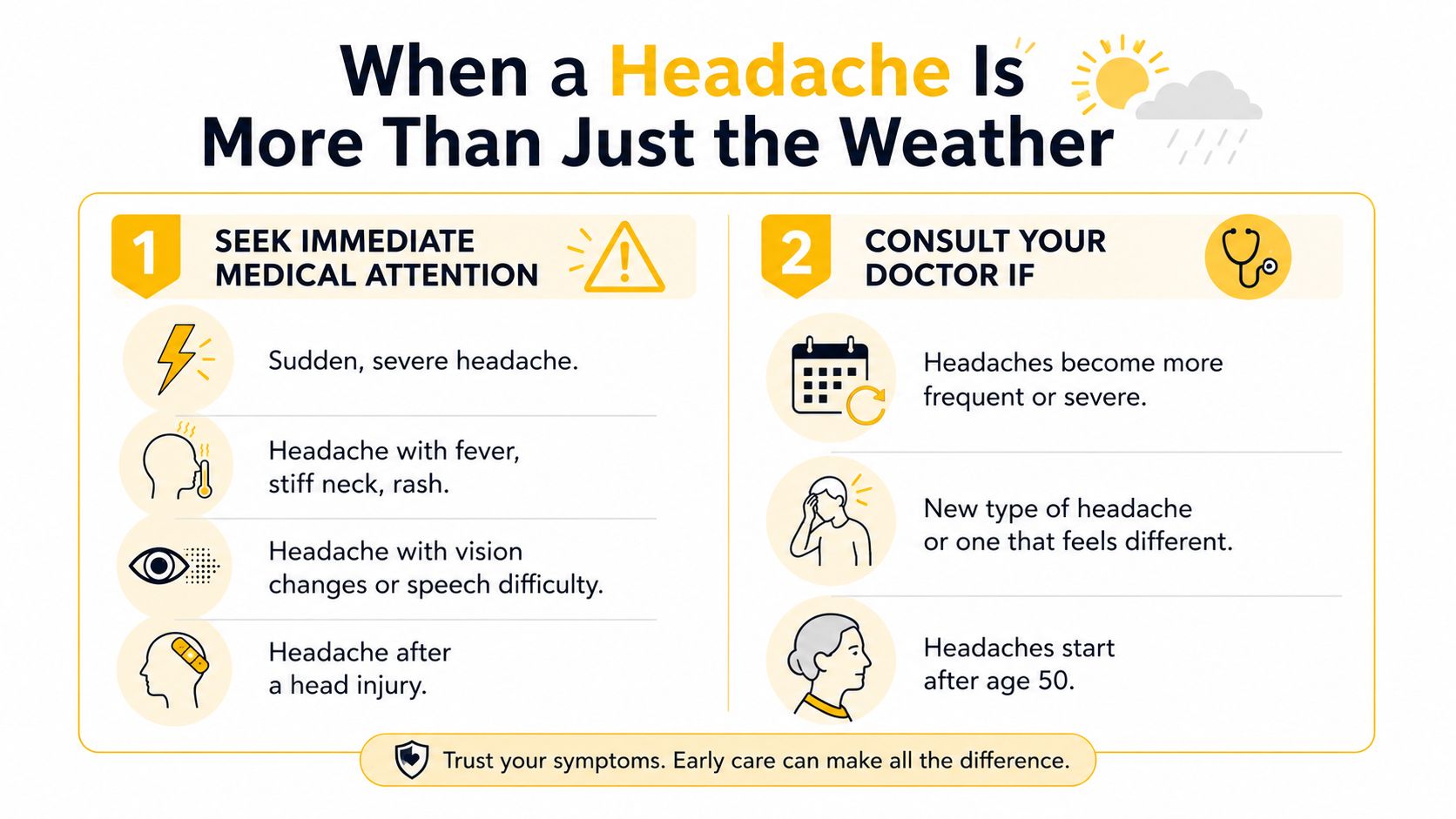
Get immediate medical care for:
- A sudden severe headache that peaks fast or feels like the worst headache of your life
- Headache with fever, stiff neck, or rash
- Neurological changes such as weakness, confusion, fainting, vision loss, trouble speaking, or new numbness
- Headache after a head injury
These symptoms need prompt medical evaluation because they can point to problems that are very different from a weather-triggered migraine.
Call a doctor soon if your pattern is changing
Make a non-urgent medical appointment if:
- Your headaches are becoming more frequent or more disruptive
- You have a new type of headache or one that feels unlike your usual migraine pattern
- Headaches begin after age 50
- Your current treatment plan isn't helping enough
Weather can be a trigger and a distraction at the same time. A pressure drop may raise the odds of an attack, especially if you already know that the 5 to 10 hPa range affects you, but it does not rule out other causes.
If you are unsure whether a headache is following your usual pattern, keeping a simple record can help you describe the change clearly. A migraine tracking app that logs symptoms alongside local weather can make those patterns easier to review with a clinician.
Using a Migraine App to Stay Ahead of Attacks
Why manual tracking helps
The best way to figure out whether weather really affects you is consistent tracking. Not perfect tracking. Consistent tracking.
Write down the day, time, symptoms, and what the pressure was doing. Include migraine-specific details like aura, nausea, photophobia, phonophobia, dizziness, and postdrome fatigue. Over time, that gives you something far more useful than a vague feeling that “storms get me.”
A simple log also helps separate patterns. You may notice that pressure drops matter only when sleep is poor. Or only during certain seasons. Or mainly when humidity and temperature are changing too.
When tracking gets easier
Manual notes work, but they can get tedious fast, especially when your head hurts. That's where an app can support you without replacing medical care.
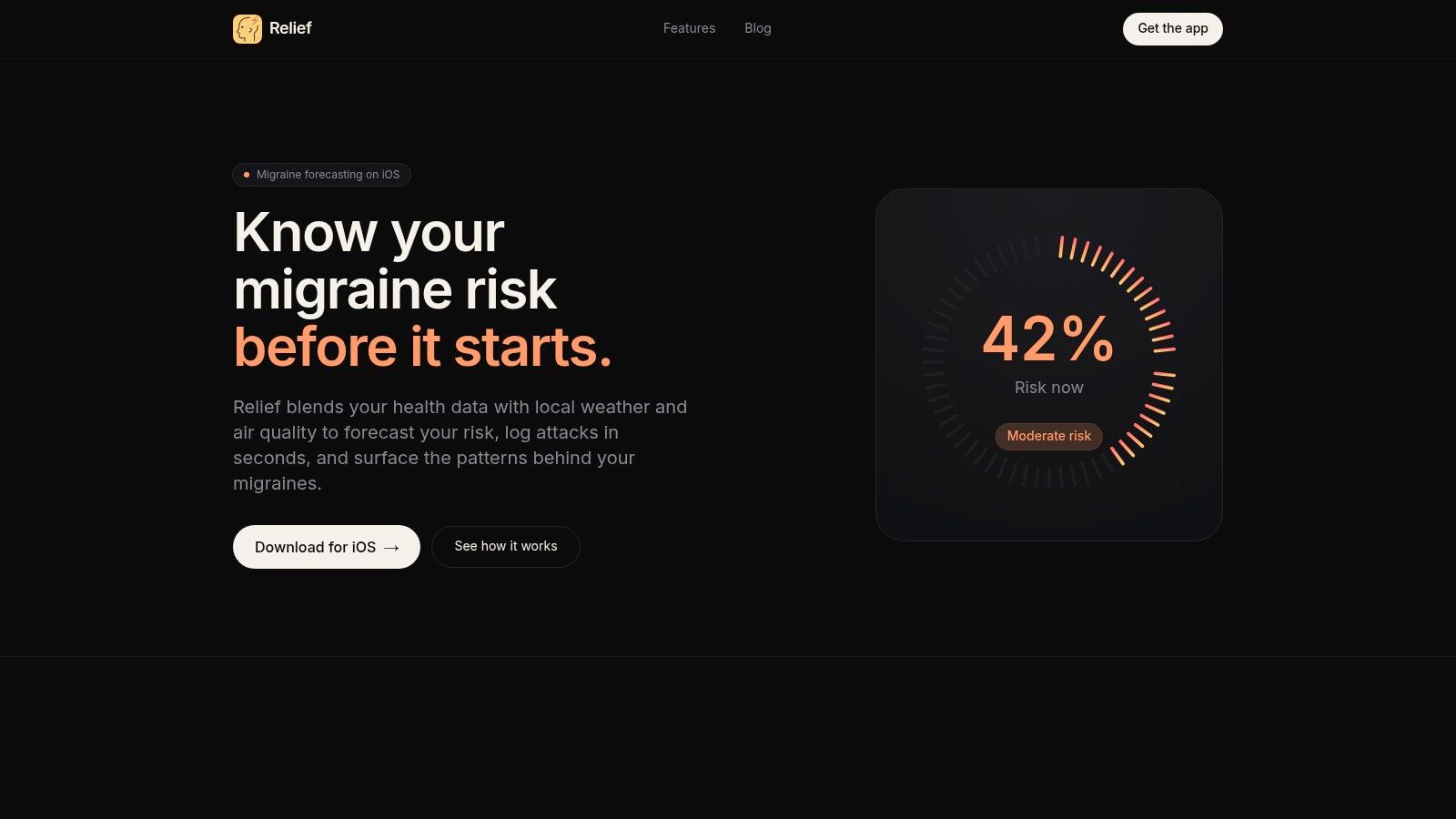
A tool like Relief for migraine tracking and forecasting can help you log symptoms, medications, and triggers alongside local weather conditions so you can spot whether pressure changes do line up with your attacks. That doesn't diagnose anything, and it doesn't replace a clinician, but it can make your patterns easier to see and discuss.
If you live with recurring attacks, the goal isn't to become obsessed with the forecast. It's to reduce surprises, prepare earlier, and make decisions based on your own history instead of vague weather advice.
If you want a calmer way to track pressure changes, symptoms, and patterns in one place, Relief can help you notice your migraine risk earlier and plan around it with fewer surprises.


