Standard blue light blocking glasses probably won't help headaches, and the best review of 17 randomized controlled trials found they probably make no difference to eye strain from computer use. But FL-41 migraine glasses are a different category, and studies have found they can reduce migraine attack frequency by up to 74% in affected patients.
If you're reading this after another workday of fluorescent lights, laptop glare, and that familiar “is this turning into a migraine?” feeling, your question makes sense. A lot of people with migraine get told to buy “blue light glasses” as if all tinted lenses do the same thing. They don't.
That difference matters most if you live with photophobia, which means painful light sensitivity, not just annoyance with bright screens. For some people, standard computer glasses are mostly marketing. For others, a specific medical tint may be a useful tool in a bigger migraine management plan.
This article is for informational purposes and is not medical advice. Consult a healthcare provider for personalized guidance.
Table of Contents
- Do Blue Light Glasses Really Help Headaches?
- Photophobia is not the same as eye strain
- Why wavelength matters more than marketing
- Signs your problem may be photophobia rather than simple screen fatigue
- When migraine glasses may be less relevant
Do Blue Light Glasses Really Help Headaches?
The short answer is: sometimes, but the label on the glasses matters less than the mechanism behind your symptoms.
“Blue light glasses” gets used as a catch-all term, and that is where readers get misled. Standard clear or lightly yellow computer glasses are one category. FL-41 tinted migraine glasses are another. If those two get lumped together, the whole topic sounds more contradictory than it is.
A practical starting point is to separate the type of headache from the type of lens. Tension headache, digital eye strain, and migraine do not respond to the same tools. If the problem is long hours of screen use, dry eyes, glare, poor posture, or missed breaks, glasses may play a small supporting role. If the problem is migraine-related light sensitivity, a targeted tint may be more relevant.
Practical rule: Ask a more specific question than “Do screens trigger pain?” Ask, “Does light itself seem to ramp up the headache, trigger nausea, or make me need to leave the room?”
That distinction changes the answer.
For ordinary blue light blocking glasses sold for computer use, the evidence for headache relief is weak. These products are heavily marketed, and some people still report that they feel better wearing them. That can happen for several reasons: the lenses may reduce glare a bit, remind someone to blink and take breaks, or feel more comfortable in a bright office. None of that proves they are treating the actual headache mechanism.
FL-41 migraine glasses belong in a separate conversation. They are not just standard blue blockers with migraine-friendly branding. They are designed to filter specific wavelengths that appear to bother some people with migraine and photophobia more than others. That does not make them a cure, and they will not help every patient. It does mean the better question is not whether all blue light glasses work, but whether a person has the kind of light sensitivity that makes a targeted tint worth trying.
This is the trade-off I want readers to see clearly. Generic computer glasses are often low-risk, but the expected benefit for headaches is modest at best. FL-41 style lenses are more promising for the right person, but they usually cost more, change color perception, and work best as one part of a broader migraine plan rather than a standalone fix.
| Lens type | Main pitch | Evidence for headaches |
|---|---|---|
| Standard blue light glasses | Screen comfort, eye strain | Weak evidence |
| FL-41 migraine glasses | Light sensitivity and migraine | More promising for the right patient |
Understanding Light Sensitivity and the Migraine Brain
For many people with migraine, the problem isn't just “too much screen time.” It's that the nervous system becomes unusually reactive to light. That's why a room that seems tolerable to everyone else can feel piercing, nauseating, or physically painful to you.
Photophobia is not the same as eye strain
Photophobia means abnormal sensitivity to light. In migraine, it's a neurological symptom, not just an eye symptom. Bright overhead LEDs, fluorescent bulbs, sunlight bouncing off pavement, and certain screens can all feel harsher than they “should.”
That's different from ordinary digital eye strain, which often shows up as dryness, blurry focus, heavy eyes, or mild discomfort after staring at a screen too long. Those symptoms matter, but they don't always point to the same mechanism as migraine.
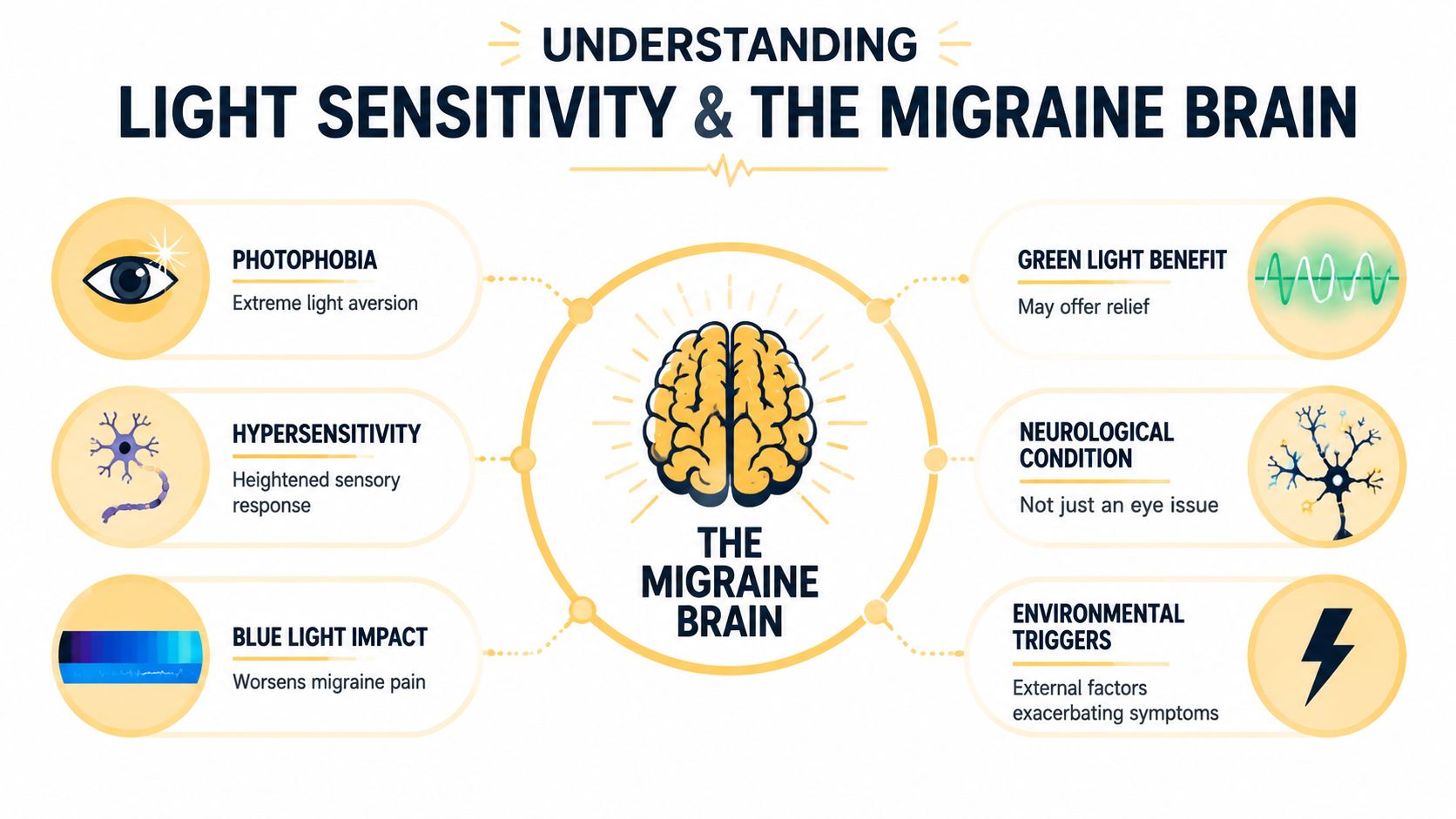
A quick self-check can help:
- Light feels painful: You squint, tear up, or need to leave a room.
- Migraine symptoms cluster: Light sensitivity comes with nausea, throbbing, dizziness, or sound sensitivity.
- You change behavior: You wear sunglasses indoors, dim devices aggressively, or avoid certain stores or offices.
If that sounds familiar, you may be dealing with migraine-related photophobia rather than simple visual fatigue.
Why wavelength matters more than marketing
An important distinction emerges regarding the idea that “all blue light glasses are the same”. According to a research guide discussing FL-41 and migraine-related light sensitivity, generic blue-light filters usually target wavelengths of 400 to 450 nm, while FL-41 is designed to block the 480 nm melanopsin peak, a wavelength identified as particularly disruptive for people with photophobia and migraine.
That's a technical detail with a practical consequence. A lens can say it blocks “blue light” and still miss the range most relevant to your symptoms.
Light sensitivity in migraine is a brain processing problem as much as an eye comfort problem.
That's why some people buy clear “blue light” glasses, wear them faithfully, and feel disappointed. The product may be filtering a slice of the spectrum that has little to do with what's provoking their migraine symptoms.
What Clinical Studies Say About Glasses and Headaches
A common pattern goes like this: someone gets headaches after long screen days, buys clear blue light glasses, wears them for a week, and feels little or no change. Then they assume all tinted lenses for migraine are overhyped. The studies support a more specific conclusion.
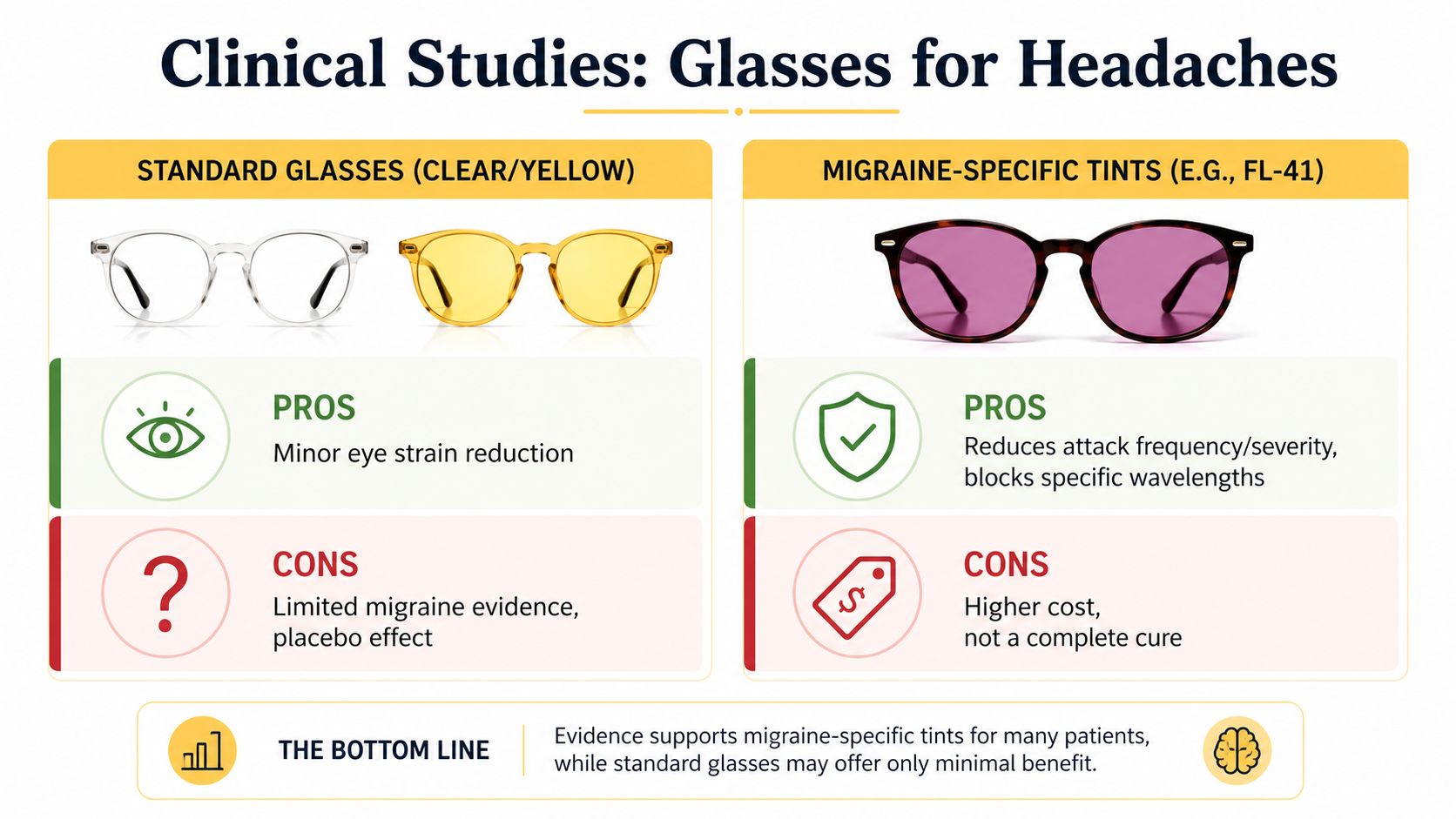
Clinical research makes more sense once you separate standard blue light glasses from migraine-specific tints such as FL-41. They are built for different problems, and the evidence behind them is not interchangeable.
What the evidence says about standard blue light glasses
For ordinary blue-light filtering glasses, the clinical picture is underwhelming. The best-known review of this category is summarized in a Cochrane systematic review summary, which found that blue-light filtering spectacles probably make little or no difference for eye strain, eye health, or sleep outcomes in the populations studied.
That does not prove nobody feels better wearing them. It does mean the current evidence does not support clear or lightly tinted computer glasses as a reliable headache treatment.
That distinction matters in practice. A person with dry eyes, poor blinking habits, glare, or an outdated prescription may still feel more comfortable with some lenses or coatings. Comfort is real. Headache prevention is a higher bar, and standard blue light glasses have not cleared it convincingly.
What makes FL-41 a separate category
FL-41 belongs in a different discussion. These lenses were studied for light sensitivity and migraine, not just screen comfort or general eye strain. A peer-reviewed study available through PubMed Central found that patients wearing FL-41 glasses had fewer migraines and less discomfort from bright light.
That is the part many articles blur together. Weak evidence for generic blue blockers does not cancel out the more promising, condition-specific evidence for FL-41.
A migraine-focused review from Migraine Disorders makes the same clinical distinction. Generic blue-blocking lenses are not the same tool as migraine glasses designed around photophobia.
I tell patients to watch the product language closely. If a pair of glasses is marketed mainly for productivity, reduced screen fatigue, or better sleep, it was probably not designed with migraine mechanisms in mind.
Trade-offs still apply. FL-41 lenses do not treat every migraine trigger, and they will not help much if light is only a minor part of your pattern. They are most useful for people whose attacks are consistently worsened by screens, fluorescent lighting, headlights, or bright indoor environments.
Are Migraine Glasses the Right Tool for You?
You get halfway through a grocery store run, the overhead lights start to feel sharp, and the pressure behind one eye begins to build. By the time you reach the checkout line, you are not dealing with ordinary screen fatigue. You are dealing with light as a migraine amplifier.
That distinction matters because migraine glasses are a targeted tool. They make the most sense for people whose attacks are regularly triggered or worsened by light. If light is only a minor part of your pattern, glasses can become an expensive detour.
Signs your problem may be photophobia rather than simple screen fatigue
The clearest way to sort this out is to pay attention to how light feels, not just when symptoms show up.
| More consistent with migraine-related photophobia | More consistent with general eye strain |
|---|---|
| Light feels painful, harsh, or hard to tolerate | Eyes feel tired, dry, or overworked |
| Fluorescent stores or offices are difficult to stay in | Long screen sessions leave you fatigued |
| Screens can push an attack higher | Screens mostly cause blur or focusing discomfort |
| You seek darker spaces during an attack | Breaks, blinking, and screen adjustments often help a lot |
Patterns outside the computer screen matter too. Headlights at night, sunlight through side windows, big-box store lighting, and bright indoor LEDs are common clues. If those settings reliably worsen symptoms, a migraine-specific tint may be worth testing.
I usually tell patients to ask a simple question: does light feel annoying, or does it feel intrusive enough to change your behavior? People with photophobia often start avoiding certain aisles, lowering brightness on every device, wearing hats indoors, or planning errands around lighting conditions. That history points to a migraine problem more than a basic comfort problem.
As noted earlier, FL-41 has more relevance here than generic clear blue light lenses. The reason is practical. It was studied in the context of migraine and light sensitivity, which is the use case that matters in this decision.
When migraine glasses may be less relevant
Migraine glasses are less likely to help when the main problem sits somewhere else.
- Dryness and blur: Lubrication, blink habits, humidity, or an updated eye exam may matter more.
- Late-night symptom flare: Sleep timing, evening light exposure, and screen habits may be bigger drivers than daytime lenses.
- Neck and shoulder tension: Desk setup, jaw clenching, posture, and muscle strain can feed headaches without light being the main trigger.
- Attacks without a light pattern: A broader trigger review usually makes more sense than starting with glasses.
Some people have both migraine and digital eye strain. That is common. The goal is not to force a neat label. The goal is to match the tool to the problem.
Wearability matters. If the tint helps in theory but you will not use it in the office, in the car, or during errands, its practical benefit will stay limited.
A Practical Guide to Choosing and Using Migraine Glasses
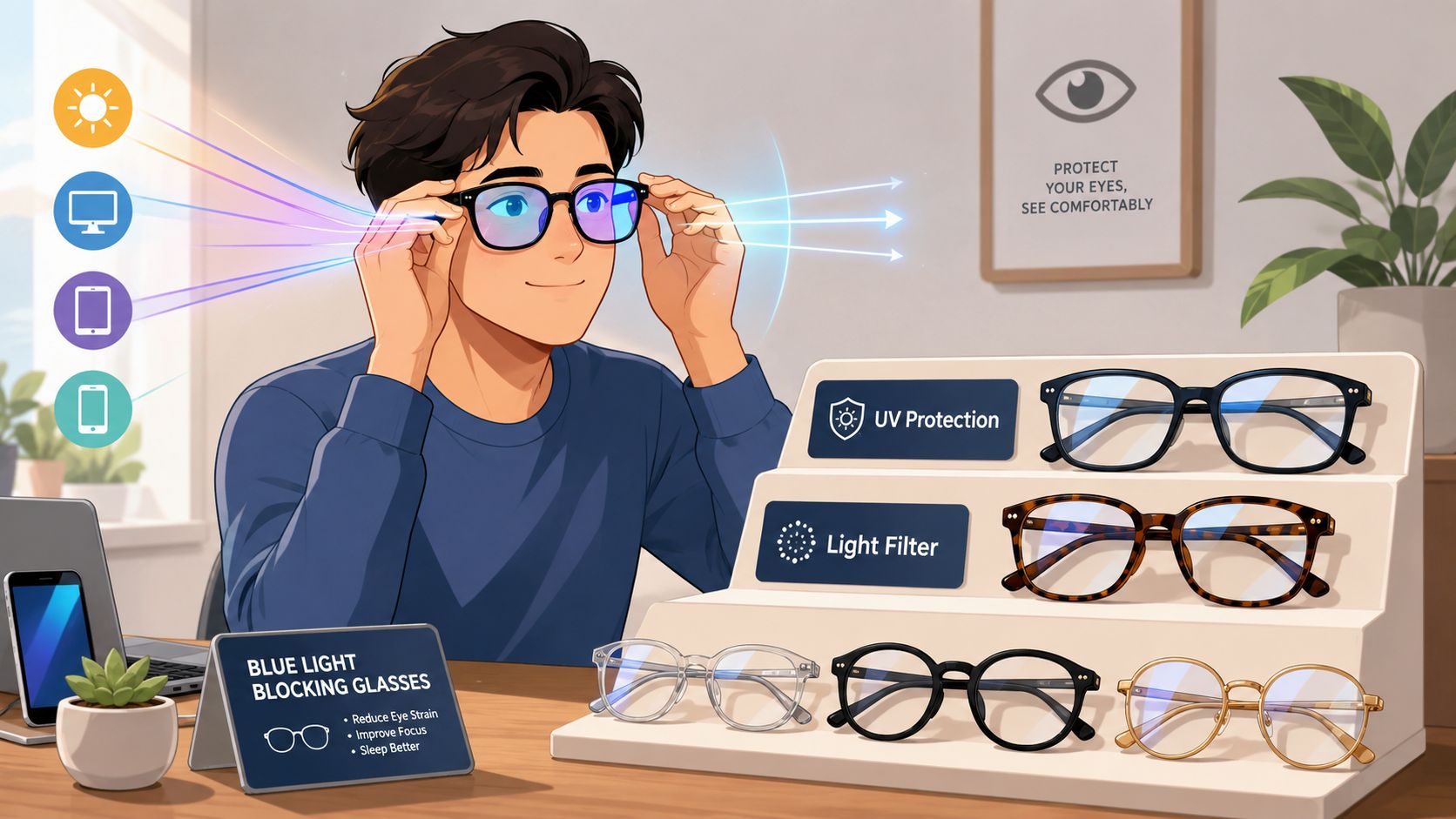
If you decide to test blue light blocking glasses for headaches, the first step is avoiding products that are built for marketing claims instead of migraine physiology. Product labels can make weak filters sound far more medical than they are.
What to look for before you buy
Start with the tint category, not the buzzwords. If you're trying to address migraine-related light sensitivity, look specifically for FL-41 or another medically described migraine tint. Be cautious with vague phrases like “screen-safe,” “anti-fatigue,” or “blue-light defense” on clear lenses.
That skepticism is warranted. A product-insights article summarizing blue light and headache claims notes that for glasses to potentially affect headache pathways, they must block at least 90% of blue light wavelengths below 450 nm, while most clear-market lenses filter only 20% to 30%, an amount described as ineffective for migraine mitigation.
That same source also notes an uncomfortable reality: blue light control glasses may induce headaches in some patients because of spectral distortion or chromatic aberration. So “some filter is better than none” isn't always true.
Use this buying checklist:
- Ask for the actual tint type: If it doesn't clearly say FL-41, keep your expectations low.
- Check the lens color: Clear lenses marketed for migraine relief deserve extra scrutiny.
- Think about side coverage: A wraparound or larger frame may help if overhead and side light trigger symptoms.
- Match them to your setting: Indoor fluorescent exposure and outdoor sunlight aren't the same problem.
How to test them in real life
Treat new glasses like an experiment, not a promise. Wear them in the settings that usually trigger symptoms, such as the office, commuting, big-box stores, or long screen sessions. Then pay attention to more than pain alone. Notice whether they reduce squinting, help you stay in bright environments longer, or make the beginning of an attack feel less intense.
This short video gives a useful visual overview before you buy:
A simple test period works better than a one-day impression:
- Pick your trigger settings: office lights, laptop work, retail stores, or driving.
- Use the glasses consistently: not just once, and not only during your worst attack.
- Track what changes: pain, photophobia, nausea, ability to stay functional, and whether you still need a dark room.
If a pair only makes the world look warmer but doesn't change your symptoms, that's useful information too.
Building Your Complete Light Management Plan
Even when migraine glasses help, they work best as one part of a broader plan. Light is rarely the only variable in a migraine attack. Sleep, meals, stress shifts, weather, hormones, smell triggers, and sensory overload can all pile on.
Use glasses as one tool, not the whole plan
A more complete light management plan often includes a mix of habits and environment changes:
- Use device settings: Night Shift, dark mode, and lower brightness may make screens less harsh.
- Change your lighting: Warm bulbs, lamps instead of overheads, and reduced glare can matter more than people expect.
- Take visual breaks: The 20-20-20 rule is simple and worth trying if screens leave your eyes tight or tired.
- Plan around known triggers: If grocery stores or office lighting are rough, wear migraine glasses before symptoms ramp up.
You can also make this more objective by tracking patterns instead of guessing. If you log when you wore the glasses, where you were, what the lighting was like, and whether photophobia or migraine symptoms escalated, you'll get a much clearer answer than memory alone. That kind of structured tracking is a key value of a tool like Relief, especially when you're trying to separate one trigger from a pile of overlapping ones.
A few related topics are worth reviewing alongside this one: articles on photophobia, screen-related migraine triggers, and identifying personal migraine patterns can all help you build a more realistic plan.
When to get urgent medical care
This article is for informational purposes and is not medical advice. Consult a healthcare provider for personalized guidance.
Seek immediate medical care for:
- A sudden severe headache: especially if it feels unlike your usual attacks
- Headache with fever or stiff neck
- Neurological changes: such as new weakness, confusion, trouble speaking, or vision loss
- Headache after a head injury
If your symptoms are changing, becoming more frequent, or no longer responding the way they used to, it's also worth discussing that with a clinician.
If you want a clearer answer on whether migraine glasses help you, Relief can help you log attacks, track light-related triggers, and spot patterns that are easy to miss in the moment.


