
Large-scale clinical evidence does not establish creatine as a direct or common cause of headaches. In a 2025 safety analysis, headaches were reported by 3.4% of creatine-treated participants and 2.2% of placebo participants, while post-supplement headaches may be more closely connected to hydration, exertion, caffeine changes, or other ingredients.
You've taken creatine after a workout, and now your head is pounding. If you already live with migraine, that timing can feel especially alarming. You may wonder whether the new supplement triggered a neurological attack, whether you should stop taking it, or whether something else changed around the same time.
The short answer is that a headache can occur while you're taking creatine, but current controlled evidence doesn't show that creatine routinely causes headaches. The useful question is not only, “Can creatine cause headaches?” It's also, “What else changed when I started using it?”
Table of Contents
The Clinical Evidence on Creatine and Headaches
A headache that starts after a new supplement deserves attention, especially if you already experience migraine. The timing is useful, but it is only one clue. Like noticing a smoke alarm after turning on an appliance, you still need to identify the true source of the signal.
Current controlled evidence does not show that creatine routinely causes headaches. A 2025 systematic safety analysis covering 685 clinical trials found no statistically significant difference in headache reports between creatine and placebo, or in overall side effects. The reported headache rates were 3.4% versus 2.2%, p = 0.635, while overall side effects were 4.60% versus 4.21%, p = 0.828. Read the full systematic safety analysis of creatine
What those findings mean for you
The analysis included studies lasting up to 14 years and evaluated 35 side effects. Creatine monohydrate did not increase the prevalence or frequency of those effects compared with placebo.
That conclusion applies to groups, not every individual body. One person may still feel unwell after taking creatine, while the supplement is coincidental or another change is responsible. Check the surrounding conditions: note the dose and timing, water intake, workout intensity, sleep, caffeine changes, and any pre-workout ingredients. Repeated timing under similar conditions offers stronger evidence than one isolated headache.
Practical rule: Treat the first headache as a clue to investigate, not as proof of causation.
Earlier reviews reached a similarly cautious conclusion. Headaches appeared in isolated studies and were sometimes mild and self-limited. Investigators occasionally considered accompanying medication more likely to explain the symptom than creatine, and pooled findings did not show a significant difference in adverse events between creatine and placebo. Review the earlier evidence on creatine safety and headaches
This article is for informational purposes and is not medical advice. Consult a healthcare provider for personalized guidance.
Migraine Attacks Versus Standard Headaches
A headache describes pain or pressure in the head, face, or upper neck. A migraine attack is a neurological event that may include head pain along with nausea, sensitivity to light or sound, visual symptoms, and changes before or after the pain phase.
That distinction matters after you begin creatine. A dull, pressure-like pain after a hard workout may feel different from your usual migraine, while a familiar attack with photophobia, nausea, or aura may follow your established pattern.
Compare the pattern, not only the timing
A tension-type headache often feels like pressure or tightness around the head. Muscle tension involving the neck, shoulders, scalp, or jaw may contribute. A migraine can involve moderate-to-severe pain and may have a throbbing quality, though migraine symptoms vary widely between people.
Aura means temporary neurological symptoms that can occur before or during some migraine attacks. Visual disturbances, tingling, or language changes can occur, but not everyone with migraine experiences aura.
The prodrome is the early phase before the main pain, and the postdrome is the period after the pain eases. Sleepiness, mood changes, food cravings, concentration difficulties, or fatigue may appear around an attack. Photophobia, or light sensitivity, is another feature many people associate with migraine, but symptoms differ across episodic, chronic, vestibular, and hemiplegic migraine.
A randomized, double-blind, placebo-controlled trial found similar overall adverse-event frequencies for creatine and placebo. Tension headache was reported by participants in both groups, and the events generally declined after the early treatment period. The investigators considered accompanying SSRI treatment a more plausible explanation than creatine itself. See the randomized trial findings on creatine and headache reports
Taking creatine and developing pain later establishes a temporal association, not a confirmed cause. Compare the symptom with your usual attack pattern, including aura, nausea, light sensitivity, duration, and prodrome. A new type of pain deserves more caution than a familiar attack that happens to occur during a supplement trial.
Debunking the Dehydration and Heat Myth
The common story is simple: creatine draws water into your muscles, leaves the rest of your body dehydrated, and causes a headache. Controlled evidence doesn't support creatine as a routine cause of dehydration, impaired thermoregulation, or increased heat illness risk in healthy people.
Creatine can alter water distribution, including water held within muscle cells. That change isn't the same as losing the fluid your body needs. A review of randomized controlled trials found that headache reports weren't associated with creatine dose or treatment duration after adjustment for study characteristics, and there wasn't a consistent exposure-response pattern showing clinically meaningful risk. Review the evidence on creatine, hydration, and adverse events
Look at the workout environment
The circumstances around creatine use can still create a headache. Hard exercise, heavy sweating, hot weather, inadequate fluid intake, alcohol, illness, or vomiting may affect how you feel after training. If you take creatine before exercising in heat and develop head pain afterward, the workout conditions deserve as much attention as the powder.
The sports nutrition guidance on creatine monohydrate and heat safety likewise describes no confirmed routine increase in dehydration or heat illness, while acknowledging that minor headaches have appeared in some studies.
You don't need to force excessive fluid intake or chase a specific water target. Maintain your normal fluid intake, pay attention to thirst and urine concentration, and record unusual sweating or heat exposure. A headache diary can also help you compare supplement days with the broader habits discussed in this guide to diet for headaches.
If your headache repeatedly follows a dose, don't assume dehydration is the explanation. Record the timing, activity, temperature, fluid intake, sleep, and meals so you can test competing explanations rather than relying on a fitness-community myth.
Hidden Triggers in Dosing and Pre-Workout Blends
Creatine is often consumed in a complicated setting, not by itself. You might start a loading protocol, increase training intensity, drink a pre-workout, delay a meal, change your usual coffee routine, and sleep poorly during the same period.
That makes the first week difficult to interpret. A headache after a scoop may reflect the product, but it may also reflect the context surrounding the scoop.
Read the whole label
Pure creatine monohydrate is different from a multi-ingredient pre-workout. A blend may contain caffeine or other stimulants, and sudden increases or decreases in caffeine can affect people who are sensitive to it. Other added ingredients may also make it harder to identify the variable associated with your symptoms.
A recent analysis examined adverse events such as headache, dizziness, and lightheadedness, but didn't establish a clear headache-specific rate for different formulations or dosing schedules. It also highlighted limited evidence for people with migraine, kidney disease, pregnancy, or complex medication and supplement use. Read the analysis of dose, formulation, and patient context
| Ingredient or circumstance | Migraine risk profile |
|---|---|
| Creatine monohydrate | Headache has been reported, but controlled evidence hasn't established a routine causal relationship. |
| Caffeine or stimulants | May be relevant if intake suddenly rises, falls, or combines with disrupted sleep. |
| Multi-ingredient blends | Make it harder to identify which ingredient or exposure preceded symptoms. |
| Empty-stomach use | May coincide with missed meals, nausea, or an exercise-related attack. |
| Aggressive loading | Creates a larger change in exposure that may be worth separating from ordinary maintenance use. |
Check whether the product contains caffeine, stimulant ingredients, or a proprietary blend. Compare the label with a plain creatine product, and don't change several variables at once. If you're also researching supplements sometimes discussed in migraine care, keep the questions separate with this overview of coenzyme Q10 and L-carnitine.
The aim isn't to prove that one ingredient is guilty. It's to make the experiment interpretable.
How to Track and Isolate Your Personal Triggers
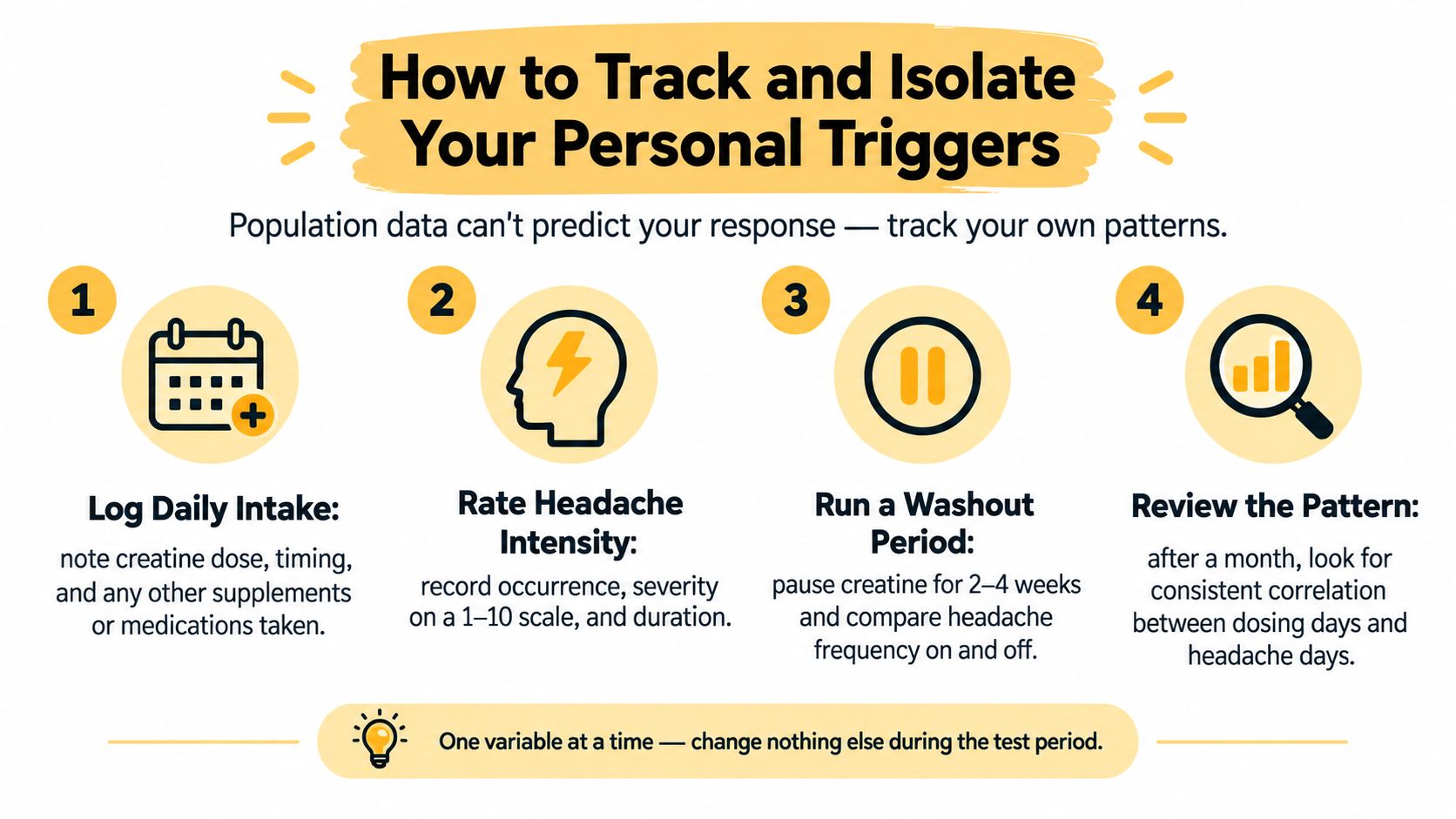
Population studies can show that creatine doesn't raise headache risk overall. They can't tell you whether your own attacks follow a particular product, timing pattern, workout, or caffeine change.
Start with a time-stamped log. Write down when you take creatine, the product name, the amount listed on its label, and every other supplement or medication taken that day. Add the time a headache begins, its severity, duration, and whether it includes nausea, aura, photophobia, dizziness, or your other familiar migraine symptoms.
Build a useful comparison
Track the surrounding conditions, not just the supplement:
- Record hydration and exertion: Note unusual thirst, sweating, workout intensity, heat, and time spent outdoors.
- Record sleep and meals: Include poor sleep, delayed meals, fasting, alcohol, and illness.
- Record caffeine changes: Include coffee, tea, energy drinks, and pre-workout products.
- Record environmental factors: Weather, humidity, temperature, air quality, and pressure changes may help explain why an attack occurred on one supplement day but not another.
- Change one variable carefully: A supervised pause or rechallenge may help identify a reproducible pattern, but repeated or severe symptoms should be discussed with a healthcare provider.
The guide to identifying migraine triggers can help you organize this information. The important comparison is whether headaches consistently cluster after creatine exposure, or whether they cluster more strongly with heat, strenuous exercise, missed food, altered caffeine, or poor sleep.
For a visual walkthrough of the tracking process, use the following video:
Don't interpret one headache as a confirmed reaction. A repeated pattern across comparable conditions is more informative, and a healthcare professional can help you decide whether continuing, pausing, or changing a supplement is appropriate.
When to Stop and Seek Medical Evaluation
A headache after exercise can have a familiar explanation, yet a new or unusual pattern deserves attention. If pain is recurrent, severe, persistent, or unlike your usual migraine, stop treating creatine as the only possible cause and arrange medical advice.
Seek immediate medical care for a sudden, severe headache that reaches peak intensity rapidly. Get urgent help if headache occurs with fever and a stiff neck, confusion, fainting, weakness, trouble speaking, vision changes, or vomiting. A headache after a head injury also needs prompt evaluation. The same applies to a new neurological symptom or an attack that feels distinctly different from your established pattern. Do not try to troubleshoot potentially serious symptoms by changing supplement timing at home.
Prepare for the appointment
Bring the product container or a clear photograph of its ingredient label. Your clinician can use tracking notes to assess whether the timing resembles a supplement reaction or another trigger. Record:
- When you started creatine and when each dose was taken.
- The product formulation and additional ingredients.
- Headache onset, duration, intensity, and associated symptoms.
- Exercise, heat exposure, fluid intake, meals, sleep, and caffeine changes.
- Medication or supplement changes made around the same time.
A population-level safety finding cannot determine your personal risk. Your log gives the clinician a clearer comparison between creatine exposure and competing explanations, such as exertion, dehydration, missed meals, or altered caffeine intake. The review of the safety analysis and its clinical context provides background, but your symptoms still require individual assessment.
This article is for informational purposes, not medical advice. A tracking app can help you organize observations for an appointment, but it cannot diagnose or treat a headache disorder.
Relief lets you log headache timing, severity, symptoms, triggers, and medications while comparing attacks with weather and air quality. Visit Relief to record what happens around creatine use and identify patterns for a more informed conversation with your healthcare provider.


