If you're lying in the dark wondering whether dinner, a skipped meal, or that second coffee set off your migraine, you're not alone. Diet for headaches is rarely about one forbidden food, and it's usually not a simple cause-and-effect story. This article is for informational purposes and is not medical advice. Consult a healthcare provider for personalized guidance.
What research supports is more practical than the usual food panic: diet can be a risk modifier, not a cure. The goal is to lower how often attacks happen, how intense they feel, and how disruptive they become over time, while also learning which foods, eating patterns, or timing issues matter for your body.
Table of Contents
- Why Your Diet Matters More Than You Think
- Why “diet quality” beats “superfood thinking”
- What this means for a real-life plan
- Start with the categories that have the clearest signal
- A practical way to test a suspected trigger
- Trigger Foods by Evidence Strength
Why Your Diet Matters More Than You Think
You can spend years hearing, “Just avoid chocolate and cheese,” and still have no idea whether that advice applies to you. That frustration is real, especially when you're already dealing with migraine, which is different from an ordinary headache because it can involve photophobia, meaning light sensitivity, as well as nausea, aura, or pain that shuts down your day.
Diet matters because it can influence several systems at once, including inflammation, blood sugar stability, and pathways tied to brain excitability. Some people notice food-related patterns, others don't, and both experiences are valid. The point isn't to build a perfect forbidden-food list, it's to understand whether your eating pattern is nudging attacks up or down.
Practical rule: if a food seems suspicious, treat it as a hypothesis, not a verdict.
The broadest takeaway is that diet for headaches works best as pattern recognition. Some people do better with regular meals, some respond to specific trigger exposures, and some see the clearest change when they improve overall diet quality. That's why broad, guilt-driven elimination usually backfires, while targeted observation often gives you something useful to act on.
What the Research Shows About Diet and Migraines
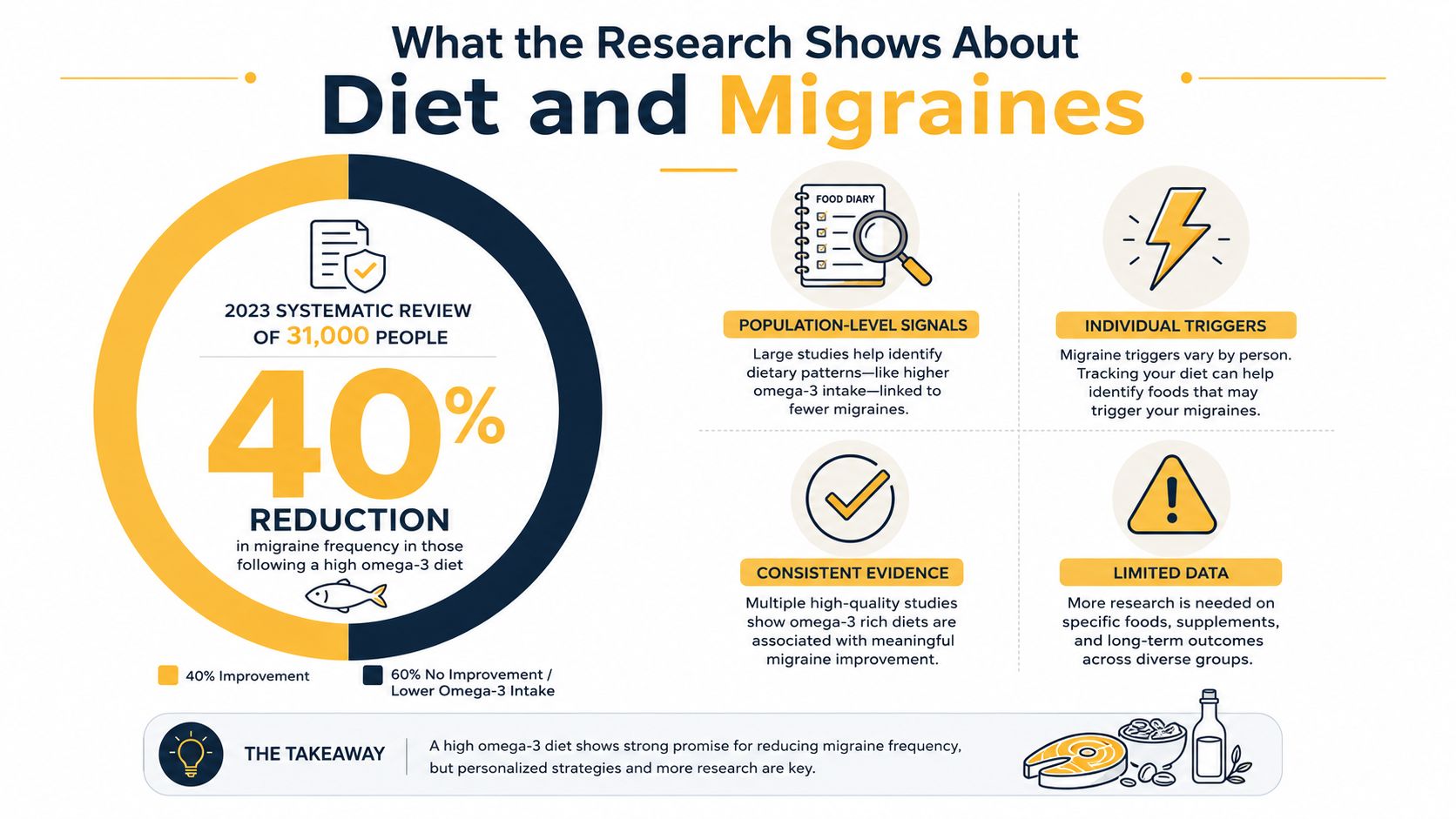
The strongest signal in the literature is about overall dietary pattern, not one magic ingredient. A 2023 systematic review synthesized evidence from 6 studies covering 31,958 people, and found that higher adherence to an anti-inflammatory diet was associated with lower frequency and severity of migraine headaches, while people with migraine tended to have lower adherence to those eating patterns than people without migraine (systematic review). That does not prove food alone causes or prevents attacks, but it does support the idea that the larger pattern matters.
Broader reviews point in the same direction. Structured diets such as ketogenic and DASH-style eating have shown reductions in attack frequency, duration, and severity in adults, though the studies are still small and the evidence is not strong enough to call any of them a cure (systematic review). The science is encouraging, but it is not finished, and it is not a one-size-fits-all prescription.
Why “diet quality” beats “superfood thinking”
The best studies keep pointing to a simple idea, broad eating habits matter more than one superfood or one banned food. Migraine biology involves several pathways at once, so a single ingredient rarely explains the whole picture. A food pattern can influence inflammatory signaling, energy availability, and how steady your body feels across the day, which is one reason diet changes may help even when no obvious trigger food stands out.
That framing also fits what people feel during real attacks. On a migraine day, the question is often not whether one food is “good” or “bad,” but whether your meals are keeping your system stable enough to avoid extra strain. Regular meals can act like a steady rail for a body that already feels over-sensitive.
The research on individual triggers belongs in a different bucket. It can be useful, but it is much messier, because one person's trigger is another person's harmless meal. For anyone using a migraine app or a paper log, tracking the pattern around attacks is often more useful than obsessing over a single ingredient.
What this means for a real-life plan
A useful plan looks like this, regular meals, enough fluids, and fewer long gaps between eating. If you are trying to improve your diet for headaches, focus first on what you repeat every week, not the rare meal you had on a bad day. That is where the strongest signal tends to live, and it is also where you can run a fair personal exposure test without turning every meal into a suspicion.
Common Trigger Foods and How to Identify Yours
The cleanest research signal for triggers is not “all migraine foods,” because that category does not really exist. Some exposures have a clearer link than others, especially caffeine withdrawal and MSG, while other suspected triggers like alcohol or aged cheese vary a lot by person and context. Reviews of provocation studies also describe glutamate and aspartame as possible triggers in some people, but the reaction is still highly individual, so a food can matter for one reader and be completely irrelevant for another (provocation review).
Start with the categories that have the clearest signal
If you're trying to sort out a possible trigger, begin with one category at a time. The goal is to test, not to punish yourself with a huge list of exclusions. Broad avoidance can make eating harder, raise stress, and leave you guessing about what changed.
Helpful mindset: a trigger is something that reliably worsens attacks for you, not something someone else says is “bad.”
The review literature also shows how variable this gets. The presence of any specific dietary trigger ranges widely depending on the study population and methods used. That spread tells you why universal rules keep failing people, and why personal pattern-finding matters more than food fear.
A practical way to test a suspected trigger
Try this one-food-at-a-time approach:
- Choose one suspect item. Start with the one you notice most often, such as caffeine timing, MSG-containing foods, or alcohol.
- Pause the item for a short, defined window. Keep the change simple so you can see whether anything shifts.
- Track the full day, not just the food. Note sleep, stress, hydration, skipped meals, and the time your attack began.
- Reintroduce only one change at a time. If symptoms return, that gives you a clearer clue than a long list ever will.
Avoid turning this into an endless restriction project. In selected patients, elimination diets can help, and prior clinical guidance suggests that avoiding identified food triggers can help a meaningful subset of patients. That matters, but it is not a reason to cut out half your diet without evidence.
Trigger Foods by Evidence Strength
| Trigger Category | Evidence Strength | Notes on Individual Variability |
|---|---|---|
| Caffeine withdrawal | Stronger | Often depends on consistency, timing, and overall intake pattern. |
| MSG, especially in liquid form | Stronger | More consistent provocation evidence than many other additives. |
| Alcohol | Mixed | Some people react reliably, others don't notice a pattern. |
| Aged cheeses | Mixed | Often overlaps with other factors like timing and total food intake. |
| Artificial sweeteners | Mixed | Evidence is inconsistent and highly individual. |
| Gluten, histamine, or fermented foods | Subgroup pattern | May matter for some people, not for everyone. |
The useful question isn't “Is this food always bad?” It is “Does this food line up with attacks often enough to matter for me?” That shift turns diet for headaches into a testable pattern instead of a permanent fear list.
Protective Foods and Nutrients That May Reduce Attacks
Avoidance gets most of the attention, but adding a few supportive foods is often easier to live with over time. Research reviews point toward anti-inflammatory eating patterns, and some dietary interventions suggest that the mix of fats in your diet can affect headache burden over time (dietary factors review). One NIH-reported intervention found that a pattern with more fish fats and less vegetable oils produced 30% to 40% reductions in total headache hours per day, severe headache hours per day, and overall headache days per month compared with the control diet (NIH summary).
What to put on the plate more often
A few food groups show up again and again in migraine-friendly eating patterns, and they work better as part of an overall pattern than as single miracle foods:
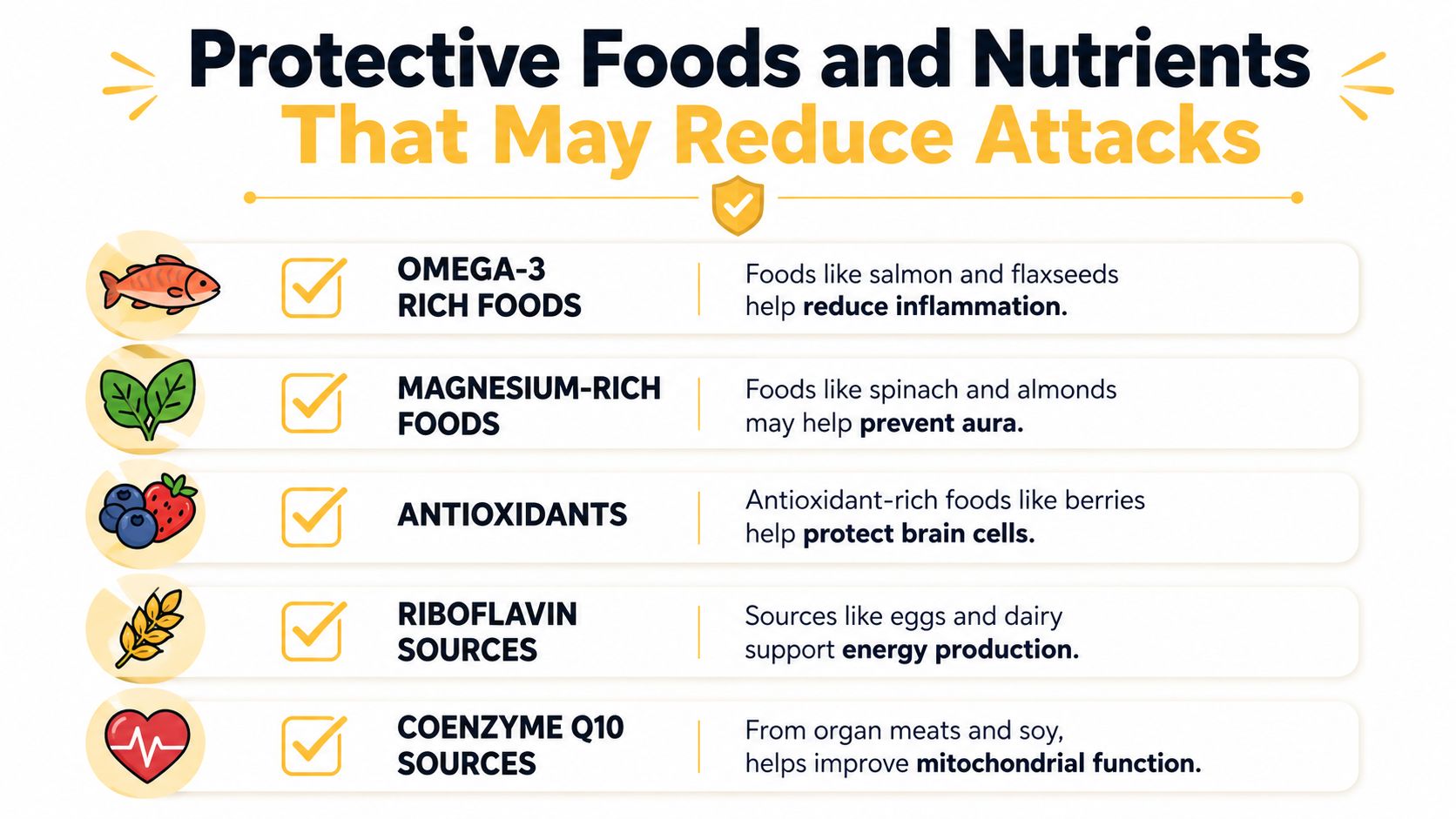
- Omega-3 rich foods, such as fatty fish, may help by influencing inflammatory pathways.
- Magnesium-rich foods, including leafy greens, nuts, seeds, and whole grains, support nerve and vascular function.
- Riboflavin sources, such as eggs and dairy, support energy metabolism.
- Anti-inflammatory meal patterns, including Mediterranean-style eating, give you steadier fuel across the day.
Why regular meals matter too
Stable blood sugar is part of the story. When you go too long without eating, some people feel worse, and headache diary data in migraine research supports that timing can matter. As noted earlier, overnight eating patterns may also matter for some people, especially if they tend to wake up feeling depleted. That does not mean everyone needs a bedtime snack, it means long gaps and energy dips can be part of the pattern worth testing.
If your attacks cluster around skipped meals, the fix may be less about finding a special food and more about eating on a steadier schedule.
The main value of these foods is support, not replacement. They may help reduce attack frequency or severity for some people, but they do not replace medical care when migraine is frequent, disabling, or changing shape.
What to Eat During an Active Migraine Attack
The hardest part of diet for headaches can be deciding what to eat when eating feels impossible. Nausea, smell sensitivity, and light sensitivity can make even familiar food feel unbearable. On attack days, the goal is simple, keep blood sugar steady and avoid dehydration, then get through the day as gently as you can.
A gentle meal is usually easier than a normal one. Plain crackers, toast, rice, bananas, applesauce, broth, and simple soups are often easier to tolerate than rich, greasy, or strongly seasoned foods. Small, frequent bites usually work better than a full plate, especially if your stomach feels unsettled.
A few practical choices:
- Hydration first: water, an oral rehydration drink, or a mild electrolyte solution if you're struggling to drink enough.
- Gentle carbohydrates: toast, plain rice, crackers, oatmeal, or bananas.
- Soothing liquids: ginger tea or warm broth if smell and nausea are part of the attack.
- Mini portions: a few bites every so often instead of forcing a big meal.
The timing piece matters too. Headache diary data from migraine research suggests that eating patterns can change how attacks show up, and one analysis found that night-time snacking was linked with fewer headaches (NIH diary analysis). That does not mean everyone needs a bedtime snack. It does mean going to bed hungry can be worth testing as a possible trigger if mornings are often rough.

For some readers, the best attack-day meal is not nutrient dense in the usual sense. It is whatever you can keep down without making nausea, odor sensitivity, or pain worse. That might mean plain toast with a little nut butter, a few crackers with soup, or a banana and water, and that is enough for the moment.
Later, once the attack eases, you can return to more balanced meals. During the attack itself, comfort and stability matter more than nutritional perfection.
Here's a quick guide to keep nearby:
| If you feel... | Try this first |
|---|---|
| Nauseated | Ginger tea, broth, plain crackers |
| Too sensitive to smell | Cold, bland foods with little aroma |
| Shaky or empty | Small carbs like toast, rice, or banana |
| Dehydrated | Water, electrolyte drink, small sips often |
If attacks keep showing up after you skip dinner or wake up hungry, that pattern is worth paying attention to. The point is not to judge every meal. The point is to learn your own exposure pattern, so you can change what you do before the next migraine hits.
Relief migraine tracking app can help you spot those patterns without turning every meal into a test.
How to Track Your Diet and Identify Personal Patterns
Good tracking doesn't need to be obsessive. It just needs to be consistent enough that your brain can spot a pattern your memory would miss. Write down what you ate, when you ate it, how much water you had, and when the headache or migraine began.
The most useful items to log are straightforward:
- Meals and timing, including skipped meals or late dinners.
- Hydration, even if it's only an estimate.
- Attack details, such as onset time, severity, duration, nausea, aura, or light sensitivity.
- Possible confounders, like sleep loss, stress, weather changes, or menstrual timing if relevant.
Patterns often take time to show up. You usually need 4 to 6 weeks of consistent tracking before the signal starts to look reliable, and some triggers can show up with a delay of 24 to 48 hours. That delay is one reason people blame the wrong meal.
How to use the data without getting overwhelmed
Look for repeats, not perfection. If attacks keep showing up after meal skipping, or after a specific food plus poor sleep, that's more useful than one dramatic day. The point is to build a personal exposure map, not to prove a theory on the first try.
Relief can help you keep those patterns in one place by pairing attack logs with food, symptoms, and environment. That's useful because food rarely acts alone, it often interacts with sleep, weather, and stress in ways that are hard to see without a timeline.
Simple rule: if a pattern repeats, it deserves attention, even if it's not dramatic.
Tracking works best when you keep it boring and brief. A few minutes per day is enough to uncover whether your diet for headaches needs a small adjustment or a more structured conversation with a clinician.
When to Seek Professional Guidance and Red Flag Symptoms
Diet changes belong in self-management, but they don't replace medical evaluation. If you have a sudden severe headache, a headache with fever or stiff neck, neurological changes like weakness or speech difficulty, or a headache after a head injury, seek immediate medical care. New headache patterns after age 50 also deserve prompt medical attention.
There are also times when diet should be reviewed with a clinician instead of handled alone. If you're thinking about a restrictive elimination plan, a dietitian can help you avoid nutritional gaps. If your food changes aren't helping after 2 to 3 months, or if you have diabetes, an eating disorder, pregnancy, or are planning pregnancy, professional guidance becomes much more important.
What to bring to the appointment
Bring your logs, not just your memory. A simple record of meals, hydration, sleep, attack timing, and symptoms helps a neurologist or dietitian see whether the problem looks like a trigger pattern, a meal-skipping issue, or something else entirely.
A specialist won't usually ask you to overhaul everything at once. They'll look for the smallest set of changes that could make the biggest difference, while keeping your nutrition safe and realistic. The About Relief page explains how the app supports symptom and trigger tracking, which can make those conversations more concrete.
If you're stuck between too many theories and too little clarity, that's a good time to get help. Diet can be part of migraine care, but it works best when it sits inside a broader plan that includes proper diagnosis, treatment, and follow-up.
If you want a clearer view of which foods, meal patterns, and symptom changes show up again and again, Relief can help you log them without turning your day into a spreadsheet. Visit Relief to track attack patterns, spot dietary correlations, and bring more useful data to your next conversation with a clinician.


