
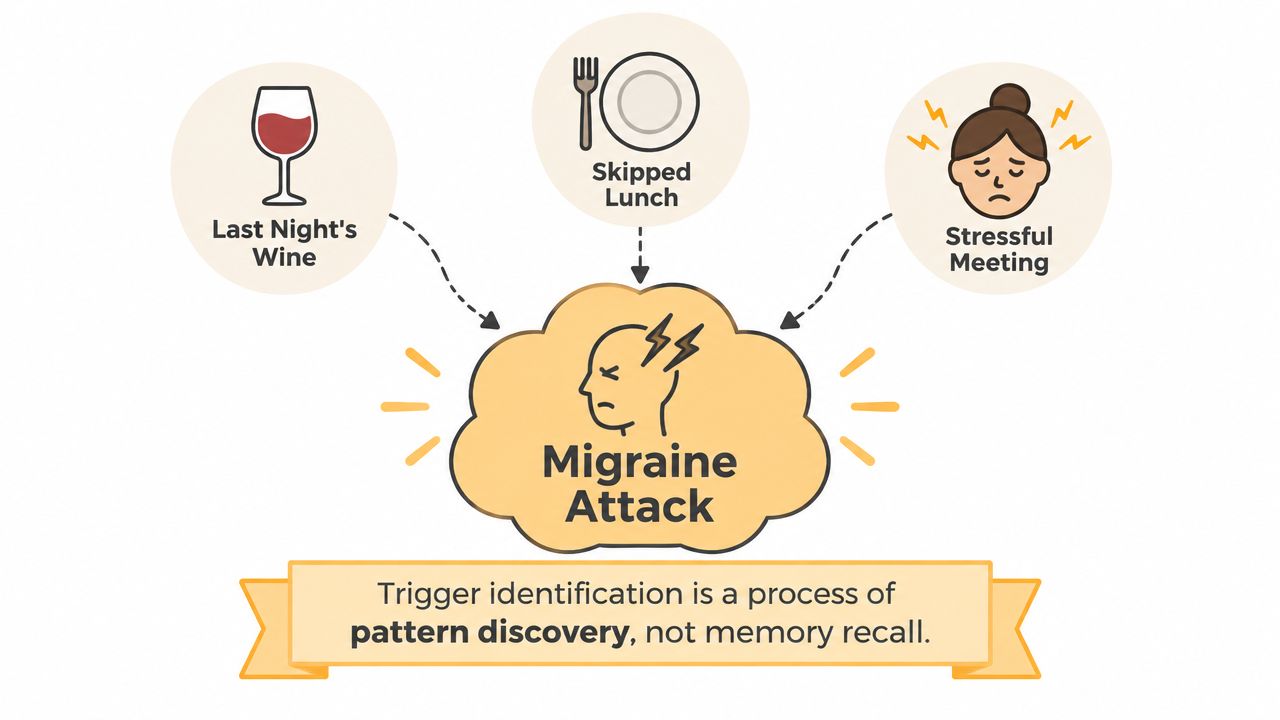
You're staring at the same familiar suspects again: last night's wine, a skipped lunch, a stressful meeting, or a sudden weather change. The useful answer to how to identify triggers isn't to collect a longer list of possible culprits. It's to run a small, repeated personal experiment with daily records, then compare exposures on migraine days with exposures on migraine-free days.
That approach matters because migraine patterns are personal, variable, and easy to misread. A diary can help you separate a plausible trigger from a coincidence, an environmental condition, or a premonitory symptom, an early sign that the migraine process has already started. This article is for informational purposes and is not medical advice. Consult a healthcare provider for personalized guidance.
Table of Contents
Why Identifying Your Migraine Triggers Is Harder Than It Sounds
You may decide that wine caused today's migraine because you drank it last night. Someone else may blame the skipped lunch or the tense meeting that afternoon. The problem is that migraine pain often follows a chain of events, and your memory tends to spotlight the most obvious event rather than the full sequence.
The more reliable method is a 90-day personal experiment built on daily logging, not memory recall. A foundational trigger study interviewed 500 patients and found that menstruation and emotional factors were among the most frequently reported triggers, followed by glare of light and foods. The same work helped establish an important principle, trigger profiles are highly individualized rather than universal, as described in this historical review of migraine trigger research.
Why memory creates false certainty
Recall is especially unreliable when several exposures happen close together. You might sleep poorly, delay a meal, spend hours under bright lights, and then experience stress. If pain begins later, it's difficult to know which factor mattered, whether several factors combined, or whether the migraine had already begun before you noticed it.
Research supports the need for systematic tracking. A review reported that trigger factors are described by up to 75.9% of patients, while a meta-analysis found that 0.81 of people with migraine or tension-type headache endorsed at least one trigger, with a 95% confidence interval of 0.75 to 0.86. In a diary study, 70.2% of 1,099 recorded headache days were associated with at least one trigger, but that doesn't make every logged exposure causal. The findings are detailed in this review of migraine trigger identification.
Practical rule: Don't ask only, “What happened before my migraine?” Ask, “How often did this happen before migraine, and how often did it happen without migraine?”
A credible pattern needs repeated exposure paired with repeated attacks. Single-cause lists rarely hold up because migraine may respond to accumulated changes in sleep, meals, hormones, stress, sensory input, and environment rather than one isolated event.
Building a Migraine Diary That Actually Captures Patterns
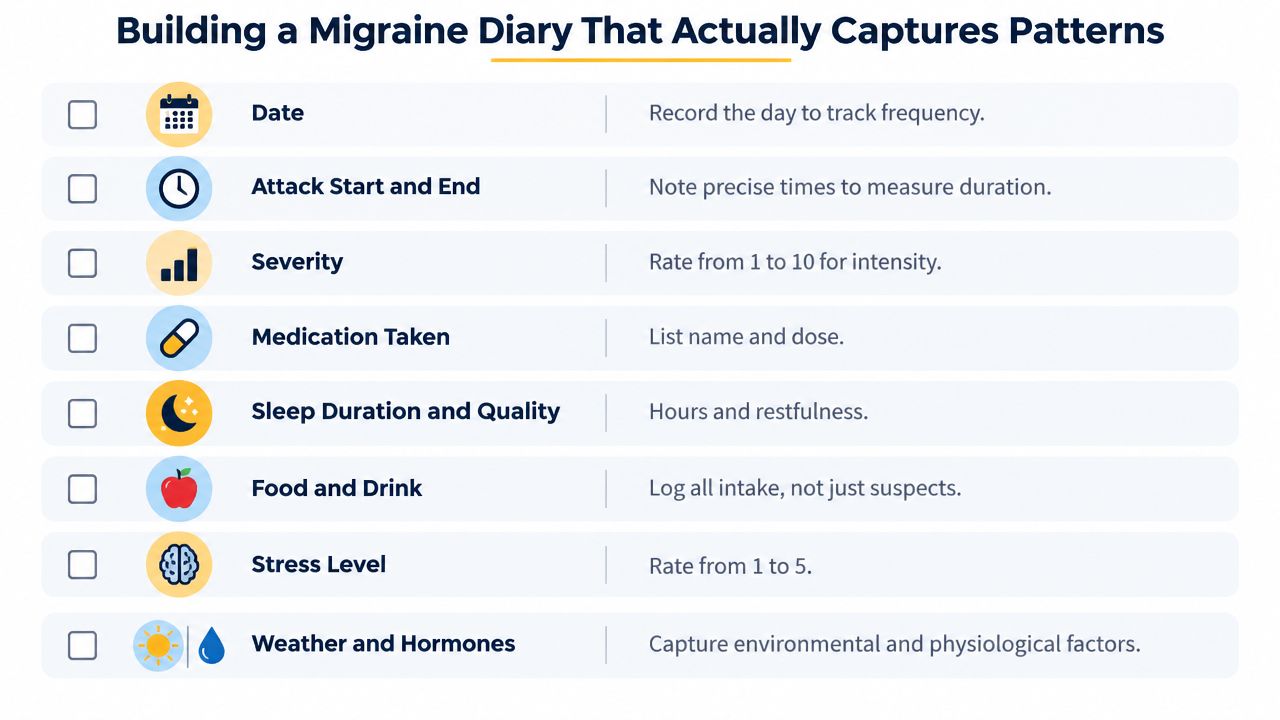
A useful diary records what happened before, during, and after an attack. At minimum, enter the date, day of the week, attack start and end, duration, severity, associated symptoms, medication taken, possible triggers, and menstrual timing. The Migraine Trust's migraine diary guidance recommends severity categories such as mild, moderate, and severe, or a 1–10 scale, where 10 represents the worst pain imaginable.
Add daily context even when you're migraine-free. Record sleep duration and quality, hydration, meals skipped, caffeine, alcohol, exercise, stress, menstrual cycle day when relevant, screen exposure, notable sensory exposures, and any unusual changes in routine.
Use two levels of detail
A quick daily log might take less than a minute:
- Headache status: Record whether you had no headache, possible symptoms, or a migraine attack.
- Sleep: Note duration and whether sleep felt restorative.
- Meals and fluids: Mark skipped meals, unusual eating times, and hydration changes.
- Exposure notes: Add caffeine, alcohol, exercise, bright light, noise, screen time, weather changes, and major stress.
- Medication: Record what you took and when, without changing treatment based on this article.
An attack-day entry should be richer. Add exact start and end times, pain severity, aura if present, nausea, photophobia, which means light sensitivity, phonophobia, which means sound sensitivity, neck symptoms, mood changes, food cravings, and response to medication.
A 2025 assessment described headache diaries as one of the most effective tools for reliable trigger identification, but it also reported that only 18% of patients in that study kept a detailed migraine diary, compared with 83–95% adherence reported in a systematic review, as reported in this assessment of digital migraine diary use. The format matters less than whether you can keep using it.
You don't need perfect detail. Consistent entries across roughly 60 to 90 days give you more useful context than a few highly detailed entries followed by a long gap. A migraine log template can make the first version easier to maintain.
Adding Environmental Overlays to Your Tracking
Weather can feel like a vague explanation until you place it beside your diary entries. Instead of writing “bad weather” in a note, add environmental conditions to the same dated row as your sleep, meals, symptoms, and attack status.
Useful overlays include barometric pressure change, temperature swings, humidity, air quality index, pollutant levels, pollen counts, daylight changes, and weather-related sleep disruption. You're not trying to prove that one atmospheric variable causes every attack. You're testing whether a defined condition appears more often before attacks than on comparable migraine-free days.
Turn impressions into comparable exposures
Choose a clear observation window. Atmospheric changes may be worth reviewing across the preceding 6 to 24 hours, while sleep disruption may require a longer context because a poor night can affect the following day. Keep the window consistent rather than selecting whichever interval makes a suspected pattern look strongest.
| Environmental Factor | Suggested Lookback Window | Data Source |
|---|---|---|
| Barometric pressure change | 6 to 24 hours | Local weather history |
| Temperature swing | 6 to 24 hours | Local weather history |
| Humidity | Same day and preceding day | Local weather history |
| Air quality and pollutants | Same day and preceding day | Local air-quality reporting |
| Pollen counts | Same day and preceding day | Local pollen reporting |
| Daylight or weather-related sleep disruption | Previous night and same day | Diary plus local weather history |
For each row, note the actual exposure condition you want to test, such as a pressure drop, a marked temperature change, or poor air quality. Avoid creating a broad label like “weather” because it combines several variables and makes the result difficult to interpret.
A useful overlay turns “today was bad” into a testable question: “How often did this defined environmental condition precede an attack?”
The environmental exposure assessment guide can help you organize local conditions beside your symptom records. Treat environmental data as context, not a diagnosis. If a weather pattern appears repeatedly, take the summary to a healthcare provider rather than making major lifestyle restrictions on your own.
Triggers Versus Prodrome and Premonitory Symptoms
Not everything that happens before migraine pain caused the attack. Prodrome, also called the premonitory phase, is the early stage of a migraine that can begin before the headache. The American Headache Society notes that prodrome commonly begins 24–48 hours before headache and may include yawning, mood changes, food cravings, gastrointestinal symptoms, increased sensitivities, and neck stiffness, as described in its migraine diagnosis resource.
That distinction can change your entire interpretation of a diary. You might notice unusual hunger, skip your normal dinner, eat a particular food, and then develop pain. It's tempting to label the food or hunger as the trigger, but the early symptom may have been evidence that the migraine process was already underway.
A peer-reviewed review found that studies of the premonitory phase, often defined as the 48 hours before an attack, reported photophobia before headache in up to 49% of patients, supporting the need to distinguish early migraine symptoms from external causes in this review of migraine phases and light sensitivity.
| Dimension | Suspected Trigger | Premonitory Symptom |
|---|---|---|
| Origin | External exposure or change | Early feature of the migraine process |
| Timing | Exposure appears before symptoms | Symptom may appear before the exposure you later blame |
| Example | A defined weather change followed by symptoms | Yawning, craving, neck stiffness, or light sensitivity followed by pain |
| Testing approach | Compare exposed and unexposed days | Track it separately as an early warning sign |
| Main risk | Treating coincidence as causation | Avoiding normal activities unnecessarily |
A practical decision rule is simple. If the exposure appears, then symptoms begin, then headache follows, it remains a possible trigger. If symptoms appear first, then you seek a particular food, rest, darkness, or another exposure, the exposure may be part of the prodrome-driven sequence.
Tag these events separately in your diary:
- P: prodrome or premonitory symptom
- T: suspected external trigger
- A: acute medication or attack treatment
The explanation of prodrome can help you recognize why a suspected trigger may be an early warning sign. Separating the tags prevents one crowded “trigger” column from turning every pre-attack detail into a cause.
Reading Exposure Hit Rates to Spot Real Patterns
The key analytical shift is to stop asking, “Did I have X before my migraine?” Instead, calculate how often X appeared before migraine days and how often it appeared before migraine-free days.
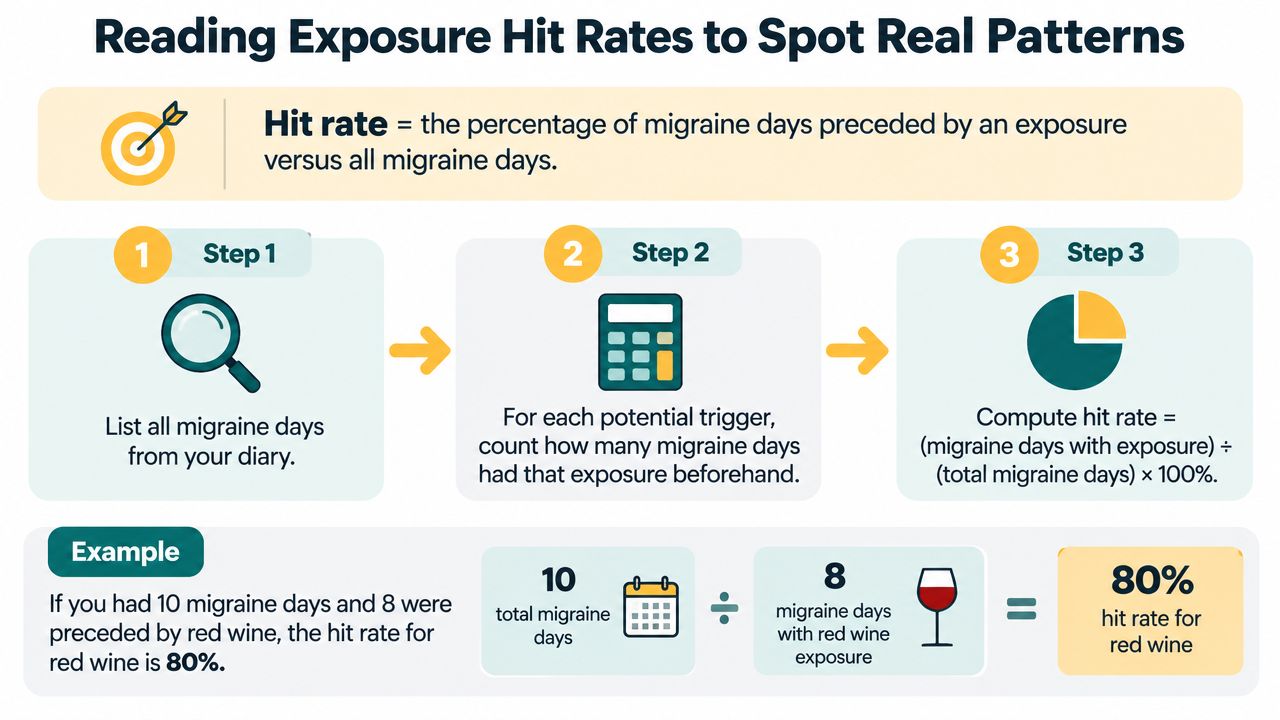
A hit rate is the percentage of migraine days preceded by an exposure. For a stronger test, compare that percentage with the percentage of migraine-free days preceded by the same exposure. A useful candidate should cluster more clearly on migraine days than on ordinary days.
Calculate the comparison
Use a simple worksheet:
- List every migraine day in your diary.
- For each potential trigger, count the migraine days with that exposure beforehand.
- Divide exposed migraine days by total migraine days, then compare the result with exposed migraine-free days.
For example, if you had 10 migraine days and 8 were preceded by red wine, the red-wine hit rate would be 80%. That number alone doesn't prove causation. If red wine also appeared on most migraine-free days, the difference would be less persuasive.
The same logic applies to weather. A barometric drop appearing on 70% of migraine days but also 60% of migraine-free days creates only a small separation. A food appearing on 30% of migraine days and 5% of migraine-free days creates a clearer signal, although it still needs cautious testing and clinical context.
A headache-diary study found observed headache likelihoods of 57.7% for stress, 55.1% for sleep deprivation, 48.5% for fatigue, and 46.5% for any trigger, as reported in this smartphone diary study of headache-day triggers. Those findings show why “stress migraine” is less useful than recording the specific stress exposure, its timing, and what happened on comparable days.
Testing rule: Act cautiously only when the pattern shows clear separation, repeats across at least two months, and grows in a dose-like way when the exposure becomes more intense.
Avoid acting on a pattern seen in fewer than 10 migraine episodes. A small sample can create false confidence, especially when several exposures occur together. When testing a suspected factor, change one variable at a time. Don't eliminate a food, overhaul sleep, and stop caffeine in the same week, because you won't know which change influenced the result.
A 326-patient study used a daily paper diary over 90 days, with participants recording 33 candidate factors and later screening potential triggers through hazard-ratio analysis. Factors were treated as potential triggers when the univariate hazard ratio was greater than 1 and p≤0.05, a more defensible process than relying on memory alone, as described in this daily-diary trigger study.
A Realistic 60-Day Mini Experiment
Consider a 34-year-old office worker who logs for two months. Each day, the record includes headache status, sleep hours, menstrual cycle day, weather, meals, screen time, and a free-text note about anything unusual.
During the first month, the entries seem to support several explanations. Coffee appears before some attacks, poor sleep appears before others, and storms show up around several difficult days. None of those observations is useless, but none is strong enough to justify a major restriction.
Month one shows possibilities, not answers
The reader then separates premonitory symptoms from exposures. Morning grogginess, which had been filed under “poor sleep” or “coffee,” often appeared before the person changed their routine. The diary now treats that grogginess as a possible early symptom rather than automatically blaming coffee.
The environmental overlay also becomes more precise. Instead of labeling every storm, the reader records pressure change over a defined interval. After comparing exposed migraine days with migraine-free days, the only pattern that remains credible is a barometric drop greater than 6 mb in 6 hours.
That finding still isn't proof. It's a hypothesis that has survived initial sorting better than the other candidates.
Month two tests one change
In the second month, the reader starts a single-variable test during the week the pressure hypothesis is identified. They avoid abrupt changes to sleep, continue recording meals and coffee, and monitor weather conditions without trying to control the weather exposure itself.
If attacks continue at the same rate when the pressure condition occurs, the hypothesis weakens. If the pattern repeats while other factors remain reasonably stable, it becomes more useful for planning, discussion with a clinician, and early response. Either outcome is valuable because the reader hasn't spent another quarter making several simultaneous restrictions.
The month-three summary would contain the pressure exposure, the dates it occurred, migraine dates, prodrome tags, medication timing, and the uncertain factors that need more observation. A trigger experiment doesn't promise certainty. It gives you a cleaner record and fewer assumptions.
Red Flags, Key Takeaways, and Tracking Going Forward
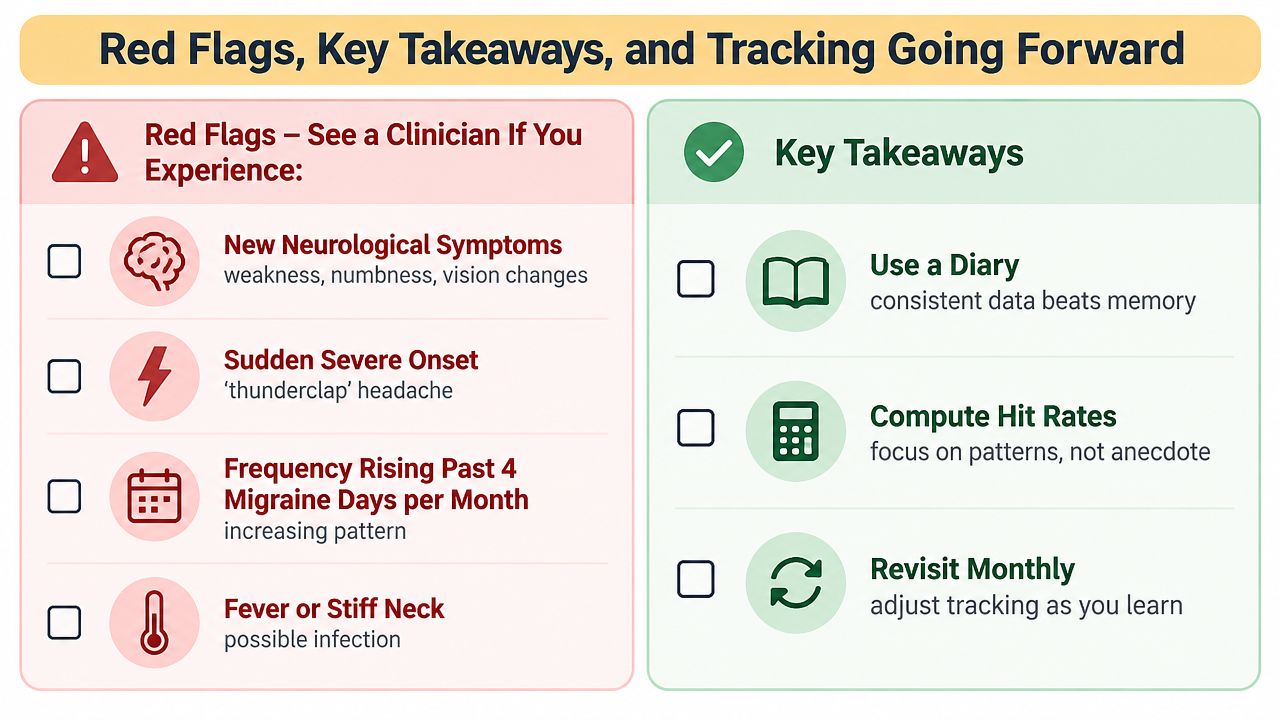
Self-tracking has limits. It can reveal patterns, but it can't determine whether a new symptom reflects a migraine subtype, another medical condition, or an urgent problem. Seek immediate medical care for a sudden severe headache, a headache with fever or stiff neck, new neurological changes, or a headache after a head injury.
Arrange clinical evaluation for new neurological symptoms, a sudden severe onset, aura symptoms lasting longer than an hour, post-attack confusion lasting days, or a rising pattern beyond 4 migraine days per month. Weakness, numbness, major vision changes, or confusion deserve prompt attention rather than another round of spreadsheet analysis.
Keep the experiment manageable
The core method is straightforward:
- Log daily: Record symptoms, attacks, medication, sleep, meals, stress, hormones, and notable exposures.
- Add overlays: Track weather, air quality, pollen, and other environmental conditions beside the same dates.
- Separate phases: Tag prodrome and premonitory symptoms separately from suspected external triggers.
- Compare hit rates: Look at migraine days and migraine-free days, not only memorable attacks.
- Review monthly: Retest patterns as your routine, hormones, sleep, and environment change.
- Bring summaries to appointments: A concise pattern report is more useful than an unstructured list of suspected causes.
A single credible pattern generally needs five to ten matched exposures before it's worth acting on cautiously. Existing consumer guidance varies, one migraine organization recommends continuing a trigger diary until at least five attacks, while another suggests a four-week elimination-and-rechallenge process for one food at a time, as outlined by the National Migraine Centre's trigger guidance. These approaches aren't guarantees, so avoid restrictive changes without appropriate professional guidance.
Structured logging and forecasting tools can reduce the mental work of checking every possible exposure manually. Relief combines symptom and attack logging with local weather, air quality, and pollen data, and presents personalized risk information on iOS. Visit Relief to keep your trigger records, environmental context, and migraine patterns in one place while you continue working with your healthcare provider.


